
✍️ By Dileep Verma
Research Expert and Associate Editor of Track2Training, New Delhi, India
Look up at the night sky at the right moment and you may see a bright point of light moving rapidly from one horizon to another.
That light is not a star or a planet.
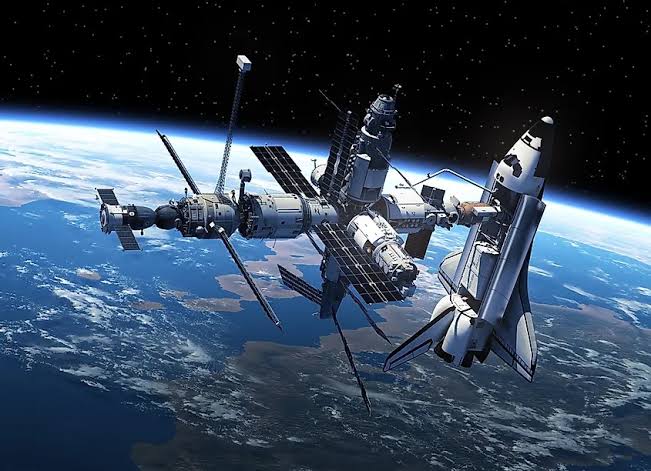
It is one of the most remarkable machines humanity has ever constructed: the International Space Station (ISS).
Orbiting roughly 400 kilometres above Earth, the ISS travels at about 17,500 miles per hour, completing an orbit approximately every 90 minutes. NASA notes that the station circles Earth about 16 times every 24 hours. It has also been continuously occupied since November 2000. NASA
But the ISS is much more than an engineering achievement.
It is a working demonstration of what human beings can accomplish when science, international cooperation, disciplined administration, technological innovation, and long-term planning are brought together.
A Laboratory Above the Earth
The International Space Station is essentially a permanently crewed research laboratory in low Earth orbit.
Its scale is extraordinary. Yet what makes the ISS especially important is not simply its physical size. It is what happens inside it.
Thousands of experiments have been conducted aboard the station. NASA reports research across biology and biotechnology, human health, physical sciences, Earth and space science, technology development, and other areas. Its research database now encompasses more than 4,000 experiments over more than two decades of station science. NASA
In 2025 alone, researchers using the orbital laboratory conducted more than 750 investigations, according to NASA’s annual research highlights. NASA
Scientists are studying questions such as:
How does the human body respond to prolonged microgravity?
How do plants grow in space?
How do cells and tissues behave without normal gravity?
How can materials be developed differently in microgravity?
How can technologies be improved for future journeys to the Moon and Mars?
The ISS therefore functions not simply as a spacecraft, but as a continuously operating scientific institution.
Five Space Agencies, One Extraordinary Project
Perhaps the greatest lesson of the ISS is not technological at all.
It is institutional.
The station is operated through an international partnership involving five major space agencies: NASA of the United States, Roscosmos of Russia, the European Space Agency (ESA), the Japan Aerospace Exploration Agency (JAXA), and the Canadian Space Agency (CSA). NASA
These partners come from countries with different languages, histories, political systems, national interests, and geopolitical relationships.
Yet hundreds of kilometres above Earth, their technologies have been integrated into one functioning system.
NASA explicitly describes the station as interdependent. Different partners manage different hardware and capabilities, and no single partner currently has the capability to operate the entire station independently. NASA
That is a remarkable organizational achievement.
From Cold War Competition to Scientific Cooperation
The ISS also carries historical significance.
For decades, the United States and Soviet Union competed intensely in space as part of the broader Cold War rivalry.
Space exploration demonstrated technological capability and national power.
Yet the ISS emerged in a different era.
Former competitors became partners.
Engineers began integrating technologies.
Astronauts and cosmonauts trained together.
Mission-control centres coordinated operations.
Scientific institutions shared responsibilities.
This does not mean that geopolitical disagreements disappeared. They did not.
The lesson is more practical:
Countries do not need to agree on everything before they can cooperate on something important.
This principle deserves greater attention in the twenty-first century.
Lesson 1: Shared Problems Need Shared Objectives
Climate change does not recognize international borders.
Neither do pandemics, environmental degradation, ocean pollution, cyber threats, or many economic shocks.
These problems cannot be addressed effectively by one country acting entirely alone.
The ISS demonstrates that cooperation becomes possible when institutions define a sufficiently clear common objective.
Instead of beginning with:
“Where do we disagree?”
international cooperation can sometimes begin with:
“What problem must we solve together?”
This shift from ideological confrontation toward problem-solving is one of the strongest lessons of the space station.
Lesson 2: Science Gives Humanity a Common Language
An American engineer and a Japanese engineer may speak different languages.
Their countries may have different political institutions.
But the physical laws governing orbital mechanics do not change with nationality.
Gravity behaves consistently.
Mathematics works consistently.
Engineering tolerances cannot be negotiated politically.
This makes scientific reasoning a powerful framework for international cooperation.
When evidence changes, scientific understanding can change with it.
That principle is particularly important when societies confront complex problems such as climate change, public health, food security, energy transitions, and environmental protection.
Policy choices involve values and trade-offs, but the factual foundations of those choices should be informed by the best available evidence.
Lesson 3: Enormous Problems Become Manageable When Divided Into Modules
The ISS could not simply be built on Earth as one enormous structure and launched into orbit.
Instead, it was assembled progressively from modules and components.
Different countries and organizations could therefore contribute specialized capabilities to a larger system.
This offers a valuable management principle:
Do not try to solve every part of a complex problem simultaneously. Break it into manageable components.
The same principle applies to governments, universities, companies, infrastructure projects, and even individual research projects.
Climate change is enormous.
But renewable energy, public transport, energy efficiency, forest protection, adaptation, climate science, and industrial innovation can become defined areas of action.
Complexity becomes manageable when it is structured.
Lesson 4: Build Redundancy Before a Crisis Occurs
On Earth, a failed system may cause inconvenience.
In space, it can become life-threatening.
That is why spacecraft engineering places enormous importance on reliability, monitoring, backup capabilities, maintenance, and contingency planning.
This mindset has relevance far beyond aerospace engineering.
Hospitals need backup electricity.
Cities need emergency water systems.
Governments need disaster-response capacity.
Companies need data backups.
Countries need resilient food and energy systems.
The central principle is simple:
Resilience should be designed before the emergency, not improvised after it.
Lesson 5: Human Problems Require Human Action
One of the deeper philosophical lessons of the ISS is human agency.
People hold many different religious and philosophical beliefs, and science does not need to settle those personal questions in order to solve practical problems.
But when astronauts need oxygen, engineers must build functioning life-support systems.
When spacecraft must reach orbit, scientists must calculate trajectories.
When equipment fails, technicians must diagnose the problem.
When climate risks increase, societies must decide how to respond.
Whatever our personal beliefs, practical problems require practical action.
Prayer, hope, or belief may have personal meaning for individuals, but they cannot substitute for engineering calculations, medical evidence, environmental measurements, functioning institutions, or public policy.
Climate change will not be addressed by hope alone.
War will not end simply because humanity wishes it away.
Poverty will not disappear without institutions, resources, education, economic opportunities, and policy action.
Human beings must take responsibility for the problems human societies can address.
The ISS Is Still Making History
This is not merely a historical story.
On October 1, 2026, NASA’s SpaceX Crew-13 mission reached the International Space Station.
NASA astronauts Jessica Watkins and Luke Delaney, Canadian Space Agency astronaut Joshua Kutryk, and Roscosmos cosmonaut Sergey Teteryatnikov docked with the station and joined Expedition 75. NASA
The mission is continuing research that includes human health, plant growth, tissue research, and technologies relevant to future exploration. NASA
So, more than a quarter-century after continuous habitation began, the laboratory is still generating scientific knowledge.
A Blueprint for the Twenty-First Century
Humanity faces serious challenges.
🌍 Climate change and global warming
⚔️ Armed conflict and geopolitical rivalry
💧 Water scarcity
🌾 Food insecurity
🦠 Emerging diseases
⚡ Energy transitions
🤖 Rapid technological change
🌊 Environmental degradation
None has a magical solution.
They require research.
They require evidence.
They require institutions.
They require international cooperation.
They require political negotiation.
They require resources.
And, above all, they require human beings willing to organize and act.
The ISS shows that countries with different interests can still build something together when they recognize a shared objective.
When You See the ISS, Look at What Humanity Built
The International Space Station should therefore be understood as more than a spacecraft.
It is a laboratory.
It is an engineering system.
It is an international institution.
It is an experiment in cooperation.
And it is a demonstration of human agency.
When we see that bright object crossing the night sky, we are looking at thousands of scientists, engineers, astronauts, technicians, administrators, organizations, and institutions whose work has been combined into one extraordinary achievement.
The ISS was not created by chance.
It was studied, calculated, financed, negotiated, engineered, tested, launched, assembled, maintained, repaired, and continuously improved by human beings.
That may be its most valuable lesson for the twenty-first century.
When humanity replaces helplessness with inquiry, isolation with cooperation, and wishful thinking with informed action, seemingly impossible problems can become solvable projects.
The ISS does not prove that humanity can solve every problem.
It proves something more useful:
we already possess powerful tools for trying.
Science gives us evidence.
Reason helps us evaluate it.
Technology expands what we can do.
Cooperation expands who can contribute.
And organized human action turns knowledge into results.
That is the lesson orbiting above us every 90 minutes.
Suggested website categories: Science | Technology | International Cooperation | Management | Public Administration
Suggested tags: International Space Station, ISS, NASA, Space Science, Scientific Thinking, International Cooperation, Human Agency, Climate Change, Global Governance, Project Management, Technology, Space Exploration, Public Administration


You must be logged in to post a comment.