
Track2Training Research Update
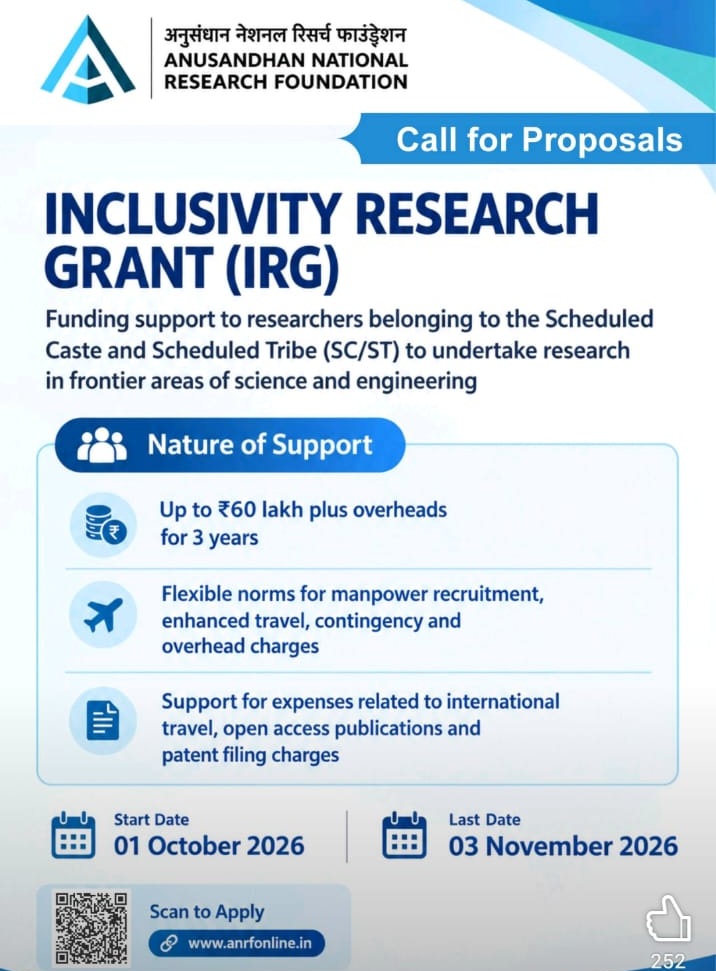
The Anusandhan National Research Foundation (ANRF) has announced a significant research funding opportunity through the Inclusivity Research Grant (IRG) 2026. The programme is designed to support eligible researchers belonging to the Scheduled Caste (SC) and Scheduled Tribe (ST) communities in undertaking high-quality research in frontier areas of science and engineering. This initiative represents an important step toward strengthening inclusion, diversity, research capacity, and wider participation in India’s scientific and technological development.
Researchers, faculty members, scientists, and eligible investigators interested in applying for this opportunity can refer to the announcement and related information here:
👉 Apply / Know More: https://lnkd.in/p/dBSYhmJp
According to the ANRF announcement, applications for the Inclusivity Research Grant open on 1 October 2026, with the last date for submission being 3 November 2026. Prospective applicants should therefore begin preparing their research concepts, project objectives, methodology, work plans, budget requirements, expected outcomes, and supporting documents well before the deadline.
What is the Inclusivity Research Grant?
The Inclusivity Research Grant is intended to facilitate greater participation of researchers from SC and ST communities in advanced scientific and engineering research. Access to adequate research funding can play a decisive role in helping investigators establish laboratories, recruit research personnel, conduct fieldwork and experiments, acquire essential resources, participate in collaborations, publish findings, and translate research outcomes into innovation.
Through initiatives such as the IRG, researchers may be able to pursue ambitious research questions while developing stronger academic and scientific networks.
The programme is particularly relevant in an environment where interdisciplinary and frontier research increasingly requires substantial financial, technical, and institutional support.
Funding Support of Up to ₹60 Lakh
One of the key features highlighted in the announcement is financial support of up to ₹60 lakh plus applicable overheads for a project duration of three years.
This level of support may provide researchers with the opportunity to design comprehensive projects involving experimental studies, computational research, field investigations, technology development, data collection, laboratory work, prototype development, or other eligible scientific and engineering activities.
A three-year project period also allows researchers to structure their work systematically through different phases, such as literature review, research design, data collection, experimentation, analysis, validation, dissemination, and publication.
Applicants should carefully prepare a realistic project budget that is directly connected to the proposed objectives and methodology.
Flexible Provisions for Research Manpower
Research projects often depend heavily on skilled manpower. The IRG announcement highlights flexible norms for manpower recruitment, which may help principal investigators build suitable research teams depending on the nature of their projects.
Research personnel can contribute to activities such as:
- laboratory experiments and testing,
- field surveys and data collection,
- programming and computational modelling,
- statistical analysis,
- documentation,
- literature reviews,
- prototype development,
- database preparation,
- technical reporting, and
- research dissemination.
Applicants should clearly explain the need for research personnel and their proposed responsibilities while preparing the project.
Support for Travel and Contingency Requirements
Research does not always take place within a single laboratory or institution. Researchers may need to conduct field investigations, visit research facilities, meet collaborators, attend academic events, collect samples, access specialised equipment, or participate in scientific discussions.
The IRG announcement indicates provisions relating to enhanced travel and contingency support.
Such provisions can be especially valuable for interdisciplinary projects requiring collaboration among institutions or field-based research in different geographical locations.
A well-prepared proposal should therefore explain why travel, fieldwork, specialised resources, or contingency expenditure is necessary for achieving the project’s research objectives.
International Travel Support
Another important aspect highlighted in the announcement is support for expenses associated with international travel.
International exposure can help researchers participate in global conferences, present findings, interact with experts, develop collaborations, learn emerging methodologies, and increase the visibility of Indian research.
Where international travel is proposed, applicants should demonstrate its relevance to the research project rather than treating it as an isolated activity. Participation in relevant conferences, research visits, specialised training programmes, or scientific collaborations may strengthen the long-term impact of a research project.
Support for Open Access Publications
Academic publishing has become increasingly important for research visibility and knowledge dissemination. At the same time, article processing charges associated with some open-access journals may be substantial.
The IRG announcement mentions support for expenses related to open-access publications.
This provision can help researchers disseminate project findings to a wider academic and professional audience. Researchers should nevertheless select journals carefully and prioritise legitimate, peer-reviewed publications that are appropriate for the scope and quality of the research.
Before submitting a paper, investigators should verify the journal’s editorial standards, indexing claims, peer-review process, publication policies, and ethical practices.
Patent Filing Support
Research projects in science and engineering frequently produce technologies, processes, products, systems, materials, designs, or methods with potential intellectual property value.
The Inclusivity Research Grant also highlights support related to patent filing charges.
Researchers developing potentially patentable innovations should consider intellectual property planning from an early stage. Institutional intellectual property or technology-transfer cells can provide guidance regarding prior-art searches, invention disclosures, patentability assessments, filing procedures, and commercialisation opportunities.
How Researchers Can Prepare a Strong Proposal
Applicants should avoid waiting until the final days before the submission deadline. A competitive research proposal generally requires a clear research problem, strong justification, appropriate methodology, measurable objectives, realistic timelines, and clearly defined outputs.
Before submitting an application, researchers should pay particular attention to the following areas:
Research Problem: Clearly identify the scientific or engineering challenge being addressed.
Literature Gap: Explain what existing research has established and what remains unresolved.
Objectives: Develop specific and achievable research objectives.
Methodology: Describe how data will be generated, analysed, validated, and interpreted.
Innovation: Clearly communicate what is new about the proposed research.
Work Plan: Divide activities into realistic stages across the three-year project period.
Budget: Ensure that requested expenditure is directly justified by project activities.
Expected Outcomes: Identify possible publications, technologies, databases, patents, prototypes, methods, policy applications, or other outputs.
Impact: Explain how the research can contribute to scientific knowledge, society, industry, technology, sustainability, or national research priorities.
An Opportunity to Strengthen Inclusive Research
Research excellence grows when talented researchers from diverse backgrounds have meaningful opportunities to participate, lead projects, develop laboratories, mentor students, and contribute to scientific advancement.
The ANRF Inclusivity Research Grant 2026 therefore has relevance beyond financial assistance. It can contribute to expanding research participation while enabling eligible investigators to pursue innovative and high-impact scientific work.
Track2Training encourages eligible researchers, faculty members, institutions, and research groups to study the official requirements carefully and begin proposal preparation as early as possible.
📅 Application Start Date: 1 October 2026
📅 Last Date: 3 November 2026
💰 Funding: Up to ₹60 lakh plus overheads
⏳ Project Duration: 3 years
🔗 More information / Application: https://lnkd.in/p/dBSYhmJp
Track2Training continues to share opportunities related to research grants, fellowships, academic publishing, research methodology, capacity building, conferences, and scholarly development for researchers and higher-education professionals.
#Track2Training #ANRF #InclusivityResearchGrant #IRG2026 #ResearchFunding #ResearchGrant #CallForProposals #SCResearchers #STResearchers #ScienceResearch #EngineeringResearch #ResearchOpportunities #AcademicResearch #HigherEducation #ResearchProposal #Innovation #IndianResearchers #PhDResearch #FacultyResearch #ResearchAndDevelopment #AcademicOpportunities
What are your favorite side-hustle ideas?
View all responses


You must be logged in to post a comment.