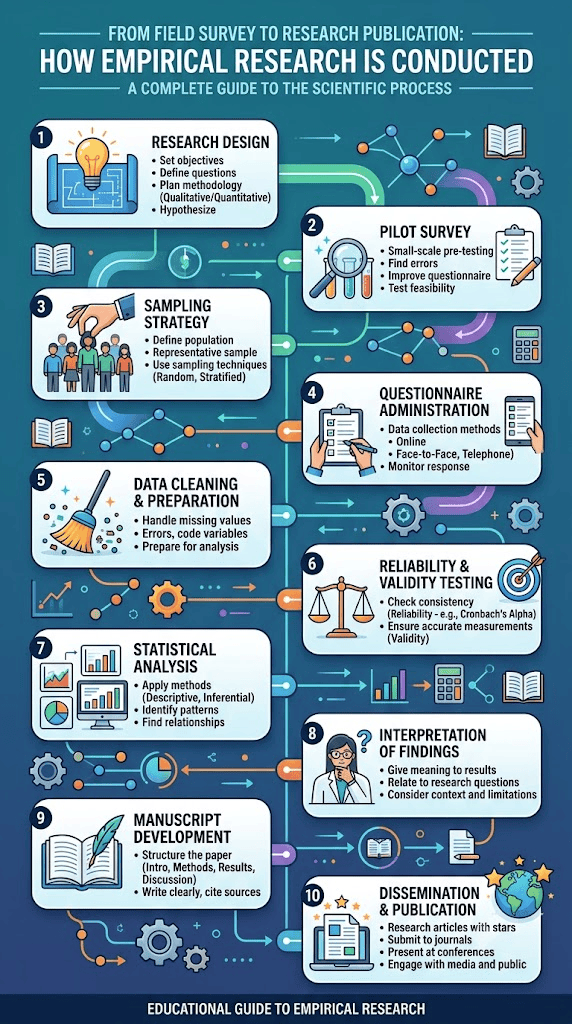
WhicFrom Field Survey to Research Publication: How Empirical Research Is Conducted
Empirical research is one of the most important foundations of academic knowledge. It involves the systematic collection and analysis of evidence derived from observations, surveys, experiments, interviews, measurements, or real-world datasets. Unlike purely theoretical work, empirical research seeks to answer research questions by examining what actually occurs in a population, community, institution, organisation, environment, or physical setting.
At Track2Training, empirical research is viewed as a complete research process rather than a sequence of isolated activities. A good field survey is not sufficient if the questionnaire is poorly designed. A large dataset is not useful if the sampling procedure is weak. Sophisticated statistical analysis cannot compensate for unreliable measurement. Similarly, a technically correct analysis may have limited scholarly value if the findings are poorly interpreted or inadequately communicated.
The quality of empirical research therefore depends on careful planning from the beginning of the study to the final publication.
1. Defining the Research Problem
Every empirical study begins with a clearly defined research problem.
A research problem should identify a specific issue that requires investigation and explain why the issue matters. It may emerge from a gap in previous literature, a practical challenge, a policy problem, contradictory findings, or a newly emerging social, technological, or environmental condition.
For example, rather than studying “public transport” broadly, an empirical researcher may investigate how accessibility, reliability, safety, and service quality influence public transport preference among urban commuters.
Similarly, a study on higher education may examine how digital learning tools affect student engagement or research productivity.
Once the problem is defined, the researcher formulates research questions, objectives, and, where appropriate, hypotheses.
These elements guide the entire empirical process.
2. Developing the Research Design
Research design provides the overall structure of the investigation.
It defines how evidence will be collected and analysed to answer the research questions.
Common designs include:
cross-sectional surveys,
longitudinal studies,
case studies,
experiments,
quasi-experiments,
comparative studies,
mixed-method designs, and
observational field studies.
The choice of design depends on the nature of the research problem.
A cross-sectional survey may be appropriate for examining attitudes at a particular point in time, while a longitudinal design may be required to examine how behaviour changes across several months or years.
A comparative study may analyse differences between cities, institutions, groups, or policies.
Researchers should decide the research design before beginning data collection because the design influences sampling, questionnaire development, analytical methods, and interpretation.
3. Reviewing Existing Literature
Before fieldwork begins, researchers need to understand existing knowledge.
A literature review helps identify relevant theories, concepts, variables, measurement scales, findings, and methodological approaches.
It also helps avoid unnecessary duplication.
Researchers may discover that a variable they intend to measure has already been validated in previous studies. They may also identify methodological weaknesses in earlier research that their own study can address.
The literature review should lead to a clear research gap.
This gap establishes why the empirical study is needed and how it can contribute to existing scholarship.
4. Developing the Conceptual Framework
A conceptual framework connects the research problem with measurable variables.
It represents the relationships that the researcher expects to investigate.
For example, a study may propose that:
Accessibility → Travel Satisfaction → Public Transport Preference
Another study might examine:
Teaching Quality + Digital Resources + Student Support → Academic Engagement
The conceptual framework helps researchers determine what information should be collected and what statistical relationships will later be tested.
Where hypotheses are used, they should be derived logically from theory and previous research.
5. Questionnaire Development
Questionnaire design is one of the most critical stages in survey-based empirical research.
Every question should serve a clear research purpose.
Questionnaires often contain several sections, such as:
demographic characteristics,
behavioural information,
socioeconomic variables,
perceptions,
attitudes,
satisfaction measures, and
outcome variables.
Likert-scale questions are commonly used to measure perceptions and attitudes. Respondents may indicate their level of agreement from “strongly disagree” to “strongly agree.”
However, researchers should avoid unnecessarily complicated wording, leading questions, vague concepts, and questions that contain multiple issues at once.
Where possible, validated items from previous studies should be adapted carefully rather than developing entirely new measures without justification.
The order of questions also matters. A questionnaire should progress logically and should not place excessive cognitive burden on respondents.
6. Conducting a Pilot Survey
A questionnaire should not normally be administered to the full sample immediately after development.
A pilot survey allows researchers to test the instrument with a smaller group before formal data collection.
Pilot testing can reveal problems such as:
confusing wording,
missing response categories,
repetitive questions,
excessive survey length,
technical errors,
misunderstood terms, or
unreliable measurement items.
Participants may also be asked whether any questions were difficult to understand or answer.
The pilot stage provides an opportunity to revise the questionnaire before larger resources are committed to full-scale fieldwork.
In some studies, preliminary reliability analysis may also be conducted using pilot data.
7. Determining the Target Population
Researchers must clearly define who or what the study intends to represent.
This is known as the target population.
For example, a transportation study might focus on daily commuters using public transport in a particular metropolitan area.
An education study might target postgraduate students enrolled in selected universities.
A planning study may focus on households located within a specified distance from transit stations.
The population definition should be sufficiently specific so that sampling and interpretation remain meaningful.
8. Selecting a Sampling Strategy
Sampling determines which members of the target population will participate in the study.
Probability sampling approaches include:
simple random sampling,
systematic sampling,
stratified random sampling, and
cluster sampling.
These methods can improve representativeness when a sampling frame is available.
Non-probability methods include:
purposive sampling,
convenience sampling,
quota sampling, and
snowball sampling.
These approaches may be suitable when the population is difficult to identify, when expert participants are required, or when practical constraints limit random selection.
Researchers should explain why their chosen sampling strategy is appropriate and acknowledge its limitations.
9. Determining Sample Size
Sample size affects the reliability and statistical power of a study.
A very small sample may fail to identify meaningful relationships, while an unnecessarily large sample may consume resources without substantial analytical benefit.
Sample-size determination may consider:
population size,
confidence level,
margin of error,
expected variability,
number of predictors,
statistical model,
effect size, and
desired statistical power.
Advanced techniques such as structural equation modelling may have additional sample requirements depending on model complexity.
Researchers should justify their sample rather than selecting an arbitrary number.
10. Field Survey Planning
Good field research requires systematic preparation.
Before data collection, researchers should finalise:
study locations,
survey dates,
field investigator instructions,
respondent eligibility,
consent procedures,
data-recording formats,
quality-control checks, and
backup procedures.
Field investigators should receive proper training.
They should understand how to approach participants, explain the study, obtain consent, administer questions consistently, and avoid influencing responses.
Digital survey platforms can support real-time data entry, GPS recording, timestamps, validation rules, and automated skip patterns.
However, technology does not eliminate the need for careful field supervision.
11. Questionnaire Administration
Questionnaires may be administered face-to-face, online, by telephone, through email, or using mixed methods.
Each approach has advantages and limitations.
Face-to-face surveys can improve response completeness but may be costly and time-consuming.
Online surveys can reach large groups efficiently but may exclude people with limited internet access.
Researchers should select a mode appropriate to the study population.
The administration process should remain consistent.
Participants should receive the same essential information, and researchers should avoid explaining questions in ways that may influence answers.
12. Research Ethics During Fieldwork
Ethical responsibility is central to empirical research.
Participants should understand the purpose of the study and what participation involves.
Where appropriate, informed consent should be obtained.
Participation should be voluntary, and personal information should be protected.
Researchers should minimise collection of personally identifiable information unless it is necessary.
Sensitive data should be stored securely, and published findings should avoid unnecessary identification of individuals or vulnerable groups.
Ethical research improves trust and protects both participants and researchers.
13. Data Entry and Data Management
Once data collection is completed, responses need to be organised systematically.
Paper questionnaires may need to be entered into digital software, while electronic surveys may already provide downloadable datasets.
Variables should be coded consistently.
For example:
Male = 1 Female = 2 Other/Prefer not to say = 3
However, codes should be accompanied by a clear data dictionary so that researchers understand what each value represents.
Data files should be backed up and securely stored.
Version control is also useful when multiple researchers are working on the same dataset.
14. Data Cleaning
Raw survey data nearly always require cleaning.
Common problems include:
missing responses,
duplicate entries,
impossible values,
inconsistent coding,
outliers,
incomplete questionnaires, and
data-entry errors.
Researchers should inspect frequency distributions and descriptive statistics before conducting advanced analyses.
For example, if an age variable contains a value of 350, this is likely an entry error.
If a respondent has selected exactly the same response for every item, the researcher may need to examine whether the response is credible.
Any data exclusion should follow predefined and defensible criteria.
Researchers should never remove observations simply because they produce inconvenient results.
15. Assessing Reliability
Reliability refers to the consistency of a measurement instrument.
When several questionnaire items are intended to measure the same concept, researchers often evaluate internal consistency.
Cronbach’s alpha is commonly used for this purpose.
Composite reliability may also be examined in structural equation modelling.
Reliability should not be interpreted mechanically. A high coefficient does not automatically prove that a construct is valid.
Researchers should consider whether the items are conceptually coherent and whether redundancy may artificially increase reliability.
16. Assessing Validity
Validity addresses whether the instrument measures what it is intended to measure.
Different forms of validity may be considered.
Content validity examines whether the indicators adequately represent the concept.
Construct validity evaluates whether the measures behave consistently with theoretical expectations.
Convergent validity examines whether indicators expected to measure the same construct show sufficient agreement.
Discriminant validity assesses whether theoretically distinct constructs are sufficiently different from one another.
In factor analysis or SEM, statistics such as indicator loadings, average variance extracted, and discriminant validity measures may be examined.
The specific criteria depend on the analytical method used.
17. Descriptive Statistical Analysis
Descriptive analysis provides the first systematic understanding of the dataset.
Researchers may calculate:
frequencies,
percentages,
means,
medians,
standard deviations,
ranges, and
distributions.
Demographic variables can help describe the study sample.
Behavioural indicators can show dominant patterns.
Descriptive statistics may also reveal unexpected trends that require further investigation.
Tables and graphs should be used carefully to communicate findings without duplicating information unnecessarily.
18. Inferential Statistical Analysis
Inferential statistics allow researchers to test relationships, differences, or hypotheses.
Depending on the research design, methods may include:
correlation,
t-tests,
chi-square tests,
ANOVA,
linear regression,
logistic regression,
multinomial regression,
factor analysis,
multivariate analysis, or
structural equation modelling.
The choice of method should depend on variable type, research objectives, assumptions, and theoretical expectations.
Researchers should report more than p-values.
Effect sizes, confidence intervals, model fit, explanatory power, and practical relevance can provide a fuller understanding of results.
19. Structural Equation Modelling and Advanced Analysis
When research involves multiple latent constructs and interconnected relationships, structural equation modelling may be appropriate.
SEM allows researchers to test both measurement quality and structural relationships.
The measurement model may evaluate:
factor or outer loadings,
internal consistency,
composite reliability,
convergent validity, and
discriminant validity.
The structural model may assess:
path coefficients,
significance levels,
effect sizes,
coefficients of determination,
predictive relevance, and
model performance.
Software such as SmartPLS, AMOS, R, or other platforms may be used.
Again, model complexity should be justified by the research problem rather than by the availability of software.
20. Interpreting the Findings
Statistical output is not the final result of research.
Interpretation is required.
Researchers should explain what each important finding means in relation to the research question.
For example, instead of reporting only that a coefficient is statistically significant, the discussion should explain the substantive meaning of the relationship.
Researchers should compare findings with earlier literature.
Where results are consistent with previous studies, this should be explained.
Where results differ, possible reasons may include differences in population, geography, methods, timing, measurement, or social context.
Interpretation should remain cautious.
Correlation does not necessarily establish causation, and statistically significant findings are not automatically important in practice.
21. Acknowledging Limitations
Every empirical study has limitations.
These may relate to:
sample size,
geographic coverage,
survey design,
self-reported data,
cross-sectional design,
measurement error,
missing variables, or
generalisability.
Acknowledging limitations does not weaken a research paper.
On the contrary, transparent discussion of limitations helps readers understand the boundaries of the conclusions.
It also creates opportunities for future research.
22. Developing the Research Manuscript
Once analysis is complete, the research must be transformed into a coherent manuscript.
A typical empirical paper includes:
Title
Abstract
Keywords
Introduction
Literature Review
Research Methodology
Results
Discussion
Conclusion
Implications
Limitations and Future Research
References
The methodology section should provide sufficient information for readers to understand how the study was conducted.
The results section should present evidence clearly without excessive interpretation.
The discussion section should interpret the findings and connect them with theory and previous research.
23. Selecting Tables, Figures and Visualisations
Tables and figures should support understanding.
A table is useful when readers need precise values.
A graph may be better for showing trends, comparisons, or distributions.
Maps may be appropriate for geographically based studies.
Researchers should avoid presenting the same information in several formats without a clear reason.
Every table and figure should have a clear title and should be discussed in the text.
24. Choosing an Appropriate Publication Outlet
Journal selection should be based on the relevance of the manuscript to the journal’s scope.
Researchers should examine:
aims and scope,
recently published papers,
readership,
indexing,
publication model,
editorial policies,
review process, and
ethical standards.
The objective should be to identify a legitimate journal whose academic audience is likely to value the research.
Researchers should be cautious of deceptive publication platforms that make misleading promises of guaranteed or extremely rapid acceptance.
25. Peer Review and Revision
Submission is rarely the end of the research process.
Peer reviewers may request additional analysis, clarification, theoretical improvement, restructuring, or methodological explanation.
Authors should evaluate each comment carefully.
A revision letter can explain how every reviewer comment has been addressed.
Where authors disagree with a recommendation, they should provide a respectful and evidence-based explanation.
Peer review can significantly improve the final quality of a manuscript when authors engage with it constructively.
26. Research Dissemination Beyond Journal Publication
Research should reach the audiences that can benefit from it.
Journal publication is important, but it is not the only form of dissemination.
Research findings can also be communicated through:
conference presentations,
institutional reports,
policy briefs,
working papers,
research seminars,
workshops,
datasets,
professional networks,
academic repositories, and
public-facing research summaries.
Different outputs may be appropriate for different audiences.
Policymakers may prefer concise recommendations, while researchers may require detailed methodological information.
From Field Evidence to Scholarly Knowledge
Empirical research is a continuous process that begins long before the first questionnaire is distributed and continues after the statistical analysis has been completed.
Every stage influences the credibility of the final findings.
A strong study requires a clear research problem, appropriate design, rigorous sampling, carefully tested instruments, ethical fieldwork, clean data, reliable measurement, appropriate statistical analysis, cautious interpretation, transparent reporting, and responsible dissemination.
At Track2Training, empirical research is approached as an integrated academic process in which methodological rigour and practical relevance work together.
From pilot surveys and field observations to reliability testing, statistical modelling, manuscript preparation, and knowledge dissemination, each stage contributes to the transformation of raw information into credible evidence.
The ultimate objective of empirical research is not simply to generate datasets or publish papers. It is to produce knowledge that is systematic, transparent, reproducible, ethically responsible, and capable of contributing to academic understanding, policy, professional practice, and society. relationship has taught you the most about yourself?



You must be logged in to post a comment.