Track2Training Working Paper Series: Promoting Early-Stage Academic Research and Scholarly Discussion
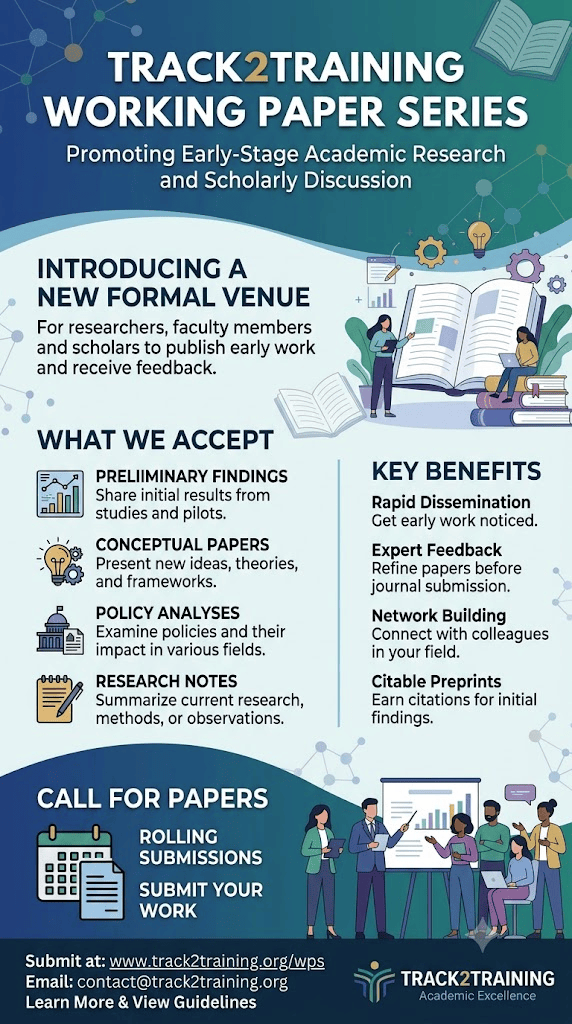
Academic research develops through discussion, revision, critique, and continuous refinement. Important ideas often emerge long before they are published in a journal, book, or formal research report. Researchers frequently need a credible platform where they can share preliminary findings, conceptual arguments, policy analyses, methodological notes, field observations, and early-stage research outputs with a wider academic audience.
The Track2Training Working Paper Series is conceived as an institutional platform for the dissemination of such emerging research.
The series is designed to provide researchers, faculty members, doctoral scholars, professionals, and independent academics with an opportunity to circulate research that is sufficiently developed for scholarly discussion but may still be undergoing refinement before submission to a peer-reviewed journal or other formal publication outlet.
By establishing a structured Working Paper Series, Track2Training aims to strengthen academic exchange, improve the visibility of ongoing research, encourage constructive feedback, and support the development of high-quality scholarly outputs.
What Is a Working Paper?
A working paper is a research document that presents ideas, evidence, analysis, or preliminary findings before final journal publication.
Unlike a published journal article, a working paper may represent a study that is still developing. The research may later be revised substantially after receiving comments from colleagues, seminar participants, reviewers, or other researchers.
Working papers are widely used by universities, research centres, policy institutes, think tanks, and academic departments because they allow knowledge to circulate more quickly than conventional publication systems often permit.
A working paper may contain completed empirical analysis, an emerging theoretical framework, a methodological innovation, a policy evaluation, a research note, or a structured discussion of an important academic question.
The key principle is transparency. Readers should clearly understand that the document represents a working version of research rather than necessarily being its final published form.
Purpose of the Track2Training Working Paper Series
The Track2Training Working Paper Series is intended to serve several interconnected academic purposes.
First, it provides a formal channel for disseminating early-stage research. Researchers often spend months or years collecting and analysing data before their work appears in a journal. A working paper enables useful findings to enter academic discussion earlier.
Second, the series encourages scholarly feedback. Early circulation allows researchers to identify weaknesses in arguments, methods, interpretation, or presentation before final publication.
Third, working papers help create a visible record of ongoing institutional research. A regularly updated series can demonstrate the range of questions being investigated by scholars associated with Track2Training and its wider research network.
Fourth, the platform can encourage interdisciplinary dialogue. A paper developed within urban planning, for example, may contain findings relevant to transportation, sustainability, public policy, economics, or environmental research.
Finally, the series can provide emerging researchers with experience in preparing professional research manuscripts and presenting their work to an academic audience.
Who Can Contribute?
The Working Paper Series is envisioned as an inclusive but academically structured platform.
Potential contributors may include:
- university faculty members,
- doctoral and postgraduate researchers,
- postdoctoral scholars,
- professionals engaged in research,
- independent researchers,
- research fellows,
- institutional collaborators,
- interdisciplinary research teams, and
- scholars participating in Track2Training research initiatives.
Collaborative papers involving authors from multiple institutions or disciplines are particularly encouraged where such collaboration contributes to the quality and relevance of the work.
Students and early-career researchers may also submit papers, preferably where the work demonstrates a clear research objective, appropriate methodology, and meaningful academic contribution.
Types of Working Papers
The series can accommodate several forms of research output.
Preliminary Empirical Findings
Researchers who have completed substantial data collection and initial analysis may use a working paper to present emerging findings.
For example, a transportation researcher may publish preliminary results from a commuter survey, while an environmental researcher may present early spatial findings from a land-use change study.
Such papers can help authors receive feedback before developing the final journal manuscript.
Conceptual Papers
Not all valuable academic work is based on primary data.
Conceptual papers may develop theoretical arguments, propose analytical frameworks, integrate ideas from multiple disciplines, or introduce new ways of understanding an existing research problem.
These papers can be especially valuable in emerging fields where established theoretical frameworks remain limited.
Policy Analyses
Policy research often needs to be communicated while the policy issue remains current.
Working papers can examine legislation, institutional frameworks, implementation challenges, governance structures, planning regulations, educational policies, environmental regulations, or public programmes.
Such papers should distinguish clearly between evidence, interpretation, and recommendations.
Research Notes
Research notes are generally shorter and more focused than full working papers.
They may report an interesting observation, methodological challenge, dataset, pilot study, technical procedure, or emerging research question that deserves wider discussion.
Research notes can help researchers communicate useful information without waiting until a complete journal article has been developed.
Methodological Papers
The Working Paper Series can also provide space for studies focusing specifically on research methods.
Possible subjects include sampling strategies, questionnaire development, structural equation modelling, machine learning applications, bibliometric methods, GIS analysis, systematic review protocols, qualitative coding approaches, or the integration of multiple methods.
Methodological working papers can support wider research capacity by making analytical procedures more transparent.
Literature and Evidence Reviews
Structured literature reviews, scoping reviews, bibliometric analyses, and evidence maps may also be suitable for the series.
These papers can identify research trends, knowledge gaps, methodological patterns, and areas requiring further investigation.
Field Reports and Case Studies
Field-based research often generates valuable evidence that may not fit immediately into a traditional journal format.
Working papers can document field surveys, planning cases, community studies, heritage assessments, institutional experiences, pilot projects, and local research initiatives.
Such outputs are particularly useful for connecting academic research with real-world contexts.
Priority Research Areas
The Track2Training Working Paper Series is interdisciplinary in scope.
Priority areas may include urban planning, architecture, transportation, sustainable development, environmental studies, education, artificial intelligence, machine learning, public policy, governance, social sciences, heritage studies, data science, research methodology, digital transformation, and emerging technologies.
The series may also include papers addressing interdisciplinary problems that cannot be adequately located within a single academic discipline.
This broad scope reflects the institutional research philosophy of Track2Training, which recognises that many contemporary challenges require collaboration across fields.
Suggested Structure of a Working Paper
Although the structure may vary depending on the nature of the research, an empirical working paper could generally include:
Title and Author Information – including institutional affiliation and contact details.
Abstract – a concise overview of the purpose, methodology, major findings, and contribution.
Keywords – terms representing the central themes of the paper.
Introduction – background, research problem, objectives, and significance.
Literature Review – relevant scholarship and identification of the research gap.
Methodology – research design, data sources, sampling, methods, and analytical techniques.
Results or Preliminary Findings – presentation of evidence.
Discussion – interpretation of findings in relation to previous research.
Implications – academic, professional, or policy relevance.
Limitations and Future Research – acknowledgement of areas requiring further investigation.
Conclusion – summary of the principal contribution.
References – properly formatted scholarly sources.
Conceptual papers, policy papers, and research notes may use a more flexible structure appropriate to their purpose.
Academic Quality and Screening
Although working papers are preliminary outputs, they should still meet basic standards of academic quality.
Submissions to the Track2Training Working Paper Series should demonstrate a clear research purpose, coherent argument, appropriate methodology where applicable, accurate referencing, and responsible scholarly practice.
An institutional screening process can be used to assess whether submitted papers are suitable for inclusion in the series.
Screening may consider:
- relevance to the scope of the series,
- originality of the research question,
- clarity of writing,
- adequacy of methodology,
- transparency of data and analysis,
- ethical considerations,
- citation and attribution practices, and
- overall scholarly value.
This screening process should not be represented as equivalent to external journal peer review unless a formal peer-review procedure is specifically established.
Clearly distinguishing editorial screening from formal peer review is important for academic transparency.
Research Ethics and Integrity
All submissions should follow recognised principles of responsible research.
Authors should ensure that their work is original, properly referenced, and free from plagiarism or inappropriate duplication.
Where human participants are involved, relevant ethical requirements should be followed, including informed consent, confidentiality, privacy, and institutional ethical approval where required.
Authors should also disclose conflicts of interest, funding sources, and important methodological limitations.
Where artificial intelligence tools have been used in research or manuscript preparation, disclosure should follow applicable institutional, journal, or disciplinary standards.
The use of AI does not transfer responsibility away from authors. Authors remain accountable for the accuracy, originality, interpretation, and integrity of their work.
Versioning and Revision
One of the most useful characteristics of a working paper is that it can evolve.
A paper may first appear as Version 1 and later be updated after receiving comments, presenting the work at a conference, completing additional analysis, or revising the conceptual framework.
A transparent versioning system can record these changes.
Each version should ideally include the date of publication and an indication that readers should consult the most recent version where available.
Versioning can demonstrate the development of research over time and provide a useful scholarly record.
Relationship with Journal Publication
A Working Paper Series should complement, rather than replace, peer-reviewed publication.
Authors may subsequently develop their working papers into journal articles, book chapters, conference papers, or research reports.
However, journal policies vary regarding prior circulation of manuscripts as working papers or preprints.
Authors should therefore check the policies of their intended journal before posting a working paper publicly.
Where a paper is later formally published, the working-paper page may be updated to include the citation of the final publication.
This creates a useful link between early-stage research and the completed scholarly output.
Visibility and Academic Communication
Working papers can improve the discoverability of ongoing research when they are organised systematically and supported by appropriate metadata.
Each paper should ideally have a dedicated webpage containing the title, authors, affiliations, abstract, keywords, publication date, working-paper number, version, and recommended citation.
A consistent numbering system could be introduced, such as:
Track2Training Working Paper No. 2026-01
This can be followed by subsequent papers according to year and sequence.
Where technically and institutionally appropriate, persistent identifiers may also be considered in the future to improve citation stability and discoverability.
The series can additionally be promoted through research newsletters, academic social networks, seminars, institutional profiles, and conference activities.
Encouraging Scholarly Discussion
A Working Paper Series should function as more than an online storage location.
Its broader value lies in encouraging dialogue.
Track2Training can connect working papers with research seminars, online discussions, author presentations, thematic workshops, or invited responses.
Researchers could present their ongoing work and receive comments from scholars working on similar questions.
This process can improve the quality of subsequent publications while developing a stronger culture of academic exchange.
Supporting Early-Career Researchers
The Working Paper Series can be especially valuable for doctoral scholars and early-career researchers.
Preparing a working paper requires researchers to organise their evidence, articulate the contribution of their study, explain their methodology, and communicate findings clearly.
This process can help scholars identify weaknesses before formal journal submission.
Early-career researchers can also benefit from the visibility created by sharing their ongoing work and engaging with other academics.
However, quality standards should remain consistent across career stages. Supporting emerging researchers should mean helping them develop rigorous research rather than lowering scholarly expectations.
Building an Institutional Research Record
Over time, the Track2Training Working Paper Series can develop into an important archive of institutional research activity.
A searchable collection of working papers can reveal the development of research themes, collaborations, methods, locations, and policy interests across years.
Individual papers may later lead to journal publications, funded projects, doctoral research, policy reports, conferences, datasets, or collaborative studies.
The series can therefore become part of a broader institutional research ecosystem connecting research projects, seminars, publications, researchers, training programmes, and knowledge dissemination.
A Platform for Research in Progress
Research rarely moves directly from an idea to a finished publication.
It develops through reading, debate, data collection, analysis, revision, criticism, and reconsideration.
The Track2Training Working Paper Series is intended to recognise this process by creating a formal space for research in progress.
By facilitating the circulation of preliminary findings, conceptual studies, policy analyses, methodological contributions, and research notes, Track2Training seeks to strengthen scholarly dialogue while helping researchers refine their work before final publication.
The series reflects a broader institutional commitment to open academic exchange, methodological transparency, research integrity, interdisciplinary collaboration, and evidence-based knowledge creation.
As the collection develops, it has the potential to become a visible record of emerging scholarship and an important component of Track2Training’s identity as a research-oriented academic institution.
Which relationship has taught you the most about yourself?
View all responses


You must be logged in to post a comment.