


A turnkey project is a form of project delivery in which a single contractor or organization is made fully responsible for the design, execution, installation, testing, and commissioning of a project. The term turnkey signifies that the client only needs to “turn the key” to begin operations once the project is completed. Such projects are commonly used in construction, infrastructure development, industrial plants, power projects, information technology systems, and urban development works, where clients prefer minimal involvement during implementation.
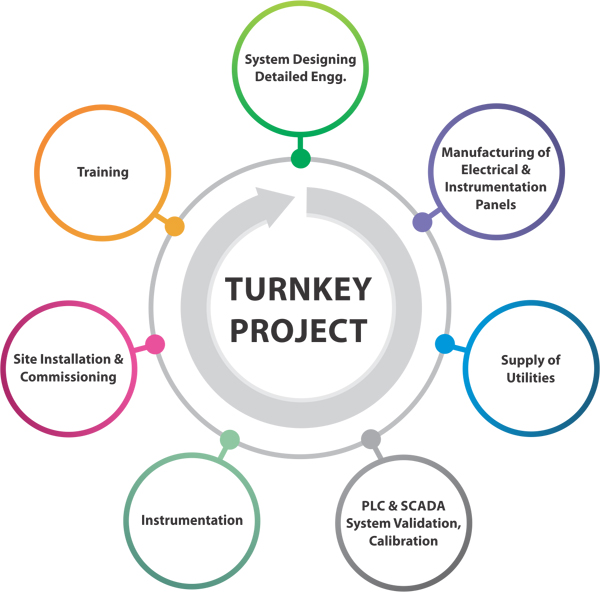
In a turnkey arrangement, the client defines the broad requirements, objectives, and performance standards at the outset. Based on these requirements, the contractor undertakes the entire project lifecycle—from conceptual design to final handover. This approach contrasts with traditional project delivery methods, where design, construction, and supervision may be handled by multiple agencies, often increasing coordination challenges and risks for the client.
One of the most significant features of a turnkey project is single-point responsibility. The contractor is accountable for cost, time, quality, and functionality. If delays occur, costs escalate, or performance standards are not met, the responsibility lies with the contractor rather than being dispersed across consultants, suppliers, and subcontractors. This greatly reduces administrative and managerial burden for the client and ensures clearer accountability.
Another important characteristic of turnkey projects is fixed pricing. In many cases, the project is executed on a lump-sum or fixed-price basis. This provides cost certainty to the client and helps in better financial planning. Since the contractor bears the risk of cost overruns, they are motivated to plan efficiently, optimize resource use, and complete the project within the agreed budget and timeline.
Turnkey projects are especially beneficial when the client lacks technical expertise or sufficient manpower to manage complex projects. By transferring technical and operational risks to the contractor, the client can focus on strategic decisions rather than day-to-day execution. This makes turnkey contracts attractive for governments, public sector undertakings, and private developers undertaking large-scale or technically complex projects.
However, turnkey projects also have certain limitations. Since the contractor controls design and execution, the client may have limited flexibility to introduce changes once the project is underway. Any modification in scope or specifications often leads to cost and time implications. Therefore, it is crucial that the client clearly defines project requirements, performance criteria, and quality standards at the planning stage.
Another concern can be quality assurance. As contractors aim to maximize profit within a fixed price, there may be a tendency to reduce costs by selecting lower-quality materials or technologies, unless strict specifications, monitoring mechanisms, and penalties are included in the contract. Hence, well-drafted contracts and effective supervision remain essential even in turnkey projects.
In practice, turnkey projects are widely used in sectors such as highways, metro rail systems, water supply schemes, wastewater treatment plants, industrial units, and housing developments. In urban and infrastructure planning, turnkey projects help expedite implementation, reduce delays caused by inter-agency coordination, and ensure faster delivery of public assets.
In conclusion, a turnkey project is an efficient and client-friendly project delivery mechanism that emphasizes accountability, risk transfer, and timely completion. While it offers significant advantages in terms of simplicity, cost certainty, and reduced managerial effort, its success depends heavily on clear initial planning, comprehensive contracts, and robust performance specifications. When applied appropriately, turnkey projects can play a vital role in achieving efficient and sustainable development outcomes.


 Track2Training
You must be logged in to post a comment.