Balkrishna Vithaldas Doshi (B.V. Doshi) (1927โ€“2023)

Balkrishna Vithaldas Doshi (1927โ€“2023) โ€” affectionately known as B.V. Doshi โ€” was a visionary Indian architect whose work bridged the worlds of tradition and modernity, and played a transformative role in shaping post-independence Indian architecture. He is widely celebrated for his humane approach to design, commitment to sustainability, and dedication to social housing, education, and culture. As the first Indian architect to receive the Pritzker Architecture Prize in 2018, Doshiโ€™s legacy extends beyond buildings to influence generations of architects and planners.

๐Ÿง’ Early Life and Education

B.V. Doshi was born on August 26, 1927, in Pune, Maharashtra, into a family of furniture makers. His early exposure to craftsmanship and traditional Indian aesthetics would later shape his architectural philosophy.

He studied at the Sir J.J. School of Architecture in Mumbai. However, it was his time in Europe during the early 1950s that had a profound impact on his thinking. Doshi worked under the legendary modernist Le Corbusier in Paris and later in Chandigarh and Ahmedabad, where he supervised major projects. He also collaborated with Louis Kahn on the Indian Institute of Management (IIM) Ahmedabad.


๐Ÿ› Architectural Philosophy

B.V. Doshiโ€™s architecture was deeply rooted in Indian traditions, climatic responsiveness, social responsibility, and human-centric design. He was a pioneer of modern Indian architecture who adapted modernist principles to the Indian context, fusing them with local materials, construction techniques, and cultural motifs.

Key principles in Doshiโ€™s work:

  • Synthesis of tradition and modernity
  • Use of natural light and ventilation
  • Community-focused spaces
  • Affordable and low-cost housing
  • Sustainability and local materials
  • Spatial hierarchy and interactivity
  • Celebration of courtyards, terraces, and verandas

๐Ÿ  Major Works

1. Aranya Low-Cost Housing, Indore (1989)

  • One of Doshi’s most significant contributions to social housing.
  • Designed for economically weaker sections, Aranya consists of over 6,500 residences.
  • Encourages incremental growth, allowing families to expand or modify their homes.
  • Winner of the Aga Khan Award for Architecture (1995).

2. Indian Institute of Management (IIM), Bangalore (1977โ€“1992)

  • A sprawling campus of interlinked courtyards, stone corridors, and shaded walkways.
  • The design reflects ancient Indian temples and educational spaces, creating contemplative environments.

3. CEPT University, Ahmedabad (1966 onwards)

  • Doshi founded and designed the campus of Centre for Environmental Planning and Technology (CEPT).
  • A model of flexible, open, and democratic learning spaces.
  • Features exposed brickwork, natural light, and a strong sense of place.

4. Tagore Memorial Hall, Ahmedabad (1967)

  • Inspired by Indian temple architecture and brutalist aesthetics.
  • Known for its bold concrete forms and acoustics suitable for performing arts.

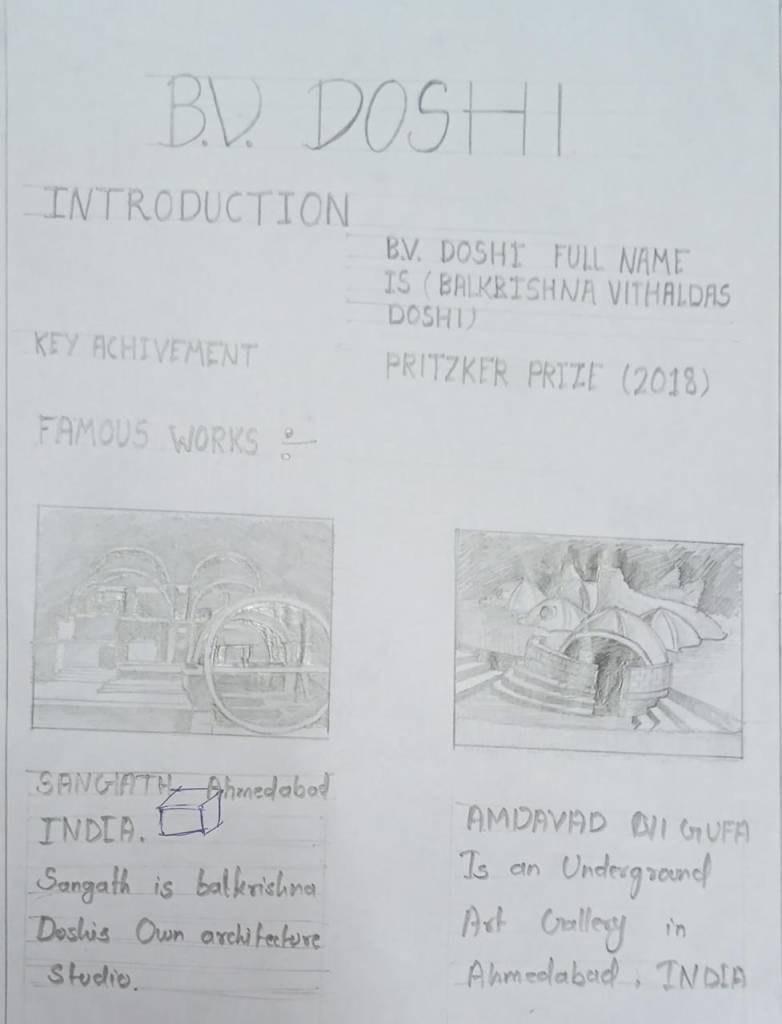
5. Amdavad ni Gufa (1995)

  • An underground art gallery built in collaboration with artist M.F. Husain.
  • Organic, cave-like forms with domes, mosaics, and undulating surfaces.
  • A symbolic fusion of art, architecture, and nature.

6. Sangath, Ahmedabad (1981)

  • Doshiโ€™s own architectural studio.
  • โ€œSangathโ€ means โ€œmoving togetherโ€ in Sanskrit.
  • Built with sunken vaults, white mosaic surfaces, and shaded gardens, it reflects his approach to spatial experimentation and climate sensitivity.

๐Ÿ† Awards and Recognition

Pritzker Architecture Prize (2018)

  • First Indian to win this prestigious award.
  • Jury citation praised Doshi for โ€œalways designing for the backdrop of life… never architecture for architectureโ€™s sake.โ€

Royal Institute of British Architects (RIBA) Gold Medal (2022)

  • One of the worldโ€™s highest honors in architecture, awarded for lifetime achievement.

Other Recognitions:

  • Padma Shri (1976)
  • Padma Bhushan (2020)
  • Aga Khan Award for Architecture (1995)
  • Numerous honorary doctorates and international acclaim

๐ŸŽ“ Academic and Institutional Contributions

  • Founder of CEPT University, a leading institution for architecture and planning in India.
  • Taught and mentored generations of students.
  • Served on design committees for national policy on architecture and planning.
  • Advocated for architecture as a tool for social change.

๐Ÿ“š Writings and Influence

B.V. Doshi was a prolific speaker, thinker, and writer. His lectures, interviews, and writings reflect a deep philosophical engagement with architecture as a cultural, spiritual, and emotional practice.

His Work Emphasized:

  • Timelessness over trends
  • Contextual relevance over global styles
  • Joyful spaces that promote human interaction
  • Democracy in spatial design
  • The spiritual dimension of built form

๐Ÿ•Š Death and Legacy

B.V. Doshi passed away on January 24, 2023, at the age of 95, in Ahmedabad. His passing marked the end of an era, but his ideas live on through his students, institutions, and built works.

Legacy Highlights:

  • Regarded as the father of modern Indian architecture
  • Celebrated globally as a humanist architect
  • Inspired new generations to design with empathy, humility, and sustainability
  • His buildings remain active, evolving spaces โ€” not static monuments

๐Ÿง  Conclusion

Balkrishna Vithaldas Doshi was more than an architect โ€” he was a philosopher, educator, and social reformer who believed in the power of design to improve lives. He showed the world how architecture could be deeply modern yet rooted in tradition; humble yet monumental; and sustainable yet imaginative.

Frank Lloyd Wright (1867โ€“1959) was one of the most Influential and iconic Architects

Frank Lloyd Wright (1867โ€“1959) was one of the most influential and iconic architects of the 20th century. Known for developing the philosophy of organic architecture, he left behind a legacy that continues to shape the way we design homes, buildings, and spaces. Wright’s visionary designs integrated buildings with their environments, emphasized harmony between the natural world and the built form, and often broke conventional architectural norms.


๐Ÿง‘โ€๐ŸŽจ Early Life and Education

Frank Lloyd Wright was born on June 8, 1867, in Richland Center, Wisconsin, USA. His early life was marked by strong influences from both his parents:

  • His mother, Anna Lloyd Jones, believed he would become an architect and encouraged his development through Froebel education methods, which emphasized geometric forms and design.
  • His father, William Wright, was a preacher and musician. Though his parents divorced when Wright was young, their influence shaped his early thinking.

Wright never formally graduated from any architecture school. In 1887, he moved to Chicago during a construction boom and found work at the prestigious firm of Adler and Sullivan, where he apprenticed under Louis Sullivan, often called the “father of skyscrapers.” Sullivan’s philosophy of “form follows function” deeply influenced Wright.


๐Ÿ›๏ธ Architectural Philosophy: Organic Architecture

Wright coined and championed the concept of organic architecture, which means that a building should:

  • Be integrated into its environment
  • Use local materials
  • Reflect the needs and nature of its inhabitants
  • Have fluid, open spaces

He believed that buildings should grow naturally from their surroundings, like a tree growing from the ground. This vision was not just aestheticโ€”it was a response to industrialization, urban sprawl, and poor housing conditions.


๐Ÿ  Major Works and Styles

1. Prairie Style (1900sโ€“1910s)

  • Wright developed the Prairie School of architecture, inspired by the flat, horizontal lines of the American Midwest landscape.
  • Features included low-pitched roofs, overhanging eaves, horizontal lines, and open floor plans.

Notable Prairie Houses:

  • Robie House (1909), Chicago, IL โ€“ Considered a masterpiece of Prairie design.
  • Unity Temple (1905โ€“08), Oak Park, IL โ€“ An early example of concrete used innovatively in architecture.

2. Usonian Houses (1930sโ€“1950s)

  • Designed as affordable housing for middle-class Americans during the Great Depression.
  • Usonian homes were single-story, L-shaped, had no basements or attics, and featured built-in furniture, radiant floor heating, and carports.

Notable Usonian Example:

  • Jacobs House (1937), Madison, WI โ€“ The first true Usonian house.

3. Integration with Nature

  • Wright’s belief in harmony with nature reached its peak in his most famous work:

๐Ÿž๏ธ Fallingwater (1935), Pennsylvania

  • A house built over a waterfall, with cantilevered balconies and local stonework.
  • Often cited as one of the greatest architectural works of the 20th century.

๐Ÿ•Œ Other Landmark Projects

๐Ÿ”ท Taliesin (1911โ€“1959)

  • Wrightโ€™s own home and studio in Spring Green, Wisconsin.
  • Rebuilt several times after fires and constantly modified, it served as a testing ground for his ideas.

๐Ÿ”ท Taliesin West (1937)

  • Wrightโ€™s winter home and architectural school in Scottsdale, Arizona.
  • Blended desert rock and wood, emphasizing the Southwestern environment.

๐Ÿ”ท The Guggenheim Museum (1959), New York

  • An iconic spiral-shaped art museum.
  • Designed to let visitors experience art in a continuous flow.

๐ŸŒ Global Impact and Influence

Frank Lloyd Wright designed over 1,000 structures, of which around 532 were built. His work influenced generations of architects worldwide and continues to be studied for its innovation in:

  • Open floor planning
  • Structural engineering (e.g., cantilevers)
  • Use of natural light
  • Integration with landscape
  • Human-centric design

His disciples spread his ideas internationally, and the Taliesin Fellowship, which he founded in 1932, trained many architects who went on to successful careers.


๐Ÿ† Awards and Recognition

  • Royal Institute of British Architects Gold Medal (1941)
  • American Institute of Architects Gold Medal (1949)
  • Named the “Greatest American Architect of All Time” by the AIA in 1991.
  • In 2019, eight of his buildings, including Fallingwater, Unity Temple, and the Guggenheim Museum, were inscribed on the UNESCO World Heritage List as โ€œThe 20th-Century Architecture of Frank Lloyd Wright.โ€

๐Ÿ“š Writings and Legacy

Wright was not only an architect but also a prolific writer and thinker. His works include:

  • “The Natural House” (1954) โ€“ Outlined his vision for simple, sustainable homes.
  • “An Autobiography” (1932) โ€“ A philosophical and detailed account of his life and work.

His legacy is preserved by:

  • The Frank Lloyd Wright Foundation
  • The Taliesin Preservation
  • Numerous museums, archives, and tours around his built works.

โšฐ๏ธ Death and Final Years

Frank Lloyd Wright passed away on April 9, 1959, at the age of 91. He was active in architectural work until the end of his life, leaving behind unfinished designs and a rich architectural philosophy that redefined modern architecture.


๐Ÿ“ Conclusion

Frank Lloyd Wright was more than just an architectโ€”he was a cultural figure who reshaped how we think about space, nature, and design. His organic philosophy of building harmoniously with the environment, combined with his innovative use of space, light, and materials, made him a pioneer of modern architecture. His ideas continue to inspire architects and environmental designers around the globe, underscoring the timelessness of his vision.

Cohort Survival Method for Population Projection

Population projection is an essential tool in demography, urban planning, public health, and economic forecasting, as it estimates future population size and structure. Among the many projection techniques, the Survival Method is one of the most widely used for medium- to long-term projections because it incorporates age- and sex-specific survival rates and accounts for births, deaths, and migration.

The Survival Method is particularly important when a planner needs age-structured projections for policy formulation, resource allocation, and infrastructure planning.


2. Concept of the Survival Method

The Survival Method projects the population by following each cohort (a group of people born in the same year or period) over time and applying survival rates to estimate how many people remain in that cohort in future years.

The method is called โ€œsurvivalโ€ because:

  • It uses life tables or survival ratios to determine what proportion of a cohort will survive to the next age group in the next projection period.
  • It moves each age cohort forward through time, reducing it according to mortality, and adding new births for the youngest cohort.

3. Data Requirements

To apply the Survival Method, the following data are typically needed:

  1. Base-Year Population Data
    • Classified by age and sex.
    • Usually obtained from a census or population register.
  2. Survival Ratios / Life Tables
    • Probability of surviving from one age group to the next over a given time interval.
    • Derived from mortality rates, adjusted for the local population.
  3. Fertility Rates (for projecting new births)
    • Age-specific fertility rates (ASFRs) for females in childbearing ages (usually 15โ€“49 years).
  4. Migration Data
    • Estimates of net migration by age and sex, if applicable.

4. Step-by-Step Procedure

Step 1: Prepare Base-Year Age-Sex Population

Organize the population into standard 5-year age groups (0โ€“4, 5โ€“9, 10โ€“14, โ€ฆ, 80+), separated by male and female.


Step 2: Obtain Survival Ratios

  • From life tables, determine the proportion of people who survive from one age group to the next over the projection interval (e.g., 5 years).
  • Example: If the survival ratio from age 10โ€“14 to age 15โ€“19 is 0.98, it means 98% of those aged 10โ€“14 will survive to the 15โ€“19 group after 5 years.

Step 3: Apply Survival Ratios to Cohorts

  • Multiply each cohort by the corresponding survival ratio to get the population in the next age group for the next projection period.
  • Example:
    Base-year population (age 10โ€“14): 20,000
    Survival ratio to age 15โ€“19: 0.98
    Projected 15โ€“19 age group (next period) = 20,000 ร— 0.98 = 19,600.

Step 4: Project the Youngest Age Group (Births)

  • Calculate expected births during the projection period using age-specific fertility rates and the projected number of women in childbearing ages.
  • Example:
    • ASFR for women aged 20โ€“24 = 0.08 (meaning 80 births per 1,000 women over the 5-year period).
    • Multiply ASFR by the number of women in that age group.
  • Sum births across all childbearing age groups to get total births.
  • Apply infant and child survival ratios to estimate how many survive to age 0โ€“4 in the next period.

Step 5: Adjust for Migration (If Applicable)

  • Add or subtract net migration by age group before moving to the next projection cycle.

Step 6: Repeat for Each Projection Interval

  • Continue moving cohorts forward for each projection period until the desired future year is reached.

5. Example (Simplified)

Base-Year Population (2025) โ€“ Males Only:

Age GroupPopulationSurvival RatioProjected Pop. (2030)
0โ€“410,0000.995(Births projected)
5โ€“99,8000.9959,751
10โ€“149,5000.9909,405
15โ€“199,2000.9859,062

For the 0โ€“4 age group in 2030, births are calculated based on projected women in reproductive ages and then multiplied by infant/child survival ratios.


6. Advantages of the Survival Method

  • Age-specific projection: Produces detailed breakdowns by age and sex.
  • High accuracy for medium-term projections (10โ€“30 years) when data are good.
  • Can incorporate fertility, mortality, and migration separately.
  • Useful for planning schools, hospitals, housing, pensions, etc.

7. Limitations

  • Requires reliable and detailed data (age-sex population, life tables, fertility rates).
  • Less accurate for small populations due to statistical fluctuations.
  • Long-term projections (>40 years) may be less reliable because fertility, mortality, and migration trends can change unexpectedly.
  • More complex than simple growth rate methods.

8. Applications

  • Urban planning โ€“ predicting future demand for housing and infrastructure.
  • Health planning โ€“ estimating needs for hospitals and elderly care.
  • Education planning โ€“ forecasting school enrollment.
  • Labour market forecasting โ€“ anticipating changes in the working-age population.
  • Social security and pension planning โ€“ understanding aging trends.

โœ… In short, the Survival Method (Cohort-Survival) is a systematic way to move each age cohort forward in time, adjusting for mortality, fertility, and migration, to produce age-structured, sex-specific population projections. Its strength lies in its demographic realism and policy relevance, making it a standard in official statistical agencies and planning institutions.

Review of Swarna Jayanti Shahari Rozgar Yojana (SJSRY)

Daily writing prompt
What’s the most money you’ve ever spent on a meal? Was it worth it?

By Shashikant Nishant Sharma

The Swarna Jayanti Shahari Rozgar Yojana (SJSRY) is an ambitious urban poverty alleviation program launched by the Government of India in December 1997. The scheme aims to provide gainful employment to the urban unemployed and underemployed, especially the urban poor, by encouraging the setting up of self-employment ventures or provision of wage employment. This review delves into the objectives, structure, implementation, achievements, and challenges of the SJSRY, shedding light on its significance and impact on urban poverty alleviation.

Objectives

The primary objectives of the SJSRY are:

  1. Alleviation of Urban Poverty: To provide sustainable employment to the urban unemployed and underemployed poor through skill development and entrepreneurial ventures.
  2. Self-Employment Promotion: To support urban poor in setting up small enterprises through financial assistance, skill training, and infrastructural support.
  3. Wage Employment: To create wage employment opportunities by providing support for the construction of community assets.
  4. Empowerment of Women and Vulnerable Groups: To enhance the income-generating capacities of the urban poor, particularly women and other vulnerable sections of the society.

Structure of the Scheme

The SJSRY is structured around five key components:

  1. Urban Self-Employment Programme (USEP): This component focuses on providing assistance to individuals or groups to set up self-employment ventures. It includes:
    • Individual Enterprises (Urban Poor): Financial support to individuals for starting small businesses.
    • Self-Help Groups (SHGs): Formation and support of SHGs for income-generating activities.
    • Skill Training for Employment Promotion amongst Urban Poor (STEP-UP): Providing training to enhance employability.
  2. Urban Wage Employment Programme (UWEP): This component aims to provide wage employment through the creation of community assets like roads, drains, and parks in urban areas.
  3. Urban Women Self-Help Programme (UWSP): Focused on empowering urban poor women by encouraging the formation of women SHGs and providing them with financial and technical support to start income-generating activities.
  4. Urban Community Development Network (UCDN): This component seeks to promote community development by involving Community Development Societies (CDS) in planning and implementation.
  5. Thrift and Credit Societies (T&CS): Encouraging savings and providing credit facilities to the urban poor.

Implementation

The implementation of SJSRY is decentralized, with the Ministry of Housing and Urban Affairs (MoHUA) overseeing the scheme at the national level. At the state level, the Department of Urban Development is responsible, and at the urban local body (ULB) level, it is implemented through Municipal Corporations, Municipalities, and Nagar Panchayats.

The process involves:

  1. Identification of Beneficiaries: The urban poor are identified through surveys and community participation.
  2. Training and Capacity Building: Beneficiaries are provided with skill training and capacity-building programs.
  3. Financial Support: Financial assistance is provided in the form of subsidies and loans.
  4. Monitoring and Evaluation: Regular monitoring and evaluation are conducted to ensure effective implementation and to address challenges.

Achievements

Since its inception, the SJSRY has made significant strides in urban poverty alleviation:

  1. Employment Generation: The scheme has created numerous self-employment and wage employment opportunities for the urban poor.
  2. Empowerment of Women: Through the formation of SHGs, many urban poor women have gained financial independence and improved their social status.
  3. Skill Development: The STEP-UP component has enhanced the employability of many urban poor through skill training.
  4. Community Development: The UCDN component has fostered community participation and development.

Challenges

Despite its successes, the SJSRY faces several challenges:

  1. Awareness and Outreach: Limited awareness among the urban poor about the schemeโ€™s benefits and provisions.
  2. Financial Inclusion: Difficulty in accessing financial services and credit facilities.
  3. Sustainability of Ventures: Ensuring the sustainability of self-employment ventures remains a challenge.
  4. Infrastructure and Capacity: Inadequate infrastructure and capacity at the ULB level hinder effective implementation.
  5. Monitoring and Evaluation: Lack of robust monitoring and evaluation mechanisms to track progress and address issues promptly.

Conclusion

The Swarna Jayanti Shahari Rozgar Yojana (SJSRY) has been instrumental in addressing urban poverty by providing employment opportunities and empowering the urban poor, particularly women. While the scheme has achieved significant success, addressing the challenges through improved awareness, financial inclusion, sustainable ventures, better infrastructure, and robust monitoring is crucial for its continued effectiveness. The SJSRY remains a vital component of Indiaโ€™s urban poverty alleviation strategy, reflecting the government’s commitment to creating an inclusive and sustainable urban economy.

References

Reddy, S. I. (2015). RATIONALE OF GOVERNMENT POLICIES AND PROGRAMMES IN RURAL DEVELOPMENT THROUGH WOMEN EMPOWERMENT.ย The Indian Journal of Political Science,ย 76(3), 611-614.

Rajkonwar, A. B. (2005). Swama Jayanti Shahari Rozgar Yojana: A study on effectiveness in Dibrugarh.ย SEDME (Small Enterprises Development, Management & Extension Journal),ย 32(4), 23-42.

Shah, G., Joshi, A., Prasad, P. N., Chettiparamb, A., Sekher, M., Kumar, M., … & Mathur, N. (2010). The globalizing state, public services and the new governance of urban local communities in India: A colloquium.ย Vikalpa,ย 35(1), 75-106.

Sharma, S. N. (2020). A Review of Swarna Jayanti Shahari Rozgar Yojana.ย Think India Journal,ย 23(1), 26-32.

Surappa, M. K. (2013). India’s ranking in materials research.ย Current Science,ย 105(2), 147-149.

Life Cycle Assessment (LCA) of Recycled & Secondary Materials in Road Construction

Daily writing prompt
What’s the most money you’ve ever spent on a meal? Was it worth it?

By Kavita Dehalwar

Life Cycle Assessment (LCA) is a systematic method for evaluating the environmental impacts of products, processes, or services from cradle to grave. In the context of road construction, the incorporation of recycled and secondary materials has gained significant attention due to its potential to reduce environmental impacts and promote sustainability. This article delves into the use of LCA for assessing recycled and secondary materials in road construction, highlighting its importance, methodologies, benefits, challenges, and case studies.

Importance of LCA in Road Construction

LCA is essential in road construction for several reasons:

  1. Environmental Impact Assessment: It provides a comprehensive analysis of the environmental impacts associated with different materials and construction processes.
  2. Resource Efficiency: It promotes the efficient use of resources by identifying opportunities to use recycled and secondary materials.
  3. Sustainability Goals: LCA supports sustainability goals by highlighting the potential for reducing greenhouse gas emissions, energy consumption, and waste generation.
  4. Policy and Decision Making: It aids policymakers and stakeholders in making informed decisions based on scientific data.

Methodologies of LCA in Road Construction

The LCA of recycled and secondary materials in road construction involves several key steps:

  1. Goal and Scope Definition: This initial phase involves defining the purpose of the study, the system boundaries, and the functional unit (e.g., one kilometer of road).
  2. Life Cycle Inventory (LCI): This phase involves data collection on all relevant inputs and outputs, such as raw material extraction, transportation, processing, construction, maintenance, and end-of-life disposal.
  3. Life Cycle Impact Assessment (LCIA): In this phase, the inventory data is analyzed to assess potential environmental impacts across various categories, such as global warming potential, resource depletion, and toxicity.
  4. Interpretation: The final phase involves interpreting the results to identify significant impacts, potential improvements, and recommendations for stakeholders.

Benefits of Using Recycled and Secondary Materials

  1. Reduced Environmental Impact: Utilizing recycled materials can significantly lower the carbon footprint, reduce energy consumption, and minimize landfill waste.
  2. Resource Conservation: It helps conserve natural resources by reducing the demand for virgin materials.
  3. Cost Savings: Recycled materials can be cost-effective, reducing the overall cost of road construction and maintenance.
  4. Improved Performance: In some cases, recycled materials can enhance the performance and durability of road surfaces.

Challenges in Implementing LCA for Recycled Materials

  1. Data Availability and Quality: Obtaining reliable and comprehensive data for all life cycle stages can be challenging.
  2. Standardization: The lack of standardized methods and guidelines for LCA in road construction can lead to inconsistent results.
  3. Technical Limitations: Some recycled materials may have limitations in terms of performance and suitability for specific applications.
  4. Regulatory and Market Barriers: Regulatory restrictions and market acceptance can hinder the widespread adoption of recycled materials.

Case Studies

  1. Recycled Asphalt Pavement (RAP): RAP is widely used in road construction. LCA studies have shown that using RAP can reduce greenhouse gas emissions by up to 25% compared to virgin asphalt.
  2. Crushed Concrete Aggregate (CCA): Recycled concrete is used as aggregate in road base layers. LCA indicates that CCA reduces the demand for natural aggregates and decreases energy consumption.
  3. Blast Furnace Slag: This by-product of steel production is used as a supplementary cementitious material. LCA demonstrates that it can lower the carbon footprint of road construction.

Conclusion

Life Cycle Assessment is a crucial tool for evaluating the environmental impacts of recycled and secondary materials in road construction. By providing a comprehensive analysis of these impacts, LCA helps promote sustainable practices, resource efficiency, and informed decision-making. Despite the challenges, the benefits of using recycled materials, such as reduced environmental impact, resource conservation, cost savings, and improved performance, make it a viable option for sustainable road construction. Continued research, data collection, and collaboration among stakeholders are essential to overcome the challenges and fully realize the potential of recycled materials in the construction industry.

References

Huang, Y., Bird, R. N., & Heidrich, O. (2007). A review of the use of recycled solid waste materials in asphalt pavements.ย Resources, conservation and recycling,ย 52(1), 58-73.

Marinkoviฤ‡, M., Zavadskas, E. K., Matiฤ‡, B., Jovanoviฤ‡, S., Das, D. K., & Sremac, S. (2022). Application of wasted and recycled materials for production of stabilized layers of road structures.ย Buildings,ย 12(5), 552.

Saride, S., Puppala, A. J., & Williammee, R. (2010). Assessing recycled/secondary materials as pavement bases.ย Proceedings of the Institution of Civil Engineers-Ground Improvement,ย 163(1), 3-12.

Sharma, S. N., Lodhi, A. S., Dehalwar, K., & Jaiswal, A. (2024, June). Life Cycle Assessment (LCA) of Recycled & Secondary Materials in the Construction of Roads. Inย IOP Conference Series: Earth and Environmental Scienceย (Vol. 1326, No. 1, p. 012102). IOP Publishing.

Sharma, S. N., Prajapati, R., Jaiswal, A., & Dehalwar, K. (2024, June). A Comparative Study of the Applications and Prospects of Self-healing Concrete/Biocrete and Self-Sensing Concrete. Inย IOP Conference Series: Earth and Environmental Scienceย (Vol. 1326, No. 1, p. 012090). IOP Publishing.