Concentric Zone Model of Urban Planning

Daily writing prompt
What is a word you feel that too many people use?

By Shashikant Nishant Sharma

The Burgess Concentric Zone Model, also known as the Concentric Ring Model or Concentric Zone Theory, is an urban land use model that was developed by sociologist Ernest W. Burgess in 1925. This model was part of a broader body of work aimed at understanding the structure and dynamics of cities, particularly in the context of rapid urbanization during the early 20th century. The model is one of the foundational theories in urban sociology and geography.

Overview of the Model

The Concentric Zone Model suggests that urban areas develop in a series of concentric rings or zones, each with distinct characteristics and functions. According to the model, a city grows outward from a central point, with different social groups and land uses segregating into these rings based on economic and social factors.

The Five Zones in the Concentric Zone Model

Burgess identified five distinct zones in the model:

  1. Zone 1: The Central Business District (CBD)
    • Location and Function: At the center of the model is the Central Business District (CBD). This is the core of the city, where commercial, administrative, and cultural activities are concentrated.
    • Characteristics: The CBD is characterized by high land values, a dense concentration of office buildings, retail spaces, and government institutions. Land use is predominantly non-residential due to the high cost of land.
    • Dynamics: The CBD is highly accessible, with major transportation hubs often located here. It is the focal point of the city’s economy and a place where businesses compete for space, leading to vertical development (e.g., skyscrapers).
  2. Zone 2: The Zone of Transition
    • Location and Function: Surrounding the CBD is the Zone of Transition. This area is in flux, often containing a mix of residential, commercial, and industrial uses.
    • Characteristics: This zone is typically characterized by deteriorating housing, often occupied by low-income residents and new immigrants. It may also contain light industry, warehouses, and other activities that are incompatible with high-quality residential areas.
    • Dynamics: The Zone of Transition is subject to change as the city expands and as land values increase in the CBD, causing commercial and industrial uses to spill over into this area. It is often associated with social problems such as poverty, crime, and overcrowding.
  3. Zone 3: The Zone of Working-Class Homes
    • Location and Function: This zone is the first true residential area, located just outside the Zone of Transition.
    • Characteristics: The Zone of Working-Class Homes is typically populated by factory workers and other blue-collar employees who work in the nearby industrial areas. Housing here is usually modest, but of better quality than in the Zone of Transition.
    • Dynamics: Residents in this zone often have strong ties to their neighborhood and place of work, resulting in relatively stable communities.
  4. Zone 4: The Zone of Better Residences
    • Location and Function: Further out is the Zone of Better Residences, where more affluent citizens live.
    • Characteristics: This area is characterized by more spacious and higher-quality housing, with residents often comprising the middle class. The homes here are larger, and the neighborhoods are more suburban in character, with more green spaces and a lower population density.
    • Dynamics: The residents in this zone often commute to work, either to the CBD or other areas of the city, and enjoy a higher quality of life compared to those in the inner zones.
  5. Zone 5: The Commuter Zone
    • Location and Function: The outermost ring in the model is the Commuter Zone, sometimes referred to as the suburbs or exurbs.
    • Characteristics: This zone is characterized by a predominantly residential landscape, with larger homes, more space, and a high level of owner-occupancy. It is typically populated by the upper-middle class and the wealthy.
    • Dynamics: Residents in this zone often have longer commutes to work, typically traveling to the CBD or other business districts. This area represents the furthest extent of urban sprawl.

Key Assumptions and Criticisms

The Concentric Zone Model is based on several key assumptions:

  • Uniform Land Use: The model assumes that land use is uniform across each zone and that each zone has a single, dominant function.
  • Transportation: The model is premised on the idea that transportation is centrally focused, with people commuting into the CBD for work.
  • Unidirectional Growth: It assumes that the city grows outward in a uniform manner from a central point.

While the model was pioneering in its time, it has faced criticism and has limitations:

  • Over-Simplification: The model is often criticized for oversimplifying the complexities of urban development and for not accounting for the diversity and multi-nucleated nature of modern cities.
  • Historical Context: The model was developed in the context of early 20th-century Chicago, which had specific social and economic conditions that may not apply universally.
  • Ignored Factors: It doesn’t account for factors such as topography, governmental zoning laws, and the impact of transportation technologies (e.g., highways and railroads) that have influenced urban development.

Relevance Today

Despite its limitations, the Concentric Zone Model remains a foundational concept in urban geography and planning. It has influenced subsequent urban models, such as the Sector Model (Hoyt Model) and the Multiple Nuclei Model, which attempt to address some of the Concentric Zone Model’s limitations. It provides a basic framework for understanding the spatial organization of cities, particularly during periods of rapid industrialization and urbanization.

References

Balakrishnan, T. R., & Jarvis, G. K. (1991). Is the Burgess concentric zonal theory of spatial differentiation still applicable to urban Canada?. Canadian Review of Sociology/Revue canadienne de sociologie28(4), 526-539.

Ford, L. R. (1974). The Urban Housetype as an Illustration of the Concentric Zone Model: The Perception of Architectural Continuity. Journal of Geography73(2), 29-39.

Pineo, P. C. (1988). Socioeconomic status and the concentric zonal structure of Canadian cities. Canadian Review of Sociology/Revue canadienne de sociologie25(3), 421-438.

Schwirian, K. (2007). Ecological models of urban form: Concentric zone model, the sector model, and the multiple nuclei model. The blackwell encyclopedia of sociology.

Sharma, S. N., & Abhishek, K. (2015). Planning Issue in Roorkee Town. Planning.

Understanding the Concept of Garden City Planning

Daily writing prompt
What is a word you feel that too many people use?

By Kavita Dehalwar

The Garden City concept is a visionary urban planning model that was conceived by Sir Ebenezer Howard in the late 19th century, specifically in his 1898 book “To-Morrow: A Peaceful Path to Real Reform,” which was later republished as “Garden Cities of To-Morrow.” This model was developed as a response to the poor living conditions in urban areas during the Industrial Revolution. Howard’s idea was to create self-contained communities that balanced the benefits of both city and countryside living, thus avoiding the pitfalls of both overcrowded cities and isolated rural areas.

Key Principles of the Garden City Concept

  1. Self-Contained Communities: A Garden City was envisioned as a planned settlement that was both economically self-sufficient and socially integrated. Each Garden City was designed to be self-contained with its own residential, industrial, and agricultural areas.
  2. Balance of Town and Country: Howard aimed to combine the advantages of both urban and rural life. Garden Cities were to offer the employment and social opportunities of urban areas while also providing the fresh air, open spaces, and healthier living conditions associated with the countryside.
  3. Greenbelts: A central feature of the Garden City was the inclusion of greenbelts, which were large areas of open space surrounding the urban area. These greenbelts served to prevent urban sprawl, provide recreational spaces, and support agriculture within proximity to the urban population.
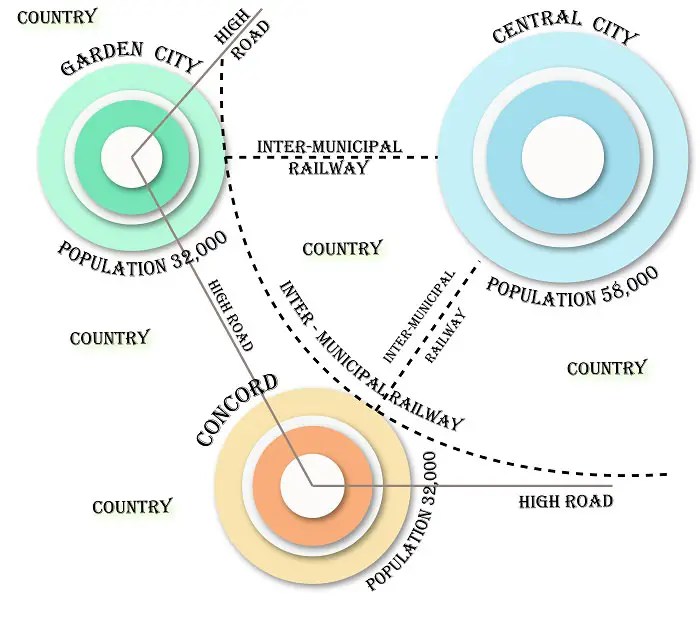
  4. Population Limits: Garden Cities were designed with a cap on population size, typically around 30,000 people. This limit ensured that the city did not become too crowded and maintained a human scale, promoting social cohesion and efficient urban management.
  5. Zoning and Land Use: The Garden City concept introduced the idea of zoning, where different land uses (residential, industrial, and agricultural) were clearly delineated and planned. The goal was to create a harmonious balance between these zones, with easy access and minimal conflict between them.
  6. Public Ownership and Cooperative Management: Howard envisioned the land within a Garden City being owned by the community and managed cooperatively. This public ownership was intended to prevent land speculation and ensure that the economic benefits of the city were shared by all its residents.
  7. Connectivity and Expansion: Garden Cities were to be connected by a network of railways, allowing easy travel between them and facilitating the exchange of goods and services. As each Garden City reached its population limit, new Garden Cities would be established nearby, forming a network of interconnected communities.

Planning Norms for Garden Cities

When translating Howard’s vision into practical urban planning, several key norms and standards are typically considered:

1. Spatial Organization

  • Concentric Layout: The Garden City is often laid out in a concentric pattern, with the central area designated for public buildings, parks, and a town center. Surrounding this core are residential neighborhoods, and beyond them, industrial zones and the agricultural greenbelt.
  • Zoning: Land is categorized into distinct zones—residential, commercial, industrial, and agricultural—with a clear separation between them. This zoning helps to minimize conflicts between different land uses and ensures a balanced urban environment.

2. Density and Population

  • Population Cap: The ideal population size is around 30,000 to 32,000 people, ensuring that the city remains at a manageable scale. Beyond this limit, new Garden Cities would be established rather than expanding the existing one.
  • Housing Density: Low to moderate housing density is preferred, with an emphasis on providing each household with access to open spaces and gardens.

3. Green Spaces and Recreation

  • Greenbelt: A surrounding greenbelt is crucial, typically spanning several thousand acres. This space is reserved for agriculture, parks, and recreational areas, preventing urban sprawl and maintaining the city’s connection to nature.
  • Parks and Open Spaces: Within the city, numerous parks and open spaces are integrated into the urban fabric. These areas serve both aesthetic and functional purposes, providing recreational areas and contributing to the health and well-being of residents.

4. Transportation and Infrastructure

  • Public Transport: A robust public transportation system is essential, ideally with a focus on railways connecting the Garden City to other cities and towns. Internally, the city would have an efficient public transit system that minimizes the need for private cars.
  • Road Network: The road network should be designed to minimize traffic congestion, with a focus on pedestrian-friendly streets and cycling paths. Roads would be hierarchical, with major arteries for through traffic and smaller streets serving residential areas.

5. Economic and Social Infrastructure

  • Local Economy: Each Garden City would have a mix of local industries and services, ensuring that residents have access to jobs, shopping, and other amenities within the city. This reduces the need for long commutes and supports the city’s self-sufficiency.
  • Public Services: High-quality public services, including schools, hospitals, and cultural institutions, are central to the Garden City. These services are ideally distributed throughout the city to ensure easy access for all residents.

6. Environmental Sustainability

  • Renewable Resources: The design of the Garden City encourages the use of renewable resources, both in terms of energy (e.g., solar, wind) and materials for construction and infrastructure.
  • Waste Management: Efficient waste management systems are essential, with a focus on recycling and minimizing environmental impact. This includes sewage treatment, water conservation, and waste recycling programs.

Implementation and Legacy

The first Garden Cities, Letchworth (1903) and Welwyn (1920), were established in the UK based on Howard’s principles, and they became models for future developments worldwide. The Garden City concept has influenced numerous urban planning movements, including the New Towns movement in the UK, the development of satellite towns, and even aspects of the modern-day smart city concept.

While the pure Garden City concept has been challenging to implement on a large scale, its principles have been adapted into various forms, particularly in the design of suburban developments and planned communities. However, one of the ongoing challenges has been maintaining the balance between growth and sustainability, particularly in the face of modern economic and environmental pressures.

In conclusion, the Garden City concept offers a visionary framework for urban development that prioritizes quality of life, environmental sustainability, and social cohesion. While it has evolved over time, its core principles remain relevant as urban planners and communities continue to seek solutions for the challenges of urbanization in the 21st century.