Salient Features of the National Commission on Urbanisation Report (1988)

1. Recognition of Urbanization as an Opportunity

  • Urbanization was seen as an inevitable and positive force for Indiaโ€™s development.
  • Cities were identified as โ€œengines of economic growthโ€ and not just as centers of population pressure.
  • Stressed that urbanization could drive modernization, innovation, and employment.
Photo by Artem Podrez on Pexels.com

2. Spatial Strategy for Urban Development

  • Proposed a spatial reorganization of settlements to reduce over-concentration in large cities.
  • Identified a hierarchy of settlements:
    • National Priority Cities (NPUs): 329 cities strategically important for balanced development.
    • Urban Corridors: Linear clusters of cities along major transport routes (Delhiโ€“Kanpur, Mumbaiโ€“Pune, Chennaiโ€“Bangalore, etc.).
    • Emerging Growth Centers: Smaller towns to act as regional hubs to check excessive migration to metros.

3. Balanced Urban-Rural Linkages

  • Emphasized strengthening urbanโ€“rural linkages by promoting market towns and service centers.
  • Advocated for Integrated Regional Planning, treating rural and urban as complementary rather than separate.

4. Focus on Metropolitan Cities

  • Recognized the dominant role of metros like Delhi, Mumbai, Kolkata, and Chennai.
  • Called for planned management of metropolitan regions to tackle congestion, housing shortages, and infrastructure deficits.
  • Stressed regional planning authorities for metro areas.

5. Equity and Inclusivity

  • Highlighted the problems of slums, poverty, and informal sector workers in cities.
  • Urged policies for affordable housing, slum improvement, and social infrastructure.
  • Stressed inclusive urbanization to prevent widening social inequalities.

6. Institutional and Administrative Reforms

  • Recommended strengthening urban local bodies (ULBs).
  • Called for decentralization of governance and greater role of municipalities in planning, finance, and service delivery.
  • Suggested capacity-building programmes for urban administrators.

7. Urban Infrastructure and Finance

  • Identified infrastructure deficit as the biggest urban challenge (housing, water supply, sanitation, transport).
  • Suggested mobilization of municipal finance through:
    • Property tax reforms.
    • User charges for services.
    • Access to capital markets (municipal bonds).
  • Advocated public-private partnerships (PPPs) in infrastructure.

8. Housing and Land Policy

  • Suggested removal of artificial constraints like the Urban Land Ceiling and Regulation Act (ULCRA).
  • Called for land-use planning reforms to ensure adequate land supply for housing.
  • Focus on low-cost housing and upgradation of existing slums rather than eviction.

9. Transport and Mobility

  • Stressed the importance of urban transport systems (mass transit, bus services, non-motorized transport).
  • Recommended integrated transport planning at regional level.

10. Environmental Concerns

  • Highlighted the dangers of unchecked urban expansion on ecology.
  • Stressed protection of water bodies, green spaces, and urban environment.
  • Called for sustainable waste management and pollution control measures.

Significance of the NCU Report

  • First comprehensive national-level urban policy framework.
  • Influenced later programmes: 74th Constitutional Amendment (1992), IDSMT scheme expansion, and eventually JNNURM (2005).
  • Shifted thinking from seeing urbanization as a problem to recognizing it as a driver of growth.

โœ… In summary:
The NCU Report emphasized balanced spatial development, strengthening smaller towns, empowering urban local bodies, inclusive housing policies, and sustainable infrastructure financing. It remains one of the most important reference points for Indiaโ€™s urban policy.

Census Definition of Urban Places in India & Functional Classification of Urban Centres

Urban settlements in India are officially classified by the Census of India using population size, density, and occupational structure. Beyond this, concepts like metropolis, megalopolis, and functional classification are used in urban studies.

Photo by Laurens den Besten on Pexels.com

1. Census Definition of Urban Places (India)

According to the Census of India, an area is classified as urban if it meets the following:

  • Statutory Towns:
    All places with a municipality, corporation, cantonment board, or notified town area committee, irrespective of size.
  • Census Towns:
    Places fulfilling all three conditions:
    1. Population of at least 5,000
    2. 75% of male working population engaged in non-agricultural pursuits
    3. Population density of at least 400 persons per sq. km

2. Categories of Urban Places (Census & Urban Studies)

(a) Town

  • Smallest statutory or census urban unit.
  • Population range: 5,000 โ€“ 1,00,000 (approx.).

(b) City

  • Larger than a town.
  • Population of 1,00,000 and above.

(c) Town Groups / Urban Agglomeration (UA)

  • A continuous urban spread consisting of:
    • A statutory town and its adjoining outgrowths (OGs), or
    • Two or more physically contiguous towns, with or without outgrowths.
  • Example: Greater Mumbai UA, Delhi UA, Kolkata UA.

(d) Standard Urban Area (SUA) (introduced in Census 1971, later dropped)

  • Meant to represent the functional region of a city.
  • Composed of a core city + surrounding urban and rural areas linked to it socio-economically.

(e) Metropolis

  • Urban settlement with a population over 1 million (10 lakh).
  • Examples: Ahmedabad, Hyderabad, Pune, Lucknow.

(f) Mega City

  • As per Census of India: Cities with population over 10 million (1 crore).
  • Examples: Mumbai, Delhi, Kolkata, Bangalore, Chennai.

(g) Megalopolis (concept from Jean Gottmann, 1961)

  • A huge urban region formed by the merging of several metropolitan areas into a continuous urban corridor.
  • Example (India): Delhiโ€“Meerutโ€“Ghaziabadโ€“Faridabadโ€“Gurgaon urban belt (NCR); also Mumbaiโ€“Pune corridor.

3. Functional Classification of Urban Places

Urban settlements are not only defined by size but also by their functions. Functional classification groups cities based on their dominant economic and social roles.

Major Functional Categories:

  1. Administrative Towns
    • Perform political/administrative functions.
    • Examples: New Delhi (national capital), Gandhinagar, Chandigarh, Bhubaneswar.
  2. Industrial Towns
    • Dominated by manufacturing and industries.
    • Examples: Jamshedpur (steel), Bhilai, Durgapur, Rourkela, Kanpur (textiles).
  3. Commercial Towns
    • Specialize in trade, markets, banking, transport.
    • Examples: Mumbai (finance, trade), Ahmedabad, Kolkata.
  4. Transport Towns
    • Grow at nodal points of rail, road, air, or waterways.
    • Examples: Itarsi, Katni (rail junctions), Kandla (port), Nagpur (roadโ€“rail hub).
  5. Cultural/Religious Towns
    • Centers of pilgrimage, heritage, or cultural activity.
    • Examples: Varanasi, Haridwar, Tirupati, Amritsar.
  6. Educational Towns
    • Developed around universities and academic institutions.
    • Examples: Varanasi (BHU), Aligarh (AMU), Pune, Kota.
  7. Mining Towns
    • Developed near mineral resource sites.
    • Examples: Dhanbad (coal), Singrauli, Jharia.
  8. Tourist Towns
    • Rely on tourism as the main economic activity.
    • Examples: Agra (Taj Mahal), Jaipur, Udaipur, Shimla, Goa.
  9. Multi-functional Metropolitan Cities
    • Large urban centres with mixed functions: administrative, commercial, industrial, cultural.
    • Examples: Mumbai, Delhi, Bangalore, Chennai, Kolkata.

4. Conclusion

The Census of India provides a statistical and legal definition of urban places, ranging from towns to megacities, while urban geographers extend the concept to megalopolises and functional types. Together, these classifications help us understand the size, spread, and role of urban settlements in Indiaโ€™s socio-economic system.

Urban Centres, Ruralโ€“Urban Continuum, and Dichotomy

1. Definition of Urban Centres

Photo by Ana Hidalgo Burgos on Pexels.com

An urban centre is a human settlement that has distinct characteristics compared to rural settlements, primarily in terms of population size, density, occupational structure, infrastructure, and functions.

  • In India, the Census of India defines an urban area based on two criteria:
    1. Statutory towns: All places with a municipality, corporation, cantonment board, or notified town area committee.
    2. Census towns: Places that satisfy the following conditions:
      • Minimum population of 5,000
      • At least 75% of male working population engaged in non-agricultural activities
      • Population density of at least 400 persons per sq. km

Thus, urban centres are places that act as nodes of administration, trade, industry, commerce, and services, and often serve as focal points for surrounding rural areas.


2. Concept of Ruralโ€“Urban Continuum

The ruralโ€“urban continuum suggests that rural and urban areas are not strictly separate categories but exist along a spectrum, with many intermediate forms of settlement in between.

  • Continuum implies:
    • A gradual transition from purely rural villages โ†’ semi-rural/small towns โ†’ medium towns โ†’ metropolitan cities.
    • Settlements share overlapping characteristics rather than being sharply distinct.
  • Examples in India:
    • Urban villages on the periphery of Delhi, Gurgaon, or Bangalore where traditional agrarian life coexists with urban services and real estate development.
    • Small market towns that act as service centers for surrounding rural populations.
  • Implication:
    The continuum reflects functional interdependence:
    • Rural areas supply food, raw materials, and labor.
    • Urban areas provide markets, education, healthcare, jobs, and modern amenities.

3. Concept of Ruralโ€“Urban Dichotomy

The ruralโ€“urban dichotomy is the traditional view that rural and urban settlements are fundamentally different and separate in terms of structure, function, and way of life.

  • Rural areas:
    • Agriculture-based economy
    • Low population density
    • Close-knit social relations, traditional lifestyles
    • Limited infrastructure and services
  • Urban areas:
    • Industry, trade, services-based economy
    • High population density
    • Individualistic lifestyles, cosmopolitan culture
    • Advanced infrastructure and services (transport, education, healthcare, housing)
  • Dichotomy Perspective:
    This view assumes a sharp boundary between rural and urban societies, often highlighting contrasts in occupation, social structure, values, and governance.

4. Ruralโ€“Urban Continuum vs. Dichotomy

AspectRuralโ€“Urban DichotomyRuralโ€“Urban Continuum
Nature of distinctionSharp, clear separation between rural and urbanGradual transition, blurred boundaries
Settlement typesOnly rural or urbanIntermediate forms: urban villages, peri-urban towns
FunctionsRural = agriculture; Urban = industry, servicesOverlap of functions (e.g., villages with IT hubs, towns with agriculture markets)
Indian contextTraditional sociological viewMore realistic in todayโ€™s urbanizing India

5. Conclusion

  • Urban centres are hubs of population, economic activity, and services defined by statutory and census criteria.
  • The ruralโ€“urban dichotomy represents a simplistic division, useful for classification but less accurate in practice.
  • The ruralโ€“urban continuum better reflects the reality of Indiaโ€™s settlement pattern, where villages, towns, and cities are interconnected and often share mixed characteristics.

Urbanization in India: A Brief History

Urbanization in India is a long and complex process shaped by geography, culture, politics, and economics. It reflects the evolution of Indian society from ancient times to the modern era. Unlike many other parts of the world, Indiaโ€™s urban tradition is among the oldest, yet it has also faced unique challenges of population growth, colonial legacy, and rapid post-independence transformations.

Photo by Navneet Shanu on Pexels.com

1. Ancient Urbanization (c. 2500 BCE โ€“ 600 BCE)

  • Indus Valley Civilization (Harappa and Mohenjo-Daro):
    The earliest evidence of urbanization in India dates back to the Indus Valley Civilization (2500โ€“1500 BCE). Cities like Harappa, Mohenjo-Daro, Dholavira, and Lothal were highly organized with grid-planned streets, advanced drainage systems, public baths, warehouses, and marketplaces. These features illustrate a sophisticated urban culture that emphasized trade, administration, and community life.
  • Decline:
    Around 1500 BCE, these urban centers declined due to ecological changes, river shifts, and external pressures. The following period saw the growth of rural and agrarian settlements with limited urban activity.

2. Early Historic Period (600 BCE โ€“ 600 CE)

  • Second Urbanization (600 BCE onwards):
    Around the 6th century BCE, urban centers re-emerged, largely due to agricultural surplus, trade, and the rise of states (Mahajanapadas). Cities like Pataliputra, Varanasi, Ujjain, Taxila, and Rajgir flourished as centers of administration, trade, and learning.
  • Mauryan and Gupta Periods:
    Under the Mauryan Empire (4thโ€“2nd century BCE), Pataliputra became one of the worldโ€™s largest cities. The Gupta period (4thโ€“6th century CE) saw prosperity and cultural development in cities such as Ujjain and Nalanda, which also became hubs of education and Buddhism.

3. Medieval Urbanization (7th โ€“ 16th Century CE)

  • Rise of Temple and Trade Towns:
    With the growth of kingdoms in South India (Chola, Pandya, Vijayanagara), temple towns such as Madurai, Thanjavur, and Kanchipuram became urban centers. Trade with Southeast Asia also expanded urban development in port cities like Calicut, Surat, and Masulipatnam.
  • Delhi Sultanate and Mughal Period:
    Northern India saw significant urban expansion under the Delhi Sultanate (13thโ€“15th century CE) and later the Mughal Empire (16thโ€“18th century CE). Cities such as Delhi, Agra, Fatehpur Sikri, Lahore, and Shahjahanabad (Old Delhi) grew as centers of governance, culture, and economy. Mughal cities often had planned bazaars, gardens, mosques, and fortifications.

4. Colonial Urbanization (18th โ€“ mid-20th Century)

  • British East India Company & Colonial Rule:
    Colonialism reshaped Indiaโ€™s urban landscape drastically. The British developed three Presidency townsโ€”Bombay (Mumbai), Calcutta (Kolkata), and Madras (Chennai)โ€”as administrative, military, and trading hubs.
  • Industrial and Port Cities:
    Industrialization, especially textile mills in Bombay and jute mills in Calcutta, spurred migration and rapid urban growth. Port cities expanded due to international trade.
  • Dual Urbanism:
    Colonial towns often had a โ€œWhite Townโ€ (European quarters with planned housing and infrastructure) and a โ€œBlack Townโ€ (densely populated Indian settlements with poor amenities).
  • Railways and Urban Expansion:
    The introduction of railways in the mid-19th century further connected and stimulated the growth of towns such as Kanpur, Nagpur, Lucknow, and Pune.

5. Post-Independence Urbanization (1947 โ€“ 1991)

  • Planned Cities:
    After independence, India focused on planned urban development. Cities like Chandigarh, Bhubaneswar, and Gandhinagar were designed as administrative capitals.
  • Industrial Townships:
    Industrial development led to the growth of cities like Bhilai, Rourkela, Durgapur, and Bokaro, which were built around steel plants and public sector industries.
  • Urban Migration:
    Large-scale rural-to-urban migration occurred due to employment opportunities, leading to rapid expansion of metropolitan centers such as Delhi, Mumbai, Bangalore, and Hyderabad. However, this also resulted in slums and housing shortages.

6. Liberalization and Contemporary Urbanization (1991 โ€“ Present)

  • Economic Reforms of 1991:
    Liberalization and globalization transformed Indian cities. Information Technology (IT) hubs like Bangalore, Hyderabad, Pune, and Gurgaon emerged as global economic centers.
  • Mega-Cities and Urban Sprawl:
    Cities such as Mumbai, Delhi, Kolkata, and Chennai grew into megacities, with populations exceeding 10 million. Urban sprawl extended into suburban regions.
  • Smart Cities Mission and Infrastructure:
    In recent years, government initiatives like the Smart Cities Mission, AMRUT, and Metro Rail Projects have attempted to modernize urban infrastructure and improve governance.
  • Challenges:
    Despite growth, Indian cities face problems like congestion, air pollution, informal housing (slums), inadequate public transport, and inequalities in access to services.

7. Conclusion

The history of urbanization in India reflects a continuous interaction between tradition and modernity, local needs and global forces, and rural-urban linkages. From the well-planned cities of Harappa to todayโ€™s sprawling metropolises, Indian urbanization has always been diverse and dynamic. However, the future of Indian cities will depend on how effectively issues of sustainability, inclusivity, and infrastructure are addressed in the coming decades.

Cohort Survival Model

The Cohort Survival Model (also called the Cohort-Component Method) is the most widely used method for population projections. It projects the future size and composition of a population by following age-sex groups (cohorts) through time and applying assumptions about fertility, mortality, and migration.

Photo by Amina Bawa on Pexels.com

Steps in the Cohort Survival Model

  1. Divide the population by age and sex (e.g., 0โ€“4, 5โ€“9, 10โ€“14, โ€ฆ).
  2. Apply survival ratios (Sx) to each cohort, based on mortality rates (from life tables), to estimate how many survive to the next age group.
    • Example: If 100,000 children aged 0โ€“4 have a survival ratio of 0.95, then 95,000 will survive to the 5โ€“9 group.
  3. Add new births by applying age-specific fertility rates (ASFRs) to women of reproductive ages (15โ€“49). These births form the new 0โ€“4 age cohort.
  4. Adjust for migration (in-migration and out-migration) if applicable.
  5. Repeat the process for each projection interval (usually 5 or 10 years).

Example (Simplified)

  • Population in 2011: 1,00,000 children in age group 0โ€“4.
  • Survival ratio from 0โ€“4 โ†’ 5โ€“9 = 0.95.
  • Projected survivors in 2016 (age 5โ€“9) = 95,000.

Inter-Regional Cohort Survival Model

Definition

The Inter-Regional Cohort Survival Model is an extension of the cohort survival model that incorporates migration between regions. Instead of treating the population as a whole, it simultaneously projects multiple regions and distributes people across them according to migration flows.


Steps in Inter-Regional Model

  1. Divide the population by age, sex, and region (e.g., Region A, Region B, Region C).
  2. Apply survival ratios (mortality) within each region.
  3. Estimate migration flows between regions using a migration matrix:
    • Shows how many people of each age/sex group move from one region to another.
    • Example: 5% of 20โ€“24-year-olds in Region A migrate to Region B in the next 5 years.
  4. Add fertility contributions (births) in each region, based on the number of women and regional fertility rates.
  5. Sum up to obtain future age-sex-region-specific population.

Uses

  • Cohort Survival Model: National population projections (fertility, mortality, migration considered as aggregates).
  • Inter-Regional Model: Regional/urban planning, migration studies, distribution of schools, hospitals, housing, transport needs.

Key Difference

FeatureCohort Survival ModelInter-Regional Cohort Survival Model
ScopeEntire population (national level)Multiple regions simultaneously
Migration TreatmentNet migration added/subtractedExplicit inter-regional flows (originโ€“destination matrix)
UsefulnessNational projectionsRegional/urban planning, migration analysis

Conclusion

  • The Cohort Survival Model is the foundation of demographic projection, focusing on fertility, mortality, and net migration.
  • The Inter-Regional Cohort Survival Model refines this by including detailed migration between regions, making it essential for regional planning and policy.

Population Estimation, Projection, and Forecasting

Population studies require methods to understand not only the present size and structure of a population but also its future trends. Three important concepts are estimation, projection, and forecasting. Though often used interchangeably, they differ in purpose, time frame, and assumptions.


Photo by Pavel Danilyuk on Pexels.com

1. Population Estimation

  • Definition: Measurement of the present population size and structure when actual census data are not available.
  • Purpose: Provides figures for the current time (between censuses).
  • Techniques:
    • Mathematical methods (e.g., arithmetic, geometric, exponential growth).
    • Administrative records (voter lists, birth and death registrations, school enrollments).
    • Sample surveys (household surveys for fertility, mortality, migration).
  • Example: Estimating Indiaโ€™s population in 2024 based on the 2011 Census plus registered births, deaths, and migration data.

2. Population Projection

  • Definition: A numerical picture of future population under clearly stated assumptions (about fertility, mortality, migration).
  • Purpose: Not a prediction, but a โ€œwhat ifโ€ scenario based on specified conditions.
  • Techniques:
    • Cohort-Component Method (most common): Projects age-sex groups separately by applying survival rates, fertility rates, and migration.
    • Mathematical Methods:
      • Arithmetic progression (constant increase).
      • Geometric progression (constant percentage growth).
      • Exponential growth models.
    • Stable Population Models: Assume constant fertility and mortality over time.
  • Example: UN World Population Prospects projections for 2050 (based on medium fertility assumptions).

3. Population Forecasting

  • Definition: A prediction of the most likely future population based on past trends, present data, and expert judgment.
  • Difference from Projection: While a projection shows possible outcomes under assumptions, a forecast attempts to give the most probable outcome.
  • Techniques:
    • Uses projections as a base, but incorporates expert opinion, policies, and uncertainties.
    • Involves judgmental adjustments (e.g., considering possible pandemics, wars, migration crises).
  • Example: A government forecasting the likely population in 2036 to plan schools, hospitals, and jobs.

Key Differences

AspectEstimationProjectionForecasting
Time framePresent (between censuses)Future (scenarios)Future (most likely)
BasisExisting data (surveys, registers)Assumptions of fertility, mortality, migrationProjections + expert judgment
PurposeFill gaps in current dataShow possible population outcomesPredict actual future size
CertaintyShort-term, relatively reliableHypothetical, conditionalProbabilistic, judgment-based

Conclusion

  • Estimation helps us know the present.
  • Projection provides possible futures under given assumptions.
  • Forecasting predicts the most probable future outcome.

Together, they form the backbone of population policy, planning, and resource allocation in areas such as health care, education, housing, food supply, and employment.

Migration: Reasons and Types of Trends

Migration refers to the movement of people from one place to another, either within a country or across borders, for temporary or permanent settlement. It is one of the most significant demographic processes that shapes societies and economies worldwide. Migration is influenced by multiple factors and takes various forms depending on direction, duration, and purpose.

Photo by Abd Alrhman Al Darra on Pexels.com

Reasons for Migration

Migration occurs due to a combination of push factors (conditions that drive people away) and pull factors (attractions of the destination).

1. Economic Reasons

  • Search for employment and higher wages
  • Better business opportunities
  • Poverty and lack of livelihood in rural or underdeveloped areas

2. Social Reasons

  • Access to better education and healthcare
  • Family reunification and marriage
  • Desire for improved quality of life

3. Political Reasons

  • Escape from wars, political instability, or persecution
  • Government resettlement programs or immigration policies
  • Civil unrest and ethnic conflicts

4. Environmental Reasons

  • Natural disasters like floods, earthquakes, and droughts
  • Climate change (rising sea levels, desertification)
  • Scarcity of water, food, or agricultural land

Types of Migration Trends

Migration is classified based on geography, time, purpose, and status.

1. Based on Geography

  • Internal Migration: Movement within a country
    • Rural-to-Urban: Villagers move to cities for jobs (e.g., rural workers migrating to metropolitan areas).
    • Urban-to-Rural: Movement from cities back to villages (often for retirement or lower living costs).
    • Urban-to-Urban: Between cities for employment or lifestyle.
    • Rural-to-Rural: Movement between agricultural areas, often seasonal.
  • International Migration: Movement across national borders
    • Immigration: Entering a new country for settlement.
    • Emigration: Leaving oneโ€™s own country.
    • Refugees & Asylum Seekers: Forced migration due to conflict, persecution, or disasters.

2. Based on Duration

  • Temporary Migration: Short-term for work, education, or seasonal labor.
  • Permanent Migration: Long-term or lifelong settlement in a new area or country.
  • Circular Migration: Repeated movement between home and destination (common in seasonal labor).

3. Based on Purpose

  • Labor Migration: Seeking jobs, often in construction, agriculture, or services.
  • Educational Migration: Students moving for schools, colleges, or universities.
  • Forced Migration: Displacement due to war, persecution, or disasters.
  • Voluntary Migration: Based on personal choice for better opportunities.

4. Based on Legality

  • Legal Migration: Movement with valid visas, permits, or government approval.
  • Illegal/Irregular Migration: Crossing borders without authorization, overstaying visas, or working without permits.

Conclusion

Migration is driven by economic, social, political, and environmental factors, and it manifests in different types and trends. Understanding these patterns is crucial for planning urban development, managing international relations, and addressing humanitarian challenges. Migration is not only a demographic process but also a reflection of human aspirations for survival, opportunity, and a better life.

Using Regression Analysis to Study the Effect of Awareness and Credit Access on Development Outcomes

In social science and development research, it is not enough to measure awareness levels and access to credit facilities; researchers also need to know how these factors actually influence outcomes such as productivity, income, technology adoption, or livelihood improvement.

To statistically test these relationships, regression analysis is one of the most powerful tools. It helps quantify:

  • Whether awareness and credit access significantly influence development outcomes.
  • The direction of influence (positive/negative).
  • The magnitude of impact (how strongly each factor contributes).

Why Regression Analysis?

Regression analysis allows researchers to:

  1. Establish a relationship between independent variables (predictors: awareness, access to credit) and a dependent variable (outcome: agricultural productivity, income, technology adoption).
  2. Control for other demographic variables (age, education, landholding, income, etc.).
  3. Test hypotheses statistically and generate predictive models.

Types of Regression Suitable for This Study

  1. Simple Linear Regression
    • When testing the impact of one predictor on one outcome.
    • Example: Does credit access alone predict agricultural income?
  2. Multiple Linear Regression
    • When testing the impact of two or more predictors on one outcome.
    • Example: How do awareness and credit access together affect agricultural productivity?
  3. Logistic Regression
    • When the outcome variable is categorical (Yes/No, Adopted/Not Adopted).
    • Example: Does awareness and credit access influence whether a farmer adopts new technology (Adopted = 1, Not Adopted = 0)?

Model Specification

(a) Multiple Linear Regression

If the outcome (Y) is continuous (e.g., income, yield, effectiveness score):


(b) Logistic Regression

Example Application

Suppose you survey 300 respondents and collect:

  • Awareness (Aware = 1, Not aware = 0)
  • Credit Access (Access = 1, No access = 0)
  • Agricultural Productivity (measured as yield in quintals per hectare).

You run a regression model: Productivity=2.1+0.8(Awareness)+1.5(CreditAccess)+0.3(Education)+ฯตProductivity = 2.1 + 0.8(Awareness) + 1.5(Credit Access) + 0.3(Education) + \epsilonProductivity=2.1+0.8(Awareness)+1.5(CreditAccess)+0.3(Education)+ฯต

Interpretation:

  • Awareness increases productivity by 0.8 units (holding other factors constant).
  • Credit access increases productivity by 1.5 units.
  • Education adds a smaller positive effect (0.3 units).
  • The Rยฒ value tells you how much of the variation in productivity is explained by the predictors.

Steps for Researchers

  1. Data Preparation
    • Collect awareness, credit access, outcome variables, and control variables.
    • Code categorical variables as dummy variables (0/1).
  2. Check Assumptions (for linear regression)
    • Linearity between predictors and outcome.
    • No multicollinearity between predictors.
    • Homoscedasticity of errors.
  3. Run Regression Analysis (SPSS, R, Stata, or Python).
  4. Interpret Results
    • Look at coefficients (ฮฒ\betaฮฒ), p-values, and Rยฒ.
    • Identify which predictors are statistically significant.

Importance of Regression in Awareness & Credit Studies

  • Provides quantitative evidence of how awareness and credit access shape development outcomes.
  • Helps in policy prioritization โ€“ for example, if awareness has a stronger effect than credit, focus on financial literacy campaigns.
  • Supports predictive modeling โ€“ policymakers can estimate the likely improvement in outcomes if awareness or credit access is expanded.

Limitations

  • Regression shows association, not causation (unless longitudinal/experimental data is used).
  • Sensitive to outliers and data quality issues.
  • Requires careful selection of control variables to avoid omitted variable bias.

Conclusion

Regression analysis is a robust method to test how awareness and credit access influence development outcomes. Whether using linear regression for continuous outcomes or logistic regression for categorical outcomes, this method helps quantify relationships and guide data-driven decisions. For policymakers and researchers, regression insights can shape targeted interventions, ensuring resources are directed where they have the strongest impact on development.

Mughal and British influences of India cities.

Urbanization in India owes much of its modern character to the Mughal and British periods. Both left distinct imprints on the physical layout, architecture, economy, and social fabric of Indian cities, though their approaches and motivations were very different.

Photo by Shantanu Goyal on Pexels.com

1. Mughal Influence on Indian Cities (16thโ€“18th Century)

The Mughals, who ruled a large part of India between the 16th and 18th centuries, were great city-builders. Their urban vision reflected their Persian, Central Asian, and Indian cultural influences.

Key Features:

  • Imperial Capitals:
    • Agra: Established as the Mughal capital by Akbar, it became a center of governance, trade, and culture.
    • Fatehpur Sikri: Built by Akbar in the late 16th century as a planned city with palaces, mosques, gardens, and administrative quarters.
    • Shahjahanabad (Old Delhi): Founded by Shah Jahan in 1648, it was a grand capital with the Red Fort, Jama Masjid, Chandni Chowk (market street), and gardens.
  • City Planning:
    • Use of fortified walls and gateways for defense.
    • Charbagh (four-part gardens) symbolizing Persian influence.
    • Central market squares and bazaars like Chandni Chowk, which encouraged trade and cultural mingling.
    • Emphasis on aesthetics โ€“ symmetry, wide avenues, and monumental architecture.
  • Architecture and Urban Aesthetics:
    • Mughal cities blended Islamic, Persian, and Indian styles.
    • Landmark structures like forts, mosques, caravanserais (rest houses), and stepwells formed the urban landscape.
    • Red sandstone and marble became signature materials.
  • Economic Role:
    • Cities functioned as hubs of craft production, trade, and administration.
    • Delhi, Agra, and Lahore became cosmopolitan centers attracting artisans, traders, scholars, and travelers.

Lasting Impact:

Many Mughal cities like Delhi, Agra, and Lahore remain cultural and architectural icons. Their forts, gardens, and bazaars still shape the identity and heritage of these cities today.


2. British Influence on Indian Cities (18thโ€“20th Century)

The British had very different urban priorities compared to the Mughals. Their cities were driven by administration, military strategy, trade, and segregation between colonizers and locals.

Key Features:

  • Presidency Towns:
    • Calcutta (Kolkata), Bombay (Mumbai), and Madras (Chennai) were the first major British cities, serving as centers of administration, trade, and ports for global commerce.
  • Dual City Pattern:
    • British cities had โ€œWhite Townsโ€ (European quarters with planned roads, bungalows, clubs, and churches) and โ€œBlack Townsโ€ (densely populated Indian settlements with bazaars and narrow lanes).
    • This segregation reflected racial and social hierarchies.
  • City Planning and Architecture:
    • Introduction of grid patterns and planned layouts, especially in military cantonments.
    • Construction of civil lines, railway colonies, and cantonments with orderly streets and open spaces.
    • Use of neo-classical, gothic, and Indo-Saracenic architecture in public buildings like Victoria Memorial (Kolkata), Gateway of India (Mumbai), and High Courts.
  • Transport and Trade:
    • Expansion of railways, ports, and telegraph systems turned cities into commercial hubs.
    • Bombay became a textile hub, Calcutta a jute hub, and Madras a center for trade in cotton and spices.
  • New Capitals and Planned Cities:
    • The British shifted their capital from Calcutta to Delhi in 1911, leading to the creation of New Delhi (designed by Edwin Lutyens and Herbert Baker).
    • New Delhi was characterized by wide boulevards, administrative buildings (Rashtrapati Bhavan, India Gate), and radial planning, contrasting with the organic growth of Shahjahanabad nearby.

Lasting Impact:

  • Indiaโ€™s modern administrative and commercial cities owe much to the British.
  • The railway network stimulated the growth of industrial towns (e.g., Kanpur, Jamshedpur).
  • Colonial architecture and urban layouts continue to dominate central areas of cities like Delhi, Kolkata, Mumbai, and Chennai.

3. Comparison: Mughal vs. British Urban Influence

AspectMughal CitiesBritish Cities
PurposeImperial capitals, cultural centers, trade hubsAdministrative, military, and commercial bases
Planning StyleOrganic + symbolic (forts, gardens, bazaars, religious centers)Segregated, grid-like, functional (civil lines, cantonments, railway towns)
ArchitectureIndo-Islamic, Persian-inspired (Red Fort, Jama Masjid, Taj Mahal)Neo-classical, Gothic, Indo-Saracenic (Victoria Memorial, India Gate, CST Mumbai)
Social FabricCosmopolitan, relatively integrated markets and settlementsSegregated โ€œWhite Townโ€ and โ€œBlack Townโ€ pattern
LegacyCultural heritage, tourism, living bazaarsAdministrative capitals, railways, colonial architecture, planned urban cores

4. Conclusion

Mughal and British urban influences represent two very different urban traditions in India. The Mughals emphasized imperial grandeur, cultural integration, and vibrant bazaars, while the British imposed segregation, order, and administrative functionality. Together, they have left a layered urban fabric in India, where Old Delhi coexists with New Delhi, Mughal Agra with colonial Cantonments, and bazaars with skyscrapers.

Over view of world urbanization

1. Historical Background

Photo by Kelly on Pexels.com
  • Pre-industrial era:
    • Most of the worldโ€™s population lived in rural areas, dependent on agriculture.
    • Only a few cities (Mesopotamia, Egypt, Indus Valley, China, Rome, Athens) acted as administrative, trade, and cultural hubs.
    • Urbanization was slow and limited (by 1800, only ~3% of the worldโ€™s population lived in cities).
  • Industrial Revolution (18thโ€“19th century):
    • Massive shift as factories, industries, and transport systems developed in Europe and North America.
    • Urban population grew rapidly due to ruralโ€“urban migration for jobs.
    • Cities like London, Manchester, New York, and Paris expanded into modern industrial cities.

2. Global Urbanization Trends (20thโ€“21st Century)

  • 1900: Only ~15% of the worldโ€™s population urban.
  • 1950: ~30% (746 million urban dwellers).
  • 2007: For the first time, more people lived in urban areas than rural areas globally.
  • 2020: ~56% of the worldโ€™s population urban (~4.4 billion people).
  • 2050 (Projection by UN): ~68% urban (~6.7 billion people).

3. Regional Patterns

  • Developed Regions (Global North):
    • High urbanization rates (>75%).
    • Urban growth slowed after 1980s due to suburbanization, aging populations, and stabilization.
    • Examples: USA, Canada, Western Europe, Japan.
  • Developing Regions (Global South):
    • Rapid urbanization since mid-20th century.
    • Asia: Largest number of urban dwellers (China, India, Indonesia).
    • Africa: Fastest urban growth rate (expected to double by 2050).
    • Latin America: Highly urbanized (~80%), dominated by mega-cities like Sรฃo Paulo, Mexico City, Buenos Aires.

4. Mega-cities and Urban Hierarchies

  • Megacity: Urban agglomeration with 10 million+ people.
    • 1950: Only 2 megacities (New York, Tokyo).
    • 2023: Over 33 megacities (Delhi, Shanghai, Lagos, Sรฃo Paulo, Cairo, Mexico City).
  • Urban primacy: Many developing countries have one dominant primate city (e.g., Bangkok, Dhaka, Manila).
  • Urban networks: Developed countries emphasize polycentric urban regions (e.g., Rhineโ€“Ruhr in Germany, BosWash corridor in USA).

5. Drivers of World Urbanization

  • Industrialization & economic opportunities (factories, services, IT).
  • Rural distress (poverty, lack of opportunities).
  • Infrastructure & services (education, healthcare, transport).
  • Globalization โ†’ integration of cities into global economic systems.
  • Migration (internal & international) fueling growth of cities.

6. Impacts of Global Urbanization

Positive:

  • Economic growth: Cities as engines of innovation, trade, and employment.
  • Social development: Better access to healthcare, education, cultural exchange.
  • Connectivity: Integration into global economy.

Negative:

  • Urban poverty & slums: ~1 billion people live in slums (UN-Habitat).
  • Environmental degradation: Air pollution, water scarcity, waste.
  • Traffic congestion & inadequate infrastructure.
  • Urban inequality: Rich-poor divide, gentrification.
  • Climate risks: Coastal megacities vulnerable to floods and rising sea levels.

7. Future of World Urbanization

  • Asia & Africa will account for 90% of global urban growth by 2050.
  • India, China, and Nigeria alone will contribute to over one-third of new urban dwellers.
  • Rise of secondary cities and small urban centers, not just megacities.
  • Focus on sustainable cities (SDG-11) โ†’ smart infrastructure, renewable energy, resilient planning.
  • Increasing importance of urban governance and planning to handle migration, inequality, and climate change.

โœ… In summary:
Urbanization has transformed from being rare in 1800 to a global norm in the 21st century. While developed countries show stable, high levels of urbanization, the developing world is undergoing explosive urban growth, bringing both opportunities for development and challenges of sustainability and inclusivity.

Migration, Pushโ€“Pull Factors, and Impacts

1. Push and Pull Factors of Migration

Photo by Rayhan Ahmed on Pexels.com

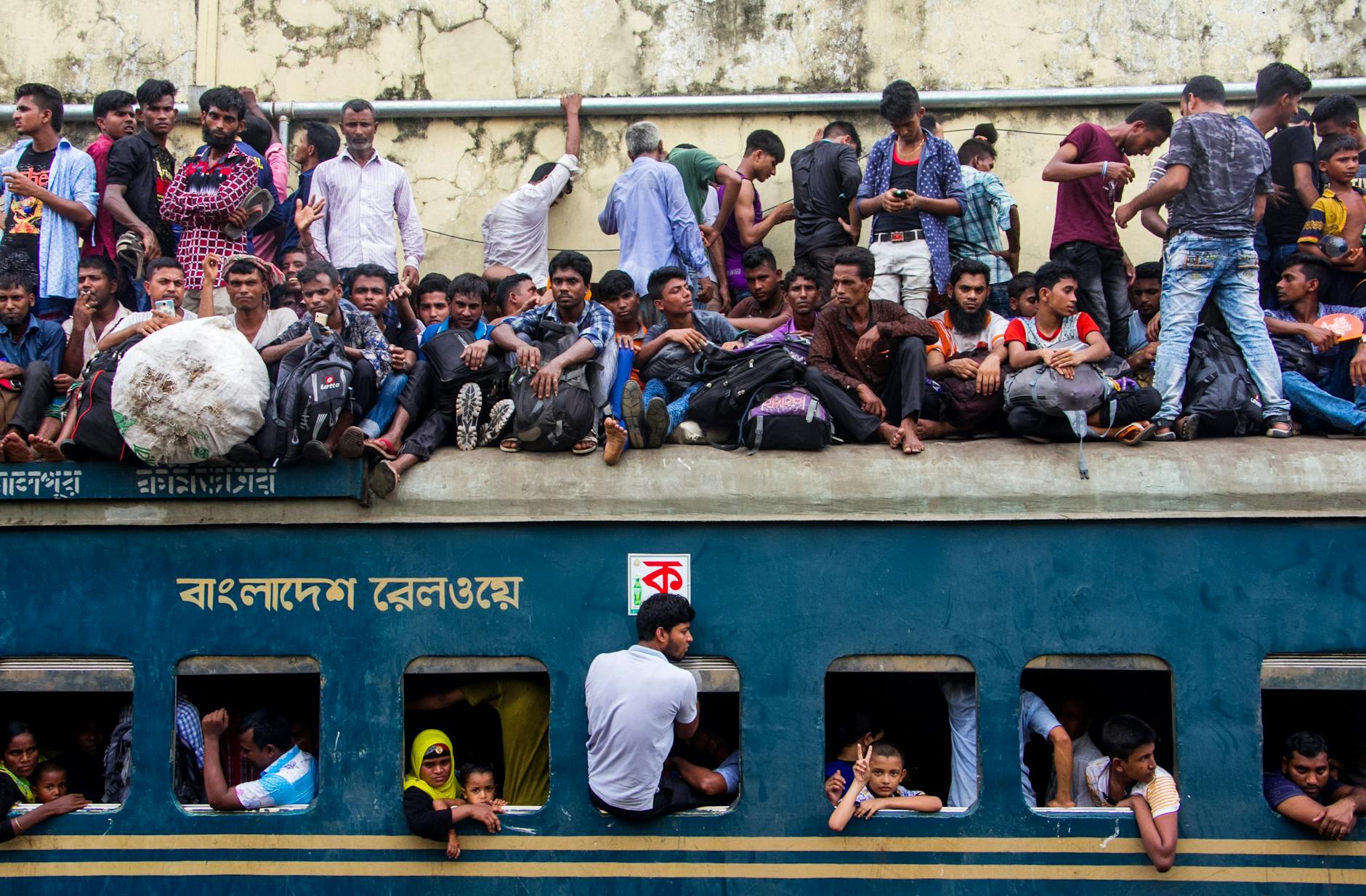
Migration is the movement of people from one place to another, often from rural to urban areas in India. It is driven by a combination of push factors (forces that drive people away from rural areas) and pull factors (attractions of urban areas).

(a) Push Factors (Rural โ€œRepulsionโ€)

  • Agricultural distress: Small landholdings, low productivity, monsoon dependency.
  • Unemployment/underemployment: Lack of non-farm jobs in villages.
  • Poverty and indebtedness: Inability to sustain livelihoods.
  • Environmental stress: Floods, droughts, soil erosion, declining groundwater.
  • Social factors: Caste discrimination, lack of education and healthcare facilities.
  • Conflict/Displacement: Insurgencies, land acquisition for dams, mining, etc.

(b) Pull Factors (Urban โ€œAttractionโ€)

  • Employment opportunities: Industrial jobs, construction, services, IT, transport.
  • Higher wages and better living standards (at least in perception).
  • Educational facilities: Colleges, universities, coaching centers.
  • Healthcare and services: Modern hospitals, access to markets, communication.
  • Social mobility: Escape from traditional caste and community restrictions.
  • Modern amenities and lifestyle: Electricity, transport, entertainment.

2. Migration Trends in India

Based on Census 2011 and NSSO surveys:

  • Magnitude: 37% of Indiaโ€™s population (โ‰ˆ 450 million people) are migrants.
  • Direction: Predominantly rural โ†’ rural (about 55%), followed by rural โ†’ urban (โ‰ˆ 22%), then urban โ†’ urban and urban โ†’ rural.
  • Gender differences:
    • Women migrate mostly due to marriage (โ‰ˆ 70% of female migration).
    • Men migrate mainly for work and employment.
  • State-level trends:
    • Out-migration states: Bihar, Uttar Pradesh, Jharkhand, Odisha, Rajasthan.
    • In-migration states/cities: Delhi, Maharashtra (Mumbai, Pune), Gujarat (Surat, Ahmedabad), Karnataka (Bengaluru).
  • Emerging trend: Increasing inter-state and international migration of skilled workers (IT, healthcare, education).

3. Impacts of Migration

Migration affects both source (rural) regions and destination (urban) areas in complex ways.

(a) Impacts on Urban Development

Positive:

  • Supply of cheap labor for industries, construction, transport, domestic work.
  • Contribution to economic growth and urban dynamism.
  • Cultural diversity, exchange of traditions, cuisines, and ideas.

Negative:

  • Overcrowding of cities โ†’ housing shortages, congestion.
  • Growth of slums and informal settlements (e.g., Dharavi in Mumbai).
  • Pressure on infrastructure: water, sanitation, transport, healthcare.
  • Urban unemployment and informalization of jobs.
  • Social tensions, sometimes conflicts between migrants and locals.

(b) Impacts on Rural Development

Positive:

  • Remittances: Migrants send money back, improving household income, housing, and education.
  • Skill transfer: Return migrants bring new skills, ideas, and technologies.
  • Reduced pressure on land: Out-migration reduces pressure on scarce agricultural land.

Negative:

  • Brain drain: Young and skilled population leaves, aging population remains.
  • Gender imbalance: Male out-migration โ†’ feminization of agriculture (women left behind).
  • Decline in traditional practices: Social cohesion weakens.
  • Dependency on remittances: Can make villages vulnerable to economic shocks.

4. Migration, Urbanization, and Development Nexus

  • Migration is a key driver of urbanization in India.
  • It strengthens the ruralโ€“urban continuum:
    • Villages depend on cities for markets, services, and remittances.
    • Cities depend on villages for labor, food, and raw materials.
  • Balanced regional development policies are needed to reduce distress migration and manage sustainable urban growth.

โœ… In summary:

  • Push factors (poverty, lack of jobs, distress) drive people out of villages.
  • Pull factors (jobs, education, amenities) attract them to cities.
  • Migration brings economic benefits but also creates social, environmental, and infrastructural challenges in both rural and urban areas.

Role of National and State-Level Policies in Urbanization

1. National-Level Policies

The Union Government plays a guiding role by providing vision, funding, and national programmes that direct urbanization trends.

a. Planning and Vision Setting

  • The National Commission on Urbanisation (1986) laid down key principles: strengthen small/medium towns, avoid overburdening metros.
  • National-level missions (e.g., Smart Cities Mission, AMRUT, PMAY, HRIDAY) provide direction and frameworks.
  • The Union frames policies on housing, transport, sanitation, environment, industries, which indirectly shape urbanization.

b. Financial Support

  • National-level schemes provide grants and incentives to states and Urban Local Bodies (ULBs).
  • Example: JNNURM (2005โ€“12) tied funding with urban reforms (property tax, e-governance, ULB empowerment).
  • Finance Commissions allocate tax devolution and grants to ULBs through states.

c. Institutional and Legislative Role

  • 74th Constitutional Amendment (1992): Empowered ULBs, mandated State Finance Commissions, ward committees.
  • National Housing Policy, National Urban Transport Policy (2006), National Habitat Standards set sectoral guidelines.
  • The Centre also facilitates data collection (Census, NSSO, NIUA, MoHUA reports).

d. Addressing Regional Imbalances

  • Central policies encourage growth centers, industrial corridors (e.g., DMIC, Chennai-Bengaluru Corridor), and SEZs to spread urbanization.
  • Promotes urbanโ€“rural linkages via Rurban Mission.

2. State-Level Policies

Urban development is primarily a State subject under the Indian Constitution (though the Centre has a supportive role). States are crucial in implementation and governance.

a. Urban Planning and Land Use

  • States prepare Master Plans, Regional Plans, Town Planning Schemes through Development Authorities and Municipal Corporations.
  • Land acquisition, zoning, building regulations โ†’ managed by state agencies.

b. Policy Formulation

  • Many states have their State Urban Policies/Housing Policies.
    • E.g., Rajasthan Urban Housing & Habitat Policy, Maharashtra Housing Policy, Karnatakaโ€™s Urban Development Policy.
  • States regulate transport, water supply, sanitation, and waste management through line departments and parastatal agencies.

c. Implementation of National Schemes

  • States are responsible for executing centrally-sponsored schemes like AMRUT, Smart Cities, PMAY.
  • Success depends on state capacity, political will, and coordination with ULBs.

d. Empowering ULBs

  • Through State Municipal Acts and amendments after the 74th CAA.
  • State Finance Commissions decide financial devolution to ULBs.
  • States also set up urban development authorities (e.g., DDA in Delhi, MMRDA in Mumbai, BDA in Bengaluru).

e. Local Economic Development

  • States design industrial policies, IT/SEZ policies, and infrastructure initiatives which directly affect urban growth.
  • Example: Gujarat Industrial Policy, Andhra Pradesh IT policy shaping new townships and IT corridors.

3. Challenges in National vs. State Roles

  • Overlap of responsibilities: Multiple agencies (Centre, state, ULBs) โ†’ poor coordination.
  • Financial dependence: States and ULBs often depend on the Centre โ†’ weak autonomy.
  • Uneven capacity: Some states (Maharashtra, Gujarat, Karnataka) perform better, while others lag in urban governance.
  • Policy mismatch: National schemes may not suit local contexts (e.g., Smart Cities design vs. needs of smaller towns).

Summary Table

LevelKey RolesExamples
NationalVision setting, financial support, policy framework, addressing regional imbalanceSmart Cities Mission, AMRUT, PMAY, 74th CAA
StateUrban planning, land use, implementation of schemes, empowering ULBs, local policiesState Housing Policies, Master Plans, Urban Dev. Authorities

โœ… In summary:

  • National policies set the direction, funding, and reforms, ensuring that urbanization supports national goals like balanced development, economic growth, and sustainability.
  • State-level policies translate these into local planning, land use, governance, and service delivery, tailoring urban strategies to regional realities.
  • For successful urbanization, synergy between national vision, state execution, and ULB empowerment is essential.