Historical Cities and Their Planning and Principles

Human civilization has always been closely associated with cities. Cities are not just physical spaces; they are reflections of culture, economy, technology, governance, and values of the societies that created them. The study of historical cities is essential in understanding how urban forms evolved, what principles guided their planning, and how those principles can still inform modern planning practice.

Photo by H. Emre on Pexels.com

1. Introduction to Historical Cities

Historical cities are settlements that emerged in ancient or medieval times, often as centers of administration, trade, culture, or religion. Their planning reflects both functional needs (defense, commerce, water supply) and symbolic meanings (religion, cosmology, social hierarchy). From the Indus Valley cities of Harappa and Mohenjo-Daro to medieval European towns, Islamic cities, and ancient Chinese capitals, each provides insights into planning traditions.


2. Key Historical Examples and Principles

a) Indus Valley Civilization (Harappa and Mohenjo-Daro, c. 2500 BCE)

  • Grid Iron Pattern: Streets were laid out in a north-south, east-west orientation.
  • Standardized Housing: Uniformity in residential blocks, with variation only in size.
  • Water Management: Advanced drainage systems, wells, and bathing areas.
  • Public Spaces: Granaries, citadels, and assembly halls served as community hubs.

Principle: Order, hygiene, and functionality.


b) Ancient Egyptian Cities

  • Oriented along the Nile River, which provided water and transport.
  • Temples and pyramids dominated the urban landscape, symbolizing religion and power.
  • Settlements developed near fertile floodplains, with planned layouts for workersโ€™ villages (e.g., Deir el-Medina).

Principle: Religious centrality and alignment with natural geography.


c) Greek Cities (Athens, Miletus, c. 5th century BCE)

  • Hippodamian Plan: Introduced by Hippodamus of Miletus, featuring a rectangular grid.
  • Agora: Central public square for markets, politics, and social life.
  • Acropolis: Elevated sacred area with temples.
  • Emphasis on civic life, philosophy, and democracy.

Principle: Balance of civic, sacred, and residential functions.


d) Roman Cities

  • Expanded grid plan with Cardo (north-south) and Decumanus (east-west) as main streets.
  • Forum: Administrative and commercial hub.
  • Infrastructure: Aqueducts, amphitheaters, baths, roads, and fortifications.
  • New towns were often established as military colonies.

Principle: Utility, connectivity, and grandeur.


e) Medieval European Cities

  • Organic Growth: Streets were often winding, adapted to terrain and defense.
  • Central Cathedral and Market Square: Spiritual and economic life revolved around them.
  • Fortifications: City walls and gates provided protection.
  • Guild-based neighborhoods: Craftsmen and traders settled in clusters.

Principle: Defense, community identity, and centrality of religion.


f) Islamic Cities (Baghdad, Cairo, Delhi, c. 8thโ€“16th centuries)

  • Central Mosque and Bazaar (Suq): Spiritual and commercial focus.
  • Citadel or Palace: Political authority emphasized.
  • Narrow, Shaded Streets: Adapted to hot climates.
  • Residential Privacy: Houses oriented inward with courtyards.

Principle: Integration of religion, commerce, and environment.


g) Chinese Cities (Changโ€™an, Beijing)

  • Based on geomancy (Feng Shui) and cardinal orientation.
  • Central Axis: Palaces, administrative centers, and ceremonial spaces aligned on it.
  • Walled cities with gates at cardinal points.
  • Hierarchical zoning: Emperorโ€™s palace at center, then officials, merchants, and workers.

Principle: Cosmic order, hierarchy, and symbolism.


h) Indian Medieval Cities (Varanasi, Jaipur, Shahjahanabad)

  • Varanasi: Organic growth along the Ganges, religious ghats dominating spatial form.
  • Jaipur (1727): Planned on gridiron pattern with wide streets, bazaars, and public squares, influenced by Vastu Shastra.
  • Shahjahanabad (Old Delhi, 17th century): Red Fort, Jama Masjid, Chandni Chowk bazaar at the heart; enclosed by walls and gates.

Principle: Blend of cosmology, commerce, and defense.


3. General Planning Principles of Historical Cities

Across civilizations, certain common principles emerge:

  1. Centrality of Power and Religion โ€“ Palaces, temples, mosques, or cathedrals were focal points.
  2. Geometry and Order โ€“ Grid patterns in Indus Valley, Greek, Roman, and Jaipur cities.
  3. Defense and Security โ€“ Walls, citadels, moats in medieval Europe and Islamic cities.
  4. Adaptation to Climate and Geography โ€“ Courtyards in hot climates, shaded narrow lanes, riverside settlements.
  5. Integration of Public Spaces โ€“ Agoras, forums, bazaars, ghats as centers of community life.
  6. Hierarchy and Zoning โ€“ Clear division of spaces for rulers, priests, merchants, workers.
  7. Infrastructure Focus โ€“ Drainage, water supply, roads, markets, storage facilities.
  8. Symbolism and Identity โ€“ Cities often reflected cosmology, religion, or imperial power.

4. Lessons for Modern Planning

Historical cities remind us that planning must go beyond physical design. They show the importance of:

  • Human-scale design (walkability, community interaction).
  • Integration of culture and identity into urban spaces.
  • Environmental adaptation (use of natural resources sustainably).
  • Resilient infrastructure (water systems, defenses, transport networks).
  • Inclusive public spaces where social, cultural, and economic life thrives.

Conclusion

Historical cities are living archives of human ingenuity, resilience, and cultural expression. Their planning was guided by principles of functionality, symbolism, and adaptability. By studying Harappaโ€™s drainage, Athensโ€™ civic spaces, Romeโ€™s infrastructure, Baghdadโ€™s bazaars, or Jaipurโ€™s grids, modern planners can learn how to design cities that are sustainable, inclusive, and culturally rooted. While times have changed, the underlying planning principles of historical cities remain deeply relevant to the challenges of todayโ€™s urbanization.

Complete Life Table vs. Abridged Life Table

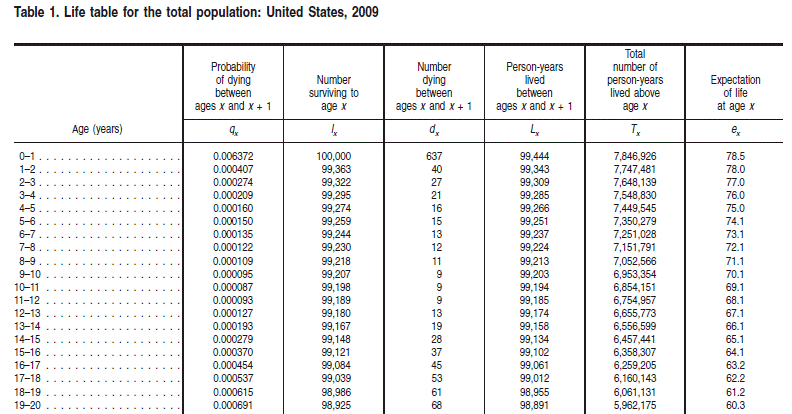
A life table is a demographic tool that provides a systematic description of mortality, survival, and expectation of life at different ages in a population. It is constructed using age-specific mortality rates and helps to estimate measures like life expectancy, survival probabilities, and death probabilities at each age or age interval. There are two main types: Complete Life Table and Abridged Life Table.


1. Complete Life Table

  • Definition: A complete life table shows mortality and survival data for every single year of age, starting from birth (age 0) up to the maximum attainable age (often 100+).
  • Structure: It has entries for each exact age (0, 1, 2, 3 โ€ฆ up to the last age group).
  • Detail level: Provides fine-grained detail about the probability of death (qโ‚“), number surviving (lโ‚“), and life expectancy (eโ‚“) at each exact age.
  • Advantage: Useful for very precise demographic and actuarial calculations such as insurance premiums, pension schemes, and health risk assessments.
  • Limitation: Requires detailed and reliable age-specific mortality data, which may not always be available, especially in developing countries.

Example:
If we construct a complete life table for India and at age 25, the table shows:

  • Out of 100,000 live births (lโ‚€ = 100,000), about lโ‚‚โ‚… = 95,200 survive to exact age 25.
  • The probability of death between ages 25 and 26 (qโ‚‚โ‚…) might be 0.0021 (i.e., 2.1 deaths per 1000).
  • Life expectancy at age 25 (eโ‚‚โ‚…) could be 47.8 years.

2. Abridged Life Table

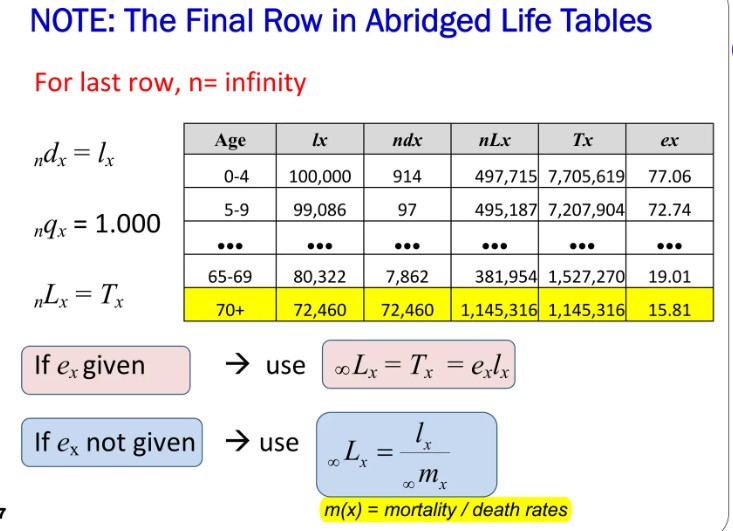
  • Definition: An abridged life table groups ages into wider intervals (commonly 5-year intervals such as 0โ€“4, 5โ€“9, 10โ€“14, etc.) instead of providing values for each single year.
  • Structure: Usually constructed with 5-year or 10-year age intervals, though the first age interval (0โ€“1, 1โ€“4) is often broken into smaller parts due to higher infant mortality.
  • Detail level: Less detailed than a complete life table but easier to construct and interpret.
  • Advantage: Requires less detailed data, can be built with smaller population samples or incomplete mortality data. Suitable for census-based or survey-based population studies.
  • Limitation: Less precise because it averages mortality experience over age intervals.

Example:
In an abridged life table for India:

  • Age group 20โ€“24 may show probability of dying (qโ‚‚โ‚€โ€“โ‚‚โ‚„) as 0.008 (i.e., 8 deaths per 1000 over 5 years).
  • Life expectancy at exact age 20 (eโ‚‚โ‚€) may be estimated as 51.5 years.
  • The table skips intermediate ages (21, 22, 23, 24), treating them as part of the group.

3. Key Differences at a Glance

AspectComplete Life TableAbridged Life Table
Age intervalsSingle year (0, 1, 2, โ€ฆ)Multi-year (often 5-year groups)
DetailVery detailed, preciseLess detailed, approximate
Data requirementNeeds full age-specific mortality dataCan be constructed from limited data
UseActuarial science, insurance, medical researchCensus analysis, demographic surveys, broad planning
Example outputProbability of death at exact age 25Probability of death for 20โ€“24 as a group

Conclusion

  • A complete life table is more precise but data-intensive, best suited for actuarial and insurance purposes.
  • An abridged life table is more practical for countries or studies with limited demographic data, commonly used in population censuses and health surveys.
  • Both are crucial tools in demography, each serving different analytical and policy needs.

Buffer Zones and Their Importance in Protecting Biodiversity

Conservation of biodiversity requires not only protecting core natural habitats but also creating transitional areas where human activities can coexist with ecological balance. One of the most effective tools for this purpose is the establishment of buffer zones. These zones play a crucial role in minimizing human pressures on sensitive ecosystems and ensuring long-term biodiversity conservation.


Definition of Buffer Zones

A buffer zone is a region that surrounds or lies adjacent to a protected area, such as a national park, wildlife sanctuary, or biosphere reserve. It serves as a transitional area between strictly protected core zones and regions of human settlement or intensive land use. Buffer zones allow limited, regulated human activities while simultaneously protecting the integrity of the core habitat.

According to UNESCOโ€™s Man and the Biosphere (MAB) Programme, biosphere reserves consist of three zones:

  1. Core Zone โ€“ Strictly protected natural ecosystem.
  2. Buffer Zone โ€“ Surrounds the core zone, permitting research, education, and limited sustainable use.
  3. Transition Zone โ€“ Outermost area where communities practice sustainable livelihoods.

Thus, the buffer zone acts as a protective shield for the core biodiversity-rich area.


Importance of Buffer Zones in Protecting Biodiversity

  1. Protection Against Human Pressure
    Buffer zones reduce the direct impact of human activities such as agriculture, grazing, logging, or settlement on sensitive ecosystems. By serving as a barrier, they minimize disturbances like noise, pollution, and encroachment into core conservation areas.
  2. Habitat Connectivity and Wildlife Corridors
    Many species require large areas for survival and migration. Buffer zones act as corridors linking fragmented habitats, enabling safe movement of species like elephants, tigers, and migratory birds. This connectivity prevents genetic isolation and supports healthy populations.
  3. Support for Research and Education
    Scientific research, environmental education, and eco-tourism are permitted in buffer zones. This not only enhances public awareness about conservation but also reduces pressures on the strictly protected core zones. For instance, eco-tourism in buffer areas of Kaziranga National Park in Assam helps in both awareness generation and revenue creation.
  4. Sustainable Livelihoods for Communities
    Buffer zones allow local communities to carry out regulated activities such as collection of non-timber forest produce, handicraft-making, organic farming, and eco-tourism. This reduces conflict between conservation authorities and local populations, fostering community participation in biodiversity protection.
  5. Mitigation of Humanโ€“Wildlife Conflicts
    Buffer zones act as โ€œsafety netsโ€ that prevent direct encounters between wildlife and human settlements. By providing regulated grazing lands, water sources, and fodder, they reduce crop raiding and livestock predation by wild animals.
  6. Pollution Control and Environmental Services
    Buffer zones often consist of vegetation that absorbs pollutants, prevents soil erosion, and reduces runoff into rivers and lakes. Wetlands and forested buffer areas play an important role in filtering water and maintaining ecological balance.
  7. Climate Change Adaptation
    Buffer zones enhance ecosystem resilience by allowing species to shift their ranges in response to climate change. They provide additional habitats for species under stress from rising temperatures or changing rainfall patterns.

Examples in India

  • The Nilgiri Biosphere Reserve has buffer zones where sustainable agriculture and eco-tourism are promoted, reducing pressures on core forests.
  • The Sundarbans Biosphere Reserve uses buffer zones to regulate fishing and forest produce collection, thereby protecting mangroves and tigers.

Conclusion

Buffer zones are essential components of modern conservation strategies. They act as protective shields for core biodiversity areas, enable habitat connectivity, provide livelihood opportunities, and reduce humanโ€“wildlife conflicts. By balancing conservation with sustainable development, buffer zones foster harmony between people and nature. In the long run, strengthening buffer zones is vital to ensure the protection of biodiversity, ecological processes, and the well-being of human communities dependent on natural resources.

Role of Biodiversity in Maintaining Soil, Air, and Water Quality

Biodiversity is not only the foundation of ecosystems but also the basis of environmental stability. It plays a critical role in regulating and maintaining the quality of essential natural resourcesโ€”soil, air, and water. Healthy ecosystems depend on the presence of diverse plants, animals, and microorganisms that interact to perform ecological functions. These processes sustain life on Earth and ensure human well-being.


1. Biodiversity and Soil Quality

Soil is the lifeline of agriculture and terrestrial ecosystems. Its fertility and structure depend heavily on biodiversity.

  • Decomposition and Nutrient Cycling: Microorganisms such as bacteria, fungi, and actinomycetes decompose organic matter, converting dead plants and animals into humus. This process releases essential nutrients like nitrogen, phosphorus, and potassium back into the soil, making them available for plant growth.
  • Soil Formation: Lichens and mosses colonize bare rocks and break them down into soil particles, initiating soil formation. Burrowing animals like earthworms and ants further enhance soil aeration and mixing.
  • Soil Fertility: Nitrogen-fixing bacteria (e.g., Rhizobium in legume roots, Azotobacter in the soil) enrich the soil with nitrogen. Mycorrhizal fungi form associations with plant roots, improving nutrient uptake.
  • Erosion Control: Plant roots bind soil particles and reduce erosion by water and wind. Vegetative cover in forests and grasslands prevents land degradation.

Thus, biodiversity sustains soil fertility, structure, and productivity.


2. Biodiversity and Air Quality

Air quality is maintained by the balance of gases in the atmosphere, a process strongly influenced by biodiversity.

  • Photosynthesis and Oxygen Supply: Green plants, algae, and phytoplankton absorb carbon dioxide during photosynthesis and release oxygen, maintaining the oxygenโ€“carbon dioxide balance necessary for life. Forests, often called the โ€œlungs of the Earth,โ€ play a crucial role in regulating air composition.
  • Carbon Sequestration: Forests, grasslands, and marine ecosystems store large amounts of carbon in biomass and soils, reducing greenhouse gases and mitigating climate change.
  • Pollutant Absorption: Plants act as natural filters by trapping dust, smoke, and other airborne particles. Certain species also absorb harmful gases like sulfur dioxide and nitrogen oxides.
  • Odor and Toxin Control: Wetland vegetation and microorganisms can absorb foul-smelling gases and neutralize toxins, improving local air quality.

Without biodiversity, the natural regulation of atmospheric gases and pollutants would collapse, leading to poor air quality and climate imbalance.


3. Biodiversity and Water Quality

Water quality is closely linked to biological processes in aquatic and terrestrial ecosystems.

  • Filtration and Purification: Wetlands, mangroves, and riparian vegetation act as natural water filters. They trap sediments, absorb nutrients, and filter pollutants before they reach rivers, lakes, or groundwater.
  • Decomposition of Organic Waste: Aquatic microorganisms and invertebrates break down organic matter, preventing water bodies from becoming polluted and oxygen-depleted.
  • Nutrient Cycling in Aquatic Systems: Algae, aquatic plants, and microbes recycle nutrients in lakes, rivers, and oceans, maintaining water productivity without excessive nutrient buildup.
  • Flood Regulation: Forests and wetlands absorb rainwater, recharge groundwater, and reduce runoff, preventing siltation and maintaining water clarity.
  • Buffer Against Pollution: Mangroves and estuaries act as buffers by absorbing heavy metals and toxic compounds, thereby protecting coastal water quality.

Through these functions, biodiversity ensures safe and clean water for human use and aquatic life.


Conclusion

Biodiversity is central to the maintenance of soil, air, and water quality. Microorganisms enrich soil and recycle nutrients; plants and forests regulate air composition and absorb pollutants; wetlands, aquatic species, and vegetation purify water and prevent pollution. In short, biodiversity acts as natureโ€™s life-support system, maintaining the very resources essential for survival. Protecting biodiversity is therefore not just about saving speciesโ€”it is about safeguarding the ecological processes that keep soil fertile, air breathable, and water pure for present and future generations.

Importance of Biodiversity in Providing Plant and Animal Food

Biodiversity, or the variety of life on Earth, plays a central role in sustaining human societies. One of its most direct contributions is the provision of food resources, which form the basis of nutrition, health, and livelihoods. From staple crops to fruits, vegetables, livestock, fish, and wild foods, biodiversity ensures both the quantity and quality of human diets. The diversity of plants and animals used for food also provides resilience against environmental stresses, pests, and diseases, making biodiversity indispensable for food security.


1. Plant Biodiversity as a Food Source

Plants form the primary source of human nutrition by supplying carbohydrates, proteins, fats, vitamins, and minerals. Agricultural biodiversity, which includes cultivated crops and their wild relatives, has developed over centuries through domestication and selective breeding.

  • Staple Crops: Cereals like rice, wheat, maize, millet, and barley form the foundation of global food supplies. India, for example, relies heavily on rice and wheat as staples. The genetic diversity within these crops allows for the development of varieties suited to different climates, soils, and resistance to pests.
  • Fruits and Vegetables: A wide variety of fruits such as mango, banana, apple, and citrus, along with vegetables like tomato, brinjal, spinach, and okra, provide essential micronutrients that prevent malnutrition and deficiency diseases.
  • Legumes and Oilseeds: Pulses like lentils, chickpeas, and beans are rich in protein, while oilseeds such as mustard, groundnut, and sunflower provide edible oils.
  • Wild Plants: Many communities, especially indigenous groups, depend on wild edible plants, tubers, and herbs as supplementary food sources. These not only diversify diets but also serve as survival foods during famine or drought.

Thus, plant biodiversity contributes directly to both staple food production and nutritional diversity.


2. Animal Biodiversity as a Food Source

Animals provide protein-rich foods that are critical for human health. Animal biodiversity encompasses domesticated livestock, poultry, aquaculture species, and wild animals that contribute to diets.

  • Livestock and Poultry: Domesticated animals such as cattle, buffalo, goats, sheep, pigs, and poultry supply meat, milk, eggs, and dairy products. India, being one of the largest milk producers, owes this to its rich diversity of cattle and buffalo breeds.
  • Fisheries: Oceans, rivers, and lakes provide fish, which are vital sources of protein and omega-3 fatty acids. In India, fish such as rohu, hilsa, and catla are important components of diets in coastal and riverine communities.
  • Wild Animals and Insects: In many tribal and rural societies, hunting of small wild animals, collection of honey, and even consumption of edible insects form part of traditional diets. This reflects the cultural significance of animal biodiversity in food systems.

3. Biodiversity and Food Security

Biodiversity enhances food security by ensuring a range of options and reducing dependence on a few species. Genetic diversity within crops and livestock allows adaptation to changing climatic conditions, diseases, and pests. For example, drought-resistant rice or pest-resistant maize varieties are developed by utilizing genetic diversity. Similarly, traditional breeds of livestock are often more resilient to local conditions compared to exotic breeds.


4. Cultural and Nutritional Importance

Different communities and regions have food traditions deeply rooted in biodiversity. Traditional diets based on local crops, spices, and livestock not only reflect cultural heritage but also ensure balanced nutrition. For instance, the Mediterranean diet with olives and seafood or Indian cuisine with pulses and spices highlights the role of biodiversity in enriching diets.


Conclusion

Biodiversity is the foundation of the worldโ€™s food systems, providing both plant-based and animal-based nutrition. It ensures food availability, dietary diversity, and resilience against environmental stresses. By conserving crop varieties, livestock breeds, fisheries, and wild species, humanity safeguards its food security and cultural heritage. Protecting biodiversity, therefore, is not only an ecological necessity but also a critical step in ensuring that present and future generations have access to safe, nutritious, and diverse food.

Major Rivers of India

Rivers are the lifelines of India, shaping its geography, culture, and economy. They provide water for agriculture, drinking, hydroelectricity, and industry, while also serving as a basis for ancient civilizations and modern settlements. The river systems of India can be broadly divided into the Himalayan rivers, which are perennial and snow-fed, and the Peninsular rivers, which are mostly rain-fed and seasonal. Below is a brief account of the major rivers of India.

1. The Ganga River

The Ganga is Indiaโ€™s most sacred and important river. Originating from the Gangotri Glacier in Uttarakhand as the Bhagirathi, it is joined by the Alaknanda at Devprayag to form the Ganga. Flowing southeast across the plains of Uttar Pradesh, Bihar, and West Bengal, it empties into the Bay of Bengal, forming the worldโ€™s largest delta, the Sundarbans. Its major tributaries include the Yamuna, Ghaghara, Gandak, Kosi, and Son. The Ganga basin is one of the most fertile regions in the world, supporting dense population and agriculture, especially rice, wheat, and sugarcane.

2. The Yamuna River

The Yamuna, a major tributary of the Ganga, originates from the Yamunotri Glacier in Uttarakhand. Flowing through Himachal Pradesh, Haryana, and Delhi, it merges with the Ganga at Prayagraj (Allahabad). The cities of Delhi, Agra, and Mathura lie on its banks. Despite pollution challenges, the Yamuna is vital for irrigation and drinking water supply in northern India.

3. The Brahmaputra River

The Brahmaputra originates as the Yarlung Tsangpo in Tibet, enters India through Arunachal Pradesh, and flows across Assam before entering Bangladesh, where it merges with the Ganga. It is known for its vast width, frequent floods, and huge water discharge. Its fertile floodplains support rice, tea, and jute cultivation. The river is also rich in hydropower potential and is central to the culture and economy of Northeast India.

4. The Indus River

The Indus, originating in Tibet near Lake Mansarovar, flows through Ladakh, Gilgit-Baltistan, and into Pakistan, where it empties into the Arabian Sea. Historically significant as the cradle of the Indus Valley Civilization, it is a transboundary river governed by the Indus Water Treaty between India and Pakistan. Major tributaries within India include the Jhelum, Chenab, Ravi, Beas, and Sutlej, which sustain agriculture in Punjab and Haryana.

5. The Godavari River

The Godavari, often called the “Dakshina Ganga” or Ganga of the South, is the longest river of Peninsular India. Originating in Maharashtra, it flows eastward across Telangana and Andhra Pradesh before draining into the Bay of Bengal. Its fertile basin supports crops like rice, pulses, and cotton. Important tributaries include the Manjira, Penganga, and Indravati.

6. The Krishna River

The Krishna originates in the Western Ghats of Maharashtra and flows through Karnataka and Andhra Pradesh into the Bay of Bengal. Major tributaries include the Bhima, Tungabhadra, and Ghataprabha. It is crucial for irrigation projects like Nagarjuna Sagar and Krishna Delta irrigation systems.

7. The Narmada and Tapti Rivers

The Narmada and Tapti are west-flowing rivers that drain into the Arabian Sea. The Narmada originates from Amarkantak Plateau in Madhya Pradesh, while the Tapti rises in Satpura ranges. Their valleys separate the Vindhya and Satpura ranges. The Narmada is especially famous for projects like the Sardar Sarovar Dam and fertile black soil tracts.

8. The Mahanadi River

Originating in Chhattisgarh, the Mahanadi flows through Odisha into the Bay of Bengal. Known for Hirakud Dam, one of the longest dams in the world, it irrigates vast rice-growing regions.

9. The Kaveri River

The Kaveri originates in Karnatakaโ€™s Western Ghats and flows through Tamil Nadu before draining into the Bay of Bengal. Known as the “Ganga of the South,” it supports agriculture, especially paddy and sugarcane, and is central to interstate water disputes.


Conclusion

Indiaโ€™s major rivers are not just geographical features but cultural and economic lifelines. The Himalayan rivers like the Ganga, Yamuna, Indus, and Brahmaputra provide perennial water supply, while the Peninsular rivers like Godavari, Krishna, Narmada, and Kaveri sustain agriculture and power generation. Together, they form the backbone of Indiaโ€™s civilization, economy, and ecology. Sustainable management of these rivers is vital for ensuring water security, environmental balance, and continued prosperity.

Tutorial on One-point perspective of simple objects, Table andย  chair, different structures, rooms.

๐ŸŽฏ Tutorial: One-Point Perspective Drawing

โœจ Basic Idea

  • Horizon line (HL): Eye level of the viewer.
  • Vanishing point (VP): A single point on the horizon line where all receding lines converge.
  • Front face: Drawn in true shape.
  • Depth: Achieved by receding lines going to the VP.

1๏ธโƒฃ Step 1: Cube / Simple Object

  1. Draw the horizon line and mark the vanishing point (VP).
  2. Sketch a front square/rectangle below or above the horizon line.
  3. From each corner, draw light receding lines to the VP.
  4. Decide the depth โ†’ cut off with a vertical/horizontal line.
  5. Darken visible edges.

๐Ÿ‘‰ Now you have a cube in one-point perspective.


2๏ธโƒฃ Step 2: Table in One-Point Perspective

  1. Start with a rectangle (top face) for the tabletop.
  2. Draw receding lines from its corners to the VP.
  3. Add back edges by closing off at desired depth.
  4. Draw the legs:
    • Vertical lines at corners of the tabletop.
    • Project the bottoms backward to VP.
  5. Erase construction lines and highlight edges.

๐Ÿ‘‰ Table appears realistic with depth.


3๏ธโƒฃ Step 3: Chair in One-Point Perspective

  1. Begin with the seat (rectangle) as the front face.
  2. Recede the back edge toward the VP โ†’ complete the seat plane.
  3. Add legs (verticals at corners) โ†’ project depth via VP.
  4. Draw the backrest:
    • Vertical rectangle rising from rear seat edge.
    • Top receding edges go to VP.
  5. Add thickness (front & side supports).

๐Ÿ‘‰ Chair looks solid and proportionate.


4๏ธโƒฃ Step 4: Simple Structures (House / Building)

  1. Draw a rectangle/square front face (the buildingโ€™s faรงade).
  2. Extend sides to VP for walls.
  3. Add roof:
    • Mark mid-point of top edge.
    • Project to VP for depth.
    • Add sloping lines for pitched roof.
  4. Doors and windows:
    • Draw front rectangles.
    • Recede tops/bottoms to VP.

๐Ÿ‘‰ Creates a realistic building in perspective.


5๏ธโƒฃ Step 5: Interior Space (Room)

  1. Draw a rectangle (back wall) inside your paper.
  2. Mark VP at the center of horizon line.
  3. Extend diagonals from corners of rectangle to VP โ†’ creates walls, ceiling, and floor.
  4. Add objects (tables, beds, windows):
    • Front face in correct proportion.
    • Depth lines recede to VP.
    • Vertical/horizontal edges stay straight.

๐Ÿ‘‰ Room appears 3D, with all furniture aligned to perspective.


6๏ธโƒฃ Tips for Accuracy

  • Always keep verticals upright and horizontals straight (except depth lines โ†’ they must go to VP).
  • Start with light construction lines.
  • Use proportional scaling (objects shrink as they approach VP).
  • Practice with grids โ†’ helps maintain proportions of interiors.

โœ… In summary:

  • Cube โ†’ Table โ†’ Chair โ†’ Building โ†’ Room.
  • Same method: front face true โ†’ receding lines to VP โ†’ depth cut-off โ†’ details added.
  • One-point perspective is best for frontal views like corridors, streets, rooms, and furniture seen head-on.

Geometric projections: Orthographic, isometric and perspectiveย  projections of one, two- and three-dimensional objects.

๐Ÿ“ Geometric Projections

Projection is a method of representing a three-dimensional object on a two-dimensional drawing surface (paper, screen) using straight lines drawn from the object to an imaginary plane.

The three main types of projections used in architecture, planning, and engineering are:

  1. Orthographic Projection
  2. Isometric Projection
  3. Perspective Projection

1๏ธโƒฃ Orthographic Projection

  • Definition: A method of representing objects by projecting perpendicular lines (orthogonal) from the object to the projection plane.
  • Characteristics:
    • Shows exact shape and size.
    • No distortion.
    • Multiple views (front, top, side) needed to fully describe object.
  • Applications: Engineering drawings, building plans, technical blueprints.

Orthographic views of different dimensions:

  • 1D object (a line) โ†’ Appears as a line or point depending on orientation.
  • 2D object (a square, triangle, circle) โ†’ Shows true shape (e.g., square as square, circle as circle) when parallel to projection plane.
  • 3D object (cube, cylinder, cone) โ†’ Represented using multiple views:
    • Front view
    • Top view
    • Side view

๐Ÿ“Œ Example: A cube in orthographic projection is shown as three separate 2D views (square front, square top, square side).


2๏ธโƒฃ Isometric Projection

  • Definition: A type of axonometric projection where the object is tilted so its three principal axes make equal angles (120ยฐ) with each other.
  • Characteristics:
    • Provides a pictorial 3D view.
    • Scale along each axis is equal, so proportions are preserved.
    • Parallel lines remain parallel (no vanishing point).
  • Applications: Design visualization, engineering drawings, exploded views.

Isometric representation of different dimensions:

  • 1D (line) โ†’ Drawn along one of the isometric axes at 120ยฐ.
  • 2D (plane figure) โ†’ A square becomes a rhombus; a circle appears as an ellipse.
  • 3D (solid figure) โ†’ Cube appears as an equal-sided rhombus structure; cylinder drawn with elliptical bases.

๐Ÿ“Œ Example: A cube in isometric looks like three visible rhombus faces meeting at 120ยฐ.


3๏ธโƒฃ Perspective Projection

  • Definition: A projection method where visual rays converge at a point (the eye or station point) and intersect the projection plane.
  • Characteristics:
    • Mimics human vision.
    • Objects appear smaller as distance increases.
    • Provides realistic depth.
    • Has vanishing points depending on type.
  • Applications: Architecture, urban design, interior design, landscape planning.

Types of Perspective:

  • One-point perspective โ†’ Used for roads, railway tracks, corridors; parallel lines converge at a single vanishing point.
  • Two-point perspective โ†’ Used for showing corners of buildings; two sets of parallel lines converge at two different vanishing points.
  • Three-point perspective โ†’ Used for tall buildings or aerial views; vertical lines also converge at a third vanishing point.

Perspective of dimensions:

  • 1D line โ†’ Appears as a line receding toward a vanishing point.
  • 2D shape โ†’ A square looks like a trapezium if tilted away; a circle appears as an ellipse.
  • 3D object โ†’ A cube appears realistic, with depth shown by receding edges toward vanishing points.

๐Ÿ“Œ Example: A cube in two-point perspective shows vertical edges true, but horizontal edges converge at two vanishing points.


๐Ÿ”‘ Comparison of Projection Methods

FeatureOrthographic ProjectionIsometric ProjectionPerspective Projection
NatureTechnical, accuratePictorial, measurableRealistic, visual
LinesParallel โ†’ parallelParallel โ†’ parallelParallel โ†’ converge
ScaleTrue scaleForeshortened equallyDiminishes with depth
UseWorking drawingsDesign visualizationArchitectural renderings

โœ… In summary:

  • Orthographic โ†’ exact, technical, needs multiple views.
  • Isometric โ†’ pictorial 3D, equal foreshortening, no vanishing point.
  • Perspective โ†’ realistic, mimics human vision, vanishing points.