Coupling and Coordination Concepts in Research

Daily writing prompt
Do you trust your instincts?

By Shashikant Nishant Sharma

Coupling and coordination are two key concepts often studied together in software engineering, systems design, and organizational research. When used as part of a research technique, these concepts explore how components of a system or organization interact and depend on each other. Hereโ€™s a detailed explanation:


1. Coupling

Coupling refers to the degree of interdependence or linkage between components in a system. It measures how tightly two or more elements (modules, teams, or subsystems) are connected or reliant upon each other.

Types of Coupling in Software and Research:

  1. Tight Coupling:
    • Strong dependency between components.
    • Changes in one component heavily affect others.
    • Leads to reduced flexibility and scalability.
    • Example: In software, tightly coupled modules require simultaneous modification for changes.
  2. Loose Coupling:
    • Minimal dependency between components.
    • Greater flexibility and easier maintenance.
    • Preferred for modular designs, as each component can evolve independently.
    • Example: Microservices architecture.
  3. Data Coupling:
    • When modules share data explicitly.
    • Example: Passing parameters between functions.
  4. Control Coupling:
    • One component dictates the behavior of another by sending control information.
    • Example: Passing a flag that alters execution.

Research Focus on Coupling:

  • Coupling is analyzed to understand system behavior, predict change impacts, or identify potential failures.
  • In organizations, coupling research examines how closely teams or departments depend on one another and how this impacts productivity, resilience, and innovation.

2. Coordination

Coordination refers to the mechanisms and processes used to manage dependencies between different entities (e.g., software modules, organizational teams, or processes).

Coordination Techniques:

  1. Direct Coordination:
    • Entities communicate directly, often through real-time communication or interaction.
    • Example: Standup meetings in agile teams.
  2. Indirect Coordination:
    • Managed through intermediaries like shared resources, schedules, or tools.
    • Example: Using version control systems in software development.
  3. Synchronous vs. Asynchronous Coordination:
    • Synchronous: Real-time interaction, e.g., video calls.
    • Asynchronous: Delayed interaction, e.g., emails or task boards.
  4. Implicit vs. Explicit Coordination:
    • Implicit: Coordination happens automatically through shared understanding or workflows.
    • Explicit: Clearly defined roles, processes, and instructions.

Research Focus on Coordination:

  • Studying coordination helps identify bottlenecks, inefficiencies, and communication barriers.
  • Investigates how systems adapt to changes in requirements or unexpected events.

Coupling and Coordination in Research:

When studied together, coupling and coordination provide insights into the complexity of systems and their efficiency:

Key Research Techniques:

  1. Dependency Analysis:
    • Identifying and mapping dependencies in a system or organization.
    • Used in system design and organizational behavior studies.
  2. Network Analysis:
    • Visualizing and analyzing the relationships and dependencies between entities.
    • Example: Social network analysis for team coordination.
  3. Simulation Models:
    • Simulating tightly coupled or loosely coupled systems to observe performance under different coordination mechanisms.
  4. Case Studies:
    • In-depth exploration of specific instances of coupled systems or coordinated teams to identify best practices and challenges.
  5. Empirical Studies:
    • Data-driven approaches using surveys, interviews, or metrics to measure coupling and coordination.

Applications Across Domains:

  1. Software Engineering:
    • Design loosely coupled modules with effective coordination through APIs or middleware.
    • Example: Object-oriented programming promotes low coupling and high cohesion.
  2. Organizational Research:
    • Analyzing how inter-team dependencies and coordination tools affect productivity.
    • Example: Investigating the use of agile practices for team collaboration.
  3. System Design:
    • Balancing tight coupling for performance with loose coupling for flexibility.
    • Example: Designing IoT systems with minimal interdependence between devices.
  4. Process Management:
    • Studying how manufacturing or logistics systems handle coupling and coordination.

Summary

Coupling and coordination research techniques involve analyzing interdependencies and communication mechanisms within systems or organizations. While coupling focuses on how tightly entities are linked, coordination emphasizes the processes for managing these dependencies. Together, these concepts guide the design of efficient, adaptable, and scalable systems.

References

Li, J., Fang, H., Fang, S., & Siddika, S. E. (2018). Investigation of the relationship among universityโ€“research instituteโ€“industry innovations using a coupling coordination degree model.ย Sustainability,ย 10(6), 1954.

Lodhi, A. S., Jaiswal, A., & Sharma, S. N. (2024). Assessing bus users satisfaction using discrete choice models: a case of Bhopal.ย Innovative Infrastructure Solutions,ย 9(11), 1-27.

Sharma, S. N., & Adeoye, M. A. (2024). New Perspectives on Transformative Leadership in Education.

Yan, B. R., Dong, Q. L., Li, Q., Amin, F. U., & Wu, J. N. (2021). A study on the coupling and coordination between logistics industry and economy in the background of high-quality development.ย Sustainability,ย 13(18), 10360.

Zhao, Y., Hou, P., Jiang, J., Zhai, J., Chen, Y., Wang, Y., … & Xu, H. (2021). Coordination study on ecological and economic coupling of the Yellow River Basin.ย International journal of environmental research and public health,ย 18(20), 10664.

Increase in Land Prices in Urban Areas – Factors that Counts

Daily writing prompt
Do you trust your instincts?

By Kavita Dehalwar

The phenomenon of rising land prices in urban areas is a critical issue affecting urban planning, housing affordability, and economic development. Over recent decades, urban land prices have surged globally, driven by complex interrelated factors. This escalation impacts individuals, businesses, and governments alike, shaping urban landscapes and influencing societal structures.

Key Factors Influencing Land Prices in Urban Areas

1. Demand and Supply Dynamics

  • Population Growth: Urbanization leads to an influx of people into cities, increasing demand for residential, commercial, and industrial spaces. As the urban population grows, the limited availability of land drives up prices.
  • Limited Land Availability: Urban areas often face constraints such as geographical boundaries, zoning regulations, and environmental considerations, which limit the supply of developable land, thereby pushing prices higher.

2. Economic Development

  • Infrastructure Development: Proximity to infrastructure such as transportation networks, schools, hospitals, and utilities makes certain areas more desirable, increasing land values.
  • Economic Opportunities: Cities with robust economic activity attract businesses and workers, increasing demand for land. Regions with thriving industries, tech hubs, or business districts experience sharper price increases.

3. Government Policies and Regulations

  • Zoning Laws: Regulations that dictate land use can impact prices significantly. For instance, limiting residential development in certain areas can lead to higher prices due to scarcity.
  • Taxation and Subsidies: Policies such as property taxes, incentives for development, or subsidies for affordable housing can indirectly affect land prices.

4. Speculation and Investment

  • Real Estate Speculation: Land is often purchased as an investment with the expectation of price appreciation. Speculative activities can artificially inflate land prices, especially in rapidly growing urban centers.
  • Foreign Investment: In some cities, foreign investors buy land or property as an asset, driving up local prices and reducing affordability for residents.

5. Economic Indicators

  • Inflation: As inflation increases, the nominal value of land rises, reflecting the general increase in prices within an economy.
  • Interest Rates: Lower interest rates make borrowing cheaper, encouraging investment in real estate and driving up land prices. Conversely, higher rates can cool demand.

6. Urbanization and Changing Lifestyles

  • Lifestyle Shifts: Preferences for urban living due to employment opportunities, better education, healthcare, and entertainment options drive demand for land in cities.
  • Densification Trends: With limited horizontal expansion possibilities, cities grow vertically, increasing the value of land plots that allow high-density development.

7. Technological Advancements

  • Smart Cities and Digital Connectivity: Land in areas with advanced digital infrastructure, such as high-speed internet and smart utilities, tends to command a premium.
  • Impact of Remote Work: While remote work trends during the COVID-19 pandemic initially shifted demand to suburban areas, urban hubs with diversified economic bases remain attractive.

8. Environmental and Geographic Factors

  • Geographical Constraints: Cities located near coastlines, mountains, or other natural barriers face limitations on expansion, making available land more valuable.
  • Climate Change and Resilience: Land in areas considered less vulnerable to climate risks such as flooding or hurricanes can become more desirable, increasing prices.

9. Cultural and Social Factors

  • Prestige and Reputation: Certain neighborhoods gain a reputation for prestige, safety, or cultural vibrancy, attracting affluent buyers and increasing prices.
  • Educational and Social Amenities: Proximity to top schools, universities, or cultural institutions can elevate land values in specific urban pockets.

10. Global and Local Events

  • Pandemics and Crises: Events like pandemics may temporarily disrupt trends, such as by increasing interest in suburban living. However, cities often rebound due to their economic and social advantages.
  • Major Events: Hosting global events like the Olympics or World Expos can boost land prices in the host city due to infrastructure development and international attention.

Consequences of Rising Land Prices

The increase in land prices in urban areas leads to several consequences, including:

  1. Housing Affordability Crisis: High land prices make housing unaffordable for lower and middle-income groups, exacerbating social inequalities.
  2. Urban Sprawl: People move to suburban or peri-urban areas in search of affordable housing, leading to sprawling cities and increased commuting times.
  3. Displacement and Gentrification: Long-standing communities may be displaced as wealthier groups purchase properties, altering the social fabric of neighborhoods.
  4. Economic Polarization: High land costs can deter small businesses and startups, concentrating economic power in the hands of larger entities.

Conclusion

The rise in urban land prices is a multifaceted issue shaped by economic, social, environmental, and political factors. Managing this trend requires a delicate balance of policy interventions, such as encouraging sustainable urban planning, enforcing regulations to curb speculation, and promoting equitable access to affordable housing. Understanding these dynamics is crucial for governments, developers, and residents to navigate the challenges and opportunities posed by urban land price escalation.

References

Bogin, A., Doerner, W., & Larson, W. (2019). Local house price dynamics: New indices and stylized facts.ย Real Estate Economics,ย 47(2), 365-398.

Colsaet, A., Laurans, Y., & Levrel, H. (2018). What drives land take and urban land expansion? A systematic review.ย Land Use Policy,ย 79, 339-349.

Ma, J., Cheng, J. C., Jiang, F., Chen, W., & Zhang, J. (2020). Analyzing driving factors of land values in urban scale based on big data and non-linear machine learning techniques.ย Land use policy,ย 94, 104537.

Quigley, J. M., & Rosenthal, L. A. (2005). The effects of land use regulation on the price of housing: What do we know? What can we learn?.ย Cityscape, 69-137.

Sharma, S. N. Land-Use Zones in Urban Planning.

Dehalwar, K., & Sharma, S. N. (2024). Social Injustice Inflicted by Spatial Changes in Vernacular Settings: An Analysis of Published Literature.

Understanding the Core-Periphery Model of Friedman (1966)

Daily writing prompt
Do you trust your instincts?

By Shashikant Nishant Sharma

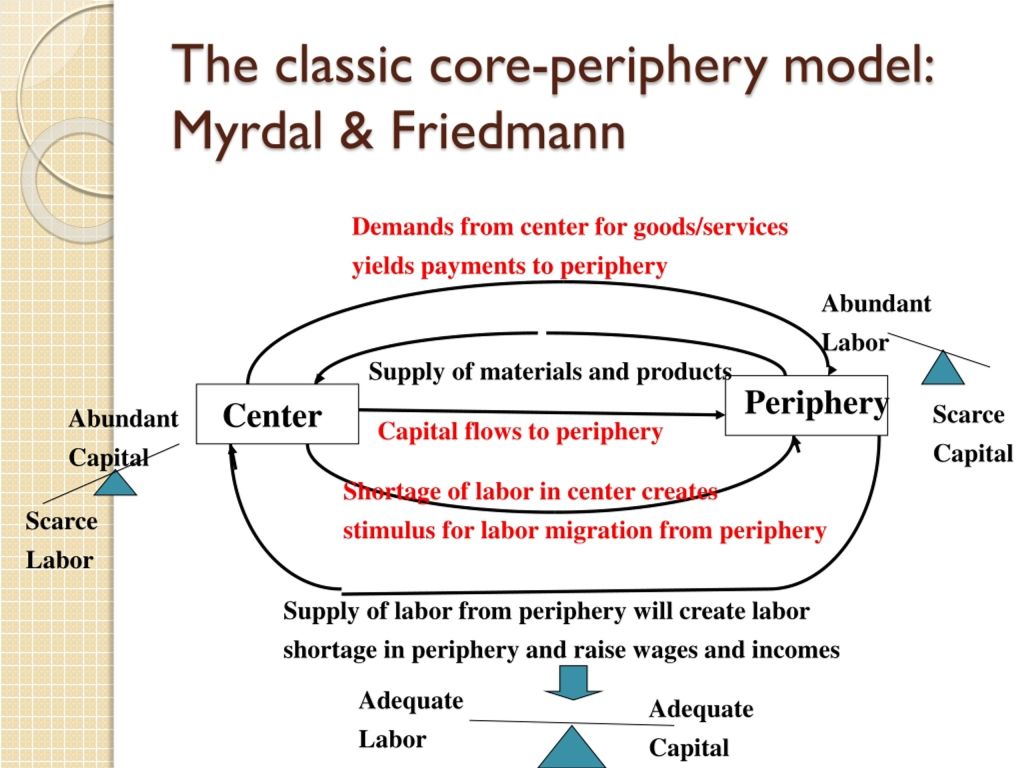
The Core-Periphery Model, developed by John Friedmann in 1966, is a framework used to understand the spatial structure of economic development and regional disparities. It explores how economic activities, resources, and development tend to concentrate in certain areas (the core), leaving other areas (the periphery) less developed. The model is particularly significant in the fields of geography, regional planning, and development economics, as it highlights the unequal distribution of economic power and resources across different regions.

Key Concepts of the Core-Periphery Model

  1. Core Region:
    • The core is the center of economic, political, and social power.
    • It is characterized by high levels of industrialization, urbanization, and infrastructure development.
    • The core regions typically have a concentration of capital, technology, skilled labor, and investment.
    • Examples include major metropolitan cities or developed countries (e.g., New York, London, Tokyo).
  2. Periphery Region:
    • The periphery consists of areas that are less economically developed, with lower levels of industrialization and urbanization.
    • These regions often depend on primary economic activities like agriculture, mining, or raw material extraction.
    • Peripheral regions tend to have lower levels of income, education, and infrastructure.
    • Examples include rural areas or developing countries that are economically dependent on the core.
  3. Semi-Periphery Region (added in later refinements of the model):
    • These are transitional regions that lie between the core and periphery.
    • They exhibit some characteristics of the core but still face challenges similar to those in the periphery.
    • Semi-peripheral regions may be emerging economies or rapidly developing cities (e.g., India, Brazil, South Africa).

Stages of Development According to Friedmann

Friedmann’s model identifies four stages in the spatial development of regions:

  1. Pre-Industrial Society:
    • Economic activities are widely dispersed with little concentration.
    • Traditional economies dominate, with a focus on agriculture and subsistence activities.
    • There is minimal differentiation between core and periphery regions.
  2. Emergence of the Core:
    • Industrialization leads to the growth of certain regions, creating a core area.
    • The core attracts investments, industries, and skilled labor, becoming an economic hub.
    • Peripheral areas remain underdeveloped, leading to a spatial economic imbalance.
  3. Core-Dominated Economy:
    • The core continues to expand, accumulating more economic power and resources.
    • The periphery becomes increasingly dependent on the core for economic activities, capital, and technology.
    • This dependence creates a hierarchical relationship, reinforcing regional disparities.
  4. Spatial Integration:
    • Over time, development policies, infrastructure projects, and technological advancements may reduce regional disparities.
    • The economic benefits of the core can spill over to the periphery, promoting regional integration.
    • This stage aims for a more balanced spatial distribution of economic activities.

Mechanisms of Core-Periphery Dynamics

  1. Polarization Effect:
    • Economic growth tends to concentrate in the core, attracting more resources, investments, and skilled labor.
    • This process, known as “cumulative causation,” leads to the growth of core regions at the expense of peripheral regions.
  2. Backwash Effect:
    • The core extracts resources, labor, and capital from the periphery, further weakening the peripheral regions.
    • This can lead to a drain of talent and resources from rural or underdeveloped areas to more prosperous urban centers.
  3. Spread Effect:
    • The core’s growth may eventually lead to positive spillover effects in the periphery, such as increased investments, technology transfer, and job creation.
    • This can happen through policies aimed at decentralization, regional development, and infrastructure improvements.

Implications of the Core-Periphery Model

  • Economic Inequality:
    • The model highlights the uneven economic development between core and peripheral regions, which can lead to social and economic inequalities.
  • Policy Formulation:
    • Policymakers can use this model to devise strategies for balanced regional development, such as promoting investment in peripheral areas, decentralizing industries, and improving infrastructure.
  • Urbanization Trends:
    • It explains the rapid urbanization and concentration of population in metropolitan areas, as people migrate from rural peripheries to urban cores in search of better economic opportunities.

Criticisms of the Core-Periphery Model

  1. Over-Simplification:
    • The model is criticized for being too simplistic, as it divides regions into binary categories of core and periphery without accounting for the complexities of regional dynamics.
  2. Lack of Consideration for Globalization:
    • The model was developed in the 1960s, before the rise of globalization and digital technologies, which have altered the spatial distribution of economic activities.
  3. Limited Applicability:
    • The model may not be fully applicable to all regions, especially in the context of modern economies where multiple cores and decentralized economic activities exist.

Applications of the Core-Periphery Model

  • Regional Planning and Development:
    • The model is used to guide regional development policies, focusing on reducing disparities between core and peripheral areas.
  • Urban Studies:
    • It helps in analyzing urbanization patterns, city growth, and migration trends.
  • Economic Geography:
    • The model provides insights into the spatial distribution of economic activities, helping economists understand the factors driving regional disparities.

Example: Application in India

  • Core Regions:
    • Major metropolitan areas like Mumbai, Delhi, and Bengaluru serve as economic cores, with high levels of industrialization, services, and technology.
  • Peripheral Regions:
    • Rural areas in states like Bihar, Odisha, and parts of Northeast India remain less developed, with economies primarily dependent on agriculture and limited industrialization.
  • Semi-Periphery Regions:
    • States like Gujarat, Tamil Nadu, and Maharashtra show mixed characteristics, with both developed urban centers and underdeveloped rural areas.

Conclusion

The Core-Periphery Model by Friedmann offers a valuable framework for understanding the spatial dynamics of economic development. While it has limitations, it provides a useful lens for examining regional disparities, informing policy interventions aimed at promoting balanced development and reducing economic inequality.

References

Baldwin, R. E. (2001). Core-periphery model with forward-looking expectations.ย Regional science and urban economics,ย 31(1), 21-49.

Borgatti, S. P., & Everett, M. G. (2000). Models of core/periphery structures.ย Social networks,ย 21(4), 375-395.

Castro, S. B., Correiaโ€daโ€Silva, J., & Mossay, P. (2012). The coreโ€periphery model with three regions and more.ย Papers in Regional Science,ย 91(2), 401-419.

Forslid, R., & Ottaviano, G. I. (2003). An analytically solvable coreโ€periphery model.ย Journal of Economic Geography,ย 3(3), 229-240.

Klimczuk, A., & Klimczuk-Kochaล„ska, M. (2023). Core-periphery model. Inย The palgrave encyclopedia of global security studiesย (pp. 239-245). Cham: Springer International Publishing.

Sharma, S. N. Exploring the Urban Growth Pole Theory.

Sharma, S. N., Dehalwar, K., Kumar, G., & Vyas, S. (2023). Redefining Peri-urban Urban Areas.ย Thematics Journal of Geography,ย 12(3), 7-13.