
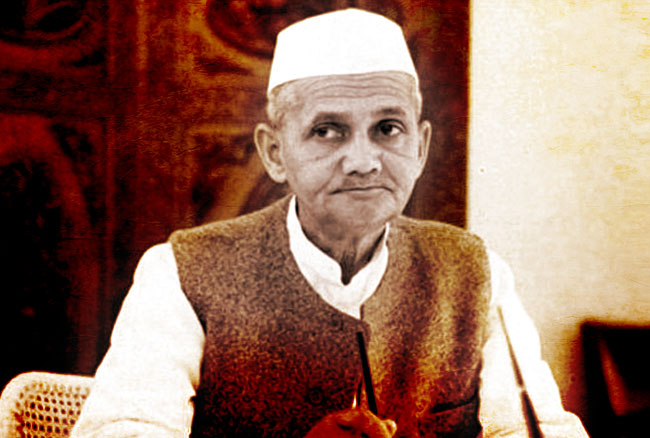
LAL BAHADUR SHASTRI AND THE MAKING OF INDIA.
Amongst the most noteworthy ‘Satyagrahi’, politician turned minister was the “little man” – LAL BAHADUR SHASTRI. Most people associate him as the second Prime Minister of INDIA for a brief period from 9th June 1964 to 11th January 1966 and seldom assess his importance on the basis of his Prime Ministerial period, but very few know about his previous political achievements. Therefore, in order to critically analyse his role in the making of India after independence, one has to consider from the very beginning of his political career.
LAL BAHADUR was born on 2nd October 1904 in Mughalsarai to SHARADA PRASAD and RAMDULARI DEVI. He lost his father when he was barely a year and a half old, for which his maternal grandfather HAZARI LAL took them to his house where Lal spent most of his childhood. He went to Harishchandra High School, it was here that Lal Bahadur’s heart throbbed with patriotism under the guidance of his teacher and mentor, Nishkameshwar Prasad Misra. He listened to Mahatma Gandhi and Lokmanya tilak’s speeches, being spellbound by their charisma, he realized there was no greater force than truth and justice. Thus, when Gandhiji started the Civil Disobedience Movement, Lal Bahadur not only left his school but also actively participated throughout the movement spreading the spirit of patriotism and nationalism. He then joined the Kashi Vidyapeeth – a nationalist school by patriots – where he took his degree in philosophy and came out as Lal Bahadur Shastri in 1926 to take up the responsibility of a nation builder.
He joined the Servants of the People Society founded by Lala Lajpat Rai in 1926 and became its third president after Purushottamdas Tondon. Tondon made him secretary of the District Congress Committee alongside his lifetime membership of the People Society. It was through these positions in Allahabad that Lal Bahadur carried out the first phase of his political career. He himself acknowledged, “ It was due to life membership of the Servants of the People Society that I got an opportunity to serve my country the most. Society has been instrumental in inculcating in me the true meaning of the term ‘servants of people’”. Lal Bahadur caught the attention of the congress “ top brass ” when he was elected in the U.P Assembly and his Land Reform Report became the basis of the Land Reform Legislation in 1937. Even during the Quit India Agitation, where all the congress leaders were arrested, Lal Bahadur kept hiding and continued the congress “underground” work.

His return from the jail in 1945 and the Independence of India marks the second phase of Lal Bahadur’s political career. Pandit Govind Ballabh Pant appointed Lal Bahadur as one of his parliamentary secretaries. Impressed by his hard work and sincerity, Pant appointed him as the Police and Transport Minister in the Government when the position stood vacant. As the police and transport minister, he sought to bring a better understanding between the people and the Police Force. For this, he injected young men into the police cadre and created the Prantiya Raksha Dal – the second line of defence – which comprised young men from society who instilled a spirit of patriotism and discipline and years later fought the Chinese invaders bravely. He initiated nationalised road transport in UP, which established contact with the hitherto backward areas and brought trade and economic prosperity. He took a socially radical move by opening bus conducting jobs to women and enforced law and order with firmness and impartiality. When Nehru took over Congress Presidentship, he appointed Lal Bahadur as the General Secretary of the Congress Party Headquarters, which the latter accepted and moved to New Delhi in 1951.
Lal Bahadur proved his skills and sincerity for which he was straightway included in the central cabinet as the Railways and Transport Minister. Lal bahadur had to take up “ the triple task of rejuvenating the railway administration and repairing the ravages of partition and providing more amenities to the ever-mounting number of passengers who were outstripping the capacity of the Indian railways.” He rearranged the travelling classes, introduced reserved three and two-tier accommodations, third class air-conditioned chair car and electric fans for the third class compartments and even solved the food problem, thus, bringing extensive relief to middle-class passengers. To improve railway efficiency, an Efficiency Bureau was set up along with a Security Adviser and a Railway Protection Force and was even responsible for the reconstitution of new units such as South-Eastern and Central Railways. He constituted Railway User’s Consultative Committee at every level and in 1954-55, approved the Ganga Bridge Project Administration for the construction of road cum rail bridge across the Ganga. These measures led to the advancement of the previously neglected sphere of Railways and inaugurated the process of making India.
In the 1957 elections, Lal Bahadur was given the Ministry of Transport and Communication for a short period, where he brought some changes in administration in accordance with the then economy. He was then moved to the Ministry of Commerce and Industry. His tenure saw remarkable progress in Commercial and Industrial fields. The Heavy Engineering Corporation was set up with the help of the Soviet Union and Czechoslovakia, Small Scale Enterprises and Industries were supported and Agro-Industries were encouraged. The Automobile Industry saw a boost in its output and these measures sought to eradicate the problem of Agricultural Unemployment and Underemployment. After the death of Home Minister, Pandit Govind Ballabh Pant in April 1961, he was appointed as the Union Minister for Home Affairs. In his new position, he faced the threat of Tara Singh in Punjab and the critical situation of Assam, where the former was a political demand; the latter arose out of language controversy. These turmoils threatened internal peace and order and disrupted the stability of the country.
Lal Bahadur was able to elope the problems and tactfully overcame the challenges. The Shastri formula was somewhat successful in re-establishing communal harmony in Assam, but the language problem was not only the “apple of discord” in Assam, rather generated tensions in other parts of the country, especially between the South and the North. He convened a National Integration Conference in New Delhi, where it was accepted that ultimately Hindi would become the national language but the need for continuation of English till the time Hindi was fully developed was also realised. The Conference set up a Permanent National Integration Council and appointed three committees, the Ashoka Mehta Committee, the Sampurnanand Committee, and the C. P Ramaswamy Aiyar Committee, to lay down the means to implement decisions. Lal Bahadur also devoted to administrative reform to curb corruption and inefficiency in the administration by setting up the Central Bureau of Investigation and appointed the Santhanam Commission. He even established the All India Board to promote the social and economic well-being of the most backward classes of India. In his tenure of the home ministry, he had to face the Chinese crisis and was to handle the state of emergency, where he is said to have played rather a “positive role”. His consequent visit to Nepal and establishing a cordial relation with the country earned him great prestige in the national arena.
Lal Bahadur enjoyed the confidence and support of the majority of the ministers for his gentle personality and his hard work. Even Jawaharlal Nehru relied on Lal Bahadur for his assistance and made him a “Minister without Portfolio” in 1964 when he himself was seriously ill. Thus, when ultimately the “banyan tree” fell, the question “ After Nehru Who and What?” became apparent. Between the two contestants, Morarji Desai and Lal Bahadur, the latter was appointed by the so-called ‘syndicate’ and the chief ministers, as the next Prime Minister of India without any strife. As the Prime Minister of India, Lal Bahadur retained the predecessor’s policy which he said, “ is beneficial to India and will be for the country in the future.” In his short tenure of 19 months of Prime Ministership, he had to face a lot of criticism along with problems. The main problems being Pakistan and Chinese invasions. In his dealings with the Chinese, he made it clear that the Colombo proposals alone could form the basis of talks and said ” we have gone to the utmost limit in accepting them” and there was no going beyond them. He, however, appeared to be more flexible with Pakistan, calling them kin and kith of Indians and believed that the two countries should live together in peace and harmony. His policy towards China and Pakistan was “one of persuasion without abandoning our basic principle.”
His main task as Prime Minister was to form his cabinet, which he did remarkably and brought Indira Gandhi into the cabinet as the Minister for Information and Broadcasting. Although his retention of Foreign Affairs evoked criticism, still he was highly accepted as the Prime Minister because of his “practical and vigorous policy to accelerate the economic growth of the country.” Along with his Prime Ministerial Ship, he inherited a” plateful of unresolved thorny problems.” Since his tenure was the product of the ‘Syndicate’ and some Chief Ministers, he owed to them, who by now acted as “powerful satraps” which ultimately slowed down the decision making and implementation process of the government. His tenure saw the food crisis affecting the economy where the prices increased 22% in 18 months. As an immediate action, he increased food import and spread the Fair Price Programme to the entire country. The Government established a Food Grain Trading Corporation, as an interim measure until the Agriculture Prices Commission took up the charge and an Adhoc Committee was appointed. The legislation was introduced for quality control of improved seeds and Irrigation along with Plant Protection was extended to the entire country. The initiation of the Green Revolution and the White Revolution also contributed to the improvement of the situation. The Prime Minister contributed to the rectification of the country’s development planning which was contributing to the problem of inflation. Even though the government was able to tackle some of the issues, the foreign exchange crisis and the southern language shook the foundation of the Shastri government.
The Kutch Incidents triggered from Jan 1965 between India and Pakistan which came to an end on July 1st with a cease-fire line. Pakistan again on September 1st, invaded Kashmir and war continued for 22 days, ultimately with the joint USA and USSR sponsored Security Council, adopted a resolution of cease-fire line from 22nd Sept. The international compulsion brought both Shastri and Ayub together at Tashkent under soviet premiere Alexie Kosygin. The Tashkent talks resulted in the signing of the famous Tashkent agreement on January 10, 1966, which ensured peace at that moment but failed to provide any permanent solution to the Kashmir issue. The government’s spokesman explained that even though the agreement could not afford any solution to the Kashmir problem, still its significance lies in the fact that both the countries despite differences, pledged to live together in peace and harmony as good neighbours.
Unfortunately, the action that gained him huge popularity and the time which favoured his grip over the Prime Ministerial position came to an end because of his unprecedented death by cardiac arrest the next day, i.e, 11th Jan 1966. Thus came to an end, the brilliant career of an outstanding politician-cum-minister, whose great achievement was to lighten the Indian people’s sinking spirits during the depressing years. Had he lived longer, he could have solved many knotty problems confronted by the country for which he remains to be criticised. The fact remains that during the first years Shastri confronted a series of crises that became the reason for his not getting time to rest back, think and formulate new policies. Thus, when he swam across the ” sea of troubles”, the critics narrated him as “a prisoner of indecision”. But from the start of his political career, his contribution for both the freedom movement and the making of a self-reliant, independent country India, can never be ignored or neglected. And thus, “the little man” from India will continue to be remembered by Indians forever.
NOTES AND REFERENCES:-
MANKEKAR, D. R, ‘Builders of Modern India- Lal Bahadur Sashtri’, Publications Division, Ministry of Information and Broadcasting, Government of India, New Delhi, 1973
Chandra Bipan, Mukherjee Mridula, Mukherjee Aditya, ‘India Since Independence’, Penguin Random House Publishing, Haryana,2008
 Track2Training
You must be logged in to post a comment.