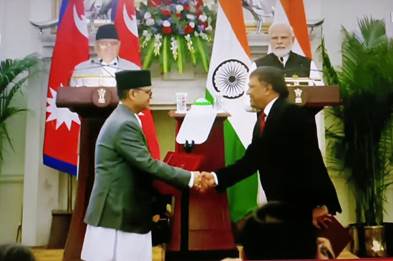
NHPC Limited (A Govt. of India Enterprise) and Vidhyut Utpadan Company Limited (VUCL), Nepal signed an MoU (Memorandum of Understanding) in New Delhi today for development of Phukot Karnali Hydro Electric Project (480MW) in Nepal. The MoU was signed in the presence of Prime Minister of India Shri Narendra Modi and Prime Minister of Nepal Shri Pushpa Kamal Dahal ‘Prachanda’ at Hyderabad House in New Delhi.
Shri R.K. Vishnoi, CMD, NHPC and Shri Surya Prasad Rijal, MD, VUCL, Nepal exchanging MOU documents for development of Phukot Karnali Hydro Electric Project (480MW) in Nepal in presence of Prime Minister of India Shri Narendra Modi and Prime Minister of Nepal Shri Pushpa Kamal Dahal ‘Prachanda’ at Hyderabad House, New Delhi.
NHPC Limited, a Schedule ‘A’ Enterprise of the Government of India with ‘MINI RATNA’ status, is a premier PSU in India for development of hydropower and Vidhyut Utpadan Company Limited (VUCL), Nepal is responsible to develop, build, own and operate large-scale hydropower projects in public-private partnership model in Nepal.
The MOU was exchanged by Sh. R.K. Vishnoi, Chairman & Managing Director, NHPC and Shri Surya Prasad Rijal, Managing Director, VUCL. Signing of this MOU is a landmark step towards India-Nepal Joint Vision on Power Sector Cooperation.
The project will use the flow from the Karnali River for power generation and the generated power will be fed into integrated power system of Nepal. The installed capacity of the project shall be 480 MW with average annual generation of about 2448 GWh. The key features of the project are a 109 metre high RCC dam and an underground power house where the 06 turbines of 79 MW each shall be housed. Additionally, to utilize minimum environmental release one Surface Power House of 6 MW capacity i.e. two machines of 3 MW each is also planned. This project is conceived as a Peaking Run-of-River (PRoR) type scheme.
India and Vietnam are marking 50 years of the establishment of bilateral diplomatic relations. Rajnath Singh held bilateral talks with Vietnam’s Minister of National Defence, General Phan Van Giang, in Hanoi on June 8, 2022. A ‘Joint Vision Statement’ was signed between India and Vietnam to enhance defence partnership between the two countries.
Earlier, India and Vietnam signed a Letter of Intent (LOI) to collaborate in the field of digital media, paving the way for further strengthening the partnership between the two countries. It promoted sharing of information and experience, cooperation to implement projects in Human Resource Development and also promoted enhanced cooperation of postal designated operators and service providers of both the countries.
Key highlights of the visit :
• India-Vietnam Defence Partnership towards 2030: Both the Defence Ministers signed the ‘Joint Vision Statement on India-Vietnam Defence Partnership towards 2030’ to bolster bilateral defence cooperation.
• Defence Line of Credit: The two ministers agreed on the finalisation of the USD 500 million Defence Line of Credit extended to Vietnam with implementation of the projects under it adding substantially to Vietnam’s defence capabilities and furthering the government’s vision of ‘Make in India, Make for the World.’
• Mutual Logistics Support: Both inked a Memorandum of Understanding (MoU) on Mutual Logistics Support.This is a major step towards simplifying procedures for mutually beneficial logistic support and is the first such major agreement which Vietnam has signed with any country.
• Simulators and a Monetary Grant: India will gift two simulators and a monetary grant towards setting up of Language and IT (Information Technology) Lab at the Air Force Officers Training School for capacity building of the Vietnamese Armed Forces.
India-Vietnam relations :
• India had established the Consul General’s office in Hanoi as early as 1956.Vietnam established its diplomatic mission in 1972. • India had stood by Vietnam in opposing US intervention in that country at the cost of embittering Indo-US relations. • The relationship was further strengthened when India, in the early 1990s, initiated its Look East Policy with the specific objective of economic integration and political cooperation with Southeast Asia and East Asia. • India and Vietnam agreed to strengthen their strategic partnership in line with India’s Indo-Pacific Oceans Initiative (IPOI) and the ASEAN’s Outlook on Indo-Pacific to achieve shared security, prosperity and growth for all in the region. • India realises that Vietnam is a potential regional power in South East Asia with great political stability and substantial economic growth. • India is investing in development and capacity assistance for Vietnam through quick impact projects (QIP), proposals in the area of water resource management in Vietnam’s Mekong Delta region, Sustainable Development Goals (SDGs), anddigital connectivity. • Vietnam is interested in India’s Akash surface-to-air systemsand Dhruv advanced light helicopters and Brahmos missiles. • Indian Naval Ship INS Kiltan undertook a visit to Ho Chi Minh City in 2020 to deliver flood relief materials for the people of Central Vietnam (Mission Sagar III).It also participated in the PASSEX Exercise with the Vietnam People’s Navy. • The China factor also weighs heavily in the respective strategic calculus of India and Vietnam.Both countries had fought wars with China and both have border problems with that country. China aggressively continues to encroach in the territories of the two countries.Hence, it is natural for both the countries to come closer with a view to restrain China from its aggressive actions. • India and Vietnam closely cooperate in various regional forums such as East Asia Summit, Mekong Ganga Cooperation, Asia Europe Meeting (ASEM).
In 2016, the first time in 15 years, an Indian Prime Minister visited Vietnam signaling India is no longer hesitant to expand its presence in China’s periphery. India’s foreign policy envisages India to play an anchor for peace, prosperity and stability in Asia and Africa, deepening ties with Vietnam will only strengthen this narrative. As India and Vietnam geographically lie at the heart of the emerging Indo-Pacific construct, both would play a major role in this strategic space which is becoming a core theatre for competition for power and influence amongst the major powers. Strengthening ties with Vietnam will eventually lead a step towards the realisation of SAGAR (Security and Growth all in the region) initiative as hailed by the Indian PM. India and Vietnam both can mutually benefit each other in the arena of Blue Economy and ocean security.
Sources : The Hindu, Drishti IAS and The Indian Express.


 Track2Training
You must be logged in to post a comment.