A large explosion tore through a Shi’ite mosque in the southern Afghan city of Kandahar during Friday prayers, killing at least seven people and wounding 13, officials and provincial leaders said.
Qari Saeed Khosti said authorities were collecting details of the explosion, which took place days after a suicide bomb attack claimed by Islamic State on a Shi’ite mosque in the northern city of Kunduz that killed scores of people.
Photographs posted by journalists on social media showed many people apparently dead or seriously wounded on the floor of the mosque.
Nematullah Wafa, a former member of the provincial council, said the blast occurred at the Imam Bargah mosque and caused heavy casualties but there were no immediate confirmation of the number of dead and wounded.
Eyewitnesses said three back-to-back explosions hit Imam Bargah mosque in Kandahar, one of the biggest mosques in the city, causing high casualties.#TOLOnewspic.twitter.com/Z2owaWzxrF
The blast, coming so soon after the Kunduz attack underlined the increasingly uncertain security in Afghanistan as Islamic State has stepped up operations following the Taliban victory over the Western-backed government in Kabul in August.
When a decision is made that fear, terror and violence are justified to achieve ideological, political or social change, radicalization to violent extremism occurs’ Terrorism, radicalization and extremism are subjective concepts that have different meanings for different people. Furthermore, their meanings are constantly evolving as they manifest themselves in different ways in different parts of the world, exploiting new vulnerabilities, technologies and approaches. 1.1. Terrorism ‘Terrorism is a complex and contested issue, as are the associated labels of extremism, violent extremism and radicalization’ There is no single universally accepted definition for terrorism because the concept is invariably political and cannot be framed in a manner that excludes the state. Most acceptable words to understand terrorism are ‘acts committed with the objective of seriously intimidating a population, destabilizing or destroying structures of a country or international organization or making a government abstain from performing actions’. 1.2. Extremism ‘Violent extremist ideologies have found fertile ground in fragile communities characterized by little access to development’ Extremism is generally understood as constituting views that are far from those of the majority of the population. Accordingly, one definition describes extremism as ‘activities (beliefs, attitudes, feelings, actions, strategies) of a character far removed from the ordinary’. Though this is clearly a relative term which invites disagreement regarding benchmarks, it is broadly agreed that extremist views are not necessarily illegal and do not automatically lead to violence or harm. Indeed those with extremist views, who may also choose to observe extreme practices with no impact on the civil liberties of fellow citizens, are rightly protected under fundamental freedoms and human rights norms. Extremism becomes a concern when those views threaten democratic and tolerant societal ideas, or promote the use of violence to coerce their followers or to achieve their objectives. This form of extremism is described as violent extremism, a term which remains contested, but which generally refers to the creation of ideologically motivated or justified violence, as well as support for such acts. 1.3. Radicalization ‘Radicalizer’s work by pointing to social, political and economic injustice around their followers.’ Like terrorism and violent extremism, radicalization is a contested term with various definitions. It is commonly understood, however, as the social and psychological process of incrementally experienced commitment to extremist political and religious ideologies. It does not necessarily mean that those affected will become violent. However, when a decision is made that fear, terror and violence are justified to achieve ideological, political or social change, radicalization to violent extremism occurs.
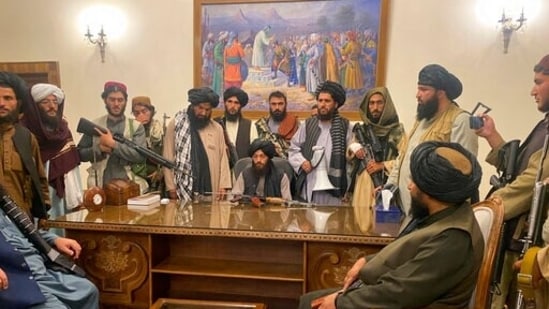
Now that the US army has pulled out from Afghanistan after spending 20 years there, the Taliban has taken control of almost whole of the country. HISTORY REPEATS ITSELF, and here history is repeating itself for the worst. Politicians have fled from the country leaving their countrymen to die and the civilians are in a state of panic. As Taliban has taken control from all the borders leaving no exit point.
What is Taliban
Taliban is the word for ‘student’ in pashto language. Ironically they have nothing to do with knowledge, at least on humanitarian basis. They emerged from the northern part of Pakistan in the early 1990s, they basically promised peace to the peope an to impose Sharia or islamic law, once in power. In September 1995, they started their rule by capturing Herat and then all the major cities one by one and by 1998, they had captured about 90% of Afghanistan.
They became popular as they finished corruption and lawlessness. They also introduced roads. But at the same time they implemented the Sharia law and gave punishments according to it, like public execution for murderers and adultration, amputating those, who were found guilty of theft. Girls were not allowed to go to school after the age of 10, women had to wear chaadri (burqa, covering whole body) when going out and they had to be accompanied by a man all the time, men too had to grow beard. Cinema, music and television were banned. women were not allowed to work even when their husbands died. Basically all their rights were taken away.
On 11 September, 2001 the world trade center was attacked and Taliban was accused of providing safety to Al Qaeda.
Malala Yousafzai was shot by the talibani terrorists as she refused to leave school and continued to study.
pic courtesy: shutterstock
Disturbing images have been coming in from airport where people were rushing as their last hope of fleeing from there. It’s very saddening to see politicians leaving their people to die on the streets. Even though talibanis have said that the people need not be scared of anything but can we trust them?? Not really. Several videos have been surfacing on the net of dead bodies littered on roads. People are being dragged out of their houses, specifically those who have in any way helped American forces. Residents are trying any possible way to get out of there but unfortunately the only exit left at last, the airport in kabul, has been shut off, shutting their last hope for now.
Well, I hope for now at least the citizens will be safe and peace will be restored soon. The Afghanistan of 1960s-70s, where women enjoyed freedom and the country was progressing will be back. Children will play with toys and not guns, knowledge will be used as weapon and not violence.




 Track2Training
You must be logged in to post a comment.