
MOBILE PHONES-NOW and THEN

Back in the days of 90’s, when people got habitual of their wired telephones, there came a revolutionary invention- THE MOBILE PHONES. They served as a very useful servant to the humans as it helped them in many ways;

Photo by Adrianna Calvo on Pexels.com
  • Now, no longer there is a need to stand next to your telephones waiting for someone’s call as you can just take it wherever you want.
  • They are small and easy to handle, so you don’t have to make much space for it.
  • Their portability is their key feature

Over the years, as humans and mobiles have undergone a drastic evolution.

They are no longer just a medium of connecting with people but has now became an important part of our lives.

In almost every situation, the first thought that comes to our mind is our mobiles. Weather it is capturing our happy moments, guiding us in difficult situations or making us feel better in bad times through music-all jobs can be performed by a single mobile phone. Now, in every household, almost each family member owns a mobile. Now that the mobiles have got smarter, people have got completely dependent on it. In fact the social media, with the initial and basic feature of connecting with world has now become an addiction for many.

Over the years, the mobile that was developed as a servant has taken over the commands and became our masters. Now we can’t even think of our lives without a mobile. I agree that mobiles can help you get out of every tough situation in all possible ways but there are times when the same device lands you in trouble.

The diary having phone numbers of all our loved ones have now been replaced by the contact in mobiles, so you don’t have to memorize them but what if someday the data gets lost. They kids can enjoy gaming and scrolling over social sites in mobiles but the parks and grounds are now left empty and the rides are layered by dust. Earlier people use to wake up by the melodious chirping of birds and gaze of the sun but now, they wake up by the disturbing sound of their alarms.

Affect on Students during pandemic

During the tough times of Covid-19 the online teaching has become the new normal. To save the career of students the education platform shifted from classrooms to laptops and mobiles. Indeed mobiles were very useful in the pandemic to connect with people, help them, study online, etc. But it was really hard for students to learn online as it required them to sit in front of their phones for more than 5 hours daily. It has caused various harmful effects on them such as:

  • Constant headache
  • Itching in eyes
  • Watering of eyes
  • Anxiety
  • Vision loss

In the race to explore the digital world, we are somehow loosing our connections with the real physical world.
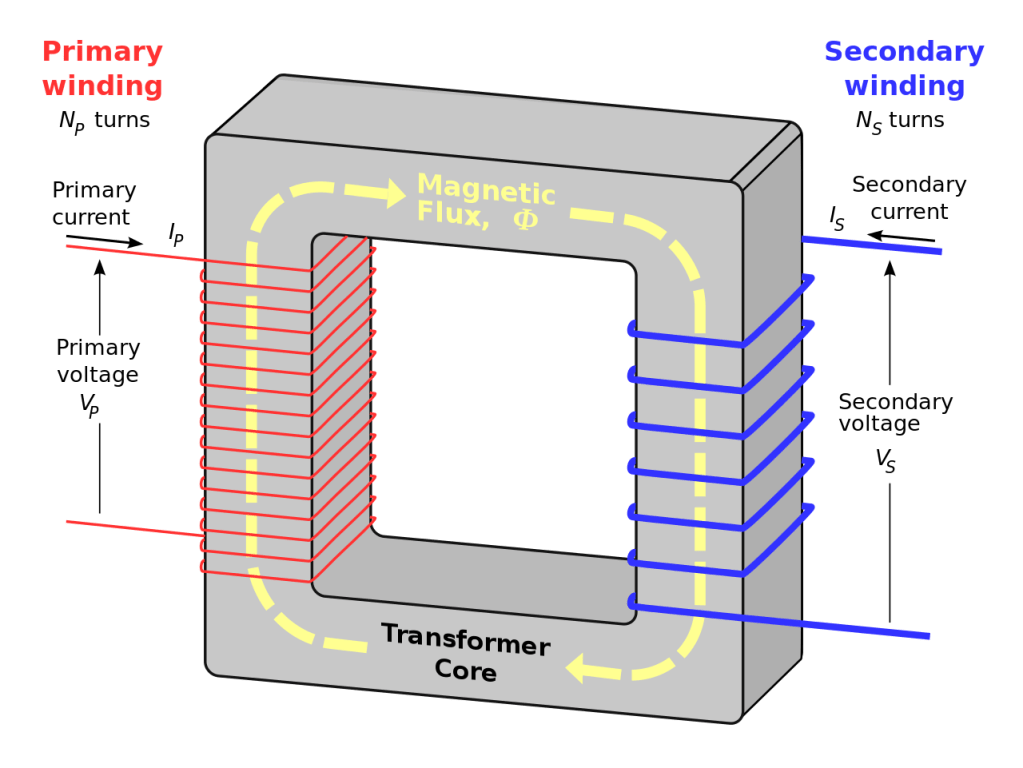
Transformer

A Transformer is an electrical device which works on principle of Faraday’s Law of electromagnetic induction. It transfers electrical power from one circuit to the other circuit by electromagnetic induction. It is a passive electrical device. It used for increasing low AC voltages at high current (called as step-up transformer) or decreasing high AC voltages at low current (called as step-down transformer), which is required for transmission and distribution of electricity.

Parts of Transformer:

A transformer has three main parts:

  • Primary Winding: It is connected to an external AC source and its purpose is to produce magnetic flux inside of transformer.
  • Secondary Winding: The flux produced by primary winding passes through the core and gets linked with the secondary winding. This winding is also present on the same core and provides the output of the transformer.
  • Magnetic Core: The flux produced by the primary winding, that will pass through this low reluctance path linked with secondary winding and create a closed magnetic circuit.

How does a Transformer work?

In a transformer there are two Windings (coils) which are called as ‘primary coil’ and ‘secondary coil’ of transformer. These coils are wound up on a soft iron core on the two opposite sides. So, when the AC voltage is connected with primary winding, an alternating flux is produced inside of transformer and surrounds the primary winding. Now if another coil is brought closer to this primary coil, the continuously changing flux will get linked with the coil and induce a voltage in it according to Faraday Law of Electromagnetic Induction and the current will flow in the circuit attached to the winding. The voltage may be higher or lower than supplied voltage depending upon the number of turns of coils. The winding which gives the output voltage due to voltage induced in it is known as the ‘secondary winding’ and the winding in which the AC voltage is provided is called ‘primary winding’.

Now, increase or decrease in voltage by transformer depends upon the number of turns present in secondary and primary winding. If there are more turns on the primary coil than the secondary coil than the voltage will decrease, which means transformer will work as a step down transformer and if there are less turns on the primary coil than the secondary coil than the voltage will increase, which means the transformer will work as a step up transformer.

Now, both these winding are wound up on a same magnetic core which is usually of soft iron. This is done because in open air very little flux will get linked with secondary winding and the current induced will be very small. That’s why we use magnetic core or soft iron core, whose purpose is to provide a low reluctance path, through which the maximum amount of flux produced by the primary winding is passed through and linked with the secondary winding.

Some important formulae related to transformer are,

The transformer turns ratio is the number of turns of the primary winding divided by the number of turns of the secondary coil. Denoted by K.

No. of turns in primary coil = Np                       No. of turns in secondary coil = Ns

Voltage in primary coil = Vp                                     Voltage in secondary coil = Vs

                                                       Np/Ns = Vp/Vs = Is/Ip K

Emf Equation of Transformer:

Erms = 4.44fNΦmax where,

f = flux frequency in Hz = ω/2π,

N= Number of turns in winding

Φmax = Maximum flux

Erms= RMS value of EMF.