
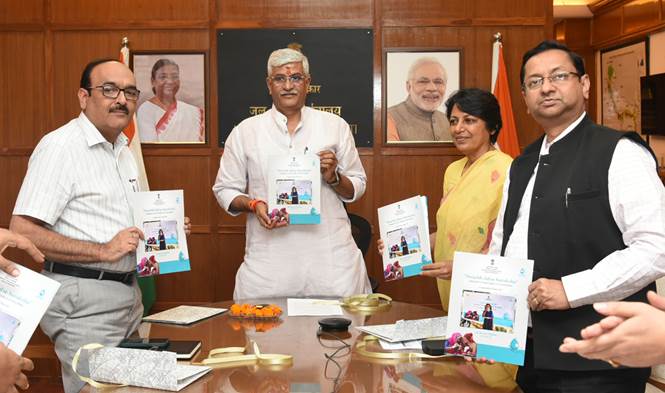
The Union Minister For Jal Shakti, Shri Gajendra Singh Shekhawat today released the report on progress under the Jal Jeevan Mission: Swachh Jal se Suraksha (SJSS) Campaign which was organised from 2nd October, 2022 to 31st March, 2023 to impress upon the States/ UTs to make concerted efforts towards taking up water quality monitoring and surveillance activities as ‘Supply of Safe Water’ has been one of the key considerations under JJM. Under the campaign, several activities had been taken up including Testing of PWS sources in all villages for chemical parameters and bacteriological parameters (post monsoon); Water quality testing at household level in villages; Water quality testing in Schools and Anganwadi Centres; Remedial action taken for contaminated samples; and Training of women for water quality testing using FTK/ H2S vials at village level.
As a result of concerted efforts made by States/ UTs for water quality monitoring and surveillance during campaign period and progress reported on WQMIS portal, the activity-wise overall progress is as under:
Water quality testing has been reported in 5.39 lakh (89.69 %) villages for chemical and in 4.47 lakh (74.46 %) villages for bacteriological contamination (post monsoon).
Drinking water samples were tested in 6.58 lakh (67.63 %) schools and 7.16 lakh (67.43 %) anganwadi centres.
21.80 lakh women have been trained from 4.59 lakh (76.41 %) villages for water quality testing using Field Testing Kits (FTKs).
Remedial action has been taken for 90.34% of contaminated sample reported.
Performance of states/UTs was also measured during the Campaign. The states of Tamil Nadu, Andhra Pradesh, Karnataka and Madhya Pradesh emerged as the best performing states during the Campaign.
Jal Jeevan Mission (JJM) was announced by Prime Minister, Shri Narendra Modi on 15 August, 2019 to make provision of potable tap water supply in adequate quantity, of prescribed quality on regular & long-term basis to every rural household. Access to assured and safe drinking water is a basic life need. The Objective of the campaign was to ensure drinking water quality and create awareness among representatives of the Panchayati Raj institutions and rural communities about quality of drinking water in their respective villages, water quality issues, water borne diseases & health impacts and avoiding use of water from quality-affected sources.
The desired outcome of the campaign was wide participation at Village, district and State level for water quality testing, building confidence and create awareness among people about quality of water being supplied through piped water supply. States/ UTs PHE/ RWS Department, being ‘Nodal Department’ implemented Swachh Jal se Suraksha campaign in respective States/ UTs by actively involving all the stakeholders viz. Gram Panchayat and/ or its sub-committees/ local community to take up water quality monitoring and surveillance and awareness activities.
*****
 Track2Training