The status of women in India has been subject to many changes over the span of recorded Indian history. Their position in history deteriorated early in India’s ancient period, especially in the Indo-Aryan speaking region and their subordination continued to be refined well with India’s early modern period.
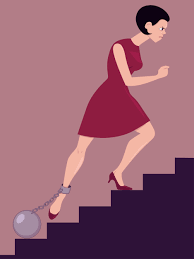
Even though, women nowadays are aware of their basic rights like right to vote, right to freedom etc but most women of India are unaware of their rights because of illiteracy and the oppressive traditions. Some of the challenges faced by India women are:
=> Gender discrimination: Women face discrimination right from the birth in the form of female foeticide and infanticide.
=>Major socio-cultural challenges such as patriarchy and gender inequality in society is the main cause of women’s deprivation by way of health, food and nutrition, more susceptible to mortality and contributing to unbalanced male female ratio as well as in the sphere of education, employment, wages and that of political representation. Subsequently this has led to increasing violence and denial of human rights, liberty, equality and justice.
=> The patriarchal family system that prevails in India gives more rights and authorities to the male enabling them to enjoy more power over the female in the family. So women are suppressed, oppressed, harassed, subjugated and deprived of even their basic rights till date.
=>Illiteracy and traditional beliefs and practices of family have prevented a great majority of women from access to health care and knowledge about their rights and privileges resulting in high rate of maternal mortality and morbidity. The high mortality rates among women as revealed by maternal death due to various diseases indicate that women health in general and reproductive health in particular are neglected in our society.
=> Rising crime and violence against women is only due to social stigma that women are weaker section of society. Due to financial constraints and acute poverty, young girls are often married at a very early stage.
=> Political challenges such as less political participation and Pati panchayats affects the role of women in decision-making process in society. Even after the reservation in Panchayats, women leaders are often used as a rubber stamp by their male family members thereby affecting the significance of the laws enacted by the government for women empowerment.
Conclusion:
Rightly did Swami Vivekanand say, “Just as a bird cannot fly with one wing only, a Nation cannot march forward if the women are left behind”.Men and women are two halves of a perfect whole. Therefore the women ought to be empowered as well as respected.
“I have been your doll-wife, just as at home I was papa’s doll-child; and here the children have been my dolls. I thought it great fun when you played with me, just as they thought it great fun when I played with them.”
“The Doll’s House” by Henrik Ibsen, a 19th century play, strongly stamps the rights of women into the minds of the readers. It explores what roles women are forced to play and how they lose themselves by doing so. Now, the ‘Doll’ in the title will make us think about what its role is and how it is connected to the play. A doll is made to look pretty, made to entertain others, and to be toyed by its owner. Similarly, women are also expected to look pretty, please men and are directed to play the roles given. This is how women were treated and are even now.
This play explores these intricacies in the lives of women. Nora is the doll in the play and her house the playhouse. Nora is also an embodiment of the entire women folk in general. The plot is set during Christmas, and so we can see Nora busy with her Christmas preparation in the first act. She is happy to hear of her husband’s promotion and also expects greater happiness because of it. She is visited by Mrs. Linde, who is an old friend of hers, and has come to seek her husband’s help in finding a job. Afterwards, she is also visited by Krogstad from whom she had leant money in the past. He blackmails her of revealing a forgery done by her in borrowing money. She has forged her father’s signature to get money. Krogstad tells her to get him a job in the bank from her husband.
Through the series of dialogues in the first act, we see how her husband, Torvald pets her and objectifies her. Instead of calling by her name, he uses ‘little squirrel’, ‘little lark’, ‘little skylark’ and so. By using such words, he objectifies her and diminishes her being. The adjective ‘little’ shows how he considers her lower than him and how he always treats her like a child. In fact, everyone in the play treats her like a child.
When Nora reveals to her friend, Mrs. Linde, that she has borrowed a huge sum to save her husband’s life, Mrs. Linde is shocked by it.
“NORA.
Couldn’t I? Why not?
MRS LINDE.
No, a wife cannot borrow without her husband’s consent.”
This shows that women of that period weren’t allowed to concern themselves with financial matters. We can even see that for a woman to borrow money, she needs a consent of a man and his sign. This is why Nora forged her father’s signature to borrow money. Nora also adds that she wouldn’t let her husband know about it because it would hurt his pride. Torvald never considers Nora as his equal and seems that being helped by women would make him look weak. This is a conventional thought which needs to be broken.
“A man who has such strong opinions about these things! And besides, how painful and humiliating it would be for Torvald, with his manly independence, to know that he owed me anything! “
In the second act, things speed up and we see Nora anxiously awaiting what would happen after the revelation. She mentally prepares herself to face the consequences and strongly believes her husband will take the blame all upon himself. This will be proved wrong later.
NORA.
Your squirrel would run about and do all her tricks if you would be nice, and do what she wants.
HELMER.
Speak plainly.
NORA.
Your skylark would chirp about in every room, with her song rising and falling –
HELMER.
Well, my skylark does that anyhow.
These lines show how Nora is always expected to please her husband. Torvad also likes to show off her to others and is proud of ‘owning’ her. A woman is a human and an individual and no mere object to own or show off. Thus the playwright brings out the toxic habit of objectification.
It is also seen that Nora never has an identity of her own. She is referred to as the daughter of her father and wife of Torvald. The society seems to repress her individuality by adding surnames to her. The play progresses to show how Nora sets out to find herself and her identity as an individual.
HELMER.
There, you see it was quite right of me not to let you stay there any longer.
NORA.
Everything you do is quite right, Torvald.
It can also be seen that Nora is never to have her own thoughts and to do what she likes. Her freedom as an individual is thus constrained by her husband. Her husband controls her, her actions, thoughts and directs her on what she has to do. And when the truth of her debt and forgery is revealed, he blames her and throws her under the bus. He is more worried about how his reputation in the society will be tarnished on the revelation of her actions. He is self-conceited and doesn’t bother to listen to Nora.
HELMER.
[walking about the room]. What a horrible awakening! All these eight years—she who was my joy and pride—a hypocrite, a liar—worse, worse—a criminal! The unutterable ugliness of it all!—For shame! For shame! [NORA is silent and looks steadily at him. He stops in front of her.] I ought to have suspected that something of the sort would happen. I ought to have foreseen it. …. Now you have destroyed all my happiness. You have ruined all my future. It is horrible to think of!
This is an awakening to Nora. Nora borrowed money in order to save her husband, but her husband completely ignores that fact. And when Krogstad sends a mail to them telling that he won’t reveal anything to the world, her husband immediately changes his colours and tells her that he had ‘forgiven’ her.
All these makes Nora realize what kind of life she was leading. She has an honest talk with her husband for the first time in eight years since they have married. She tells him that he had never considered her as an individual with feelings but a merely pleasing doll.
“You have never loved me. You have only thought it pleasant to be in love with me.”
She says that she was a mere doll passed down from her father to him. She was never to have her opinions with her father and so the same with her husband too. All her life she was treated like a doll and now she has also become to treat her own children like that. Here I quote the lines told in the beginning again.
She breaks up her marriage and sets herself free from everything that restrains her from being an individual. Before everything, she owes a duty to herself which she had not been concerned about before. She is going to educate herself and find herself.
HELMER.
Before all else, you are a wife and a mother.
NORA.
I don’t believe that any longer. I believe that before all else I am a reasonable human being, just as you are—or, at all events, that I must try and become one.
The realization that she had never lived her life as an individual and that she had always been objectified transforms her. She slams the door of her house and sets out.
“I was your little skylark, your doll, which you would in future treat with doubly gentle care, because it was so brittle and fragile. [Getting up.] Torvald—it was then it dawned upon me that for eight years I had been living here with a strange man, and had borne him three children—. Oh, I can’t bear to think of it! I could tear myself into little bits!”
Every woman like Nora should liberate themselves from their constraints. The entire play takes place inside the house and it shows how Nora and women are confined to four walls. Nora finally escapes her confinement and liberates into the real world.
[The sound of a door shutting is heard from below.]
Thus this play motivates every woman to find her way out of the door and slam it. This is a realistic play even applicable for the 21st century.





 Track2Training
You must be logged in to post a comment.