
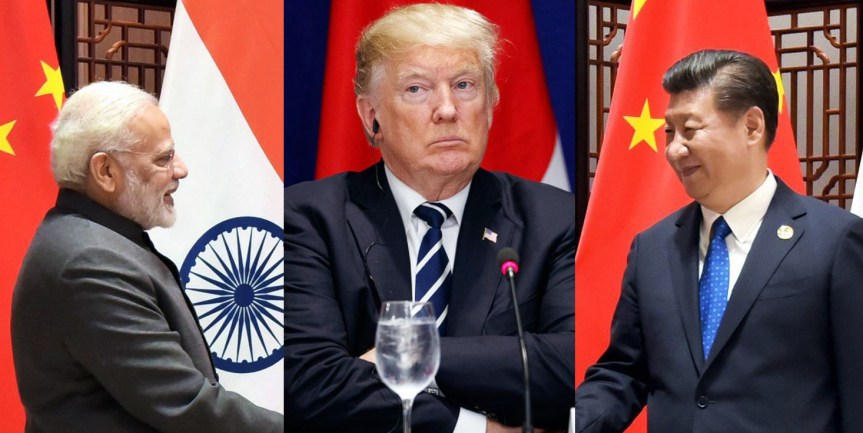
Due to the clash between soldiers of both the countries – India and China around Pangong Lake in Ladakh, one thing is clear that nobody knows what’s coming up next. Once India’s friendship with China seemed natural as the country has put socialist principles in its national constitution and prided on taking a neutral stand during the cold war. Under its first prime minister, Jawaharlal Nehru, India was interested in broadening ties with other socialist nations, including Russia & China. But factors more powerful than the ideologies knocked off the relationship leading to tensions and war-like situations today.
At first, the relationship was all smiles based on five principles enunciated under the Panchsheel Agreement: mutual non-aggression, mutual respect for territorial integrity and sovereignty, mutual non-interference in internal affairs, peaceful coexistence and equality and mutual benefit. A slogan also went out, “Hindi Chini Bhai-Bhai”– India and China are brothers.
But soon, India and China started to disagree on the border between the two nations. All thanks in part to the legacy of certain colonial boundaries. The Ardagh- Johnson Line was drawn by British India that showed Aksai Chin inside Jammu& Kashmir in India. This didn’t go down well with China as they never accepted this border. Instead, they argued for Macartney-MacDonald Line, a later boundary that gave it more territory.
There were talks in India in 1960 between Nehru and Zhou Enlai, the Chinese Premier to address border issues but no solutions came up. Keen to maintain the strategic relationship between the two countries, India hosted Dalai Lama when he fled and kept funding resistance movements in Tibet.
The brotherhood died after the two nations went to war. The events of 1962 are broadly seen as humiliating domestically for India.
Even more critical to understand India- China relationship is an alliance between Pakistan & China. As both have border issues with India, a common goal emerged. In recent years, Pakistan Prime Minister Imran Khan and his predecessors have maintained deeper ties with China through initiatives such as Chinese funding for Gwadar port, China-Pakistan Economic Corridor, and other economic initiatives. Because of this, Pakistan’s cooperation with the US has also crumbled up under pressure. If another Cold War happens, it already seems Pakistan has chosen its side.
This has helped India to strengthen its relationship with the US. India choosing free markets was a drastic change for the nation, and a shift to the Western economic sphere soon followed. As India started seeing high rates of growth, it started becoming China’s competitor. India also managed to tighten relations with American allies such as Vietnam and Japan.
Today, the United States plays a key role in the Indo-China relationship. In recent times, India has sought to strengthen ties with the US, powered by fear of Chinese political and economic influence in the region. Even since the Chinese have got more aggressive in the Indian Ocean, India is seeking an ally in the US to bolster deterrence.
All this clearly shows we are a long way in Hindi-Chini Bhai Bhai.
 Track2Training