


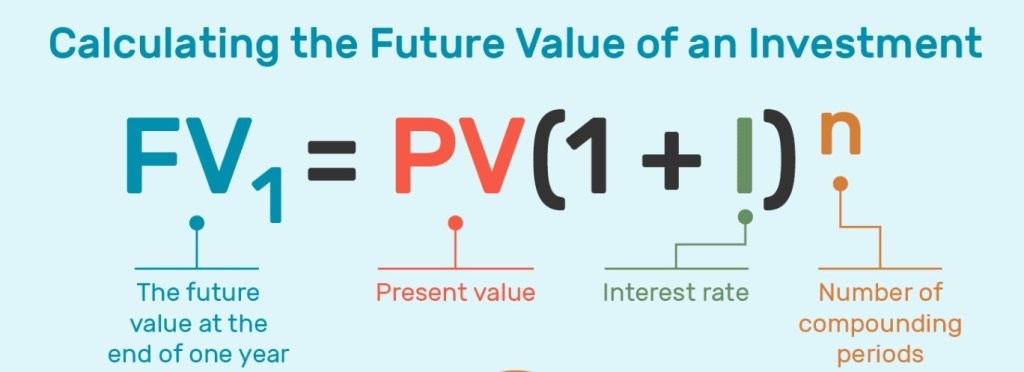
1️⃣ What is Future Value (FV)?
Future Value (FV) is the value of a present investment at a specific time in the future, assuming a certain rate of interest (or growth rate).
It answers:
“If I invest today, how much will it grow in the future?”
In architecture and planning, FV is used to:
- Estimate future land value
- Project rental income growth
- Evaluate long-term infrastructure returns
- Assess property appreciation
- Forecast maintenance funds
2️⃣ Basic Future Value Formula (Single Lump Sum)
FV=PV(1+r)n
Where:
- FV = Future Value
- PV = Present Value
- r = Interest or growth rate
- n = Number of years
3️⃣ Future Value with Multiple Annual Cash Flows
If equal annual payments are made (annuity):FV=A(r(1+r)n−1)
Where:
- A = Annual amount
- r = Interest rate
- n = Number of years
4️⃣ Example 1: Land Appreciation in Urban Planning
An investor buys land for ₹10,00,000.
Expected annual appreciation rate = 8%
Holding period = 5 years
Step 1: Apply Formula
FV=10,00,000(1+0.08)5 FV=10,00,000(1.4693) FV=₹14,69,300
👉 After 5 years, the land value is approximately ₹14.69 lakh.
5️⃣ Example 2: Commercial Property Investment
Present Investment = ₹50,00,000
Expected annual growth rate = 10%
Period = 3 yearsFV=50,00,000(1.10)3 FV=50,00,000(1.331) FV=₹66,55,000
👉 The property value grows to ₹66.55 lakh in 3 years.
6️⃣ Example 3: Future Value of Annual Rental Savings
A building generates annual surplus cash of ₹5,00,000.
The amount is reinvested at 7% interest.
Period = 4 years
Using annuity formula:FV=5,00,000(0.07(1.07)4−1) (1.07)4=1.3108 FV=5,00,000(0.071.3108−1) FV=5,00,000×4.44 FV≈₹22,20,000
👉 Total accumulated value after 4 years = ₹22.2 lakh.
7️⃣ Applications in Architecture & Urban Planning
🔹 1. Real Estate Feasibility
- Predicting property appreciation
- Estimating resale value
- Forecasting rental growth
🔹 2. Transit-Oriented Development (TOD)
- Estimating future land value increase
- Forecasting commercial return near metro stations
🔹 3. Infrastructure Projects
- Estimating future toll revenue
- Predicting parking revenue growth
🔹 4. Maintenance Fund Planning
- Planning sinking funds for building repairs
- Estimating future corpus for redevelopment
8️⃣ Difference Between Present Value and Future Value
| Future Value | Present Value |
|---|---|
| Moves money forward in time | Brings future money to present |
| Used for forecasting | Used for feasibility analysis |
| Calculates growth | Calculates discounting |
9️⃣ Importance in Planning Decisions
Future Value helps planners:
- Understand long-term asset appreciation
- Evaluate redevelopment timing
- Plan phased investment strategies
- Compare long-term financial scenarios
- Estimate infrastructure revenue growth
🔟 Limitations
❌ Assumes constant growth rate
❌ Does not account for risk variations
❌ Inflation uncertainty affects accuracy
❌ Market volatility not considered
11️⃣ Conclusion
Future Value (FV) is a crucial financial tool in architecture and urban planning. It helps estimate how present investments grow over time, enabling planners and developers to forecast:
- Land and property appreciation
- Rental growth
- Infrastructure returns
- Long-term financial sustainability
Understanding FV supports better strategic decision-making in long-term urban development projects.


You must be logged in to post a comment.