
By Dileep Verma (Research Expert and Associate Editor of Track2training, New Delhi, India)
Writing your first research paper and targeting Scopus or ESCI (Emerging Sources Citation Index) journals feels like a daunting task when you start your PhD. Many early-career scholars make the mistake of jumping straight into writing without understanding how academic papers are structured and built.
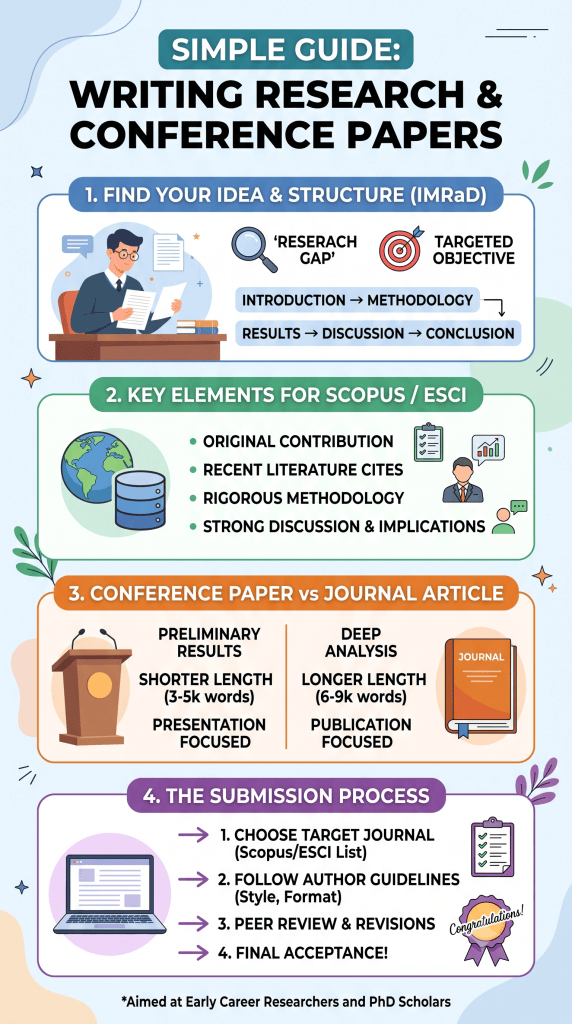
Here is a step-by-step roadmap to guide you from a raw research idea to a polished paper ready for indexing.
1. Foundation: Framing a Publishable Idea
A paper published in Scopus or ESCI must contribute something distinct. It does not need to revolutionize the field, but it must offer a fresh lens, clear data, or a new context.
- Identify a Specific Research Gap: Read 15 to 20 recent papers (published in the last three years) from top journals in your field. Look at their “Future Research Directions” or “Limitations” sections. That is where your paper begins.
- Refine Your Objective: Avoid broad topics. Instead of writing about “Public Policy in India,” focus on a concrete, measured angle like “Perception Analysis of Reservation Policy Implementation among SC Communities in Central India.”
- Choose the Right Paper Type: As a beginner, focus on either an empirical paper (based on primary data like surveys or interviews) or a systematic literature review (SLR) using PRISMA guidelines. Both are welcomed by Scopus/ESCI journals if done rigorously.
2. Standard Structure of a Research Paper (IMRaD)
High-impact journals follow a clear, predictable structure: Introduction, Methodology, Results, and Discussion (IMRaD).
+-------------------------------------------------------------------+| TITLE || Clear, specific, and reflecting main variables |+-------------------------------------------------------------------+ | v+-------------------------------------------------------------------+| ABSTRACT || Context -> Problem -> Method -> Key Finding -> Implication |+-------------------------------------------------------------------+ | v+-------------------------------------------------------------------+| INTRODUCTION || 1. Background & Context || 2. Practical & Theoretical Problem || 3. Literature Gap || 4. Research Questions / Objectives |+-------------------------------------------------------------------+ | v+-------------------------------------------------------------------+| LITERATURE REVIEW || Thematic mapping of existing studies & theoretical framework |+-------------------------------------------------------------------+ | v+-------------------------------------------------------------------+| METHODOLOGY || Research design, sample selection, data collection & tools |+-------------------------------------------------------------------+ | v+-------------------------------------------------------------------+| RESULTS & FINDINGS || Direct, clear presentation of data (Tables/Graphs + Narrative) |+-------------------------------------------------------------------+ | v+-------------------------------------------------------------------+| DISCUSSION || Compare your findings with existing literature & theory |+-------------------------------------------------------------------+ | v+-------------------------------------------------------------------+| CONCLUSION || Key takeaway, policy/practical implications, & limitations |+-------------------------------------------------------------------+
The Section-by-Section Breakdown
A. Title and Abstract
Write these last. Your title should be direct and informative. The abstract (150–250 words) must summarize five things:
- Context/Problem
- Objective
- Methodology used
- Key findings
- Broader implications
B. Introduction
Your introduction sets the hook for reviewers. Keep it clear and logical using a 4-paragraph model:
- Paragraph 1: Context and importance of the topic.
- Paragraph 2: The core problem and what previous studies missed (the gap).
- Paragraph 3: Your study’s specific objective and research questions.
- Paragraph 4: The value and originality of your contribution.
C. Literature Review
Do not just summarize paper by paper (“Author A said X, Author B said Y”). Instead, organize your review thematically. Group existing works around themes, spot contradictions in past research, and show how your study connects to established theories.
D. Methodology
Write this section with enough clarity that another researcher could replicate your study.
- Explain your research design (quantitative, qualitative, or mixed-methods).
- State your population, sample size, sampling technique, and instruments (e.g., Likert-scale surveys or semi-structured interviews).
- Mention ethical considerations and data validation techniques (e.g., Cronbach’s alpha for quantitative reliability or thematic analysis for qualitative data).
E. Results
Present your data plainly. Use tables and figures to summarize large blocks of information. Walk the reader through the key patterns in your data without over-interpreting them yet. Keep your prose objective and direct.
F. Discussion (The Core of Scopus/ESCI Acceptance)
This is where many early papers fail. Do not just repeat your findings. Answer these questions:
- Why did you get these results?
- How do your findings compare with previous studies? Do they agree, contradict, or extend prior research?
- What does this mean for theory and practice (e.g., policy implementation)?
G. Conclusion and Implications
Summarize the main contribution in simple terms. Clearly outline practical/policy implications (how practitioners or policymakers can use this work) and state the limitations of your study candidly.
3. Transitioning from Conference Papers to Journal Articles
Conferences are testing grounds; journals are permanent records.
| Feature | Conference Paper | Scopus/ESCI Journal Paper |
| Length | 3,000–5,000 words | 6,000–9,000 words |
| Focus | Preliminary ideas, ongoing work | Completed research with deep analysis |
| Review Process | Rapid (2–6 weeks), broad feedback | Rigorous peer review (2–6 months) |
| Depth | Basic methodology and initial findings | Comprehensive literature and strong theoretical grounding |
How to Convert a Conference Paper to a Journal Paper
- Expand the Literature Review: Move beyond basic context to deep theoretical analysis.
- Strengthen the Data: Add a larger sample size or deeper qualitative analysis.
- Expand the Discussion: Elaborate heavily on why the findings matter.
- Target a New Draft: Scopus journals typically require significant structural and content updates (at least 30–40% new material) compared to conference proceedings.
4. Academic Writing and Style Essentials
To reach Scopus/ESCI quality, your writing must meet clear academic standards:
- Use Active Voice: Instead of writing “The data was analyzed by the researcher,” write “We analyzed the data using SPSS.” It makes your writing direct and clear.
- Keep Sentences Short and Strong: Express one main idea per sentence. Complex ideas do not require long, convoluted sentences.
- Avoid Fluff: Skip empty phrases like “it is widely acknowledged that” or “a pivotal moment.” Get straight to the point.
- Cite Recent, High-Quality Sources: At least 60–70% of your references should come from indexed journals published in the last 5 years.
5. Submitting and Handling Reviews
Finding the right journal is half the battle.
- Journal Selection: Use tools like Elsevier Journal Finder, Springer Journal Suggester, or Web of Science Master Journal List. Check if the journal is actively listed in Scopus or ESCI.
- Follow Author Guidelines: Adjust formatting, citation style (APA, IEEE, Harvard), word count, and heading styles strictly according to the target journal’s template.
- Handling Rejections and Revisions:
- Desk Reject: Means the paper does not fit the journal scope or lacks basic formatting. Refine and target another journal.
- Major/Minor Revision: A huge win. Address every single reviewer comment in a point-by-point response table, explaining clearly what changes you made.
Writing high-quality papers is a skill built through practice. Focus on clear logic, explicit methods, and strong evidence, and your work will find its place in reputed indexed journals.

