
By Dileep Verma (PhD Senior Research Scholar)
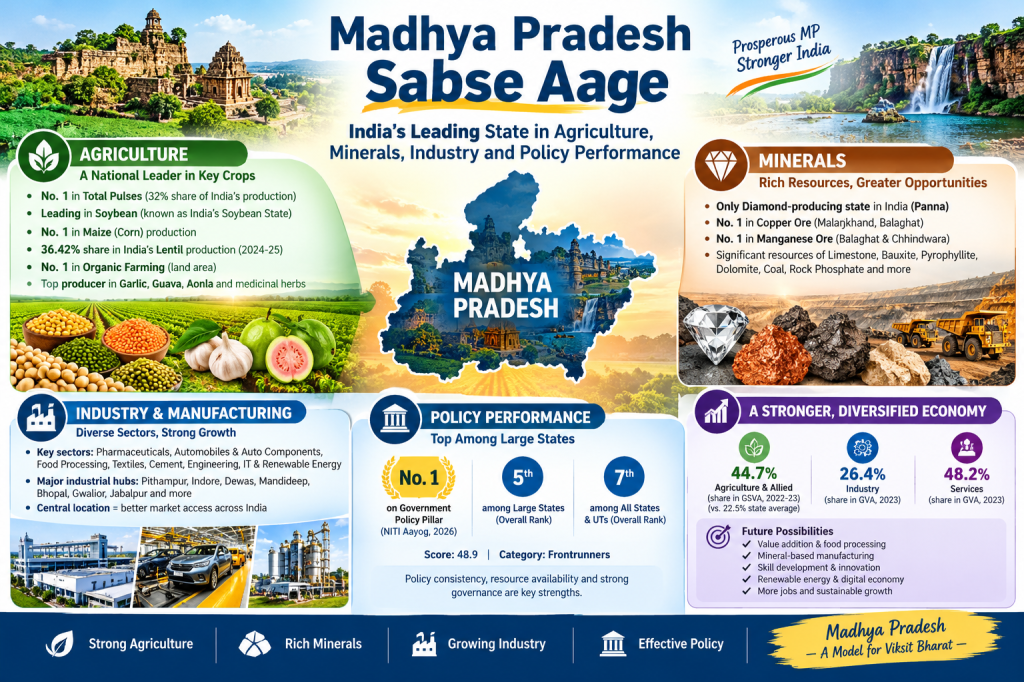
Madhya Pradesh is increasingly emerging as one of India’s important production, investment and economic growth centres. Located at the geographical heart of the country, the state has a unique combination of fertile agricultural land, extensive mineral resources, industrial potential, improving infrastructure and a strategic location connecting northern, western, southern and central India.
The economic strength of Madhya Pradesh is particularly visible in agriculture, minerals, manufacturing, food processing and emerging industries. At the same time, the state’s policy environment is becoming an important advantage. The NITI Aayog Investment Friendliness Index 2026 places Madhya Pradesh 5th among large states and 7th overall, with an overall score of 48.9. More significantly, Madhya Pradesh receives 5.4 out of 10 on the Government Policy pillar—the highest score among the large states in the index.
Agricultural Strength: A Major National Producer
Agriculture remains one of the most important pillars of Madhya Pradesh’s economy. NITI Aayog’s assessment shows that agriculture and allied activities have a much larger share in Madhya Pradesh’s Gross State Value Added than the average for Indian states. In 2022-23, agriculture and allied activities accounted for 44.7% of the state’s GSVA, compared with a states’ average of 22.5%.
Madhya Pradesh has established a particularly strong position in pulses, oilseeds, soybean, wheat, maize and several horticultural crops. The state is one of India’s major pulse-producing centres and has traditionally held a leading position in overall pulse production.
Its importance is especially clear in lentil production. According to the Government of India’s Agricultural Statistics at a Glance 2024-25, Madhya Pradesh accounted for 36.42% of India’s lentil production in 2024-25, placing it ahead of other major producing states.
Soybean is another major strength. Madhya Pradesh is popularly known as India’s “Soybean State” because of its large soybean cultivation and production base. The combination of soybean cultivation with edible-oil processing, food processing and agricultural markets creates significant opportunities for value addition.
The state’s agricultural strength also provides a foundation for expanding food-processing industries, cold chains, warehousing, agricultural logistics, dairy, oil extraction, pulse milling and agro-based manufacturing. The next stage of development is therefore not only to increase production but also to process more agricultural commodities within the state.
Mineral Wealth: A Distinctive National Advantage
Madhya Pradesh has one of India’s most diverse mineral-resource bases. The Indian Bureau of Mines (IBM) identifies Madhya Pradesh as the only diamond-producing state in India and a leading producer of several important minerals, including copper concentrate, diaspore, pyrophyllite, manganese ore, limestone and certain clays.
The state’s diamond resources make it particularly distinctive. Panna district is India’s principal diamond-producing region, and IBM reports estimated diamond resources of 8,47,559 carats in Madhya Pradesh.
Copper is another important mineral resource. Madhya Pradesh is home to the major Malanjkhand copper-mining area in Balaghat district. IBM reports that the state produced approximately 25.46 lakh tonnes of copper ore during 2023-24.
Madhya Pradesh also possesses substantial resources of manganese, limestone, dolomite, coal, rock phosphate, bauxite, pyrophyllite and other minerals. IBM reports that the state hosts significant shares of India’s mineral resources, including approximately 19% of the country’s copper-ore resources, 12% of manganese resources and 8% of rock-phosphate resources.
This mineral wealth offers a major opportunity for industrial development. Instead of concentrating only on mineral extraction, Madhya Pradesh can expand mineral processing, engineering, metal-based manufacturing, construction materials and downstream industries. Such value addition can generate greater employment and economic output.
Manufacturing and Industrial Potential
The industrial economy of Madhya Pradesh is becoming increasingly diversified. Major opportunities exist in pharmaceuticals, automobiles and auto components, food processing, textiles, cement, engineering, mineral-based industries, logistics, renewable energy and information technology.
Industrial areas around Pithampur, Indore, Dewas, Mandideep, Bhopal, Gwalior, Jabalpur and other cities provide a foundation for manufacturing and investment. The central location of the state is an additional competitive advantage because industries can serve markets across several major regions of India.
Madhya Pradesh’s economic structure is gradually changing. According to NITI Aayog’s state profile, agriculture accounted for 25.4% of GVA, industry 26.4% and services 48.2% in FY2023 when measured using the profile’s sector classification.
This diversification demonstrates that the state’s economy is not dependent solely on agriculture. Manufacturing and services are increasingly contributing to growth, creating opportunities for skilled employment, entrepreneurship and investment.
Policy Implementation: Madhya Pradesh Ranks First Among Large States
One of the most significant developments in Madhya Pradesh’s economic profile is its performance in government policy.
The NITI Aayog Investment Friendliness Index 2026 evaluates states across several pillars, including business climate, resources, government policy, infrastructure, financial health and institutional factors. Madhya Pradesh scored 5.4 out of 10 on the Government Policy pillar, the highest score among the large states shown in the index. Gujarat followed with 5.1, Rajasthan with 4.8, Odisha with 4.6 and Maharashtra with 3.8.
This is an important distinction: Madhya Pradesh can accurately be described as No. 1 among large states on the Government Policy pillar of NITI Aayog’s Investment Friendliness Index 2026. It should not, however, be described as No. 1 overall in investment friendliness.
On the composite index, Madhya Pradesh scored 48.9 and ranked fifth among 17 large states and seventh among all 36 states and Union Territories. NITI Aayog places it in the “Frontrunners” category.
The index also identifies government policy and resource availability as key enablers for Madhya Pradesh, while identifying business climate as an area requiring further improvement. The report highlights the consistency of state policies as one of the state’s positive indicators.
Comparing Madhya Pradesh with Other States
The comparison with other large states provides an important perspective. Gujarat, Maharashtra, Tamil Nadu and Odisha occupy higher positions in the overall Investment Friendliness Index, but Madhya Pradesh performs particularly strongly in the Government Policy pillar.
This means Madhya Pradesh has an opportunity to convert its policy strengths into stronger outcomes in investment, manufacturing, exports, employment and innovation.
The state’s challenge is therefore not simply to announce policies but to ensure effective implementation at the district and local levels. Faster approvals, reliable infrastructure, skilled labour, easier access to finance, stronger logistics and better connections between industry and research institutions can further improve the investment environment.
Future Possibilities
Madhya Pradesh’s greatest opportunity lies in connecting its different economic strengths.
Agricultural production can support food-processing industries. Soybean and pulses can supply edible-oil and pulse-processing units. Mineral resources can support downstream manufacturing. Industrial clusters can generate employment for skilled workers. Better roads, railways, logistics and warehousing can connect production centres with national and international markets.
The state can also strengthen research, innovation, startups, digital technology, renewable energy and skill development. These areas can help move the economy from resource-based production toward knowledge-based and value-added growth.
Conclusion
Madhya Pradesh has a strong foundation for becoming one of India’s major production and investment hubs. Its agricultural leadership, distinctive mineral resources, growing manufacturing sector, central geographical location and strong performance on the Government Policy pillar provide important advantages.
Its national position should nevertheless be described accurately. Madhya Pradesh is the only diamond-producing state in India, a leading producer of several important minerals, a major agricultural producer, and No. 1 among large states on NITI Aayog’s Government Policy pillar in the 2026 Investment Friendliness Index. Overall, it ranks 5th among large states and 7th across all states and Union Territories in that index.
The future potential of Madhya Pradesh lies in moving beyond the production of raw agricultural and mineral commodities toward value addition, processing, manufacturing, exports, innovation and skilled employment. With effective policy implementation and continued improvements in infrastructure and business conditions, Madhya Pradesh can strengthen its contribution to India’s economic development and establish itself as a major production powerhouse in the years ahead.
References
- NITI Aayog – Investment Friendliness Index 2026
This is the key source for Madhya Pradesh’s 5th position among large states, 7th overall, and its Government Policy performance.
NITI Aayog – Investment Friendliness Index 2026 - NITI Aayog – A Macro and Fiscal Landscape of the State of Madhya Pradesh
Useful for the state’s agriculture, industry, services, GSVA and overall economic structure. The report notes that agriculture and allied activities accounted for 44.7% of Madhya Pradesh’s GSVA in 2022-23, substantially above the states’ average.
NITI Aayog – Madhya Pradesh Macro and Fiscal Landscape - Indian Bureau of Mines – Indian Minerals Yearbook 2024: Madhya Pradesh
This is the main source for the article’s diamond, copper, manganese, limestone and other mineral information. It identifies Madhya Pradesh as India’s only diamond-producing state and a leading producer of several minerals.
Indian Bureau of Mines – Indian Minerals Yearbook 2024 - Department of Agriculture & Farmers Welfare, Government of India – Agricultural Statistics at a Glance 2024-25
This source supports the article’s agricultural production claims, including Madhya Pradesh’s 36.42% share of India’s lentil production in 2024-25.
Agricultural Statistics at a Glance 2024-25 - NITI Aayog – Madhya Pradesh State Profile / Investment Friendliness Index 2026
This provides the state’s sectoral GVA structure, key industries, resource advantages and policy consistency indicators, making it useful for the industrial and investment sections.
NITI Aayog – Madhya Pradesh State Profile - NITI Aayog – Fiscal Health Index: Madhya Pradesh
This can be used as an additional official reference for the state’s fiscal position, revenue performance, capital expenditure and infrastructure-related financial capacity.
NITI Aayog – Fiscal Health Index: Madhya Pradesh

