
By Ashutosh Sharma
Urban Planning, Sustainable Development and City Governance
Indian cities are undergoing profound transformations. Population growth, infrastructure expansion, housing demand, changing mobility patterns and environmental pressures are reshaping urban landscapes. Yet the central question of urban development is not simply how much a city grows, but whether that growth improves the quality of life of its inhabitants while protecting the natural systems on which urban survival depends.
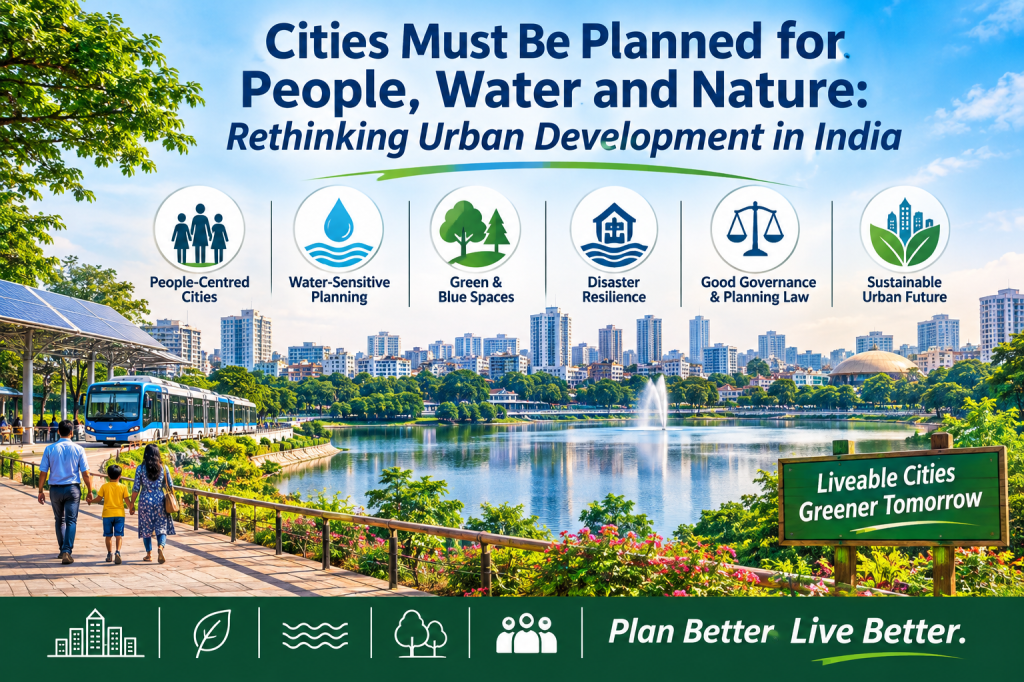
Urban planning must therefore move beyond conventional land-use allocation, road construction and building regulation. A sustainable city requires an integrated framework connecting people, water, land, housing, mobility, public spaces, ecological systems and governance. The future of Indian cities depends on how effectively these elements are planned together rather than managed through fragmented institutional decisions.
1. Urban renewal must begin with existing communities
Indian cities are historically layered settlements. Their traditional neighbourhoods, commercial districts, informal settlements, institutional areas and newer residential developments coexist within complex social and spatial relationships. Redevelopment that treats these areas merely as parcels of land awaiting reconstruction risks destroying valuable social networks, cultural identities and local economies.
The concept of urban renewal must consequently be understood as more than physical improvement. It involves economic revitalisation, environmental restoration, social inclusion, cultural continuity and institutional strengthening. Onkar, Dhote and Sharma, in their discussion of urban renewal in the Indian context, emphasised the need for integrated approaches that respond to existing urban conditions rather than relying exclusively on expansion-oriented planning. Their work highlights the importance of combining physical investment with community development and broader neighbourhood improvement.
[1]
Urban renewal should therefore prioritise upgrading infrastructure, improving housing conditions, rehabilitating public spaces, strengthening local economic activity and protecting vulnerable residents. Redevelopment should be evaluated not merely by the number of buildings replaced or the amount of investment attracted, but by whether existing communities experience lasting improvements in accessibility, affordability, safety and dignity.
2. Water must become the organising principle of urban planning
Water is not simply a utility supplied through pipelines. It is a landscape system involving lakes, rivers, wetlands, groundwater, catchments, drainage channels, rainfall, soil permeability and urban ecosystems. Cities that disregard these relationships often face the paradox of water scarcity during dry periods and flooding during the monsoon.
Water-sensitive urban planning offers an alternative. Instead of treating stormwater as a problem to be removed rapidly through drains, urban development should retain, infiltrate, recharge, reuse and restore water wherever possible. Natural drainage systems, wetlands, lake buffers, permeable surfaces, rainwater harvesting and green infrastructure should become integral components of development plans.
Research on water-sensitive urban planning in Indian cities has highlighted the relationship between urbanisation, altered drainage, declining water availability and increasing flood vulnerability. The Bhopal case discussed in this research demonstrates the relevance of integrating land-use planning, hydrological processes and urban infrastructure management.
[2]
The implications are particularly significant for cities built around lakes and water bodies. Urban lakes should not be regarded as isolated recreational assets. They are ecological infrastructure supporting groundwater recharge, biodiversity, flood moderation, microclimatic regulation and public well-being. Their protection requires catchment-level planning, pollution control, restrictions on encroachment and coordinated management across administrative boundaries.
3. Nature-based solutions are essential urban infrastructure
The conventional model of urban infrastructure has largely emphasised roads, drains, buildings, pipelines and engineered structures. These remain essential, but they cannot independently address the complex challenges of climate change, urban heat, flooding, biodiversity loss and declining environmental quality.
Nature-based solutions offer complementary strategies by working with natural processes. Urban forests, restored wetlands, bioswales, rain gardens, green roofs, permeable pavements, river corridors and interconnected open spaces can perform multiple functions simultaneously. They improve environmental quality while providing recreational, social and economic benefits.
The publication Nature Based Solutions to Prevent Urban Flooding presents the value of integrating ecological restoration, green infrastructure, sustainable land management and water-sensitive interventions into urban flood management. Such approaches encourage cities to consider nature not as leftover space after development, but as a fundamental component of infrastructure planning.
[3]
The challenge for Indian planning institutions is to translate these concepts into enforceable development regulations, infrastructure investment programmes and measurable planning standards. Green spaces should be connected, accessible and ecologically functional—not merely designated as green on maps.
4. Resilience must be built into development plans
Urban resilience is frequently discussed after disasters, but effective resilience begins before construction. Flood-prone areas, seismic vulnerabilities, drainage corridors, unstable terrain and critical infrastructure locations should influence land-use decisions at the earliest planning stage.
A development plan should identify areas where development must be restricted, areas requiring additional safety measures and infrastructure networks that must remain operational during emergencies. Hazard assessment should influence building regulations, evacuation routes, development intensity, emergency services and infrastructure investment.
The research Planning Model for Multiple Hazard Prone Towns, by Kamat, Saxena and Sharma, proposes a planning approach informed by earthquake and flood damage assessment. It underscores the importance of incorporating disaster-risk considerations into the development plans of vulnerable settlements rather than treating disaster management as a separate activity.
[4]
This principle is especially important for rapidly expanding Indian cities. Peripheral development frequently advances into areas where infrastructure provision, environmental assessment and disaster preparedness are inadequate. Resilient planning must anticipate these risks and guide growth toward locations where development can be supported safely and sustainably.
5. Planning law must protect the public interest
A development plan is not simply a technical document. It is a public instrument that determines land rights, development opportunities, infrastructure obligations, environmental protection and the future distribution of urban benefits.
The effectiveness of planning depends on transparent procedures, evidence-based decisions, public participation and enforceable legal safeguards. Planning authorities must explain the rationale behind zoning decisions, development regulations, land reservations and infrastructure proposals. Citizens should have meaningful opportunities to understand, question and influence decisions affecting their neighbourhoods.
In Law of the City – Ready Reference Handbook, planning legislation and urban governance are examined through the relationship between statutory procedures, administrative responsibilities, public accountability and development-plan implementation. The book emphasises the importance of legal compliance and procedural fairness in urban decision-making.
[5]
Legal accountability is essential because a technically sophisticated plan can still fail if implementation is arbitrary, institutional responsibilities are unclear or public objections are inadequately considered. The legitimacy of urban planning rests on its ability to reconcile development aspirations with constitutional principles, statutory requirements and collective public interest.
6. From master plans to measurable urban outcomes
The future of urban planning requires a shift from plan preparation to performance evaluation. Cities need measurable indicators that reveal whether planning interventions are delivering meaningful outcomes.
Such indicators could include:
- Percentage of households with reliable year-round drinking-water access.
- Walking distance to public parks and open spaces.
- Percentage of urban land protected from inappropriate development.
- Public transport accessibility and pedestrian safety.
- Stormwater infiltration and groundwater recharge.
- Affordable housing availability and infrastructure adequacy.
- Reduction in flood exposure and urban heat.
- Compliance with development regulations and public participation requirements.
These indicators should be spatially mapped and regularly updated. Geographic information systems, remote sensing, field surveys, public data and citizen participation can support monitoring and enable planners to identify disparities between planned provisions and actual conditions.
Cities should also establish mechanisms for reviewing development plans as environmental, demographic and economic conditions change. Planning should be a continuous learning process rather than a static exercise undertaken once every few decades.
Conclusion: The city as a living system
The sustainable Indian city of the future cannot be created through infrastructure expansion alone. It must emerge from an integrated understanding of urban development as a relationship between people, land, water, nature, institutions and law.
Urban renewal must protect communities. Water-sensitive planning must restore ecological processes. Nature-based solutions must become essential infrastructure. Disaster resilience must shape development decisions. Planning law must ensure accountability. And measurable indicators must establish whether cities are delivering equitable and sustainable outcomes.
The objective of urban planning should ultimately be to create cities that are not only economically productive and physically developed, but also environmentally responsible, socially inclusive, legally accountable and capable of sustaining everyday life.
A city is successful not merely when it grows, but when its people, ecosystems and institutions can thrive together.
References
1. Onkar, P., Dhote, K. K., & Sharma, A. (2008). Exploring the concept of urban renewal in the Indian context. ITPI Journal, 5(2), 42–46. itpi.org.in+1
2. Sharma, S., Bharat, A., Das, V. M., & Bhatt, V. (2013). Indian urban centers in need for water-sensitive urban planning approach. India Water Week, New Delhi. ResearchGate
3. Sharma, S. N., & Ayuba, D. (2024). Nature Based Solutions to Prevent Urban Flooding. EduPub International Book Publisher. ISBN 978-93-92585-34-0. EduPub Books
4. Kamat, R., Saxena, A., & Sharma, A. (2010). Planning model for multiple hazard prone towns. Coordinates: Positioning, Navigation and Beyond. mycoordinates.org+1
5. Sharma, A. (2026). Law of the City – Ready Reference Handbook: Planning Legislation and Urban Governance in India. EduPub International Book Publisher. ISBN 978-93-92585-10-4. https://doi.org/10.26643/EDUPUB/978-93-92585-10-4 Ready Reference H


You must be logged in to post a comment.