
Cryptocurrency Heist

Programmers behind one of the greatest ever advanced coin heists have presently returned about all of the $610 million (generally Rs. 4,530 crores)-plus they stole, Poly Organize, the cryptocurrency stage focused on prior this week by the assault, said on Thursday. The stage, which was small known some time recently Tuesday’s heist, pronounced the programmer on Twitter as a “white cap,” alluding to moral programmers who by and large point to uncover cyber vulnerabilities, upon the return of the reserves.

Poly Arrange, which encourages peer-to-peer token exchanges, included that the tokens were exchanged to a multi-signature wallet controlled by both the stage and the hacker. The as it were remaining tokens however to be returned are the $33 million(roughly Rs. 245 crores) in tie stablecoins solidified prior within the week by cryptocurrency firm Tie, Poly Organize said.

The reimbursement prepare has not however been completed. To guarantee the secure recuperation of client resource, we trust to preserve communication with Mr. White Cap and pass on precise data to the open,” said Poly Arrange on Twitter. A individual claiming to have executed the hack said Poly Organize advertised him a $500,000 (generally Rs. 3.7 crores) bounty to return the stolen resources and guaranteed that he would not be responsible for the occurrence, agreeing to computerized messages shared on Twitter by Tom Robinson, chief researcher and co-founder of Elliptic, a crypto following firm. Poly Arrange, which permits clients to exchange or swap tokens over distinctive blockchains, said on Tuesday it had been hit by the cyberheist, encouraging the guilty parties to return the stolen stores

The still as however unidentified programmer or programmers show up to have misused a powerlessness within the computerized contracts Poly Arrange employments to move resources between distinctive blockchains, agreeing to blockchain forensics company Chainalysis. On Wednesday, the programmers begun returning the stolen coins, driving a few Blockchain examiners to guess that they might have found it as well troublesome to wash stolen cryptocurrency on such a scale. Later on Wednesday, the programmers said in computerized messages moreover shared by Elliptic that they had executed the assault “for fun” and needed to “uncover the defenselessness” some time recently others could abuse it which it was “continuously” the arrange to return the tokens.

At $600 million (generally Rs. 4.460 crores), in any case, the Poly Organize burglary distant surpassed the record $474 million (generally Rs. 3,520 crores) in criminal misfortunes that were enrolled by the whole decentralized fund (DeFi) division from January to July, concurring to crypto insights company CipherTrace. The burglary outlines the dangers of the for the most part unregulated DeFi segment, said crypto specialists. DeFi stages permit clients to conduct exchanges, more often than not in cryptocurrency, without conventional watchmen such as banks or trades.
FOREIGN EXCHANGE MARKET

The market or a platform in which the national currencies of various countries are exchanged or converted for each other is called the foreign exchange market. This market covers various institutions such as banks, official government agencies, dealers in foreign exchange etc.

The foreign exchange market is bifurcated-Spot market and Forward market.

A spot market handles spot or current transactions in foreign exchange. The exchange rate is Spot rate. The transactions are affected by the prevailing rates at the point of time and delivery of foreign exchange is thus affected.

A market where the foreign exchange is bought and sold for future delivery is called forward market. It deals with foreign exchange transactions that are contracted today but are implemented in future. The exchange rate prevailing in this market is Forward rate.

REASONS FOR RISING DEMAND FOR FOREIGN EXCHANGE

  • In a situation of fall in foreign exchange rates, the imports from that foreign country becomes cheaper and thus, there will demand for higher imports. Hence the demand for that foreign currency increases.
  • The price fall in foreign exchange rate also implies foreign currency becomes cheaper than domestic currency and promotes tourism to that country. This increases demand for foreign currencies.

The situation is just opposite for falling demand for foreign currencies where imports become costly and thus its demand falls.

REASONS FOR RISING SUPPLY OF FOR FOREIGN EXCHANGE

  • In a situation of rise in foreign exchange rates, then the home country’s goods are cheaper to the foreign countries and thus, it increases the flow of foreign currency into home country by way of exports.
  • A rise in foreign exchange rates also attract foreigners to visit home country as the home country’s currency becomes cheaper. This also increases supply of foreign currencies.

The situation is just opposite for falling supply of foreign exchange as investment in goods and services become costly for foreigners.

DETERMINATION OF FOREIGN EXCHANGE RATE

The exchange rate is determined at that point where demand for foreign exchange equates supply of foreign exchange which is nothing but the equilibrium exchange rate of foreign currency.

In the diagram above, there are two currencies US dollars(foreign country) and Indian rupees (home country) taken in X- axis and Y-axis respectively.

In the diagram, the demand curve is downward sloping. The reason of demand curve being negatively sloped, any graph for that matter, is because in general demand for a commodity increases when there is a decrease in its price. Thus, demand and price of that commodity are inversely related to each other. However, supply curve is positively sloped because supply and price have a direct relationship. In the context of foreign exchange market, demand (DD) is negatively sloped which implies less foreign exchange is demanded when exchange rate rises. Supply (SS) is upward sloping which mans that supply of foreign exchange rises with increase in exchange rate.

In the diagram , both curves intersect at point E which is the equilibrium point. OR is the equilibrium rate and the equilibrium quantity is OQ.

There are changes in the exchange rate only when there are changes in demand and supply. Suppose, if there is an increase in the demand for US dollars in India, it shifts the demand curve from DD to D’D’. The demand will increase the exchange rate shifting it from OR to OR1. It represents depreciation of Indian currency in terms of US dollars.

Similarly, a rise in the supply of US dollars will cause supply curve to shift from SS to S’S’ and the exchange rate would also shift from OR to OR2. This leads to appreciation of Indian rupees in terms of US dollars.

This is the process by which the exchange rate between various currencies take place.

Relevant links:https://www.ndtv.com/business/rupee-vs-dollar-rate-today-rupee-depreciates-to-74-23-against-dollar-amid-muted-domestic-equities-2475230 https://in.news.yahoo.com/goal-without-proper-plan-destined-074454320.html

2000 Rupees Notes Not Printed By RBI In 2019-20, Currency is Still Valid

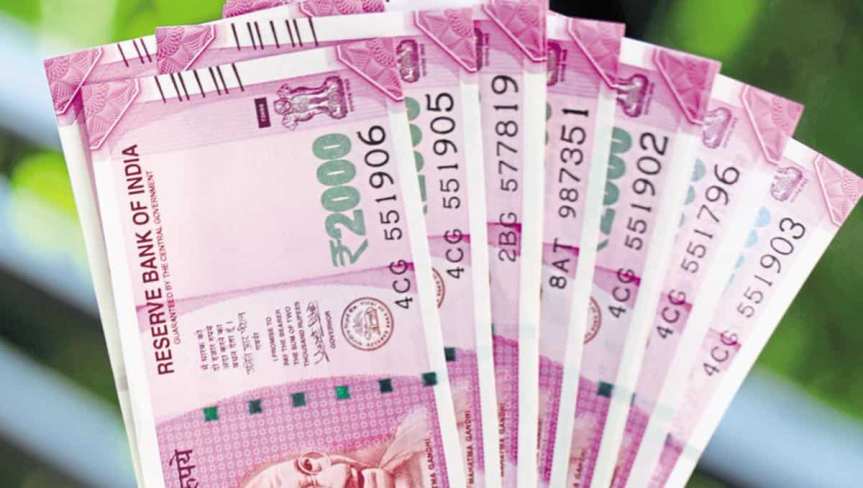
Rs. 2000 notes were introduced by the Government of India after the announcement of the demonetization of 500 and 1000 rupees notes in November, 2016. Currently, it is the highest denomination currency note of the country. According to the annual report of the RBI, the Rs 2000 denomination note was not printed at all during 2019-2020.

These notes were introduced after the government announced demonetisation of old Rs 500 and Rs 1,000 notes 4 years back. At that time, those two denominations had accounted for 86% of the then total currency in circulation.

The number of Rs 2,000 denomination notes had peaked at 3.36 billion units in 2017-18. This number had dropped to 3.29 billion in the years 2018-19. It has again fallen to 2.73 billion in 2019-20. The currency note presses of the Reserve Bank of India (RBI) did not print even one Rs 2,000 note in the last year. This happened because the presses did not receive any order for printing those. This seems to indicate a conscious decision for starting the trend of decreasing the number of notes which are circulated. The 2000 notes under circulation was 50% in 2016-17 and it has come down to almost 22% in 2019-20. These figures are based on RBI’s Annual Report for 2019-20, which was released on August 25 2020.

It is also known that RBI has also disposed a disproportionate share of Rs 2,000 notes in the soiled category. This has raised many questions on the government’s plan about the 2000 denomination note. In January, 2019 the was an indication that the Rs. 2000 notes were not being printed any further because there was adequate supply.

A total of 176.8 million pieces, which is quite a high number, of Rs 2,000 notes under the category of soiled notes were disposed of in 2019-20 by the RBI. While in 2018-19, just 1 million Rs 2,000 notes were disposed of and in 2016-17 or 2017-18, no Rs 2,000 notes were disposed of. Both the 2000 and 500 denomination notes were introduced after demonetisation. In 2019-20, the share of Rs 2000 notes which were disposed of was 6.5% while that of Rs.500 notes was 0.6%. Out of the 22 billion currency notes printed in 2019-20, more than 50% of those were of the Rs 500 denomination. Due to these changes in currency composition, the Rs 500 notes has reached a very high share in the total currency under circulation.

The Minister of State for Finance Anurag Singh Thakur had told the Lok Sabha on March 16, 2020 that, “Printing of bank notes of particular denomination is decided by the government in consultation with RBI to maintain the desired denomination mix for facilitating transactional demand of public. No indent was placed with the presses for printing of Rs 2,000 denomination notes for 2019-20. However, there is no decision to discontinue the printing of Rs 2,000 bank notes.”

A government official said that, “The Rs 2,000 notes were introduced in 2016 to quickly fill the gap created by demonetisation of Rs 500 and Rs 1,000 notes. It was the need of the hour. Gradually, with increased supply of smaller notes, including new notes of Rs 100 and Rs 200, and with growing popularity of digital transactions, the urgency to issue new Rs 2,000 notes is no longer there. But this does not mean that there is any move to discontinue Rs 2,000 notes. Increasingly, commercial banks are also using more and more smaller notes because their customers often find difficulties in getting change for Rs 2,000 notes.”