DILEEP VERMA

Research Associate, Track2Training, New Delhi, India

PhD Senior Research Fellow (SRF)
Department of Humanities and Social Sciences
Maulana Azad National Institute of Technology (MANIT), Bhopal, Madhya Pradesh, India – 462003

๐Ÿ“ง Email: dilipverma1505@gmail.com
๐Ÿ“ฑ Mobile: +91 7509750540
๐Ÿ”— ORCID: https://orcid.org/0009-0001-0526-3171
๐Ÿ”— LinkedIn: https://www.linkedin.com/in/dileep-verma-41b811325/
๐Ÿ”— ResearchGate: https://www.researchgate.net/profile/Dileep-Verma-7
๐Ÿ”— Google Scholar: https://scholar.google.com/citations?user=Ude17KQAAAAJ&hl=en

PROFESSIONAL HEADLINE

PhD Research Scholar at MANIT Bhopal | Public Policy Researcher | Affirmative Action, Reservation Policy & Dalit Studies | Quantitative Analysis | Stata | SmartPLS | R

PROFESSIONAL PROFILE

Dileep Verma is a PhD Senior Research Fellow in the Department of Humanities and Social Sciences at Maulana Azad National Institute of Technology (MANIT), Bhopal. His doctoral research examines the impact of caste-based reservation policies on Scheduled Castes (SCs) in Madhya Pradesh, with a particular focus on educational access, socio-economic mobility, policy effectiveness, and social justice outcomes.

He holds a Master’s degree in Political Science from Babasaheb Bhimrao Ambedkar University, Lucknow, where he was awarded the Gold Medal for academic excellence. The award was conferred by the Hon’ble President of India, Smt. Droupadi Murmu.

His research interests lie at the intersection of public policy, affirmative action, reservation policy, educational equity, social inclusion, and Dalit studies. He employs quantitative, qualitative, and mixed-method approaches to analyse policy outcomes and social inequalities. His work has been published in internationally recognized Scopus-indexed and ESCI-indexed journals.

He has actively participated in numerous national and international conferences, seminars, workshops, faculty development programmes, and research methodology training programmes. His scholarly contributions focus on reservation policy, affirmative action, social justice, educational inequality, higher education access, and the socio-economic development of marginalized communities.

ACADEMIC QUALIFICATIONS

PhD (Ongoing)

Maulana Azad National Institute of Technology (MANIT), Bhopal
December 2021 – Present

Research Title:
A Study of the Impact of Caste-Based Reservation Policy on Scheduled Castes (SCs) Communities in the State of Madhya Pradesh

Master of Arts (Political Science)

Babasaheb Bhimrao Ambedkar University, Lucknow
2019 – 2021

Dissertation:
Reservation Policy Perspective to Scheduled Community

Achievement: Gold Medalist

Bachelor of Arts

Political Science, History and Social Sciences
2014 – 2017

RESEARCH INTERESTS

  • Public Policy and Governance
  • Reservation Policy and Affirmative Action
  • Dalit Studies and Social Justice
  • Educational Equity and Higher Education
  • Social Inclusion and Social Mobility
  • Policy Evaluation and Impact Assessment
  • Caste, Inequality and Development
  • Quantitative and Mixed-Methods Research

PROFESSIONAL SKILLS

Research and Policy Analysis

  • Public Policy Research
  • Policy Evaluation and Impact Assessment
  • Literature Reviews and Evidence Synthesis
  • Survey Design and Field Research
  • Quantitative and Qualitative Research Methods
  • Academic Writing and Scientific Publishing

Statistical and Analytical Skills

  • Stata
  • SmartPLS (PLS-SEM)
  • R (Bibliometrix/Biblioshiny)
  • SPSS
  • Microsoft Excel
  • Data Visualization

Advanced Methods

  • Logistic Regression
  • Firth Logistic Regression
  • Principal Component Analysis (PCA)
  • Fairlie Decomposition
  • Oaxaca-Blinder Decomposition
  • Bibliometric Analysis
  • Systematic and Structured Literature Reviews

RESEARCH EXPERIENCE

Senior Research Fellow (SRF)

Maulana Azad National Institute of Technology (MANIT), Bhopal
December 2021 – Present

Key Responsibilities

  • Conducting household-level field surveys across multiple districts of Madhya Pradesh.
  • Designing research instruments and survey questionnaires.
  • Performing quantitative and qualitative data analysis.
  • Evaluating public policies related to reservation and affirmative action.
  • Preparing journal articles, policy reports, and conference papers.
  • Conducting literature reviews and evidence synthesis.

PUBLICATIONS

  • Published research articles in Scopus-indexed journals.
  • Published research articles in Emerging Sources Citation Index (ESCI) journals.
  • Published scholarly work in the fields of:
    • Reservation Policy
    • Affirmative Action
    • Social Justice
    • Dalit Studies
    • Higher Education
    • Public Policy
    • Educational Equity

CONFERENCE PRESENTATIONS

Presented research papers at numerous National and International Conferences on:

  • Reservation Policy
  • Affirmative Action
  • Social Justice
  • Public Policy
  • Educational Inclusion
  • Higher Education
  • Dalit Studies
  • Social Mobility and Development

WORKSHOPS AND TRAINING PROGRAMMES

Participated in various national and international:

  • Research Methodology Workshops
  • Quantitative Data Analysis Workshops
  • Academic Writing Workshops
  • Public Policy Workshops
  • Bibliometric Analysis Training Programmes
  • Faculty Development Programmes (FDPs)
  • Higher Education and Social Inclusion Workshops
  • Research Ethics and Publication Workshops

ACADEMIC ACHIEVEMENTS

  • Gold Medal Recipient, Babasaheb Bhimrao Ambedkar University, Lucknow.
  • Award conferred by the Honโ€™ble President of India, Smt. Droupadi Murmu.
  • Senior Research Fellow (SRF), MANIT Bhopal.
  • Published in Scopus and ESCI indexed journals.
  • Presenter at national and international academic conferences.

DECLARATION

I hereby declare that the information provided above is true and correct to the best of my knowledge.

Dileep Verma
PhD Senior Research Fellow
Maulana Azad National Institute of Technology (MANIT), Bhopal

Daily writing prompt
Share one of the best gifts you’ve ever received.

Cash Flow in Architecture and Planning Projects

Daily writing prompt
Share one of the best gifts you’ve ever received.

1๏ธโƒฃ What is Cash Flow?

Cash Flow refers to the movement of money into and out of a project over a specific period of time.

In architecture and planning projects, cash flow helps determine:

  • Project liquidity
  • Financial sustainability
  • Timing of expenditures and revenues
  • Funding requirements
  • Project feasibility

Unlike profit, cash flow focuses on actual money movement, not accounting estimates.


2๏ธโƒฃ Types of Cash Flow in Planning Projects

1. Initial Cash Outflow

  • Land purchase
  • Construction cost
  • Consultant fees
  • Approval fees
  • Infrastructure development

2. Operating Cash Inflows

  • Sales revenue
  • Rental income
  • Parking fees
  • Service charges
  • Government grants

3. Operating Cash Outflows

  • Maintenance
  • Utility expenses
  • Management cost
  • Loan repayment

3๏ธโƒฃ Basic Formula of Cash Flow

๐Ÿ”น Single Period Cash Flow

Net Cash Flow=Cash Inflowsโˆ’Cash OutflowsNet\ Cash\ Flow = Cash\ Inflows – Cash\ OutflowsNet Cash Flow=Cash Inflowsโˆ’Cash Outflows


๐Ÿ”น Multi-Year Cash Flow

Net Cash Flowt=Inflowtโˆ’OutflowtNet\ Cash\ Flow_t = Inflow_t – Outflow_tNet Cash Flowtโ€‹=Inflowtโ€‹โˆ’Outflowtโ€‹

Where:

  • ttt = year or time period

๐Ÿ”น Total Project Cash Flow

Total Net Cash Flow=โˆ‘(Cash Inflows)โˆ’โˆ‘(Cash Outflows)Total\ Net\ Cash\ Flow = \sum (Cash\ Inflows) – \sum (Cash\ Outflows)Total Net Cash Flow=โˆ‘(Cash Inflows)โˆ’โˆ‘(Cash Outflows)


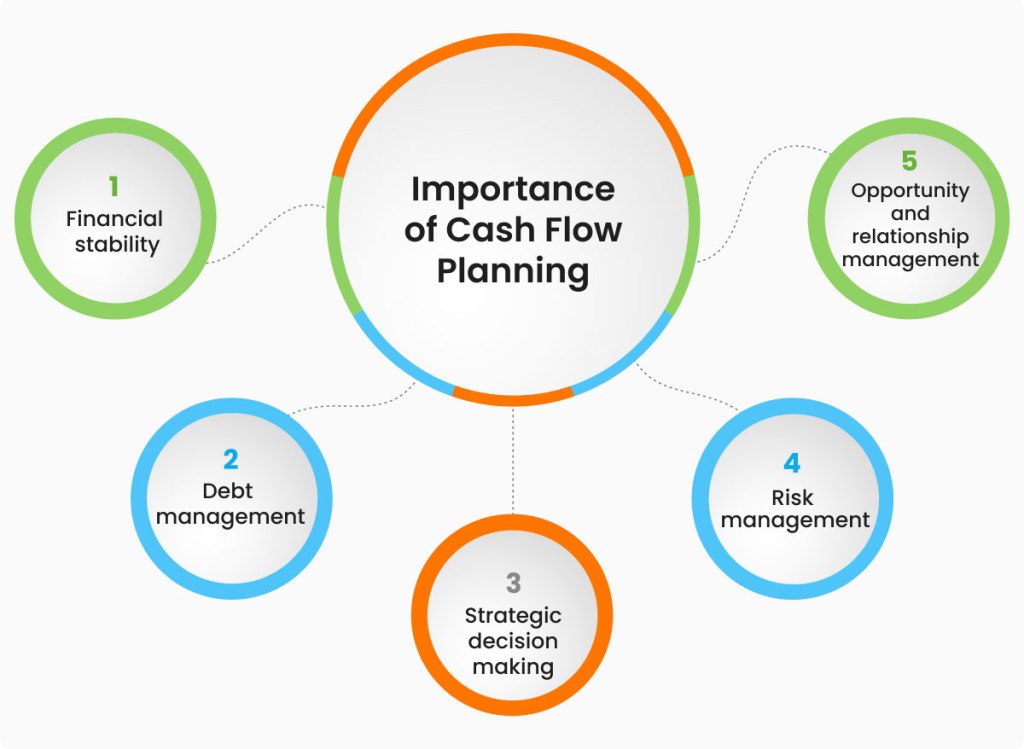
4๏ธโƒฃ Importance of Cash Flow in Architecture & Planning

Cash flow analysis helps:

  • Determine funding gaps
  • Plan construction phases
  • Decide project phasing
  • Manage loans and EMIs
  • Evaluate real estate feasibility
  • Assess infrastructure viability

Without positive cash flow, even profitable projects can fail due to liquidity issues.


5๏ธโƒฃ Detailed Examples in Architecture and Planning Context


โœ… Example 1: Residential Apartment Project (3-Year Development)

Initial Investment (Year 0)

  • Land = โ‚น40,00,000
  • Construction = โ‚น50,00,000
  • Other Costs = โ‚น10,00,000

Total Outflow (Year 0) = โ‚น1,00,00,000


Year 1

Sales Revenue = โ‚น30,00,000
Expenses = โ‚น5,00,000Net Cash Flow1=30,00,000โˆ’5,00,000Net\ Cash\ Flow_1 = 30,00,000 – 5,00,000Net Cash Flow1โ€‹=30,00,000โˆ’5,00,000 =โ‚น25,00,000= โ‚น25,00,000=โ‚น25,00,000


Year 2

Sales Revenue = โ‚น50,00,000
Expenses = โ‚น10,00,000Net Cash Flow2=50,00,000โˆ’10,00,000Net\ Cash\ Flow_2 = 50,00,000 – 10,00,000Net Cash Flow2โ€‹=50,00,000โˆ’10,00,000 =โ‚น40,00,000= โ‚น40,00,000=โ‚น40,00,000


Year 3

Sales Revenue = โ‚น45,00,000
Expenses = โ‚น5,00,000Net Cash Flow3=45,00,000โˆ’5,00,000Net\ Cash\ Flow_3 = 45,00,000 – 5,00,000Net Cash Flow3โ€‹=45,00,000โˆ’5,00,000 =โ‚น40,00,000= โ‚น40,00,000=โ‚น40,00,000


Total Cash Flow Over Project

Total Inflows = โ‚น1,25,00,000
Total Outflows = โ‚น1,00,00,000 + โ‚น20,00,000

Total Outflows = โ‚น1,20,00,000Net Cash Flow=1,25,00,000โˆ’1,20,00,000Net\ Cash\ Flow = 1,25,00,000 – 1,20,00,000Net Cash Flow=1,25,00,000โˆ’1,20,00,000 =โ‚น5,00,000= โ‚น5,00,000=โ‚น5,00,000


โœ… Example 2: Commercial Office Building (Rental Model)

Initial Construction Cost

โ‚น5,00,00,000 (Year 0)


Annual Rental Income = โ‚น80,00,000

Annual Maintenance = โ‚น20,00,000

Net Cash FlowAnnual=80,00,000โˆ’20,00,000Net\ Cash\ Flow_{Annual} = 80,00,000 – 20,00,000Net Cash FlowAnnualโ€‹=80,00,000โˆ’20,00,000 =โ‚น60,00,000= โ‚น60,00,000=โ‚น60,00,000


If calculated for 5 years:60,00,000ร—5=โ‚น3,00,00,00060,00,000 \times 5 = โ‚น3,00,00,00060,00,000ร—5=โ‚น3,00,00,000

Remaining investment recovery after 5 years:5,00,00,000โˆ’3,00,00,000=โ‚น2,00,00,0005,00,00,000 – 3,00,00,000 = โ‚น2,00,00,0005,00,00,000โˆ’3,00,00,000=โ‚น2,00,00,000

This shows project still needs 2โ€“3 more years to break even.


โœ… Example 3: Urban Parking Facility

Initial Investment = โ‚น2,50,00,000

Annual Parking Revenue = โ‚น70,00,000
Annual Operating Cost = โ‚น30,00,000Net Cash FlowAnnual=70,00,000โˆ’30,00,000Net\ Cash\ Flow_{Annual} = 70,00,000 – 30,00,000Net Cash FlowAnnualโ€‹=70,00,000โˆ’30,00,000 =โ‚น40,00,000= โ‚น40,00,000=โ‚น40,00,000


Payback Period:2,50,00,000รท40,00,000=6.25 years2,50,00,000 รท 40,00,000 = 6.25\ years2,50,00,000รท40,00,000=6.25 years

๐Ÿ‘‰ The project will recover its cost in approximately 6.25 years.


6๏ธโƒฃ Cash Flow Statement Structure (Project-Based)

YearInflowsOutflowsNet Cash Flow
001,00,00,000-1,00,00,000
130,00,0005,00,00025,00,000
250,00,00010,00,00040,00,000
345,00,0005,00,00040,00,000

7๏ธโƒฃ Applications of Cash Flow in Planning

โœ” Phasing of Urban Projects

  • Township development
  • TOD corridor development
  • Smart city implementation

โœ” Infrastructure Planning

  • Metro station development
  • Bus terminals
  • Multi-level parking

โœ” Sustainability Investments

  • Green building features
  • Solar installations
  • Water treatment systems

โœ” Public-Private Partnerships (PPP)

Cash flow determines:

  • Concession period
  • Revenue sharing
  • Viability gap funding

8๏ธโƒฃ Advantages of Cash Flow Analysis

  • Shows liquidity position
  • Helps manage loans
  • Identifies funding gaps
  • Supports phased development
  • Essential for DPR preparation

9๏ธโƒฃ Limitations

  • Does not consider time value of money (unless discounted)
  • Future cash flow projections may be uncertain
  • Ignores social and environmental benefits

For advanced analysis, planners combine cash flow with:

  • Discounted Cash Flow (DCF)
  • Net Present Value (NPV)
  • Internal Rate of Return (IRR)

๐Ÿ”Ÿ Conclusion

Cash Flow analysis is a fundamental financial tool in architecture and urban planning projects. It helps:

  • Track money movement
  • Plan project phasing
  • Evaluate feasibility
  • Assess infrastructure viability
  • Ensure financial sustainability

For architects and planners, understanding cash flow is essential for preparing financially realistic and implementable projects.