Innovative Approaches to Sustainable Waste Management in Global South
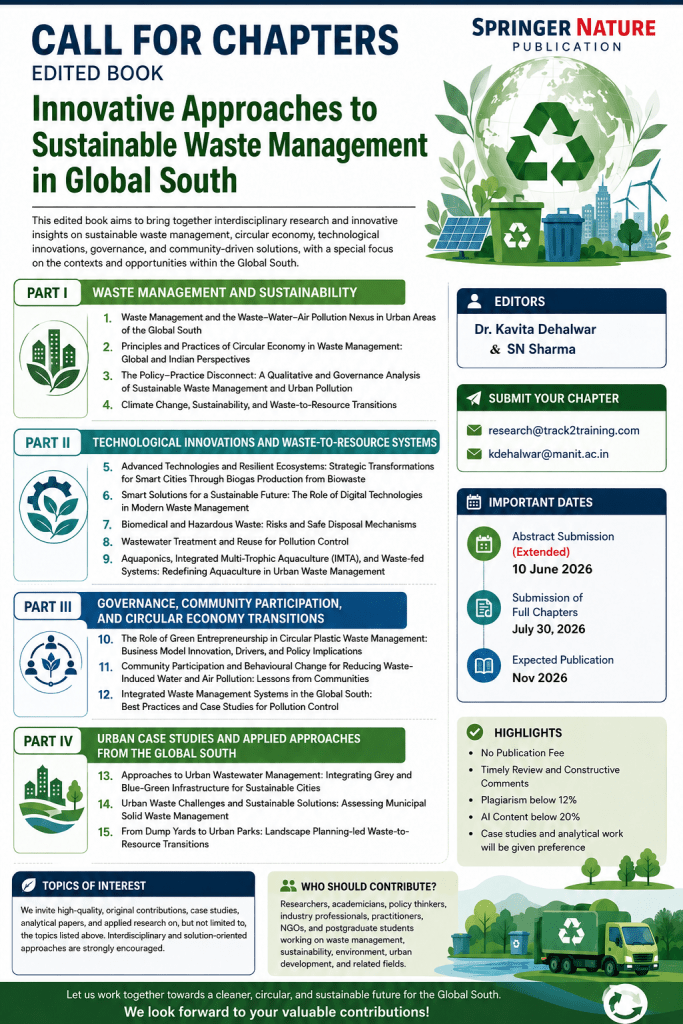
We invites original book chapter proposals for the upcoming edited volume “Innovative Approaches to Sustainable Waste Management in Global South” to be published with Springer Nature. This edited book aims to provide a multidisciplinary platform for researchers, academicians, planners, environmentalists, engineers, policymakers, and practitioners working on sustainable waste management, circular economy, urban resilience, environmental governance, and climate-responsive development.
The volume focuses on innovative, technology-driven, policy-oriented, and community-centered approaches to waste management practices in developing and emerging economies. Contributions are expected to address contemporary challenges and practical solutions related to solid waste, wastewater, hazardous waste, circular economy systems, waste-to-energy technologies, sustainable urban planning, environmental health, and resource recovery systems within the Global South context.
Editors have previously contributed to internationally recognized scholarly publications indexed and hosted by Springer Nature, including:
- Deltas Resilience: Nature-Based Solutions for Sustainable Development in India
- Springer Nature Publications
These publications demonstrate the commitment of Track2Training toward supporting high-quality interdisciplinary academic publishing and global research dissemination.
About the Edited Book
Rapid urbanization, population growth, industrial expansion, and changing consumption patterns have intensified waste generation across cities and regions of the Global South. Many developing countries continue to face significant challenges related to waste collection, segregation, recycling, landfill management, wastewater treatment, and environmental pollution. At the same time, emerging technologies, circular economy models, decentralized systems, and community-led initiatives are creating new opportunities for sustainable transformation.
This edited book seeks to critically examine these challenges while presenting innovative approaches, policy frameworks, technological interventions, governance mechanisms, and practical case studies that contribute toward sustainable waste management and environmental resilience.
The book particularly encourages chapters emphasizing:
- Circular economy transitions
- Smart and digital waste management systems
- Waste-to-resource innovations
- Climate-responsive waste management
- Urban sustainability and resilience
- Community participation and behavioral change
- Governance and policy integration
- Environmental justice and public health
- Nature-based and ecosystem-oriented solutions
- Sustainable infrastructure and urban planning approaches
Themes and Topics
Part I: Waste Management and Sustainability
- Waste Management and the Waste–Water–Air Pollution Nexus in Urban Areas of the Global South
- Principles and Practices of Circular Economy in Waste Management
- Governance Challenges and Policy-Practice Gaps in Sustainable Waste Management
- Climate Change, Sustainability, and Waste-to-Resource Transitions
Part II: Technological Innovations and Waste-to-Resource Systems
- Smart Technologies and Digital Solutions in Waste Management
- Waste-to-Energy and Biogas Production Systems
- Biomedical and Hazardous Waste Management Innovations
- Wastewater Treatment and Water Reuse Strategies
- Integrated Aquaculture and Waste-fed Systems
Part III: Governance, Community Participation, and Circular Economy
- Green Entrepreneurship and Circular Plastic Waste Management
- Community Participation and Behavioral Change Approaches
- Integrated Waste Management Systems and Best Practices
Part IV: Urban Case Studies and Applied Approaches
- Sustainable Urban Wastewater Management
- Municipal Solid Waste Challenges in Developing Cities
- Urban Landscape Planning and Waste-to-Resource Approaches
Who Can Contribute?
The edited volume welcomes contributions from:
- Researchers and academicians
- PhD scholars and postgraduate students
- Urban planners and architects
- Environmental scientists and engineers
- Government officials and policymakers
- NGOs and sustainability practitioners
- Industry professionals and consultants
Interdisciplinary and collaborative contributions are highly encouraged.
Submission Guidelines
Authors are invited to submit:
- Original research chapters
- Review chapters
- Policy-oriented studies
- Analytical and conceptual papers
- Empirical case studies
- Applied and practice-based research
Chapter Requirements
- Chapters should be original and unpublished.
- Similarity index should preferably remain below 12%.
- AI-generated content should remain below acceptable academic thresholds.
- Referencing style and formatting guidelines will be shared after abstract acceptance.
- Chapters should demonstrate academic rigor, methodological clarity, and practical relevance.
- Analytical Maps, Tables, Graphical Analysis
- References in Springer Nature Basic or APA 7
- All authors’ names, affiliations, email and ORCID ID must be mentioned in the abstract and full chapters.
Important Dates
- Abstract Submission Deadline: 10 June 2026
- Full Chapter Submission: 30 July 2026
- Expected Publication: November 2026
Editors
- Dr. Kavita Dehalwar
- SN Sharma
Why Publish With Us?
- Publication with an internationally recognized academic publisher
- Interdisciplinary scholarly visibility
- Rigorous editorial and review process
- Focus on sustainable development and Global South perspectives
- Opportunity to contribute toward SDG-oriented research dissemination
- Constructive peer-review feedback and academic networking opportunities
- No publication fee.
Springer Nature is recognized globally for academic and scientific publishing across diverse disciplines.
Word Limit
Abstract 150-200 words
Full Chapter 5000-10000 words
Submission and Contact
Authors may submit abstracts and queries through email:
For academic collaborations, training programs, conferences, and publication opportunities, visit:
We warmly invite scholars, professionals, and practitioners to contribute toward this important academic initiative addressing sustainable waste management challenges and innovative solutions for the Global South.


You must be logged in to post a comment.