
Shashikant Nishant Sharma
Head of Research, Track2Training, New Delhi, India
Email ID: research@track2training.com
ORCID: https://orcid.org/0000-0001-8031-8569
Abstract
Urban development programmes commonly report completed dwellings, infrastructure expenditure and installed facilities, yet these outputs do not establish whether residents experience lasting improvements. This article develops a practical approach to evaluating inclusive urban development in India through the relationships among housing, livelihoods, mobility, environmental comfort and service reliability. It draws on eleven selected publications addressing settlement typologies, redevelopment, urban renewal, vernacular architecture, heritage comfort, public transport, pedestrian access, green buildings and waste management. The approach is a conceptual synthesis, not a systematic review or an evaluation of a completed programme. Two descriptive graphs document the publication years and primary themes of the selected literature, while tables translate the discussion into proposed evaluation questions, indicators and reporting arrangements. The article distinguishes inputs, outputs, outcomes and distributional consequences; explains how baselines, comparison strategies and repeated observations can support interpretation; and examines the risks of composite scores, incomplete household records and unverified technology claims. It proposes an evaluation process that begins before intervention selection and continues through transition, occupation and maintenance. Special attention is given to recurring household costs, livelihood continuity, complete journeys, user experience and residents missing from routine administrative records. The resulting framework supports municipal decision-making, interdisciplinary education and future empirical research, while requiring local adaptation and validation.
Keywords: Urban evaluation; inclusive development; housing affordability; accessibility; neighbourhood planning; environmental services; monitoring indicators; post-occupancy evaluation.
1. Why Evaluation Must Begin With Everyday Life
A city improvement programme can complete its construction schedule while leaving important questions unanswered. Can households meet the cost of living in the new environment? Can workers reach their jobs at the necessary times? Do installed services operate reliably? These questions concern the experience of development, and they cannot be answered by expenditure and completion figures alone.
Evaluation should connect physical change with the daily activities it is intended to support. A drainage project should be examined through service performance and reported problems, while a housing intervention should be assessed through occupation, affordability and suitability for household use. The purpose is to understand whether the intended improvement occurs and for whom.
This article places evaluation at the centre of inclusive planning. It treats housing, movement and environmental quality as interconnected conditions. A change in residential location can affect travel costs; an unreliable service can consume household time; and a poorly designed approach route can reduce the practical usefulness of public transport. These relationships require more than separate departmental accounts.
The central argument is that evaluation should begin before a preferred intervention has been selected. Early investigation helps define the problem, compare alternatives and establish what later success would mean. When evaluation is added only at completion, the programme may lack a credible baseline or a clear explanation of its intended outcomes.
For students and practitioners, this offers a disciplined way to connect research with public decisions. The task is not to collect every available number. It is to identify meaningful questions, obtain dependable evidence and use the results to improve action. Evaluation becomes valuable when it changes a decision, corrects a failure or reveals a consequence that would otherwise remain unnoticed.
2. Evidence Base and the Purpose of the Graphs
The discussion uses eleven distinct publications selected for their relevance to neighbourhood conditions and urban intervention. Six works originate from the initial bibliography supplied for this series of articles; five complementary works were identified through the Track2Training research collection. A duplicated redevelopment reference is counted once, and the verified journal version represents the vernacular-architecture work.
The selection is purposive and should not be interpreted as a comprehensive literature search. Available publisher records, abstracts and accessible texts support the descriptions. Different publication types contribute different forms of evidence, and their findings are not combined into an estimated overall effect. Where original text was unavailable, detailed results are not attributed.
Figure 1 shows the years represented in this selected bibliography. Years without a selected publication are displayed as zero. This describes the reference set; it does not demonstrate changes in research activity across India or establish that particular periods lacked relevant work. Such conclusions would require a much broader and reproducible search.
Figure 2 assigns each publication one primary theme for descriptive counting. Several works span more than one topic, so this coding simplifies their scope. The complete assignment is provided in Table 1 to make that simplification visible. Theme counts reflect the choices made for this article, not the relative importance or maturity of urban research fields.
The graphs therefore serve an educational purpose: they show how a small body of literature can be described transparently without turning bibliographic counts into evidence of intervention effectiveness. The same restraint should apply when cities present dashboards. A visual display is useful only when readers understand the population, definitions and limitations behind it.
Table 1. Selected publications and primary-theme coding
| Publication | Year | Primary theme | Focus |
| Sharma & Dhote | 2003 | Buildings and climate | Heritage and thermal comfort |
| Dhote, Onkar & Das | 2012 | Buildings and climate | Vernacular habitat |
| Jaiswal et al. | 2012 | Mobility and public space | Janmarg BRT |
| Singh et al. | 2013 | Housing and regeneration | Settlement typologies |
| Dhote, Silakri & Onkar | 2013 | Housing and regeneration | Intervention selection |
| Bouddha et al. | 2014 | Housing and regeneration | Inclusive redevelopment |
| Lodhi et al. | 2024 | Mobility and public space | Bus-user satisfaction |
| Sharma, Dehalwar & Singh | 2024 | Environmental services | Solid waste management |
| Lalramsangi et al. | 2025 | Mobility and public space | Open-space access |
| Sharma, Singh et al. | 2025 | Buildings and climate | Green neighbourhoods |
| Yadav et al. | 2026 | Mobility and public space | First and last mile |
Source: reference metadata and author-assigned primary themes. Each distinct work is counted once; thematic categories simplify overlapping subjects.
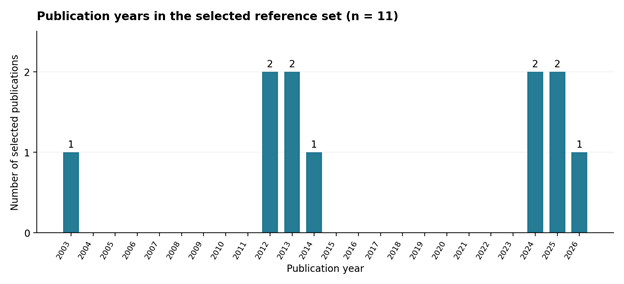
Figure 1. Publication years of the selected reference set (n = 11). Zero denotes no selected item in that year; this is not a trend in the wider research literature.
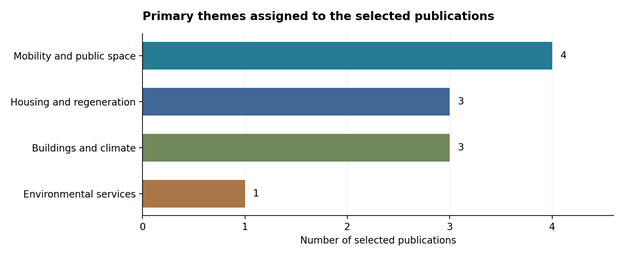
Figure 2. Author-assigned primary themes (n = 11): mobility and public space, 4; housing and regeneration, 3; buildings and climate, 3; environmental services, 1. One primary theme per publication; see Table 1.
3. Distinguishing Inputs, Outputs, Outcomes and Wider Effects
Evaluation becomes clearer when different levels of achievement are separated. Inputs are the resources committed to an activity. Outputs are the immediate products delivered. Outcomes concern changes in the conditions or experiences that the activity seeks to improve. Wider effects extend beyond those immediate changes and generally require stronger evidence to establish.
For example, the budget and staff assigned to a pedestrian improvement programme are inputs. Completed crossings and repaired walking surfaces are outputs. Easier access to a bus stop is a potential outcome. A change in employment participation or household expenditure is a possible wider consequence, but it should not be inferred automatically from construction.
Each level answers a legitimate question. Financial records help establish whether resources were used as intended, and construction inspections help determine whether works meet the approved specification. These are necessary checks. They become misleading only when presented as sufficient proof that residents’ lives have improved.
A practical evaluation plan should state the connection expected between levels. If a new facility is intended to reduce travel difficulty, the programme should explain who will use it, which barriers it addresses and what other conditions must hold. An accessible stop, for instance, still depends on a service that reaches useful destinations at relevant times.
The evaluator should also record alternative explanations. Changes in household circumstances or wider service provision may influence the outcome independently of the project. The strength of the conclusion should match the design and evidence available. Describing a change is different from attributing it to an intervention, and both forms of reporting should be labelled accurately.
Table 2. Distinguishing levels of evaluation
| Level | Question | Example evidence |
| Input | What resources were committed? | Budget, staff allocation and implementation capacity. |
| Output | What was delivered? | Verified dwellings, crossings or service assets completed. |
| Outcome | What changed for users? | Occupation costs, journey difficulty or service reliability. |
| Wider effect | What broader change can be supported? | Sustained opportunity or well-being changes, with attribution examined. |
Proposed analytical distinction. Examples are evaluation questions and evidence types, not measured programme results.
4. Defining the Unit of Evaluation
The choice of unit determines what an evaluation can see. A project boundary is convenient for contracts, but residents may depend on destinations beyond it. A dwelling is useful for inspecting building conditions, but household activities can extend into shared spaces and nearby streets. A neighbourhood assessment should therefore combine several connected units.
Dhote, Silakri and Onkar (2013) emphasise understanding physical and social conditions before selecting renewal or redevelopment. Their intervention framework provides a relevant foundation for examining local circumstances rather than assuming that a single response fits every area. Read the urban-intervention study.
The approach proposed here distinguishes the household, dwelling, neighbourhood and journey. Household information explains affordability, work and care. Dwelling information describes the physical environment. Neighbourhood information captures shared services and public space. Journey information connects residents with opportunities outside the immediate area.
These units should be linked carefully rather than merged indiscriminately. An average neighbourhood service score cannot establish that every household receives a reliable service. Similarly, a good building inspection cannot show that the dwelling suits all occupants. Reporting at several levels makes those differences visible.
Boundaries should be documented at the start and retained for comparison where possible. If the area, population or service definition changes, the evaluation should explain how that affects interpretation. Otherwise, an apparent improvement may arise because the measurement unit changed rather than because conditions improved. Clear units are a basic requirement for a trustworthy account of urban change.
5. Using Settlement Typologies Without Losing Household Variation
Classification can help organise a complex urban area into categories relevant to action. It may distinguish service deficiencies, building conditions or site constraints. However, a typology should support investigation rather than replace it. The way categories are defined influences which problems become visible and which interventions appear appropriate.
Singh, Dhote and Soni (2013) develop a settlement typology through a Jabalpur case study, considering location, poverty, housing and services. Their matrix-based approach is intended to support intervention prioritisation. It shows the value of examining differences between settlements before making redevelopment choices. Read the typology study.
An evaluation can build on this principle by comparing outcomes within and across clearly defined starting conditions. A programme serving areas with severe service failures should not be compared casually with one addressing minor building defects. Baseline differences affect what improvement is feasible and how quickly it might occur.
Variation within a category remains important. Some households may have direct access to a service while others depend on shared or distant facilities. Renters may experience changes differently from owners. A category average can therefore conceal unequal outcomes, even when its overall direction appears favourable.
The proposed practice is to retain both the classification and the underlying observations. Evaluators should explain why a category exists, which indicators define it and how uncertainty is handled. Residents should have a route for correcting inaccurate information. Classification then becomes an accountable analytical step rather than a permanent label attached to a place.
6. Establishing a Baseline That Can Be Revisited
A baseline should describe the conditions that an intervention intends to change. Collecting information merely because it is easy to obtain can leave important outcomes unmeasured. The starting point should be a set of evaluation questions linked to the programme’s objectives and residents’ priorities.
The baseline should combine records, observation and household accounts where appropriate. Administrative information may identify a connection or facility, while users describe interruptions or access difficulties. Disagreement between sources should prompt investigation rather than an automatic preference for the more formal record.
Timing requires attention. A service observed during one season may operate differently at another time. Travel conditions can vary across weekdays, weekends and working hours. An evaluation should document its observation periods and avoid presenting a short survey as a complete account of annual conditions.
Repeatability also matters. Questions, measurement procedures and location records should be sufficiently clear for another team to revisit them. Changes in instruments or survey wording should be recorded so that later differences are not mistaken for real improvement. Baseline documentation is part of the evidence, not an administrative afterthought.
Finally, the baseline should be usable by the people making decisions. A concise summary can identify major deficiencies, uncertainty and groups requiring closer attention. Detailed records can support analysis without overwhelming public discussion. The aim is a starting account that is credible, understandable and capable of supporting future comparison, rather than a large dataset whose relationship to the project remains unclear.
7. Measuring Housing Affordability Beyond the Initial Price
Housing affordability should be examined through the continuing costs of occupation. The initial payment or allocation condition is only one component. Utilities, maintenance, repairs and changes in transport expenditure can influence whether a household can remain in the improved environment.
Bouddha, Dhote and Sharma (2014) connect redevelopment approaches with environmental management and residents’ well-being. Their review provides a relevant basis for considering improvement beyond physical shelter replacement. The evaluation questions developed here extend that inclusive perspective into recurring household costs. Read the redevelopment review record.
A practical survey should distinguish regular obligations from occasional expenses. It should ask how payments are managed, whether costs are predictable and whether households experience difficulty meeting them. Sensitive financial questions require clear explanations and appropriate privacy arrangements; exact income figures are not always necessary for every evaluation purpose.
Interpretation should consider household composition and income variability. The same expenditure may have different implications for households with different needs and resources. A single affordability threshold should not be introduced without explaining its basis, and any reported ratio should identify what costs and resources it includes.
A hypothetical relocation illustrates the connection with mobility. A dwelling with a lower direct payment may involve higher travel expenditure. The evaluation should record the combined change rather than declaring success from the housing figure alone. This is a proposed appraisal principle, not an observed result for a particular programme. Its purpose is to make transferred burdens visible.
8. Following Livelihoods Through the Transition
Livelihood evaluation should begin with how work depends on location, space and relationships. Some residents travel to a fixed workplace, while others work from home or serve nearby customers. The physical arrangement that supports income can be as important as the distance to an employment centre.
Before intervention, evaluators should document the activities residents wish to continue and the conditions that make them possible. Relevant questions may concern storage, customer access, deliveries, working hours and the combination of paid work with care responsibilities. These details can inform design and transition planning.
The construction period requires separate attention. Restricted access, temporary moves or service interruptions may affect work before the completed project begins operating. Evaluating only the final condition can miss costs experienced during this period. A transition record should capture disruption and the adequacy of arrangements intended to address it.
Follow-up should distinguish continuity, adaptation and loss. A person may continue working but at different hours, with new expenses or a changed customer base. A simple employed-or-unemployed category may miss those consequences. Qualitative interviews can help explain changes that a short indicator cannot describe.
The purpose is not to assume that existing arrangements must remain identical. Regeneration can create new possibilities, but those possibilities should be examined alongside risks and actual experience. Tracking livelihoods over time provides evidence about whether promised opportunities become usable and whether households have the resources to make the transition. This helps connect spatial planning with the household economy.
9. Examining Residential Continuity and Missing Residents
Evaluations often depend on the people who remain available for follow-up. This creates a problem when some residents leave, cannot be contacted or were never included in the original record. Their absence may be closely related to the very outcomes the evaluation seeks to understand.
The proposed approach therefore records different forms of occupation at baseline, including rental and shared arrangements where participants consent to provide that information. It does not infer legal entitlement from residence. Its purpose is to identify the population whose experience should be considered when assessing the intervention.
Follow-up procedures should document contact attempts, refusals and unavailable participants. Researchers should avoid assuming that an unreachable household has experienced either a positive or negative outcome. They should report the extent of missing information and discuss how it may affect conclusions.
Where appropriate and authorised, repeated neighbourhood surveys can complement a household panel. A panel follows the same participants, while repeated surveys describe the population present at each observation. These approaches answer different questions. Using both can help distinguish changes among original residents from changes in the composition of the area.
The public report should make that distinction clear. Improved average conditions among current occupants do not necessarily establish improved conditions for the people originally affected. Residential continuity is consequently both an outcome question and a methodological concern. Taking it seriously prevents evaluation from overlooking households whose experience is difficult to observe but central to an inclusive account.
10. Evaluating Buildings Through Use, Comfort and Adaptation
Building evaluation should combine technical inspection with an understanding of use. Rooms, entrances and shared spaces support activities that may differ from the assumptions in the design brief. Occupant feedback can reveal where a feature works well, where adjustments are needed and where the intended operation is impractical.
Dhote, Onkar and Das (2012) examine vernacular settlements and habitats in central India, including spatial organisation and climatic responsiveness. Their discussion supports investigating underlying practices and adapting them to contemporary requirements. Read the vernacular-architecture study. Sharma and Dhote (2003) provide an earlier bibliographic contribution on heritage buildings and thermal comfort; its original text was not examined here, and no specific results are attributed to it.
For evaluation, a promising design idea should be translated into an observable question. If a shared shaded space is intended to support everyday activity, the study can examine when it is used, by whom and under what conditions. Observation should be accompanied by explanation, since absence of use may have several causes.
Comfort monitoring should state the period, occupancy and conditions of measurement. Short observations cannot establish annual performance. Interviews should explain how residents adjust openings, move between spaces or manage privacy and security. These practices influence what the building actually delivers.
The goal is a balanced account of physical performance and lived suitability. Evaluators should avoid treating traditional appearance, new materials or technological sophistication as proof of success. Each claim requires evidence appropriate to the function and the conditions under which the building is occupied.
11. Connecting Green-Building Claims With Operating Evidence
Environmental design proposals often contain predicted savings or expected improvements. Evaluation should preserve the distinction between these expectations and observed performance. Installing equipment demonstrates delivery of an asset; it does not by itself show that the asset produces its intended benefit under everyday conditions.
Sharma, Singh, Kumar, Pandey and Dehalwar (2025) discuss green buildings in relation to sustainable neighbourhoods, including resource efficiency and occupant well-being. Their review offers a basis for examining environmental objectives across building and neighbourhood scales. Read the available green-buildings paper.
A practical assessment should ask what is being compared. Changes in occupancy, use, weather or service availability can affect consumption independently of an installed measure. A simple comparison of bills may be informative, but the report should explain relevant differences before attributing the change to design.
Maintenance evidence is also necessary. Records should identify faults, periods of non-operation, repair arrangements and user understanding. An efficient system on paper may deliver limited value if residents cannot operate it or obtain support. These are implementation questions rather than reasons to reject innovation automatically.
Neighbourhood connections should remain visible. Evaluators can examine whether building entrances, service areas and shared spaces work with surrounding movement and collection arrangements. The strongest assessment links expected environmental performance with actual operation, realistic costs and occupant experience. Its value lies in identifying what works, what needs correction and what future projects should avoid assuming without evidence.
12. Measuring Accessibility as a Complete Journey
Accessibility concerns the opportunities people can reach under realistic conditions. A transport route near a housing area is relevant, but so are waiting, transfers, operating hours and the approach to the stop. Evaluation should therefore examine complete journeys rather than relying only on network proximity.
Jaiswal, Dhote, Krishnan and Jain (2012) examine Ahmedabad’s Janmarg bus rapid transit system through a sustainable transport perspective, discussing coordinated infrastructure and operations. This historical case contributes to the rationale for integrated service assessment; it is not a current audit of the system. Read the Janmarg study record.
The proposed evaluation begins by identifying destinations and times that matter to residents. Early work shifts, evening education and journeys involving dependants may require different service conditions. Representative journeys should be selected transparently and should not be presented as an exhaustive account of everyone’s mobility.
Data collection can combine participant accounts with observation of selected journeys. The record should distinguish walking, waiting, travel and transfer components, alongside cost and reported difficulty. This helps identify where a change occurs and which organisation could address the problem.
Accessibility outcomes should be interpreted alongside residential change. If a housing project moves households, evaluating only the new dwelling misses a potentially important effect on opportunity. If it improves local services, some journeys may become unnecessary. The evaluation should allow for both possibilities rather than assuming that more or faster travel is always the desired result.
13. Combining Passenger Feedback With Environmental Access Audits
Passenger experience and route conditions provide complementary evidence. A timetable or vehicle record may indicate operational performance, while users explain difficulties with information, waiting or boarding. An approach-route audit adds the conditions encountered before and after the ride.
Lodhi, Jaiswal and Sharma (2024) study bus-user satisfaction in Bhopal using a survey of 1,313 respondents and discrete choice models. Their findings identify comfort and safety among important concerns, alongside operational attributes. Read the passenger-satisfaction study. Yadav, Dehalwar and Sharma (2026) review environmental influences on first- and last-mile mode choice, identifying microclimatic conditions, environmental quality and infrastructure continuity as relevant considerations. Read the first- and last-mile review.
The evaluation proposed here combines these perspectives without assuming that one dataset explains every experience. Passenger surveys should be supplemented where necessary by consultation with non-users, including people who cannot reach the service. Otherwise, the assessment may describe only those who have already overcome its barriers.
Audits should examine continuous routes and the points where usability breaks down. A missing connection can matter even when most of the route is improved. Observations should state time and conditions, especially where rainfall or exposure may affect the experience.
Finally, each finding should connect with an action and an accountable organisation. Separate agencies may manage the service and the street, but passengers experience a single journey. Evaluating coordinated improvement is more informative than reporting isolated works without checking their combined effect.
14. Public Space and the Difference Between Proximity and Usability
Public-space evaluation should examine who can reach a space, how it is used and what prevents participation. Area and visitor totals provide useful information but do not describe all aspects of inclusion. A nearby destination can remain difficult to use because of its approach, entrances or management arrangements.
Lalramsangi, Garg and Sharma (2025) study route choices to public open spaces in Aizawl using space syntax. Their work highlights the relevance of hill-city conditions and the need to consider more than a flat representation of pedestrian routes. Read the public-open-space study.
An evaluation should consequently distinguish straight-line distance from usable access. Gradients, steps and indirect connections can change the effort involved. The appropriate information depends on the users and the setting; a single distance threshold should not be treated as proof of accessibility for everyone.
Observation should cover more than one period where practical. Different groups may use a space at different times, and a quiet visit does not necessarily indicate failure. Interviews can help explain patterns, including why some residents do not visit. Evaluation should avoid assuming that absence always reflects lack of interest.
Maintenance and management deserve the same attention as initial design. Cleaning, repairs and the handling of conflicts can influence continued usability. Reporting should identify responsible organisations and unresolved difficulties. The purpose is to understand whether the space supports meaningful opportunities for use, rather than to treat its physical completion as the end of the public responsibility.
15. Evaluating Environmental Services as Working Processes
Environmental services are delivered through connected tasks. Collection, transport, treatment, inspection and repair require coordination and dependable resources. An evaluation focused only on facilities can miss failures in the process that links them.
Sharma, Dehalwar and Singh (2024) review emerging solid-waste-management techniques, including recycling, composting and waste-to-energy approaches, together with their benefits and challenges. Their chapter offers a basis for examining options while retaining attention to local operating conditions. Read the waste-management chapter.
A service evaluation should define the expected process and identify points where performance can be checked. For waste management, this may include collection regularity, handling arrangements and the destination of materials. Data should distinguish intended procedures from observed practice and explain the coverage of the observations.
Worker knowledge is particularly useful. People carrying out routine tasks can explain access constraints, equipment problems and inconsistencies that administrative summaries overlook. Consultation should respect their time and protect sensitive information. It should also distinguish organisational problems from individual blame.
User experience adds another perspective. Households may report missed collections or difficulties following instructions, while service teams identify the conditions that make compliance possible. Combining these accounts can support practical correction. The proposed outcome measure is dependable service, supported by evidence about failures and responses over time. A count of installed bins or purchased vehicles remains an output and should be reported as such.
Table 3. Proposed indicator menu for local adaptation
| Domain | Candidate indicator | Evidence and caution |
| Housing costs | Reported difficulty meeting recurring occupation costs. | Household follow-up; define included expenses and protect privacy. |
| Livelihoods | Continuity and changes in income-generating activity. | Interviews and activity records; distinguish adaptation from loss. |
| Residential continuity | Original households contacted and their occupation status. | Consented panel records; report missing cases separately. |
| Accessibility | Difficulty and time components of selected complete journeys. | Journey logs and interviews; specify destinations and observation times. |
| Comfort | Observed conditions and occupant-reported usability. | Monitoring plus interviews; identify season and occupancy. |
| Public space | Usable access and patterns of participation. | Route audits and observations; include reasons for non-use. |
| Service reliability | Documented interruptions and time to response. | Service records and user accounts; reconcile conflicting reports. |
| Participation | Documented influence of resident input on decisions. | Decision-response records; attendance does not demonstrate influence. |
All indicators are proposed. Local teams must define units, periods, sampling, responsibilities and interpretation before collecting data. No city values or universal thresholds are assigned.
16. Equity, Disaggregation and the Danger of the Average
An average improvement can coexist with poor outcomes for particular groups. Inclusive evaluation should therefore ask how benefits and burdens are distributed. The relevant groupings depend on the intervention and the evidence available, rather than a fixed list applied without purpose.
Household circumstances that may matter include occupation arrangement, livelihood type, mobility requirements and care responsibilities. These characteristics can influence how a project is experienced. However, subgroup reporting should protect privacy and avoid presenting unstable estimates from very small numbers as dependable comparisons.
Disaggregation should be planned early. If the baseline does not collect information needed to distinguish relevant experiences, later analysis may be unable to answer important questions. The evaluation team should discuss these needs with residents and explain why particular information is requested.
Qualitative evidence can help interpret differences without pretending to establish their population prevalence. A detailed account may reveal an overlooked mechanism or difficulty. It should be presented as that kind of evidence, rather than as a substitute for a representative estimate.
Equity reporting also involves explaining trade-offs. A project may improve one group’s access while creating disruption for another. The evaluator’s task is to make these consequences visible and distinguish them from the policy judgement about how they should be addressed. Transparent reporting supports a more informed discussion than a single citywide score that conceals who benefits, who pays and whose experience remains uncertain.
17. Comparison, Attribution and Claims of Success
Before-and-after information can show that a condition changed, but it does not automatically show why. Wider service changes, economic conditions or household transitions may contribute. The evaluation design should reflect whether the objective is descriptive monitoring or a stronger claim about an intervention’s effect.
A comparison area may help, but only if its role is justified. Areas can differ in starting conditions, investment histories and population characteristics. Selecting a convenient comparison without examining these differences can introduce false confidence. The report should explain why the comparison is informative and where it remains imperfect.
Repeated observations can strengthen understanding of timing and persistence. They help distinguish a temporary disruption from a continuing problem or an early benefit from a durable improvement. Observation intervals should follow the expected process of change and the resources available, not an arbitrary desire for more data.
Where a stronger causal design is not feasible, evaluation can still provide value. It can document outcomes, investigate plausible explanations, compare experiences and identify operational failures. The limitation should be stated clearly, and the language of the conclusion should remain proportionate.
Success is therefore best reported as an evidence-based account with boundaries. A programme may meet construction targets, improve a measured service and leave other outcomes unresolved. Acknowledging that mixed picture is more useful than forcing the result into a simple successful-or-unsuccessful category. It directs attention to the next decision and the evidence needed to support it.
An additional safeguard is to specify the expected direction of change before examining results. If a programme is intended to reduce reported travel difficulty, that outcome should not be replaced after data collection merely because another measure looks more favourable. Changes to the evaluation plan may be justified, but the reasons should be recorded and the revised analysis distinguished from the original question.
Uncertainty can also be explored through deliberately different interpretations. Analysts can examine whether conclusions change when incomplete cases are described separately, when observation periods differ or when unusual values are retained and investigated. These checks should address plausible weaknesses in the evidence rather than become an exercise in searching for a preferred result. The public account should explain the practical implication: whether the finding appears stable, depends on a particular assumption or requires further information before action is justified.
18. Tables, Dashboards and Composite Scores
The way results are displayed affects how they are interpreted. Tables are useful for exact definitions and comparisons, while graphs can reveal distributions or differences more quickly. Both should identify their source, unit and scope. A polished display cannot compensate for an unclear denominator or an unsupported claim.
The two graphs in this article illustrate a limited but verifiable use of visual evidence. They describe the eleven selected references and expose the coding behind the counts. They do not rank cities, estimate programme benefits or assign empirical strength to publication themes. That boundary should remain visible wherever the figures are reproduced.
Composite scores require additional caution. Combining affordability, accessibility and service reliability into one number involves choices about scaling and weights. It can also allow a favourable result in one domain to offset a serious problem elsewhere. Those choices should be justified rather than hidden in a formula.
For an initial evaluation, separate domain results are often easier to interpret. Decision-makers can see which conditions improved, which deteriorated and where evidence is missing. If an index is later developed, sensitivity analysis should examine how alternative reasonable choices affect rankings or conclusions.
Reporting should also distinguish proposed indicators from collected results. Table 3 is a menu for local adaptation, not a dataset. Its entries have no assigned city values because no new field survey was conducted. Maintaining this distinction allows the article to offer practical tools without creating the appearance of measurements that do not exist.
19. Governance, Maintenance and Learning After Delivery
Evaluation requires an organisation able to respond to what it finds. A report that documents service problems without identifying responsibility may have limited practical effect. The process should therefore connect evidence with a decision, a responsible body and a mechanism for follow-up.
Responsibilities should be assigned before handover. Shared spaces, installed systems and public access routes may involve different agencies or community arrangements. The evaluation should examine whether those arrangements are clear, adequately resourced and understood by the people expected to use them.
Resident participation should extend into interpretation. Public discussions can help explain why a measured change matters and whether proposed corrections address the actual difficulty. Participants should be told which decisions can change and how their comments will be considered. A record of responses is more informative than attendance totals alone.
Maintenance information should be treated as learning evidence. Repeated faults may indicate a design issue, an operating constraint or a mismatch between the asset and available support. Identifying the pattern can improve future procurement and design rather than merely recording each repair separately.
The proposed evaluation cycle consequently continues after delivery. It moves from a baseline to implementation checks, outcome review and corrective action. The intervals and responsibilities should be adapted to local capacity. The essential requirement is that findings can lead to a practical response and that the response is checked, creating a visible connection between research, management and residents’ experience.
Evaluation itself needs a realistic budget. Field visits, data management, interpretation and returning findings to participants take time. A programme that funds only a final report may lack the resources needed to investigate emerging problems or maintain contact with affected households. The evaluation plan should identify these tasks early and assign enough capacity to perform them consistently.
The budget should also distinguish routine monitoring from additional research. Service teams may already collect useful operational records, while household follow-up may require a separate arrangement. Reusing existing information can reduce duplication, provided its definitions and quality suit the evaluation question. Data collected for one administrative purpose should not be assumed to answer a different research question without review.
Corrective action should have a documented closure process. Recording a complaint as resolved is different from checking whether the user’s difficulty has ended. A proportionate follow-up can ask whether the service works, whether the repair lasted and whether the response created another problem. This closes the connection between evidence and action while producing practical information for later projects. It also gives residents a clearer account of what the programme has done with their contribution.
Table 4. Proposed evaluation and response cycle
| Stage | Main task | Responsible arrangement | Review output |
| Before selection | Define questions and revisit existing records. | Planning team with resident input. | Baseline and uncertainty statement. |
| Options appraisal | Compare benefits, burdens and dependencies. | Design and service teams; affected groups. | Transparent comparison of alternatives. |
| Transition | Track disruption and temporary arrangements. | Delivery team with a clear contact point. | Problems recorded and responses assigned. |
| After occupation | Check usability, costs and service operation. | Evaluator and operating organisations. | Outcome account with missing cases noted. |
| Maintenance | Investigate recurring faults and repair capacity. | Named asset and service managers. | Corrective actions and resource needs. |
| Learning review | Check whether corrections solved the problem. | Managers with user verification where appropriate. | Lessons for future design and delivery. |
Proposed roles and stages, not a mandated timetable. Assign local organisations, resources and review intervals before implementation.
20. Research and Teaching Applications
The framework can support interdisciplinary teaching through clearly bounded exercises. Students might compare a mapped service with observed operation, document complete journeys or investigate how a dwelling supports everyday activities. Each task should have a manageable question and an output useful to the people who contribute information.
Research training should emphasise the distinction between description and inference. A small field exercise can produce valuable observations without supporting citywide estimates. Students should report selection procedures, observation periods and uncertainty. This makes modest work credible and provides a foundation for more demanding designs.
Universities can also contribute to indicator development. Proposed questions should be tested for clarity, relevance and feasibility before routine use. Repeated collection can help examine consistency, while consultation can reveal whether the information captures concerns residents consider important.
Future research could compare intervention approaches under documented starting conditions or follow households through transition and occupation. It could investigate how maintenance arrangements influence the durability of benefits. These studies would need designs appropriate to their claims and resources sufficient to retain meaningful follow-up.
The present article remains conceptual. Its literature is selected rather than comprehensive, and its proposed tools have not been validated as a universal evaluation system. Their value will depend on adaptation, testing and transparent revision. Reporting difficulties and unsuccessful applications would be as useful as reporting favourable results, because both contribute to understanding when an approach works and what it requires.
Teaching projects should include a clear agreement about what students can and cannot provide. Participants need to know whether the exercise is intended for learning, municipal decision support or a formal research study. Students should avoid implying that an interview guarantees assistance, eligibility or a design change. An honest account of purpose protects participants and improves the quality of the exchange.
Supervision should cover how findings are represented. A photograph may show a physical condition but reveal private information; a quotation may explain an experience but make a person identifiable. Decisions about inclusion should consider consent, necessity and potential consequences. Public outputs can often communicate the planning issue without exposing a household’s specific circumstances.
The final educational task is to return the findings in a usable form. A short local-language summary, an annotated map or a discussion with service staff may be more helpful than a lengthy technical report alone. Returning information allows participants to correct misunderstandings and helps students learn whether their interpretation matches lived experience. That feedback should be documented as part of the project’s learning, with unresolved disagreements retained where appropriate.
21. Conclusion
Urban evaluation should explain whether development improves the conditions that matter in everyday life. Construction, expenditure and asset records remain necessary, but they should be connected with affordability, livelihoods, accessibility, comfort and reliable services. The evaluation question must extend from what was delivered to what changed, for whom and for how long.
The selected literature offers complementary perspectives on those relationships. Settlement typologies encourage contextual diagnosis; redevelopment and renewal studies support careful intervention choice; architectural research raises questions of use and comfort; and transport and environmental studies direct attention to complete service experiences.
The practical approach proposed here begins before selection, retains a revisitable baseline and continues through transition, occupation and maintenance. It separates outputs from outcomes, treats missing residents as an important evidence concern and avoids presenting aggregate improvement as proof of universal benefit. Its tables provide proposed tools, while its graphs describe only the selected reference set.
For public agencies and educational institutions, the immediate opportunity is to make evaluation more usable and accountable. Clear definitions, proportionate claims and visible responsibility can help turn findings into corrections. A city programme deserves confidence when it can show how its decisions improve residents’ conditions and explain openly where the evidence or outcomes remain incomplete.
Evaluation should also preserve a clear record of revisions. When definitions, responsibilities or project arrangements change, documenting the reason allows future teams to interpret results consistently and understand which lessons remain applicable to the next stage of urban improvement.
Declarations and Source Notes
Article type: Conceptual article and narrative synthesis. No new household survey, city-performance dataset or intervention experiment was conducted.
Figures: Both graphs are descriptive calculations from the eleven references listed below. Theme assignments are author-coded and mutually exclusive for counting, although the publications may span several themes. The graphs do not represent the wider literature or measured urban outcomes.
Tables: Table 1 documents the selected reference set. Tables 2–4 contain proposed evaluation tools and reporting arrangements that require local adaptation and validation.
Reference handling: The duplicate Bouddha/Charumitra redevelopment entry is consolidated. The journal version represents the supplied vernacular conference citation. Original text for Sharma and Dhote (2003) was not examined; no detailed findings are attributed to it.
References
Bouddha, C., Dhote, K. K., & Sharma, A. (2014). Slum redevelopment strategy: A way forward to urban environment management through inclusive approach. Research Journal of Engineering Sciences, 3(7), 28–37. Publisher record.
Dhote, K. K., Onkar, P., & Das, S. (2012). Identifying the sustainable practices from the vernacular architecture of tribes of central India. American Transactions on Engineering & Applied Sciences, 1(3), 237–251. Published full text.
Dhote, K. K., Silakri, R. K., & Onkar, P. (2013). Urban renewal and redevelopment: Identification of appropriate planning intervention for Indian cities. International Research Journal of Social Sciences, 2(7), 42–48. Published full text.
Jaiswal, A., Dhote, K., Krishnan, R., & Jain, D. (2012). Bus rapid transit system: A milestone for sustainable transport: A case study of Janmarg BRTs, Ahmedabad, India. OIDA International Journal of Sustainable Development, 4(11), 45–62. Study record.
Lalramsangi, V., Garg, Y. K., & Sharma, S. N. (2025). Route choices to access public open spaces in hill cities. Environment and Urbanization ASIA, 16(2), 283–299. https://doi.org/10.1177/09754253251388721.
Lodhi, A. S., Jaiswal, A., & Sharma, S. N. (2024). Assessing bus users satisfaction using discrete choice models: A case of Bhopal. Innovative Infrastructure Solutions, 9, Article 437. https://doi.org/10.1007/s41062-024-01652-w.
Sharma, A., & Dhote, K. K. (2003). Thermal comfort and heritage buildings. Institution of Engineers (India), Architectural Engineering, 84, 1–3. [Original full text not examined; bibliographic form retained from the supplied reference.]
Sharma, S. N., Dehalwar, K., & Singh, J. (2024). Emerging techniques of solid waste management for sustainable and safe living environment. In M. Nasr & A. Negm (Eds.), Solid waste management (pp. 29–51). Springer. https://doi.org/10.1007/978-3-031-60684-7_3.
Sharma, S. N., Singh, S., Kumar, G., Pandey, A. K., & Dehalwar, K. (2025). Role of green buildings in creating sustainable neighbourhoods. IOP Conference Series: Earth and Environmental Science, 1519(1), 012018. https://doi.org/10.1088/1755-1315/1519/1/012018.
Singh, P. O., Dhote, K. K., & Soni, N. (2013). Development of typologies of slum settlements: The case of a million plus city of India. WIT Transactions on Ecology and the Environment, 179, 153–164. In The Sustainable City VIII: Urban Regeneration and Sustainability. https://doi.org/10.2495/SC130131.
Yadav, K., Dehalwar, K., & Sharma, S. N. (2026). Exploring the environmental determinants of mode choice in first and last mile connectivity: Evidence from a systematic review. Innovative Infrastructure Solutions, 11, Article 204. https://doi.org/10.1007/s41062-026-02614-0.


You must be logged in to post a comment.