Track2Training Shares a Call for Papers: Envisioning Urban Development–2047
Track2Training invites researchers, urban planners, architects, educators, students and development professionals to explore the forthcoming 75th National Town & Country Planners International Conference, organised by the Institute of Town Planners India (ITPI). With the theme “Envisioning Urban Development–2047,” the conference offers an opportunity to contribute ideas and research addressing the future of cities, towns and regions.
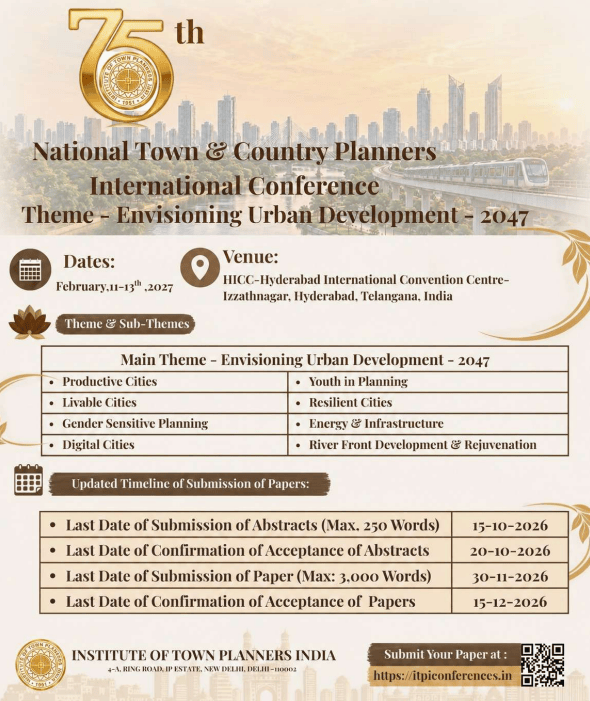
Scheduled for 11–13 February 2027, the conference will take place at the Hyderabad International Convention Centre (HICC), Izzathnagar, Hyderabad, Telangana, India. Its eight sub-themes connect economic development with liveability, inclusion, technology, resilience, infrastructure and environmental renewal.
For the Track2Training community, this announcement is an invitation to examine how research can inform practical planning decisions and help shape urban development that serves people across generations.
Planning Towards 2047
The year 2047 provides a significant horizon for examining India’s urban future. Planning for that future requires attention to the choices being made today: where housing is developed, how transport networks connect communities, how infrastructure is financed and how environmental resources are protected.
A long-term urban vision must address both expanding metropolitan regions and smaller settlements experiencing change. It should also recognise differences in local economic conditions, institutional capacity and community priorities.
The conference theme encourages researchers to connect these everyday planning challenges with a broader development agenda. Strong contributions can move beyond identifying problems to explain which interventions work, under what conditions and for whom.
Productive Cities: Connecting Economic Opportunity and Urban Form
Productive cities depend on the relationship between employment, land use, infrastructure and accessibility. Businesses need reliable services, while workers need affordable housing and convenient connections to workplaces.
Research relevant to this sub-theme could examine employment centres, industrial development, logistics networks, informal livelihoods, mixed-use neighbourhoods or regional economic linkages. Studies might also investigate whether infrastructure investments distribute opportunities fairly across urban populations.
For researchers, the central challenge is to explain how planning can support economic activity while improving the conditions in which people live and work.
Livable Cities: Making Everyday Life Better
A city’s quality is experienced through daily routines: travelling to work, accessing healthcare, taking children to school or finding a safe place to rest outdoors.
The livable cities sub-theme creates space for research on housing, public spaces, walkability, public transport, sanitation, neighbourhood amenities and environmental quality. User surveys, spatial analysis and comparative case studies can help reveal gaps between planned provision and actual experience.
Track2Training encourages scholars to consider whose experiences are represented in their research. Children, older people, persons with disabilities and residents of underserved neighbourhoods can offer essential perspectives on urban liveability.
Gender Sensitive Planning: Designing for Different Needs
Urban spaces and services are experienced differently by different users. Travel associated with caregiving, access to public toilets, personal safety and the location of essential services all have implications for gender sensitive planning.
Potential contributions could explore women’s mobility, public transport design, street lighting, participation in planning or access to employment and public facilities.
Research becomes more useful when it translates these experiences into clear planning recommendations. Inclusive consultation, carefully designed surveys and attention to intersecting social circumstances can help planners understand needs that conventional approaches may overlook.
Digital Cities: Using Technology with Purpose
Digital tools can strengthen urban analysis, service delivery and public participation. Relevant research areas include geographic information systems, remote sensing, digital twins, urban data platforms and technology-supported infrastructure management.
However, a useful digital intervention should address a clearly defined urban problem. Researchers can examine data quality, accessibility, privacy, institutional readiness and the ability of residents to use digital services.
This sub-theme offers opportunities to assess both technological capabilities and implementation challenges. Studies grounded in actual applications can help clarify where digital tools improve decisions and where additional capacity is needed.
Youth in Planning: Bringing Emerging Voices into Decisions
Young people experience cities as students, workers, commuters, entrepreneurs and community members. Their perspectives can contribute to discussions about public spaces, housing, mobility and future employment.
The youth in planning sub-theme invites attention to meaningful participation, planning education, student engagement and opportunities for emerging professionals.
For students and early-career researchers, preparing a conference paper can also strengthen essential skills: defining a research question, reviewing evidence, explaining methods and communicating findings. A focused study with transparent analysis can make a valuable contribution without attempting to address every urban challenge.
Resilient Cities: Preparing for Disruption
Urban resilience involves preparing for hazards, reducing vulnerability and maintaining essential services during disruption. Research may address flooding, extreme heat, water insecurity, infrastructure failure or the capacity of institutions and communities to respond.
Useful studies can connect environmental conditions with land-use decisions, building patterns and service provision. They can also investigate how risks differ across neighbourhoods and social groups.
This sub-theme encourages approaches that link preparedness with long-term planning, including ecosystem protection, infrastructure maintenance and community participation.
Energy, Infrastructure and River Rejuvenation
The Energy & Infrastructure sub-theme provides scope to investigate energy efficiency, renewable energy integration, transport systems, water supply, sanitation and infrastructure financing. Contributions could assess how service networks support sustainable growth and equitable access.
The River Front Development & Rejuvenation sub-theme invites research on the relationship between cities and rivers. Relevant questions include water quality, floodplain management, sewage treatment, ecological restoration, public access and river-dependent livelihoods.
Researchers can contribute by examining environmental and social outcomes alongside physical improvements. Comparative evidence and clearly documented case studies can support more informed decisions about investment and management.
Submission Dates and Participation
According to the conference poster, the updated submission schedule is:
- Abstract submission: 15 October 2026; maximum 250 words.
- Confirmation of abstract acceptance: 20 October 2026.
- Full paper submission: 30 November 2026; maximum 3,000 words.
- Confirmation of paper acceptance: 15 December 2026.
Submit through the conference portal: https://itpiconferences.in.
Track2Training encourages interested contributors to select a relevant sub-theme, prepare an original abstract and follow the organisers’ submission instructions. Present a clear research problem, explain the method and show how the findings can inform planning practice.
Let us use this opportunity to advance thoughtful discussion about productive, livable, inclusive and resilient urban futures.
#Track2Training #ITPI #UrbanPlanning #CallForPapers #UrbanDevelopment2047 #SustainableCities #PlanningResearch #Hyderabad
Conference details sourced from the supplied poster: 75-poster-5-oct-2026.pdf
What’s the weirdest movie you’ve ever watched?
View all responses


You must be logged in to post a comment.