
A TIMELINE OF INDIA’S MOST PROMINENT AGRARIAN PROTESTS

The four-month-old farmer’s protests in India took a violent turn on January 26, 2021, when farmers stormed the streets of Delhi, demanding the abolition of the three new farm bills. Farmers were greeted with tear gas, water guns, and abuse as they rode their tractors onto the roads. These agrarian demonstrations, on the other hand, are not the first in India’s history. For a large portion of India’s independent existence, farmers have been protesting. The majority of protests arose as a result of promises of economic growth eluding farmers and general disillusionment with a government that is unresponsive to their plight. “Large-scale protests have been taking place against a background of widespread and growing unrest in India’s vast countryside, often rooted in the discontent caused by agricultural stagnation and unemployment,” writes Alf Gunvald Nilsen, professor of sociology at the University of Pretoria. Here is a timeline of some of India’s most significant and large-scale agrarian protests.

1988, BOAT CLUB PROTESTS, DELHI

The protests of 1988, in which Mahendra Singh Tikait, a Jat farmer from Uttar Pradesh and the chief of the Bharatiya Kisan Union (BKU), stormed the Boat Club Lawns of Delhi with a charter of demands, are recounted by writer Rakesh Sinha in The Indian Express. This sit-in drew over 5 lakh farmers who demanded a rise in sugarcane prices as well as loan forgiveness. They were within hearing distance of the legislature and made their voices known just before the winter session began. It was one of the most significant farmer demonstrations in the 1980s and 1990s.
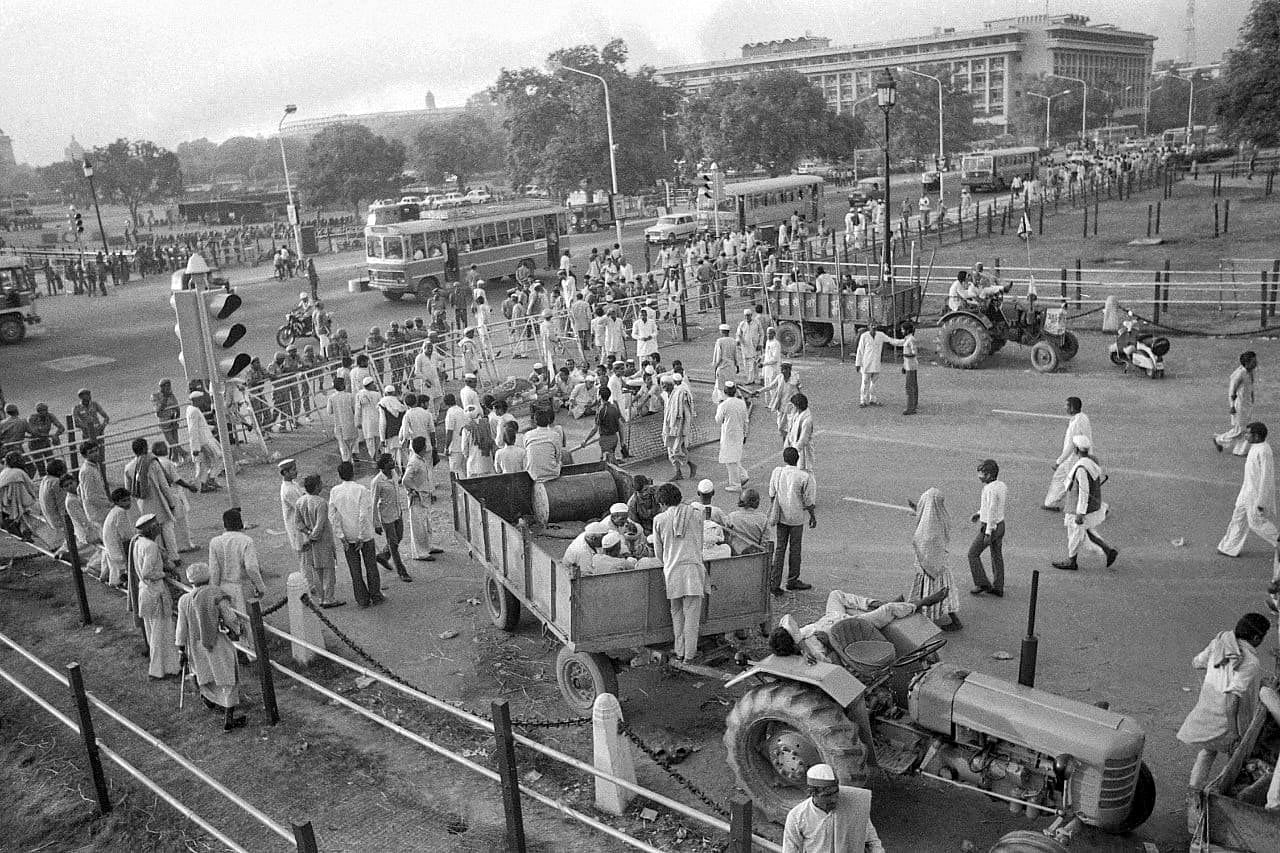
Farmers with tractors, hookahs & chaupar — rare photos of protests at  Delhi's Boat Club – ThePrint

2017, MANDSAUR PROTESTS, MADHYA PRADESH

Five farmers were shot dead in Mandsaur, Madhya Pradesh, in June 2017, while seeking higher MSPs for the onion crop and grains, as well as loan waivers for farmers who were experiencing firsthand the negative effects of the 2016 demonetization on the rural economy, according to an article in India Today.
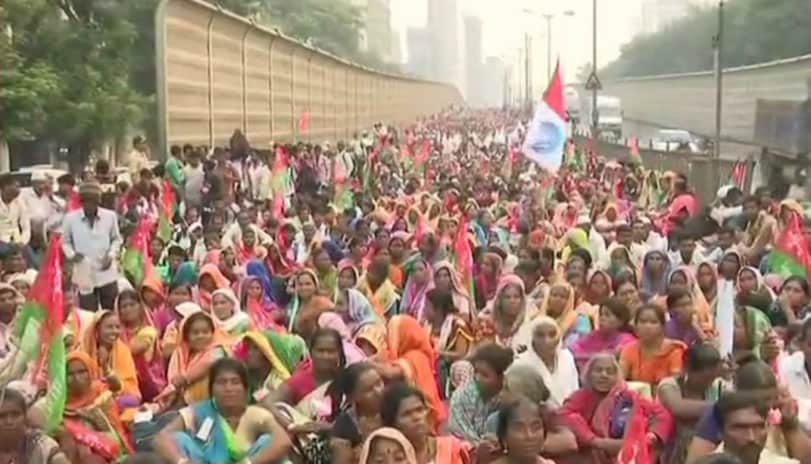
Mandsaur News: Read Latest News & Live Updates on Mandsaur, Photos, Videos  at CNBCTV18.com

TAMIL NADU FARMERS PROTESTS, 2017

Farmers from Tamil Nadu staged a dharna in Delhi in 2017, led by P Ayyakannu. They demanded a 40,000-rupee drought relief package from the federal government, as well as an increase in retired farmers’ pensions. When protesting, they performed grotesque acts such as staging suicides and wearing skulls around their necks. They said that these skulls belonged to farmers who committed suicide because they couldn’t cope with their overwhelming debt. Sunaina Kumar, a journalist, dubbed it the “skull protest,” which was at the time the “longest continuous demonstration of nonviolent demonstrations.” Farmers with half of their faces shaved as a form of protest are depicted in iconic photographs from these demonstrations.

Will the Tamil Nadu farmers' protest in Delhi go beyond theatrics to  translate to action?

THE 2018, KISAN LONG MARCH, MUMBAI

In 2018, 50,000 farmers marched 180 kilometres barefoot from Nashik to Mumbai in favour of drought relief, better minimum support prices (MSPs), and crop insurance. This peaceful protest came to an end after the Maharashtra government gave these farmers assurances, which, according to a Scroll paper, have yet to be fulfilled.

Kisan Long March: Over 30,000 farmers reach Mumbai's Azad Maidan; gherao  Maharashtra Assembly

Why do Indian farmers feel compelled to use violent tactics in protests that began peacefully?
Rakesh Tikait, the son of the aforementioned Mahendra Singh Tikait, is leading the latest farmer protests that have ravaged the country for the past six months. This may reflect generations of farmers’ resentment of India’s deep-rooted agrarian crisis and the negative consequences it has had on the agricultural sector and our Indian farmers. “India’s agrarian crisis—a crisis that has resulted in over 3,00,000 suicides among farmers and farmworkers in the last twenty years,” writes Nilsen.

“To say that protesting farmers are misled or confused is to evade critical issues,” writes Sudha Narayanan, Associate Professor at the Indira Gandhi Institute of Development Research. She emphasises the importance of farmers being included in discussions about the implementation of new agricultural laws, as well as the role they play in Indian democracy through demonstrations, which are an important way to keep a democratically elected government in check.

Agriculture : The Lone Survivor

Apart from the enormous consequence of coronavirus on the human life which claimed more than 1.75 million lives worldwide and infected more than 75 million people, COVID 19 also demolished economies around the globe. Amongst the most badly affected nation was India, which recorded more than 1 crore case and a lakhs deaths and counting. While this sounds bad, visuals of lakh and lakh of migrant workers waking back thousands and thousand of kilometers on foot made the situation worse. If this was not the end of misery Indian economy shrinks by 23.9 percentage point in the first quarter of FY 2020-21 lowest since independence. Every sector of economy from manufacturing to industries and even services tanked except one : Agriculture and allied services which recorded growth 3.4 percentage point at constant prices. Agriculture and allied services contributes nearly 16 % to country GDP while providing employment to 42 % of the workforces.

Several economical and agriculture expert had the views that had there been slummed in agriculture and allied services, things would have been much worse. Agriculture provided employment to the migrated worker who returned to there home and provided them with some earning in these apocalyptic times. Such was its importance and necessity that it was the first sectors to get relaxation from nationwide lockdown for manufacturing and transportation of agriculture input, seeds, machine, etc. Supply chains related to agriculture goods and services were allowed to function with protective measures in place. Efforts paid the dividend a sharp increase of 5.7% in area coverage of Kharif crops was registered as on September 2020. Amid good monsoon and adequate water storage in the winter reservoir for Rabi crops the Government of India set an all time high record for food production target of 301 million tons for 2020-21.

When the prime minister Modi announced nationwide lockdown, the immediate consequence was the mass exodus of migrant labourer from virtually every part of country to there rural household and faces an immediate risk of hunger and livelihood. So government announced a number of schemes for them. Government released an advance installment of Rs. 2000 from PM- KISAN scheme, wage rate of worker were increased and number of days of guarantee work was increased to 150 days under NAREGA. Under the economic stimulus package, credit support for small farmer were announce through various institution like NABARD was extending additional support of Rs. 30,000 crore for crop loan through RRB(Region Rural Bank) and other institutions. Nearly 25 lakhs new Kisan credit cards were sanctioned with a loan limit of Rs. 25000 at a minimal rate of interest were provided to not just farmer but also to one belonging fisheries, animal husbandries and agriculture allied services. The timely credit stimulus helped thousand of farmers and laborer to sustain themselves during such a tough times. A new scheme under the name of Pradhan Mantri Garib Kalyan Yojana was launched to take care poor and vulnerable section of society. In order to boost the rural economy, Indian Railways launched Krishi Rail scheme for transportation and building a seamless supply chain of perishable product like milk, fruits, fish etc. It is benefitting farmer from all around the country as they will be able to sell there product all around the country.

In addition to the schemes and relaxation, good monsoon season and tremendous efforts of our farmers and workers help agriculture to stay afloat at a most delicate point in our economic history. These schemes and announcement might seems be rewarding but not a solution for a sector which is on a downward trend for quiet a few years and the news of suicides of farmer reported daily. There is a need for a comprehensive long term vision and policy with huge investment not just on agriculture and its subsidiaries but also on the farmer. When agriculture and its allied sector will grow at a great pace so will rural economies of our countries and in process increasing the income of farmers and laborer which in turn will increase the growth of our overall GDP.