
By Shashikant Nishant Sharma
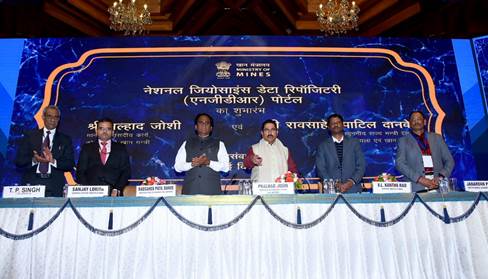
Gearing up for the success of the first tranche of auction of Critical and Strategic Minerals, launched on 29th November, 2023, the Ministry of Mines conducted a roadshow here on 19th December, 2023, in the presence of Union Minister of Parliamentary Affairs, Coal and Mines, Shri Pralhad Joshi, Minister of state for Mines, Coal & Railways, Shri Raosaheb Patil Danve and Secretary, Ministry of Mines Shri V.L. Kantha Rao, senior officers of the Ministry, Industry Associations and PSUs. Over 45 companies, consultants and exploration agencies participated in the event. Minister Shri Pralhad Joshi also launched the National Geoscience Data Repository Portal (NGDR) during the event.
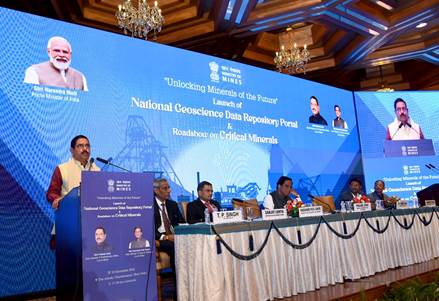
A total of 20 critical & strategic mineral blocks will be auctioned in the 1st tranche, out of which 16 mineral blocks are put up for grant of Composite Licence and four mineral blocks for grant of Mining Lease. The minerals include Graphite, Glauconite, Lithium, REE, Molybdenum, Nickel, Potash etc. The blocks are spread across the States of Tamil Nadu, Odisha, Uttar Pradesh, Bihar, Jharkhand, Chhattisgarh, Gujarat and UT – Jammu & Kashmir.
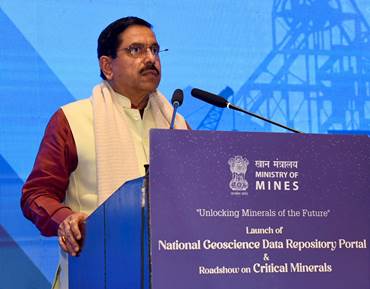
Addressing the function, Minister Shri Pralhad Joshi appraised the efforts and initiatives undertaken by Ministry of Mines for increasing domestic production of minerals, meeting the goals of self-sufficiency as envisioned by the Prime Minister Shri Narendra Modi. He emphasized how the Indian mining sector in general, and critical minerals in particular are significant in the present global context, underscoring priorities such as strengthening domestic production, fostering self-sufficiency, diminishing import reliance, advocating sustainable resource management, attracting investments in the mining sector and advancing key industries crucial for India’s industrial and technological progress. The Government is committed to bring more critical mineral blocks to auction in a phased manner, the Minister added.
The Minister of State for Mines, Coal and Railways, Shri Raosaheb Patil Danve expressed optimism about the potential success of the initial phase of the critical minerals auction, seeing it as a positive stride toward establishing a dependable supply chain for these minerals, aligning with the vision of Atma Nirbhar Bharat and contributing to heightened economic growth. The Minister of State of Mines reiterated the government’s efforts to bring these blocks into auction and how the success of this auction process relies on the active participation from the industry. He called upon all the participants to demonstrate the highest standards of transparency, fairness and ethical practices throughout the auction process.
Shri V.L. Kantha Rao, Secretary, Ministry of Mines gave insights about the steps taken by Ministry of Mines to increase the exploration activity carried out in the country and about the efforts to streamline the policy framework for multifaceted growth of the mineral sector. Secretary, Mines also responded to the queries of the participants and ensured all assistance from the Ministry for easy participation in the e-auction process. Shri Rao also encouraged the participants to give their suggestions for the e-auction process being conducted by Central Government.
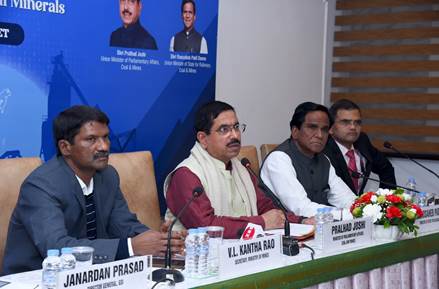
The roadshow was held with the objective to guide the potential bidders regarding the auction process. Additional Secretary – Ministry of Mines, Mr. Sanjay Lohiya welcomed the dignitaries and initiated the discussion on the importance of the auction of critical & strategic minerals.
Dr Veena Kumari Dermal, Joint Secretary, Ministry of Mines began with the presentation and appraised the audience regarding the prevalent mineral policies and the reform of MMDR Act and rules thereunder for enabling the Central Government for auction of critical & strategic mineral blocks. Further, the Joint Secretary briefed the audience about the 20 blocks launched in the first tranche of auction and presented the estimated timeline of the e-auction process. This was followed by presentations of SBI Capital Markets Limited – Transaction Advisor, MECL – Technical Advisor, and MSTC – Auction Platform provider, giving information to the potential bidders regarding the e-auction and details of the critical mineral blocks put to auction.
SBI Capital Markets Limited presented the details of the auction process to the stakeholders including the eligibility conditions, general guidelines to the auction process, and bidding parameters. MECL highlighted the importance of Critical and Strategic Minerals in modern technologies and shared the details of 20 critical mineral blocks being put to auction. MSTC walked participants through the registration process along with the technicalities of the auction portal. Subsequently, the queries received from the audience were addressed by the presenters.
Director (NMET), Ministry of Mines highlighted the efforts of Ministry in facilitating the engagement of Notified Private Exploration Agencies (NPEAs) to expedite mineral exploration in the country. He further informed about the scheme on funding of Notified Private Exploration Agency (NPEA) through National Mineral Exploration Trust (NMET). The Ministry has notified 16 such private agencies. Also informed about the proposed amendment in Mineral (Auction) Rules 2015 and comments were sought on the same.
Further, presentation on the details of Exploration Licence, a recently included provision in the MMDR Act and the rules thereunder. Exploration Licence is a provision for grant of a mineral concession for undertaking full range of exploration starting from reconnaissance to prospecting operations. The move is to engage the private players and junior mining companies in the exploration of deep-seated minerals, in line with international practice. The draft amendments made in the MMDR Act were presented to the participants and suggestions/comments were sought from the stakeholders.
Pre-bid conference with prospective bidder is scheduled on 22nd December 2023, last date of sale of Tender Document is 16th January 2024 and last date of bid submission is 22nd January 2024. Thereafter, e-auction will commence for selection of preferred bidder. Details of the mines, auction terms, timelines etc. can be accessed on MSTC auction platform at www.mstcecommerce.com/auctionhome/mlcl/index.jsp.
The National Geoscience Data Repository(NGDR) has been created, as a part of the National Mineral Exploration Policy, 2016, hosting all baseline and exploration-related geoscientific data in a single GIS platform, to expedite, enhance and facilitate the exploration coverage of the country. The NGDR initiative, spearheaded by Geological Survey of India (GSI) and Bhaskarachaya Institute of Space Applications and Geoinformatics (BISAG-N) represents a significant leap forward in democratizing critical geoscience data, empowering stakeholders across industries and academia with unprecedented access to invaluable resources.
Currently, 35 map services like geological, geochemical and geophysical, data layers have been incorporated with the NGDR portal. These data sets can be viewed accessed and downloaded. This interplay of different geo-layers and further interpretation helps in targeting potential mineral zones. The NGDR portal can be accessed through https://geodataindia.gov.in. The user, after registration in the portal can view, download and interpret the data.
The creation of NGDR was conceptualized by the Ministry of Mines (MoM) as part of the National Mineral Exploration Policy (NMEP) 2016. The Geological Survey of India (GSI) was given the responsibility to establish NGDR. The NGDR will make available all geological, geochemical, geophysical and mineral exploration data in public domain on a digital geospatial platform. This will include baseline geoscience data and all mineral exploration information generated by various central and state government agencies and mineral concession holders . The greater goal of this initiative is to increase the investment attractiveness of the mining sector in India.
Key Features of the National Geoscience Data Portal (NGDR):
- Centralized Access: Provides a centralized repository of diverse geoscience datasets, including geological maps, mineral resources, seismic data, and environmental information.
- User-Friendly Interface: An intuitive interface designed to cater to a wide range of users, enabling seamless navigation and exploration of data.
- MERT template: The Mineral Exploration Reporting Template facilitates all the geoscientific stakeholders to submit their data in the NGDR portal in a standard reporting template.
- Analytical Tools: Equipped with state-of-the-art analytical tools to interpret and extract valuable insights from complex geospatial data.
- Open Access: Encourages transparency and knowledge sharing by offering open access to a wealth of geoscience information.
How to Access:
The NGDR Portal can be accessed at https://geodataindia.gov.in.
The development of this portal will help various geoscience agencies such as GSI, MECL, State Departments of Mining and Geology, private agencies, and other stakeholders agencies of the country. As the geoscience data through this portal will be available globally for viewing, downloading and interpretation, it will facilitate global mining companies to invest in India and bring new technologies in mineral exploration.
Globally, all the mineral-rich countries have a robust geoscience data portal having various layers of geoscientific information i.e. geological, geophysical, geochemical, etc. to support their mineral exploration programmes. With this state-of-the-art, user-friendly, interoperable platform, India is now in the league of other mineral-rich countries where the accessibility of geoscientific data plays a vital role in fostering their mineral exploration programmes.
****

 Track2Training
You must be logged in to post a comment.