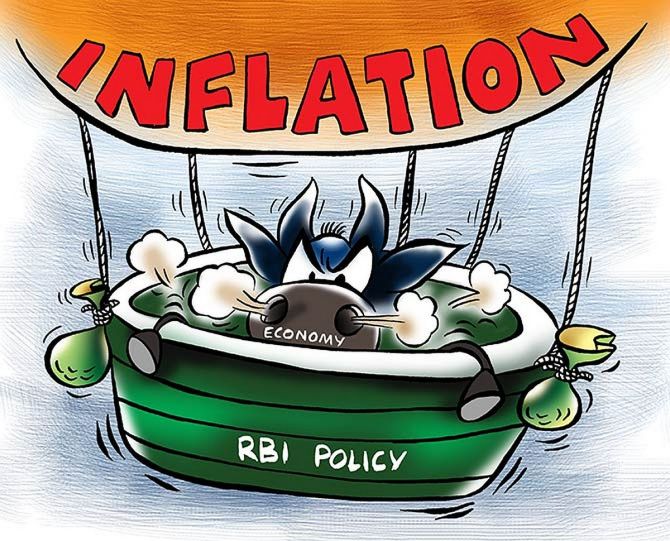
Inflation

Inflation refers to the rise in the prices of goods and services like food, clothing, petrol, housing, transport, etc. over a period of time. When there is rise in Inflation rate, purchasing power of money decreases,i.e. same amount of goods will be purchased in higher prices. When there is fall in the price index of the items, the purchasing power of the money increases this is called deflation. A certain level of inflation is required in the economy to promote expenditure and to demotivate hoarding money through savings. The optimum level of inflation will nurture economic growth.

Types of Inflation :

1.Demand Pull Inflation : An increase in the supply of money and credits stimulates the overall demand for goods and services. The demand increases more rapidly than the economic’s production capacity. This increasing demand creates demand-supply gap as there is not the supply of products as per demand, leading increase in prices.
2.Cost Push Inflation : Demands of the  goods and services remains constant but there is increase in their prices. There are several factors affecting this pricing of goods like depletion of resources,  monopoly over market , government taxation, change in exchange rate,etc. For example, sudden increase in prices of tomatoes, onions etc. due to poor harvest, crude oil fluctuations,etc.
3.Built-in Inflation : It evolves from the past events and continues to affect the economy of the country. We often get to see blue collar worker’s protest for higher pay scales.

Causes of Inflation :

• Increase in supply of money in the market beyond a certain limit reduces the value of currency.
• Increase in prices of imported products.
• High demand and low supply of products leads to hike in price.
• People with more money tends to spend more causing increase in demands.
• Low growth of agricultural products leads to decrease in agricultural prices causes rise in price of goods through reduced supply.

Impact of Inflation :

• It causes loss of purchasing power of the money. It impacts the general cost of living as now people have the constant wages but have to buy less amount of daily products due to hike in price which ultimately leads to deceleration of economic growth.
• It reduces savings as substantial amount of income is spent on daily consumables due to increased costs.
• It also leads to consumers hoarding goods in fear of further increase in prices leading more shortage of supply and exponential increase in price.


Basics of inflation accounting

Inflation accounting is an improvisation of cost accounting in presence of a considerable rate of inflation or deflation.Historical information on financial statements is no longer applicable when a business operates in a country where there is a significant amount of market inflation or deflation. In some cases, companies are allowed to use inflation-adjusted figures to counter this issue, restating the numbers to reflect current economic values.

Advantages of Inflation Accounting

The following are the advantage of Inflation Accounting

  • It reflects the current( market value) and not the historical cost of the balance sheet.
  • It is highly effective in times of general inflation or hyperinflation.
  • Depreciation of the business is valued and cost on the current price and not on the historical or the carrying value of the asset which is the correct method.
  • Profit and loss will be more reliable and true.
  • Financial ratios based on figures, adjusted to the current value, are a good reflection of reliable integrity of the company.

Disadvantages of Inflation Accounting

The following are the disadvantage of Inflation Accounting

  • Changing in price is a never-ending process hence it becomes difficult every time to reinstate the figures of the company and present the financial statements.
  • Inflation accounting is a complicated process and it involves long calculation and the data gathering process thus increased cost incurred

Inflation: Common man’s witch hunt

Photo by cottonbro on Pexels.com

Now may be the best time to sing the folk song ‘Mehangai daiyin khaye jaat h’ (Inflation named witch is a killer) but sadly singing a song is a challenge because coronavirus has killed the mood. Prices of food products and petrol have skyrocketed. The common man like always is helpless. With no job, the future seems shrouded in clouds of uncertainty. The government is doing its bit by provisioning the poor through ration distribution. This however cannot suffice for the uncertainties that are waiting ahead. To understand what is happening in India currently, we have to know about the concept of inflation.

Inflation simply means a rise in the price of goods that we, the consumers, use daily. In India, the ministry of statistics and program implementation has the responsibility of measuring inflation. It can occur due to a variety of reasons like excess money circulating in the economy that reduces the purchasing power of the money, high demand and low supply or the supply-side constraints that cannot cater to the present level of demand. There are many types of inflations depending on the reason and the effect. The one that we experienced most recently is called stagflation. It is a condition with no economic growth, relatively high unemployment along with high inflation.

Inflation decreases the purchasing power of the currency. This translates to a higher cost of living further pulling down the economic growth of the country. Like everything else inflation also affects people differently. It is profitable for borrowers because they own an asset that was bought from the borrowed money. On the other hand, inflation is bad for those who kept cash or liquidity since the money that they own now has less value than before.

Interestingly, a little inflation is good for the economy because it improves expenditure. In simple words, a small amount of inflation will prevent people from saving money. Instead of increasing the bank balance, the focus will shift on investment and this will bring economic growth to the country.

We are living in unprecedented times. India’s story of inflation is the same as other economies. The pandemic has disrupted supply and demand. Many external factors have influenced the economy. Crude oil price, for example, is determined by complex metrics of international economics which include import and export of the commodity amongst other things. Despite bumper production in the primary sector or agricultural sector, there were logistical issues that ensued during the pandemic. Customers were risk-averse and tried to save money by cutting down the investment. The demand for goods became low. There were incentives by the government and the Reserve Bank of India, the central bank, to improve the demand. These included decreasing the repo rate to make interest rates more lucrative to the people. Till now nothing seems to work since inflationary pressures persist.

To keep a check over inflation, the government tried to set a target in the Fiscal Responsibility and Budget Management Act, 2003. Albeit, the experts suggest that right now inflation should not be a matter of concern for the government. The focus should be on public investment so that the economic engine that went cold can run again. This means that price might remain high for some time. The government will try to compensate for the inflationary pressure through schemes and subsidies to give to impetus demand and this is the only silver lining that we can rely on during these tumultuous times while waiting for normalcy to get restored.

Understanding Inflationary gap in an Economy

In macroeconomic level, when there is excess of aggregate demand over aggregate supply at a situation of full employment, the gap of difference is called the inflationary gap. The terms might be confusing and thus are explained below.

Aggregate demand is the total demand of all final goods and services produced in an economy. It can also be said defined as the total quantity of money that all sectors of an economy are willing to spend on the purchase of goods and services at a given period. Aggregate demand consists of expenditures relates to consumption, investment by firms, purchase of goods and services by the government and finally the net exports( difference of imports from exports). The aggregate demand curve does not start from origin because it cannot begin from value zero. It is because even at zero level of income, there is some level of consumption, known as autonomous consumption. Just because we do not receive income doesn’t mean we don’t eat. We borrow money and still have some consumption level. Thus there is still expenditure on consumption and aggregate demand curve can never start from origin(0,0).

Aggregate supply is the money value of the total output available in the economy for purchase during a given period. Aggregate supply also represents the national income of a country.

Full employment is a situation where all those able bodied persons who are willing to work at the existing wage rate, are actually employed( meaning no unemployment in an economy).

As we move on to inflation. How does it actually occur?

In layman terms, when there is increased demand for a good or service than the supply, it leads to an increase in the price of the commodity or service as consumers are willing to pay more to obtain it. Thus the increasing prices lead to inflation.

The concept of inflationary gap is explained with a graph:

Aggregate demand curve is synonymous to total or aggregate expenditure or price and is thus taken on the Y-axis. Aggregate supply curve is synonymous to total income or total output which taken in the X-axis.

At the level of full employment, the aggregate supply is a 45 degree line. The aggregate demand curve is represented as AD0. Both these curves intersect at point A which is said to be an equilibrium point.

An equilibrium point in layman terms it is the point at which the the market forces balance or equate. It is a state of rest. It literally means :

Aggregate demand = Aggregate supply, at a given price and quantity.

A note to the reader, the price and quantity at the point of equilibrium is the equilibrium price and equilibrium quantity respectively.

In case of inflation, aggregate demand>aggregate supply.

As I said above, price and aggregate demand are synonyms. When is an increase in price, it implies an increase in aggregate demand. So, excess of aggregate demand pushes the curve upwards. So there is a shift in the position of the demand curve. The demand curve shifts from AD0 TO AD1. We arrive at the new demand curve. The new equilibrium point is at E.

So Aggregate demand = Aggregate supply at the equilibrium point E where the new equilibrium price and quantity are higher than the old ones.

In the graph we can clearly see gap maintained between the two demand curves and the gap is constant throughout. The inflationary gap thus lies between the new and old aggregate demand curves.

Relevant links: https://www.intelligenteconomist.com/inflationary-gap/ https://www.microeconomicsnotes.com/india/inflation/inflationary-gap-concept-criticisms-and-importance/1396