
Fortified milk is cow’s milk that contains extra vitamins and minerals that are not naturally found in milk in significant amounts. Typically, vitamins D and A are added to milk sold in the United States (1Trusted Source). However, milk can be fortified with various other nutrients, including zinc, iron, and folic acid (2Trusted Source). How or if milk is fortified depends on where you live and what nutrients may be lacking in the typical diet of your country. While some countries require fortification of milk by law, this is not the case in the United States (3Trusted Source). Still, fortified milk is much more common than unfortified milk in the United States. In terms of uses, fortified milk is utilized in the same way as unfortified varieties, such as for drinking or cooking. To fortify milk, vitamin A palmitate and vitamin D3 are added. These are the most active and absorbable forms of these nutrients (4Trusted Source, 5Trusted Source). As they’re heat resistant, these compounds can be added to milk before pasteurization and homogenization, which are heat processes that kill harmful bacteria and improve shelf life (2Trusted Source, 6, 7). Other nutrients like B vitamins must be added later, as heat can destroy them. However, milk is not typically fortified with B vitamins in the United States (2Trusted Source).
Tag: #milk
Milk Powder: Is it a Viable Alternative to Regular Milk?
The very mention of milk powder brings back memories of relishing a spoonful straight from the tinned boxes. Or those railway journeys, when as kids we would eagerly wait for tea-time because along with the beverages came those little sachets of milk powder.
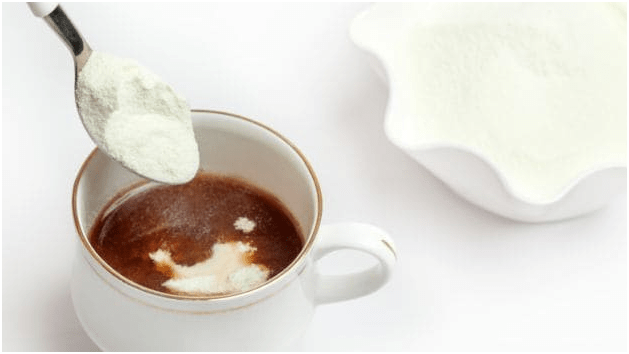
Many people are not fond of raw milk, but the fluffy milk powder is a temptation hard to resist. Sweet and creamy, it continues to be a favoured option to satisfy sudden sugar carvings. But more than that, it is the quickest and easiest option for your much needed milk fix. There’s no need to worry about boiling the milk before consuming or refrigerating it to prevent spoilage. Just add a large spoonful of milk powder in a glass of warm water, stir well and it’s ready.
(Milk Compound Keeps You Slim Despite Lazy Lifestyle)
In today’s times, it has become an important part of household needs, from being used as a whitener for tea and coffee to being used as an ingredient while cooking. It is easy to store, offers value for money and is packed with essential nutrients.

What is Milk Powder?
Raw milk roughly comprises 87.3 per cent water, 3.9 per cent milk fats and 8.8 per cent non-fat milk solids (protein, milk sugar, minerals, etc.). To obtain milk powder, raw milk is evaporated till it leaves behind milk solids minus the moisture content. In short, milk powder is evaporated milk, which is further condensed and processed. During the evaporation process, milk is also pasteurized under controlled temperatures to ward off any bacterial growth.
Similar to raw milk, powdered milk is loaded with nutrients; it is a good source of essential minerals and vitamins such as magnesium, calcium, zinc, potassium as well as vitamins A, D, E and K. During the evaporation process, it is ensured that these beneficial nutrients are not lost. Milk powder also meets your daily dose of other important nutritional elements such as amino acids and antioxidants which are responsible for a number of functions such as cellular growth, stimulating the body’s immune system, aiding in blood clotting, calcium absorption and so on.
(10 Best Milk Recipes)

(Raw Milk Versus Pasteurized Milk, Which One Should You Pick?)
Can I Substitute Regular Milk with the Powdered Version?
Powdered milk serves as a viable and feasible alternative to regular pasteurized milk; however there are a few things one needs to keep in mind before switching to the powdered version.
– Powdered versions have almost similar nutritional profile as regular milk except the fact that the latter scores slightly better on flavour, aroma and some of the essential nutrients like phosphorous, selenium and B-complex vitamins. In case you are planning to opt for powdered milk, make sure that it is enriched and fortified with essential minerals and nutrients.
(14 Recipe Ideas for Leftover Milk)
– A Delhi based nutritionist and weight management expert, Dr. Gargi Sharma points out at one of the disadvantages associated with powder milk consumption. According to her, “Many times, people are unable to strike a balance between the right proportion of milk powder and water. This could lead to nutritional deficiency and also compromises the nutritional efficacy of milk consumption in form of powder. As a nutritionist I won’t recommend milk powder for long-term consumption. It can’t be treated as a stand-alone meal replacement,” concluded Dr. Gargi.
– However, Dr. Ritika Samaddar of Max Healthcare Saket, New Delhi, stresses on the fact that “The back of the pack clearly states how much of powder needs to be added with what amount of water to achieve your desired nutritional output. If one diligently follows the directions given at the back of the pack, milk powder consumption is as good as regular milk.” She also cautions consumers, “In India, most milk powders contain added sugar which automatically increases the calorific value and is also not desirable for people with diabetes. In such a case, make sure that you opt for a brand that doesn’t mention ‘added sugar’”.
All in all, powdered milk offers a convenient alternative to regular milk. However, as the experts have noted above, it is imperative that you chose the right product and consume it as per the nutritional directions mentioned on the pack – this is extremely crucial, especially when it is being fed to children.
A little note about Powdered Milk
Powdered milk or dried milk is a manufactured dairy product made by evaporating milk to dryness. One purpose of drying milk is to preserve it; milk powder has a far longer shelf life than liquid milk and does not need to be refrigerated, due to its low moisture content. Another purpose is to reduce its bulk for economy of transportation. Powdered milk and dairy products include such items as dry whole milk, nonfat (skimmed) dry milk, dry buttermilk, dry whey products and dry dairy blends. Many exported dairy products conform to standards laid out in Codex Alimentarius. Many forms of milk powder are traded on exchanges.
Powdered milk is used for food and health (nutrition), and also in biotechnology (saturating agent)
History and manufacture

Modified dry whole milk, fortified with vitamin D. This is the original container from 1947, provided by the Ministry of Food in London, England
While Marco Polo wrote of Mongolian Tatar troops in the time of Kublai Khan who carried sun-dried skimmed milk as “a kind of paste”, the first modern production process for dried milk was invented by the Russian doctor Osip Krichevsky in 1802. The first commercial production of dried milk was organized by the Russian chemist M. Dirchoff in 1832. In 1855, T.S. Grimwade took a patent on a dried milk procedure, though a William Newton had patented a vacuum drying process as early as 1837.
In modern times, powdered milk is usually made by spray drying[6] nonfat skimmed milk, whole milk, buttermilk or whey. Pasteurized milk is first concentrated in an evaporator to approximately 50 percent milk solids. The resulting concentrated milk is then sprayed into a heated chamber where the water almost instantly evaporates, leaving fine particles of powdered milk solids.
Alternatively, the milk can be dried by drum drying. Milk is applied as a thin film to the surface of a heated drum, and the dried milk solids are then scraped off. However, powdered milk made this way tends to have a cooked flavour, due to caramelization caused by greater heat exposure.
Another process is freeze drying, which preserves many nutrients in milk, compared to drum drying.
The drying method and the heat treatment of the milk as it is processed alters the properties of the milk powder, such as its solubility in cold water, its flavour, and its bulk density.
Food and health uses
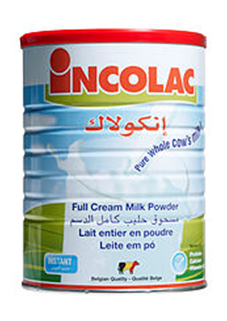
Incolac powdered milk
Powdered milk is frequently used in the manufacture of infant formula, confectionery such as chocolate and caramel candy, and in recipes for baked goods where adding liquid milk would render the product too thin. Powdered milk is also widely used in various sweets such as the famous Indian milk balls known as gulab jamun and a popular Indian sweet delicacy (sprinkled with desiccated coconut) known as chum chum (made with skim milk powder). Many no-cook recipes that use nut butters use powdered milk to prevent the nut butter from turning liquid by absorbing the oil.[7]
Powdered milk is also a common item in UN food aid supplies, fallout shelters, warehouses, and wherever fresh milk is not a viable option. It is widely used in many developing countries because of reduced transport and storage costs (reduced bulk and weight, no refrigerated vehicles). Like other dry foods, it is considered nonperishable, and is favored by survivalists, hikers, and others requiring nonperishable, easy-to-prepare food.
Because of its resemblance to cocaine and other drugs, powdered milk is sometimes used in filmmaking as a non-toxic prop that may be insufflated.[citation needed]
Reconstitution
The weight of nonfat dry milk (NFDM) to use is about 10% of the water weight.[8][note 1] Alternatively, when measuring by volume rather than weight, one cup of fluid milk from powdered milk requires one cup of water and one-third cup of powdered milk.
Nutritional value
Milk powders contain all 21 standard amino acids, the building blocks of proteins, and are high in soluble vitamins and minerals.[9] According to USAID,[10] the typical average amounts of major nutrients in the unreconstituted nonfat dry milk are (by weight) 36% protein, 52% carbohydrates (predominantly lactose), calcium 1.3%, potassium 1.8%. Whole milk powder, on the other hand, contains on average 25-27% protein, 36-38% carbohydrates, 26-40% fat, and 5-7% ash (minerals). In Canada, powdered milk must contain added vitamin D in an amount such that a reasonable daily intake of the milk will provide between 300 and 400 International Units (IU) of vitamin D.[11] However, inappropriate storage conditions, such as high relative humidity and high ambient temperature, can significantly degrade the nutritive value of milk powder.[12]
Commercial milk powders are reported to contain oxysterols (oxidized cholesterol)[13] in higher amounts than in fresh milk (up to 30 μg/g, versus trace amounts in fresh milk).[14] Oxysterols are derivatives of cholesterol that are produced either by free radicals or by enzymes. Some free radicals-derived oxysterols have been suspected of being initiators of atherosclerotic plaques.[15] For comparison, powdered eggs contain even more oxysterols, up to 200 μg/g.[14]
Export market

National household dried machine skimmed milk. This was U.S.-produced dry milk for food export in June 1944.
European production of milk powder is estimated around 800,000 tons of which the main volume is exported in bulk packing or consumer packs.
Brands on the market include “Nido“, from the company Nestlé, “Incolac” from the company Milcobel, “Dutch Lady” from FrieslandCampina and “Puck” from Arla Foods.
Adulteration
In the 2008 Chinese milk scandal, melamine adulterant was found in Sanlu infant formula, added to fool tests into reporting higher protein content. Thousands became ill, and some children died, after consuming the product.
Contamination scare
In August 2013, China temporarily suspended all milk powder imports from New Zealand, after a scare where botulism-causing bacteria was falsely detected in several batches of New Zealand-produced whey protein concentrate. As a result of the product recall, the New Zealand dollar slipped significantly[quantify] based on expected losses in sales from this single commodity.[16]
Use in biotechnology
Fat-free powdered milk is used as a saturating agent to block nonspecific binding sites on supports like blotting membranes (nitrocellulose, polyvinylidene fluoride (PVDF) or nylon),[17] preventing binding of further detection reagents and subsequent background.[18] It may be referred as Blotto. The major protein of milk, casein, is responsible for most of the binding site saturation effect.
 Track2Training


You must be logged in to post a comment.