
We can’t imagine a world without humans. Who will use earth’s resources and the environment? Human beings develop the economy and society. The people invent resources and use them for their needs. Their growth and characteristic give the background for understanding all aspects of the environment. Human beings are consumers of earth’s resources. It is important to keep track of all the people living, and their increase in number.
Size of India’s Population
The current population of India is 1,394,901,748 according to United Nations data. All these people are unevenly distributed across 3.28 million square kilometers of our geographical area. This is due to the varying population density of India. Population density is the total number of people per unit area. Population density is totally dependent on the geographical location and factors. India is one of the most populated country in the world.
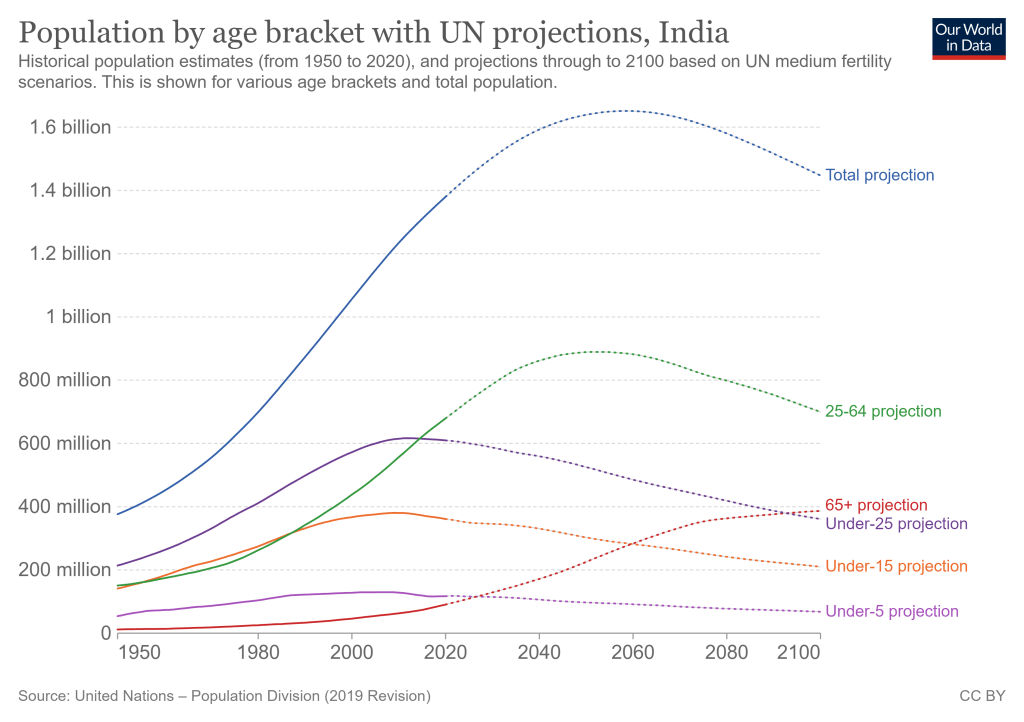
Population Change
The number and density of population is constantly changing. It is generally determined by the growth per annum. Population growth can be determined in terms of percentage change per year. India’s population is consequently increasing steadily. Important aspect of the population growth is – births, deaths, and migration.
Birth rate – It is the number of births per thousand persons in a year.
Death rate – It is the number of deaths per thousand persons in a year.
Migration – It is the movement of people across regions and territories.
Birth rate is always increasing than death rate. High birth rate and declining death rate led to a large difference between birth rates and death rates.
Migration can be internal or international. Internal migration does not lead to population change, but it does affect the population density in the migrated areas. Migration plays a very significant role in changing the composition and distribution of population.
Characteristics of Population Change
Age Composition
It refers to the number of people in different age groups. The percentage of a population found within the children of different age groups, determines the social and economic structure of the nation. Population of a nation generally categorised into three broad categories:
- Children – below 15 years
- Working-age – 15- 59 years
- Aged (Senior) – 59 years and above
Sex Ratio
It is the number of females per 1000 males in the population. India’s sex ratio helps in understanding the equality of males and females in the society, which consequently gives an idea of the nation’s culture.
Literacy rate
Literacy rate determines the social and economic structure of the country. Noteworthy, there has been a steady increase in literacy level in India. According to the census the literacy rate in the country is 74.04%.
Occupational Structure
The percentage of population that is involved in economic activities leads to economic growth of the country. Distribution of the population according to different types of occupation is know as occupational structure. This is an important element of the population of India. Also, our occupational structure has three broad categories –
- Primary occupation – agriculture, fishing, mining, animal husbandry, forestry etc.
- Secondary occupation – manufacturing, building, construction work etc.
- Tertiary occupation – communication, transportation, administration etc.

The study reveals that the country’s population growth is imposing an increasing burden on the country’s limited and continually degrading natural resource base. The natural resources are under increasing strain, even though the majority of people survive at subsistence level. Population pressure on arable land contributes to the land degradation. The increasing population numbers and growing affluence have already resulted in rapid growth of energy production and consumption in India. The environmental effects like ground water and surface water contamination; air pollution and global warming are of growing concern owing to increasing consumption levels. Population is a dynamic phenomenon.
 Track2Training
You must be logged in to post a comment.