
About Teen Pregnancy

The US teen birth rate (births per 1,000 females aged 15 to 19 years) has been declining since 1991.  Teen birth rates continued to decline from 17.4 per 1,000 females in 2018 to 16.7 per 1,000 females in 2019.  This is another record low for US teens and a decrease of 4% from 2018. Birth rates fell 7% for females aged 15 to 17 years and 4% for females aged 18 to 19 years.

Although reasons for the declines are not totally clear, evidence suggests these declines are due to more teens abstaining from sexual activity, and more teens who are sexually active using birth control than in previous years.

Still, the US teen pregnancy rate is substantially higher than in other western industrialized nations, and racial/ethnic and geographic disparities in teen birth rates persist.

Disparities in Teen Birth Rates

Teen birth rates declined from 2018 to 2019 for several racial groups and for Hispanics. Among 15- to 19-year-olds, teen birth rates decreased:

  • 5.2% for Hispanic females.
  • 5.8% for non-Hispanic White females.
  • 1.9% for non-Hispanic Black females.

Rates for non-Hispanic American Indian/Alaska Natives (AI/AN), non-Hispanic Asians, and non-Hispanic Native Hawaiian, and other Pacific Islander teenagers were unchanged.

In 2019, the birth rates for Hispanic teens (25.3) and non-Hispanic Black teens (25.8) were more than two times higher than the rate for non-Hispanic White teens (11.4). The birth rate of American Indian/Alaska Native teens (29.2) was highest among all race/ethnicities.

Birth Rates for Females Aged 15 to 19 Years, by Race and Hispanic Origin of Mother: United States, 2018 and 2019
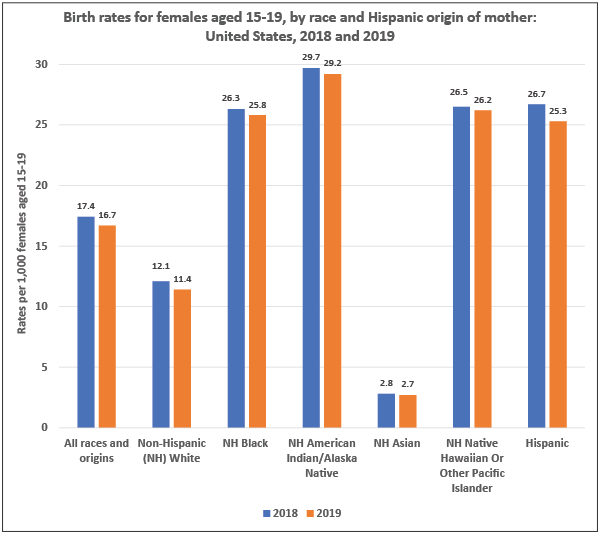
Birth Rates per 1,000 Females Aged 15 to 19 Years, by Race and Hispanic Origin of Mother: United States, 2018 and 2019.  All races and origins, 2018: 17.4; 2019: 16.7 Non-Hispanic White, 2018: 12.1; 2019: 11.4 Non-Hispanic Black, 2018: 26.3; 2019: 25.8 Non-Hispanic American Indian/Alaska Native, 2018: 29.7; 2019: 29.2 Non-Hispanic Asian, 2018: 2.8; 2019: 2.7 Non-Hispanic Native Hawaiian or Other Pacific Islander, 2018: 26.5; 2019: 26.2 Hispanic, 2018: 26.7; 2019: 25.3

Data source: Martin JA, Hamilton BE, Osterman MJK, Driscoll AK. Births: final data for 2019. Natl Vital Stat Rep. 2021;70(2):1–50.

Geographic differences in teen birth rates persist, both within and across states. Although among states with low overall teen birth rates, some counties have high teen birth rates.

Social determinants of health, such as low education and low income levels of a teen’s family, may contribute to high teen birth rates. Teens in certain settings are at higher risk of teen pregnancy and birth than other groups. For example, young women living in foster care are more than twice as likely to become pregnant than young women not in foster care.

To improve the life opportunities of adolescents facing significant health disparities and to have the greatest effect on overall US teen birth rates, CDC uses data to inform and direct interventions and resources to areas with the greatest need.

The Importance of Prevention

female  and male teen

Teen pregnancy and childbearing are associated with increased social and economic costs through immediate and long-term effects on teen parents and their children.

  • Pregnancy and birth are significant contributors to high school dropout rates among girls. Only about 50% of teen mothers receive a high school diploma by 22 years of age, whereas approximately 90% of women who do not give birth during adolescence graduate from high school.
  • The children of teenage mothers are more likely to have lower school achievement and to drop out of high school, have more health problems, be incarcerated at some time during adolescence, give birth as a teenager, and face unemployment as a young adult.
  • On a positive note, between 1991 and 2015, the teen birth rate dropped 64%, which resulted in $4.4 billion in public savings in 2015 alone.

Is the age of mother really important for CHILDBEARING?

Know the right age for pregnancy and also the risks involved in late pregnancies.

Every eye visiting this article would be having a definite answer in their head; NO. In these modern times when every women wants an established career no one even thinks of planning a baby before 35 or say 30. But the question that follows here is Does the age of mother really matter for childbearing?

The age of reproduction of women starts around 13-14 years and lasts on an average till 45 years. So some may be wondering that when the reproduction can be done till the age of 45 then why to have baby in 20s and 30s. But the answer to the previous question is ‘YES’. The age of the mother really matters when it comes to bearing a child. Let’s understand why.

There are some facts we need to understand while we understand the reason:

  1. Definitely timed biological clock.
  2. Quality of eggs.
  3. Certain risks of Pregnancy.

Definitely timed biological clock:

As said that the reproductive age in women starts from 13-14 years and lasts till 45 years, there is certain age where the fertility of the women is at its peak. In her late teens and upto her late 20s, the women experiences the best fertile period. Post 30, the fertility potential decreases with each passing year. This decline is very pronounced after the age of 35. It decreases rapidly after that. So for a healthy couple if the chances of a pregnancy is about 1 in 4 in the late twenties or the early thirties, the chances reduces drastically by 1 in 10, by the time the woman reaches about 40.

Quality of eggs:

When we say that the possibility of the woman to get pregnant after 35 declines, but what is it that actually affects this? It is the Number and the Quality of eggs in a female. With age the number and the quality of the eggs reduces which opens the gates for the risks like miscarriage or having an abnormal baby. While the fertility potential of males also declines with age, this is seen to be dramatically declining in the case of females.

Certain risks of Pregnancy:

There are certain risks for the women and their foetus who plan their pregnancy after the age of 35.

  • The relative risks of having certain diseases like High blood pressure, diabetes, miscarriage, premature births increase with an increasing age of the mother.
  • The chances for genetic abnormality in an unborn baby of the mother who ages 25 is about 1 in 700 but this risk inclines about 1 in 400 for the mother ageing 35. Beyond the age of 40, this risk increases to 1 in 100.

Does that mean women have to leave their career and plan their babies first? No, it does not. With the progression of the science and technology there are certain solutions available. Do not look for them on the Google, instead visit a gynecologist for the same. Those women planning their babies after 40 can freeze their eggs when they are about 30 to 34 of age. Also the healthier the woman maintains her lifestyle, the lesser will be the chances of having a miscarriage.

And after all it’s not necessary to have a biological child to be a parent. Share this with every woman to spread awareness.