
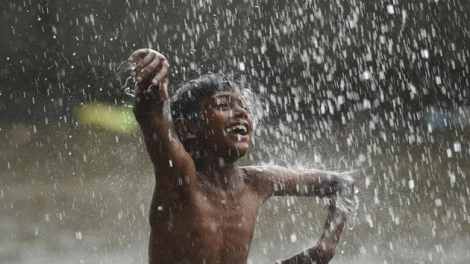
RAIN

RAIN


INTRODUCTION :

The main component of climate is water. We get water in various types of precipitation. Downpour is the most helpful of a wide range of precipitation. Downpour is the thing that gathers our yields that give us food to eat. Without downpour, no yields would develop and we would ward off the substance of this Earth.

Significance of Rainy Days 

As expressed before, stormy days are delighted in by individuals, all things considered. The children are presumably the most energized parcel of all. Blustery days bring wonderful climate and elevate the states of mind of children. Additionally, it’s anything but an opportunity to venture out and play in the downpour, bounce in the puddles and make paper boats.

Likewise, for understudies, a blustery day implies a break from school. It’s anything but a break from their dreary daily schedule as the school pronounces an occasion. The delight of going to class on a stormy day getting a charge out of the climate and afterward understanding the school is shut is exceptional experience. The understudies become loose and go through their day doing different exercises like going out with companions and the sky is the limit from there.

My Rainy Day Experience

At the point when I consider blustery days, it brings back extremely unique recollections for me. Notwithstanding, one memory is such which is the nearest to my heart. I recall our educator planned a test for us when it began pouring intensely.

I woke up in the first part of the day with the dread of stepping through the exam for which I was not ready. I implored God for the abrogation of the test. As I was preparing, it began coming down vigorously. I got spruced up and went to class with my dad, and amazingly, we came to realize the school was shut that day because of a blustery day.

I was large and in charge when I came to think about it. I got back with my dad and returned then stripped down. Quickly, I changed into my home garments to go f\and wash in the downpour on my porch. I played with my kin a ton in the downpour; we made paper boats also. After we were done, we saw that my mom was making onion wastes. She served them consuming hot with stew chutney. We savored the wastes as we watched the precipitation. It was really quite possibly the most vital blustery days of mine.

CONCLUSION :

At the point when we get into the downpour, we as a whole get wet. Nobody is superior to another when you’re dousing wet and in urgent need of a Swiss Miss Hot Chocolate, the nectar of the divine beings. Downpour is the general voice of lowliness. Regardless of what gadgets man has made to keep away from the downpour, it actually comes.
Rainwater Harvesting

It is said that World War III will not be fought for territories and geographic dominance, but it will be fought solely on the basis of water. This may sound unbelievable to citizens of developed nations. However, in a nation like India, there are already daily battles being waged by projects, individuals for access to this precious research.

India which almost completely depends on the annual monsoon season for water, currently faces the most severe water water crisis in its known history. A recent report by NITI Aaykg predicts that as many as 21 cities in the country will see total depletion of their groundwater resources by as early as 2020. Even today, our cities run like dry clockwork during summers. Neverthless there is not awareness raised about the simple solution of rainwater harvesting in India. Can we really afford to neglect this straightforward solution?

Let’s discuss what exactly is rainwater harvesting. It is the collection of rainwater rather than allowing it to run off. Rainwater is collected and stored in reservoirs or boreholes that allow percolation and increase of  the underground water table. However, this rainwater can also be purified and then used in domestic households and agricultural practices.

In Chennai, rainwater harvesting has been made compulsory and fresh design structures have been incorporated into the Tamil Nadu Combined Developemnt and Building Rules, 2019.

In rural Maharashtra,  Shirpur-once a drought stricken area-has literally turned green due to adoption of rainwater harvesting.

Major cities like Delhi, Mumbai, Bangalore and Hyderabad do have laws regarding rainwater harvesting. For example, in Bangalore, law states that every structure built on 30×40 Sq feet and above and old buildings built on 40 x 60 Sq feet and above should install rainwater harvesting systems.  In case any building fails to do so, a penalty will be faced every month.

However, it is not good enough for these rules to exist just on paper. If the concerned authorities fail to check regularly to ensure their on ground implementation, rules for harvesting won’t hold value.

State governments can popularize rainwater harvesting by launching awareness drives, not just in urban areas but in rural areas as well. This can be done by incentivising housing societies that do comply, such as offering a rebate on property tax for installing the system.

But in situations like these, joint efforts need to take place. We all are citizens of this country, hence its our duty to ensure that we preserve our environment and the planet. Even if it is not given in the law, people can consciously work towards installation of rainwater harvesting systems in their building or even in their locality if they get the right kind of support.

In rural areas, rooftop water harvesting is the most easy solution. It is seen as a basic, inexpensive method for requiring minimum expertise for implementation. This is ideal for supplementing existing water sources which may become brackish or polluted.

We need to act soon, before our water resources get completely dried up. Water is slowly becoming a rare resource in many areas of the country, and this cannot happen-or India will eventually lose it’s own water wars.


RAIN

ABOUT RAIN:

Rain is liquid precipitation which is water falling from the sky. Rain is liquid water in the form of droplets that have condensed from atmospheric water vapor and then become heavy enough to fall under gravity. Rain is part of the water cycle. A light rain of small drops is known as a drizzle. Spring is the rainiest season of the year as measured by the number of days with precipitation. Rainfall is measured by the depth of water that falls on a level surface without soaking in. Rainfall is measured with a rain gauge.

HOW RAIN IS FORMED? :

Clouds are made of water droplets. Within a cloud, water droplets condense onto one another, causing the droplets to grow. When these water droplets get too heavy to stay suspended in the cloud, they fall to Earth as rain.

IMPORTANCE OF RAIN:

Rain is a wonderful gift of Nature to all mankind. Rain is a major source of water to the inhabitants of the earth, and it also plays a major role in ensuring the water cycle is complete. Rain may be the most essential weather phenomenon for life to exist on Earth. The growth of plants also may depend on rain. Without rain, no crops would grow. If rainfall is less, there is water scarcity which sometimes causes a drought-like situation. It can improve the level of groundwater. Rainfall is also very important for the survival of plants and animals. It brings freshwater to the earth’s surface. With temperature, rainfall is perhaps the most important factor in defining climate. Rainfall is also the major source of energy that drives the circulation of the atmosphere. The rain waters the Earth and refills streams, rivers, lakes, and oceans, and provides the moisture trees and plants use to make their food. This water also gives wild animals the water they need to drink. Thus, Rain is very important.

INTERESTING FACTS ABOUT RAIN:

Some of the interesting facts about rain are,

* Some regions of the world get rain nearly every day or every other day. Galway, Ireland gets this weather about 220 – 230 days or more each year. Similarly, parts of Hawaii and other tropical areas receive brief spurts of rain on an almost daily basis.

* The place that receives the most annual rainfall on average is a village in India called Mawsynram, Meghalaya, India. They receive about 467 inches each year, most of which falls during monsoon season.

*Drops are not shaped like teardrops as they fall, as is commonly depicted – they are actually dome-shaped.

* When raindrops fall on clay or dusty soils, they trap small air bubbles on the surface which raise upward and burst out of the droplet. This then produces pockets of scent into the air where they are then carried by the wind. This is what causes the familiar smell of rain, which is called ‘Petrichor’.

*Up in the clouds, rain most often starts off as snow. Clouds are made of freezing-cold water droplets and tiny crystals of ice. In most rains, this cold water adheres to ice, forming nascent drops that then fall out of the clouds. As they descend towards the relative warmth of the earth’s surface, they melt and become rain.

* Not all raindrops are made of water: Rain also consists of sulfuric acid or methane, which can also be found on other planets in the solar system.