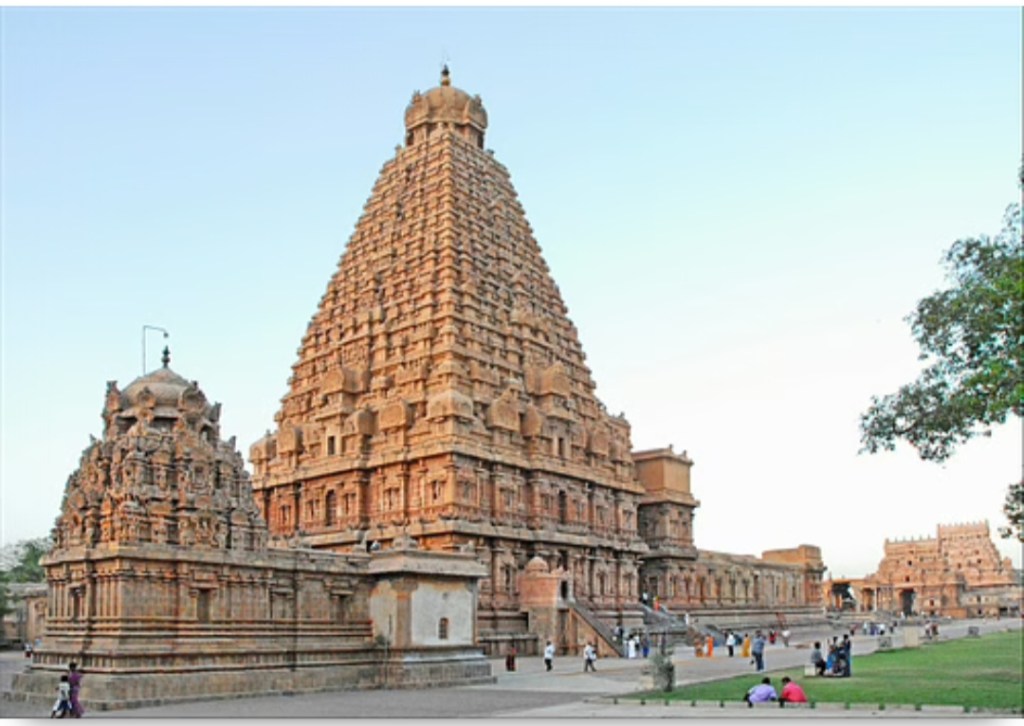
This Temple is situated in Thanjavur Tamil Nadu.It is constructed by Raja Raja chola in 1003 and 1010 A.D. This temple is originally known as Peruvudaiyar Kovil locally known as Thanjai Periya Kovil, and also called Rajarajeswaram, is a Hindu temple dedicated to Shiva located in South bank of Cauvery river in Thanjavur, Tamil Nadu, India. It is one of the largest Hindu temples and an exemplary example of a fully realized Tamil architecture.[4] It is called as Dakshina Meru.In top of the temple they built the vimana which is one of the highest in South India.
The main temple along with its gopurams is from the early 11th century. The temple also saw additions, renovations, and repairs over the next 1,000 years. Because the kings who made wars caused damaged to the temple And it is renovated by the Hindu dynasty.The main temple-related monuments and the great tower is in the middle of this courtyard Around the main temple that is dedicated to Shiva, are smaller shrines, most of which are aligned axially. These are dedicated to his consort Parvati, his sons Subrahmanya and Ganesha, Nandi, Varahi, Karvur deva As a world heritage monument, the temple and the premises comes under the Archaeological Survey of India (ASI) which falls under the Ministry of Culture of the Government of India, to ensure safety, preservation and restoration.The lighting of the monument is designed to enhance the natural color of the stone along with the sculptural forms adorning all corners of the temple. The restoration has been undertaken by the Archaeological Survey of India.
Almora district is a district in the Kumaon division of Uttarakhand state, India. The town of Almora is surrounded by Pithoragarh district to the east, Garhwal region to the west, Bageshwar district to the north, and Nainital district to the south. The landscape of Almora attracts tourists each year for its views of the Himalayas, cultural heritage, handicrafts, and cuisine, and is a business hub for the Kumaon region.
Almora has attracted several eminent people through the ages, including Swami Vivekananda, Rabindranath Tagore, Uday Shankar, and his troupe, and Ravi Shankar, who contributed to the cultural enrichment of the town. Govind Ballabh Pant noted freedom fighter was born in Almora. Former Indian Captain and ace cricketer Mahendra Singh Dhoni has ancestral roots in Lwali village in Almora. The town also serves as the starting point for many treks like Jageshwar, Pindari, Mornaula, Mukteshwar, Binsar, and Ranikhet among others.
The place owes its name to “Kilmore” a tiny plant found in the nearby regions, used for washing utensils of Katarmal sun temple. The people who used to bring the plant were referred to as Kilmore or Almora. Hence, the town came to be known as Almora or Almoda.
Almora
Places to visit –
Chitai Golu Devta Temple
Presided by the deity of Golu Ji, an incarnation of Lord Shiva in the form of Gaur Bhairav, the Chitai Temple is recognized by the number of copper bells hung in its premises. Although there are many temples of Golu Devta in Almora the Chitai Golu Devta Temple is the most sacred one.
Chitai Golu Devta Temple
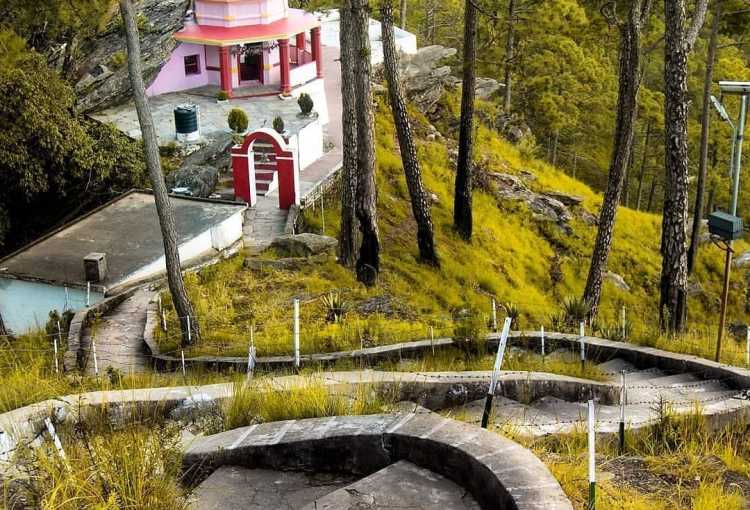
Kasar Devi
Kasar Devi is a village near Almora, Uttarakhand. It is known for the Kasar Devi temple, a Devi temple, dedicated to Kasar Devi, after whom the place is also named. The Kasar Devi temple offers a pleasant view of the Almora city and Hawabagh Valley. In the 1890s Swami Vivekanand came to this temple for meditation.
Kasar Devi Temple
Dunagiri
Dunagiri temple is located 14 km far from Dwarahat. The temple is dedicated to the goddess Durga. It is believed that when Hanuman Ji was carrying the mountain with ‘Sanjiwani buti’ for Laxman, a piece of it fell here and since that day this place is known as ‘Doonagiri’ (‘giri’ meaning fell).
Dunagiri Temple
Jageshwar
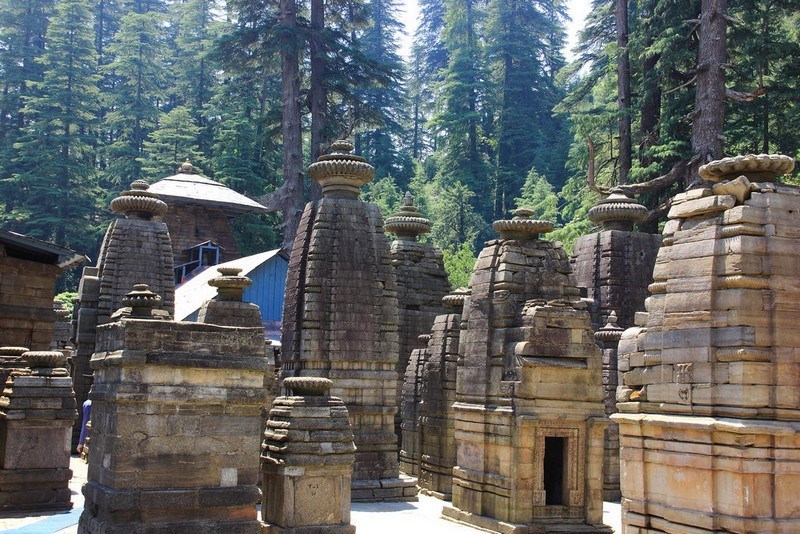
One of the finest examples of architecture in Uttarakhand, Jageshwar Dham is a group of temples dedicated to Lord Shiva. The Jageshwar temple site attracts many pilgrims and visitors every day. Many complete a part of the post-cremation last rites after the death of a loved one at the Jageshwar temple site.
Jageshwar Temple
Binsar
Binsar is a small town adorned on the hills of Kumaon. Binsar is known for offering spell-binding views of the majestic Himalayan peaks such as Chaukhamba, Nanda Devi, Nanda Kot, Panchauali, and Kedarnath. This compact hill town is encircled by the Binsar Wildlife Sanctuary which serves as a habitat for the rare animals, birds, and flower species. It is the best place for experiencing adventurous hiking and camping.
Binsar
Katarmal Sun Temple
Katarmal Sun Temple is considered the second most important sun temple in India after Konark Sun Temple (Orissa). It is believed to be the only sun temple located in the hills. The Katarmal Sun temple is a unique cluster of temples that is the tallest temple in the Kumaon region. Inside the main temple along with the statue of Vraddhaditya, other deities are also present. The locals believe that this shrine is significant for two reasons. One, this is the only Sun temple in the hills, and second, in February and November, the sun rays fall directly on the deity making it an extraordinary sight.
Nature is ever at work building and pulling down, creating and destroying, keeping everything whirling and flowing, allowing no rest but in rhythmical motion, chasing everything in endless song out of one beautiful form into another.
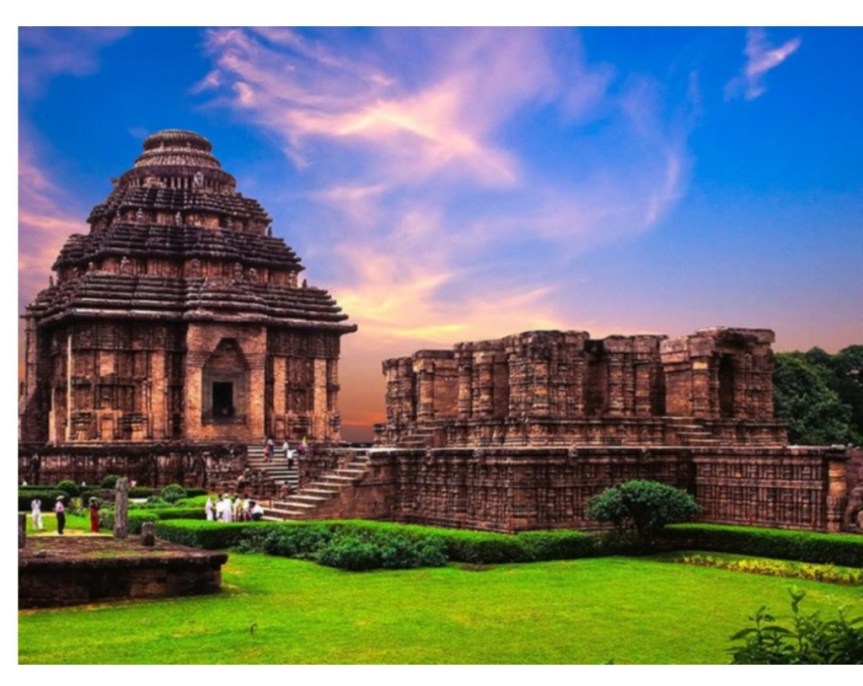
Konark, a small town located in the Puri, area of Odisha on the east coast of India, is the home to a 800 years old Sun Temple dedicated to the Sun God, a World Heritage Site which is now almost in ruins . The word ‘Konark’ is a combination of two words ‘Kona’ and ‘Arka’. ‘Kona’ means ‘Corner’ and ‘Arka’ means ‘Sun’, so when combines it becomes ‘Sun of the Corner’. It was built in the thirteenth Century by King Narasimhadeva I of the Eastern Ganga Dynasty, this Sun Temple in which is also known as “Black Pagoda” due to its dull black color, is outlined as a tremendous chariot underpinned by twenty-four chariot wheels, devoted to the Sun God. Also known as Arka khetra, there are three images of the Sun God at three different sides of the temple, positioned in proper direction to catch the rays of the sun at morning, noon and evening. The Konark temple is widely known not only for its architectural greatness but also for the sophistication and abundance of sculptural work. Konark is an exceptional mixture of marvelous temple architecture, heritage, exotic beach and salient natural beauty.
Narasimhadeva had preferred the place for his proposed temple, for not only enabling him to bring his building materials from different places by the said river, but the sanctity of the was also considered by him. The beauty of the Sun-rise at that place was said to have charmed Narasimhadeva since his early life. The river Chandrabhaga which is now dead, was once flowing within a mile to the north of the temple site and was joining the sea. On its banks, existed flourishing towns and important trading centres. Trade was carried on with foreign countries as well, by sea routes, as there was no better communication other than the river in those days. Besides the sanctity and the favourable surroundings, the presence of majestic sea eternally roaring and rolling within a striking distance, was perhaps an added attraction for them.
This Sun Temple, a symbol of India’s ancient architectural skills was completed in 12 years (1243-1255 AD) with the help of 1200 workers. Beautifully designed as a chariot mounted on 24 wheels, each of diameters about 10 feet decorated by most exquisite stone carvings, and drawn by 7 strong horses, it boasts of India’s rich cultural heritage. The Sun temple follows Odissi style of architecture (except the erotic stone carvings on the walls), however a significant part of the main structure has fallen and it survives just in parts. However, it’s sad to see the present state of this temple which is almost in ruins. Although, the Sun Temple even in its available demolished state, is still a marvel to the entire world.
Erotic art is a topic that richly possesses practically all portions of the Konark Sun temple. The life-size loving couple, the vulgar priests, the ideal female figures in seductive poses along with their killer grins have made Konark a feast for the eyes of the visitors. The stone carvings display many other sites like dancers with musical instruments, beautiful doors, Giraffes eating grapes, camels and Snake God. The pleasure of seeing the flesh in abundance blended with various Kamasutra positions, gives Konark an unrivalled position in the domain of romantic art.
Every year in the month of February, Konark Dance and Music Festival is organized within the temple premises featuring Odissi dancers and sometimes noted musicians.
The 800 years old Sun Temple cannot just be regarded as a landmark of historical importance. It is much more than a world heritage site as it has the potential to amaze the scholars of many schools like Science, Astronomy, Maths, Physics, Chemistry, Biology, and Construction Engineering. Also it continues to impress artists and poets. In the words of Rabindranath Tagore – “The Language of stone surpasses the language of man here”.
The Sun Temple is a living testimony to the speculative, daring and the artistic sensibility of a human race that once knew how to live, love, worship and create in heroic proportions. Though Konark is turning into a ruin fast, having been empty and untouched for so long, still the magnificence of it’s architecture continues to outgrow itself so beautifully, like green patches all over with flowers above them.







 Track2Training
You must be logged in to post a comment.