
Hinduism, being the oldest religion, has many rituals in it. Sati, burning a woman alive with her husband’s dead body, is the most influential and controversial ritual. Many other religions had similar ill practices in the past such as witch-hunting (women were hanged to death for being suspicious of witches), and female genital mutilation. It was declared illegal in 1829 but even today we see women committing it, which might be voluntarily or forcefully.
If it was a voluntary act, then it was considered to be the greatest form of devotion of a wife toward her husband. As time passed sati became a forced practice.
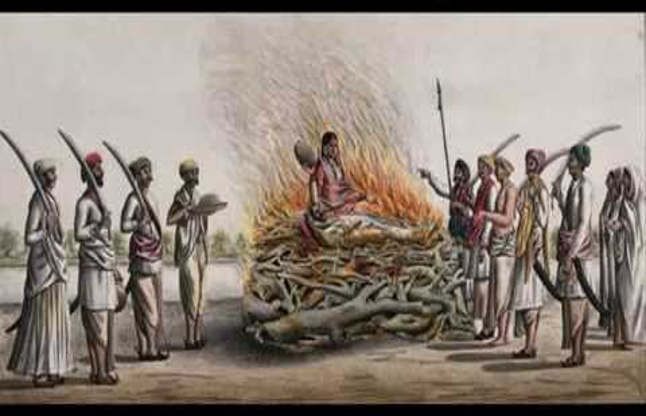
Origin Of Sati Pratha
We have read about sati pratha and how it was abolished in our history books but do you know how it was originated in the first place.
As per mythology, Sati was the name of the wife of lord shiva. Sati was the daughter of Daksha who was the son of Brahma. Her father never respected shiva and often despised him. So to protest against the hatred that her father held for her husband she burnt herself. While she was burning she prayed to be reborn as shiva’s wife again. Thus this did happen and her new incarnation was called Parvati.
There is no mention of sati pratha in any ancient Indian scriptures like The Valmiki Ramayana and Vedas. In Mahabharata, Madhuri the second wife of Pandu, burned herself to death after her husband died. She considered herself responsible for his death as she could not save her husband from the poison. Her sacrifice was not the result of any sati pratha but sheer love toward her husband.
If you look in Ramayana and Mahabharata you can see many women who lost their husbands did not perform sati. In Ramayana, Sita had to undergo fire to prove her chastity. But there is no correlation cause sati happens when the husband dies but Ram or Shiva never dies in those stories.
There is a resemblance between sati and jauhar (another form of sati performed by Rajput women). Jauhar was a mass suicide performed by women to avoid capture by Muslim invaders. Sati on other hand is performed by a widow.
Spread of Sati Pratha
This tradition has been followed since ancient times in India. Sati was considered as a dignified sacrifice, a way to clean the sins of the spouse and his family but some considered it as a private matter of spouses who follow his/her loved one into death, and with time it became public. Initially, the practice of sati was confined to the rural families of Kshetriya cast and only later spread to the lower caste becoming widely practiced among all social classes. The window of royal families prefers dying rather than being captivated by the soldiers who defeated their king in the war.
Abolition of Sati
Many Hindu scholars and poets have condemned the sati tradition. The first ones who tried to put a stop to this inhuman tradition were the Muslim rulers of India, namely the Mughals and Nizams. But the attempt was unsuccessful as they were criticized by many people. However, in the 19th century, during British rule in India, Sati was abolished by the governor of India at that time, William Bentick.
 Track2Training