
✍️ By Dileep Verma
Research Expert and Associate Editor of Track2Training, New Delhi, India
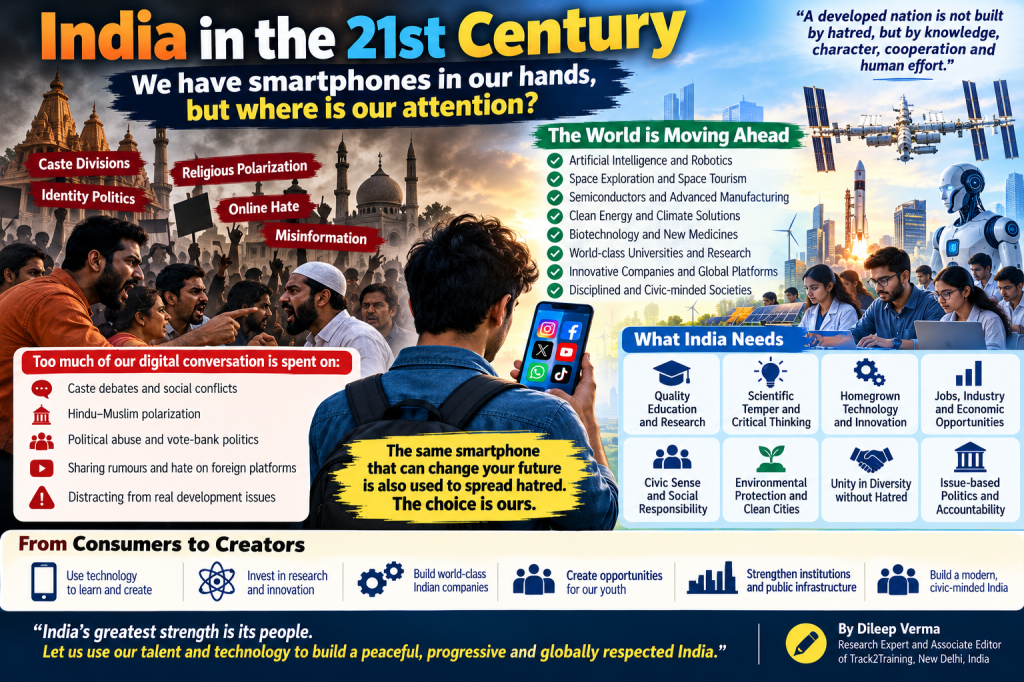
We are living in one of the most exciting periods in human history.
Artificial intelligence can write, translate, analyse data and help scientists discover new medicines. Robots are working in factories and hospitals. Machines can learn from huge amounts of information. Private companies are sending people into space. Countries are investing billions in semiconductors, quantum computing, biotechnology, clean energy and advanced defence technologies.
Knowledge has become power.
Technology has become power.
Research has become power.
And in this fast-changing world, India has more than a billion people, millions of young students, engineers, researchers and entrepreneurs. We have enormous human potential.
Yet sometimes, when I open social media or watch our public debates, I ask myself a simple question:
Are we using enough of this potential in the right direction?
We have smartphones in our hands, high-speed internet in our homes and access to almost unlimited knowledge. But too much of our public conversation is still trapped in caste fights, Hindu-Muslim arguments, religious controversies, political abuse and social-media hatred.
This is one of the great contradictions of modern India.
A Modern Phone Does Not Automatically Make a Modern Society
Think about the smartphone in your hand.
It may contain technology developed across several countries. Its processor, operating system, display, camera sensors, software and applications are the result of decades of scientific research.
Through this small device, we can read books from the world’s best universities, learn programming, study mathematics, watch scientific lectures, use artificial intelligence, start a business or communicate with people thousands of kilometres away.
But what are we sometimes doing with this extraordinary technology?
We forward rumours.
We fight over caste.
We abuse people because of religion.
We share edited videos without checking whether they are true.
We insult strangers because they support a different political party.
There is something deeply ironic about using some of the world’s most advanced technology to fight some of society’s oldest battles.
Technology may be modern, but our thinking must also become modern.
Caste and Religion Are Real, But Hatred Is Not a Solution
India cannot simply pretend that caste and religion do not matter.
Caste discrimination is real. Social inequality is real. Religious freedom matters. Minority rights matter. Historical injustice matters.
These issues deserve serious discussion.
But discussing inequality is different from spreading hatred.
Protecting one’s religious freedom is different from insulting another person’s religion.
Being proud of one’s community is different from believing another community is inferior.
India’s diversity is not the problem.
The problem begins when diversity is converted into permanent hostility.
A country of more than a billion people cannot move forward if every community is continuously encouraged to fear or hate another community.
We Also Need to Change the Questions We Ask Politicians
Politicians respond to what voters reward.
If elections are discussed mainly through caste arithmetic, religious identity and community polarization, political parties naturally invest more energy in those issues.
But imagine if voters repeatedly asked different questions:
Where are the jobs?
How good are our government schools?
Why is the air in our city polluted?
How much are we spending on scientific research?
Where are the new universities and laboratories?
Why is public transport poor?
How many new industries have come to our district?
What are we doing in AI, robotics and semiconductor technology?
Why are talented researchers leaving our institutions?
These questions can change political priorities.
Voting is not only a right. It is also one of the ways citizens communicate what they expect from government.
India Is Making Progress, But We Should Aim Higher
It would also be unfair to say that India is doing nothing in technology.
India has built a major IT industry, a respected space programme and important digital public infrastructure. Electronics and mobile-phone manufacturing have expanded significantly. The country is investing in artificial intelligence and semiconductor capabilities.
These achievements should be recognized.
But recognizing progress does not mean that we should stop asking difficult questions.
India’s expenditure on research and development remains relatively low compared with several major technology-driven economies.
That matters.
Countries do not become scientific powers simply because millions of their citizens use smartphones.
They become scientific powers when they create knowledge.
They build laboratories.
They fund researchers.
They produce patents.
They develop technologies.
They manufacture sophisticated products.
They encourage experimentation.
They allow talented people to take risks.
We Must Move From Consumers to Creators
Most of us use global digital platforms every day.
We watch videos.
We upload photographs.
We send messages.
We use AI tools.
There is nothing wrong with using foreign technology. International trade and knowledge exchange are important parts of modern civilization.
But India should also ask:
What are we building for the world?
Can the next major AI platform come from India?
Can Indian companies become global leaders in robotics?
Can we design and manufacture advanced semiconductor chips?
Can our universities become destinations where researchers from other countries want to work?
Can an Indian company create a digital product used by billions of people?
Can India develop affordable technologies that solve problems in healthcare, agriculture, education and clean energy?
These are the conversations young Indians should be having.
Do Not Blame Young Engineers for Going Abroad
We often complain that India’s best engineers and researchers leave for the United States, Europe and other developed economies.
But we should be careful before blaming them.
Imagine a young researcher receiving two opportunities.
One offers a modern laboratory, strong research funding, professional freedom, a good salary and the opportunity to work with leading scientists.
The other offers limited equipment, uncertain funding and fewer research opportunities.
Which one would most people choose?
Instead of asking only:
“Why are our talented people leaving India?”
we should ask:
“How can we build an India where talented people want to stay, return and create?”
Patriotism is valuable, but patriotism cannot replace laboratories, research grants, professional opportunities and good institutions.
Give talented young people an environment in which they can succeed, and many will happily build their future here.
Civic Sense Matters Too
Technology alone cannot make a country developed.
Our everyday behaviour matters.
Do we stop at a red traffic light when no police officer is watching?
Do we throw garbage on the road?
Do we damage public property?
Do we unnecessarily honk?
Do we respect queues?
Do we verify information before forwarding it?
Can we disagree with someone without abusing them?
Can a Hindu respect a Muslim neighbour?
Can a Muslim respect a Hindu neighbour?
Can people from different castes study, work and live together with dignity?
These small behaviours tell us something important about a society.
Civic sense is also a form of national development.
A developed country is not only one with tall buildings, expensive cars and fast internet.
It is also a society where people respect public spaces, laws, institutions and one another.
Our Education System Must Build Citizens, Not Just Job Seekers
We spend years preparing children for examinations.
Marks matter.
Degrees matter.
Employment matters.
But education should do something more.
It should teach a young person how to think.
How to question information.
How to distinguish evidence from rumours.
How to respect another person’s dignity.
How to behave in public spaces.
How to understand the Constitution.
How to use technology responsibly.
How to disagree without hatred.
And how to solve problems.
Interestingly, India’s Constitution itself speaks about developing scientific temper, humanism and the spirit of inquiry and reform under Article 51A(h).
Those words feel especially important today.
Imagine a Different Competition
Imagine if our young people competed as passionately over innovation as people sometimes fight over identity online.
Which Indian university will produce the next major scientific discovery?
Which state will build the best government schools?
Which Indian startup will create a globally successful AI product?
Which city will become India’s cleanest and most liveable?
Which engineering college will produce the next breakthrough in robotics?
Which Indian company will develop affordable medical technology for the world?
Which research team will create better batteries, solar technologies or agricultural systems?
That is the kind of competition India needs.
The Smartphone in Our Hand Represents a Choice
Every morning, millions of Indians pick up a smartphone.
That device gives us a choice.
We can use it to learn.
Or we can use it to hate.
We can read research.
Or forward rumours.
We can learn artificial intelligence.
Or spend hours fighting strangers over religion.
We can build professional networks.
Or create communal divisions.
We can learn from the world.
Or remain trapped in arguments inherited from the past.
The technology does not make that decision.
We do.
What Kind of India Do We Want?
India does not need to abandon religion, caste identities, traditions or cultural diversity to become modern.
Modernity does not mean becoming Western.
It means developing the ability to use reason, evidence, science, education and good institutions to improve human life.
We can preserve our cultures while building laboratories.
We can practise our religions while respecting other religions.
We can recognize caste injustice without creating caste hatred.
We can disagree politically without treating fellow citizens as enemies.
And we can be proud Indians while remaining open to knowledge from the entire world.
The twenty-first century will not wait for us.
AI is advancing.
Robotics is advancing.
Biotechnology is advancing.
Space technology is advancing.
Clean-energy technology is advancing.
Other societies are investing heavily in the industries and knowledge systems that may define the next fifty years.
India has the population, talent and ambition to be part of that future.
But our greatest resource is not our population alone.
It is what we educate, enable and inspire that population to do.
So perhaps the question we should ask ourselves is not:
Which caste are you from?
Not:
Which religion do you follow?
But:
What are you learning?
What are you creating?
What problem are you solving?
And what kind of India are we building together?
Because the future will not be built by hatred.
It will be built by knowledge, character, scientific thinking, cooperation and human effort.

