
Effects of Population on Geography of India

We can’t imagine a world without humans. Who will use earth’s resources and the environment? Human beings develop the economy and society. The people invent resources and use them for their needs. Their growth and characteristic give the background for understanding all aspects of the environment. Human beings are consumers of earth’s resources. It is important to keep track of all the people living, and their increase in number.

Size of India’s Population

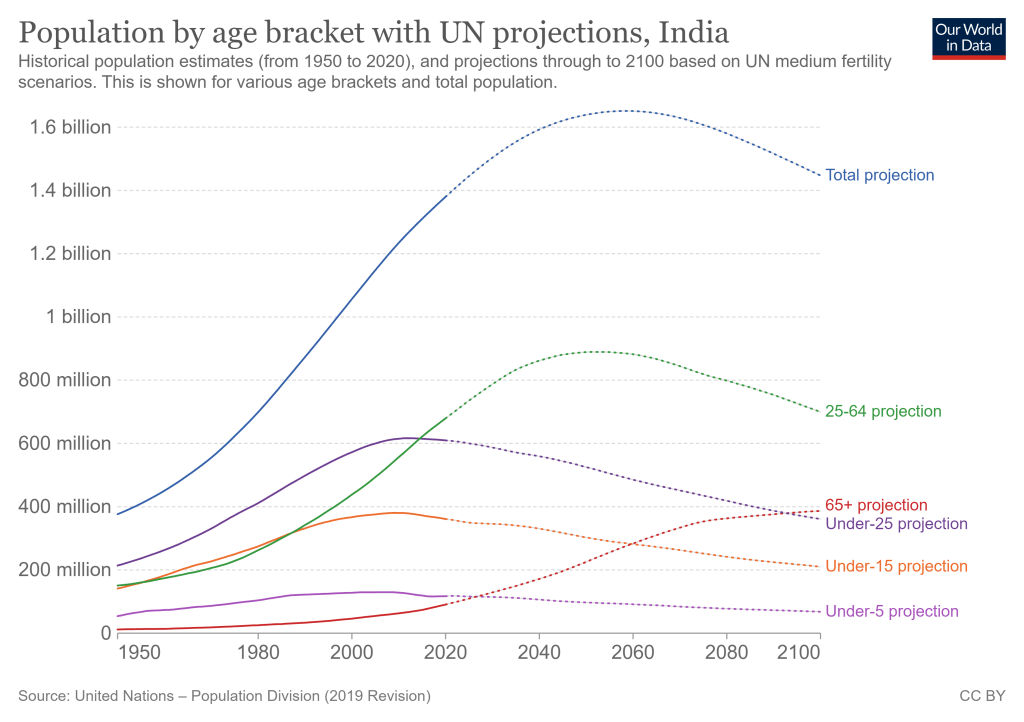
The current population of India is 1,394,901,748 according to United Nations data. All these people are unevenly distributed across 3.28 million square kilometers of our geographical area. This is due to the varying population density of India. Population density is the total number of people per unit area. Population density is totally dependent on the geographical location and factors. India is one of the most populated country in the world.
Population Change

The number and density of population is constantly changing. It is generally determined by the growth per annum. Population growth can be determined in terms of percentage change per year. India’s population is consequently increasing steadily. Important aspect of the population growth is – births, deaths, and migration.

Birth rate – It is the number of births per thousand persons in a year.

Death rate – It is the number of deaths per thousand persons in a year.

Migration – It is the movement of people across regions and territories.

Birth rate is always increasing than death rate. High birth rate and declining death rate led to a large difference between birth rates and death rates.

Migration can be internal or international. Internal migration does not lead to population change, but it does affect the population density in the migrated areas. Migration plays a very significant role in changing the composition and distribution of population.

Characteristics of Population Change

Age Composition

It refers to the number of people in different age groups. The percentage of a population found within the children of different age groups, determines the social and economic structure of the nation. Population of a nation generally categorised into three broad categories:

  • Children – below 15 years
  • Working-age – 15- 59 years
  • Aged (Senior) – 59 years and above

Sex Ratio

It is the number of females per 1000 males in the population. India’s sex ratio helps in understanding the equality of males and females in the society, which consequently gives an idea of the nation’s culture.

Literacy rate

Literacy rate determines the social and economic structure of the country. Noteworthy, there has been a steady increase in literacy level in India. According to the census the literacy rate in the country is 74.04%.

Occupational Structure

The percentage of population that is involved in economic activities leads to economic growth of the country. Distribution of the population according to different types of occupation is know as occupational structure. This is an important element of the population of India. Also, our occupational structure has three broad categories –

  • Primary occupation – agriculture, fishing, mining, animal husbandry, forestry etc.
  • Secondary occupation – manufacturing, building, construction work etc.
  • Tertiary occupation – communication, transportation, administration etc.

Photo by Anna Shvets on Pexels.com

The study reveals that the country’s population growth is imposing an increasing burden on the country’s limited and continually degrading natural resource base.  The natural resources are under increasing strain, even though the majority of people survive at subsistence level. Population pressure on arable land contributes to the land degradation. The increasing population numbers and growing affluence have already resulted in rapid growth of energy production and consumption in India. The environmental effects like ground water and surface water contamination; air pollution and global warming are of growing concern owing to increasing consumption levels. Population is a dynamic phenomenon.
How to Accelerate Azure Migration

Azure is a cloud computing platform and an online portal that allows you to access and manage cloud services and resources provided by Microsoft. These services include virtual computing, networking, storing data, and transforming it, depending upon your requirements. Azure supports multiple programming languages, including Java, Node.Js, and C#.

It’s free to start and follows a pay-per-use model, which means you pay only for the services you opt for.

Interestingly, 80 percent of the Fortune 500 companies use Azure services for their cloud computing needs. As it is a fast, flexible and affordable platform, its pricing and capabilities make it the best public cloud offering on the market. It is the second-largest cloud service provider right now.

Cloud Computing

Cloud computing is a technology that provides access to various computing resources over the internet. Cloud computing can be used for various purposes: machine learning, data analysis, storage, and backup, streaming media content and so much more.

Cloud Migration

Reduced cost, scalability, high-end security are the major reasons for cloud migration. Migrating to the cloud requires a lot of preparation and advanced work, but it is generally worth it, resulting in savings and greater flexibility. The overall goal or benefit of any migration to the cloud is to host applications and data in the IT environment in the most efficient way possible, based on factors such as cost, performance, and security.

A cloud migration strategy is a plan an organization makes to move its data and applications from on-premises architecture to the cloud. Not all workloads benefit from running on cloud-based infrastructure, so it is important to validate the most efficient way to prioritize and migrate applications before going live. A systematic, documented strategy is crucial.

Migration Process

Your exact roadmap for migrating to the cloud depends on the size and complexity of your environment. These are the basic steps:

Step 1: Planning your Migration

Before getting started, you should be clear on your reasons for the move and which strategy can best support them. Start by assessing your current environment. It is important to calculate your cloud server requirements based on current application resource requirements to avoid buying more than you need. At this critical stage, you will need the resources and expertise of a specialist. An application performance management (APM) solution can provide complete, real-time visibility into your environment and all its dependencies while rolling up strategy as part of the package.

Step 2: Choose a Migration Strategy

Once you have planned your migration and collected data on your current systems, you must decide on a migration strategy. These are the six most common approaches:

  • Rehosting (Lift and Shift”): Replicate on-premise architecture in the cloud. This involves lifting your stack and shifting it from on-premises hosting to the cloud.
  • Replatforming (“Lift and Reshape”): It involves making a few further adjustments to optimize your landscape for the cloud. Again, the core architecture of applications stays the same.
  • Repurchasing (Drop and Shop): This means redesigning and developing an application using cloud-native features. Even so, repurchasing might be your most cost-effective option if moving from a highly customized legacy landscape.
  • Refactoring (Re-architect): This means optimizing an application for the cloud by re-architecting. Refactoring is generally the most expensive option, but also the most compatible with future versions.
  • Retiring (Decommission): Once you have assessed your application portfolio for cloud readiness, you might find some applications are no longer useful. In this case, turn them off.
  • Retaining (No Movement): For some organizations, cloud adoption does not yet make sense. In this case, plan to revisit cloud computing at a later date. You should only migrate what makes sense for your business.

Step 3: Migrating your Apps and Data

Planned accurately, your actual migration should be plain sailing. Still, keep in mind cloud security concerns, such as complying with security policies and planning for data backup and recovery. Also, be sure to use APM to baseline premigration performance in preparation for the next step.

Step 4: Validating post-move Success

You cannot declare a cloud migration successful without evidence that it works as expected. With a solution like AppDynamics Business iQ, you can prove the benefits of cloud migration by comparing pre-and post-move application performance, from both a technical and business perspective, in a low-risk test environment.

With more than 200 services and numerous benefits, Microsoft Azure is the fastest-growing cloud computing platform adopted by businesses. Microsoft Azure’s total revenue is expected to surpass $19 billion by 2020. This growth in the implementation of Azure by businesses is creating various opportunities for professionals in this technology.

Diversity of India

Indian Society is a vast social order with multitude of culture, language, religion and caste. It has a very extensive history. Indian society was a layered society from ancient times. Rulers of India belonged from different culture and religion ruled for a long time. “Unity in Diversity” is most frequent feature of our Indian Society. It manifests to unity among individuals who have different culture, ideology, religion, language, ethnicity, etc. Despite the diversity in people, they have the sense of unity. India has different people in every society yet it doesn’t lose their separate identity. People have been living here peacefully for thousands of years.

People have freedom to live their life in their own way. People from different culture and religion interact with each other in many ways which leads to exposure, development of trust, bonding among them, mutual respect for each other, love, etc. Unity in Diversity binds people to maintain peace and harmony and brotherhood. If the people are united like this it will help in the growth and development of country.

History of Indian Society

In ancient Indian history, many races and tribes were involved. The Greek, the Aryans, and many others were living in India. Each and everyone contributed in the development of Indian society, language, art and architecture, and literacy. They blended so perfectible from north to south, east to west.

Significance of history in present

Some people want to rehabilitate the ancient Indian society and culture. This was for the concern of preservation of ancient art and architecture. This advancement cannot be achieved without the clear and accurate understanding of the history. This can’t go along with the achievement of modern science and technology. This will increase social inequalities that can plague India. All these species of the past have to be eradicated from India for the growth of the nation.

Importance of Unity in Diversity

Unity in Diversity is of much importance in the Development of the country, Global Recognition, National Integration, Peace and Harmony. It is very easy to divide people having different ideology but if the people of India are united it is very tough to break down the nation. Unity between people maintains peace in the nation. If the Indian Society is weak and distributed on different terms, India won’t be able to move on the path of development. India is always appreciated on international platforms for its unity. It is a symbol of Unity for other nations despite their different culture and religion.

Role of Unity in Diversity

In India People from different religion and culture live here. Every state has different beliefs, language, ideas, culture, religion, rituals, etc. People follow religion of their choice as India is Secular country. Yet, they live with the spirit of love and brotherhood. Indian Society learned this all from ancient times. There are about 29 religions and more than 1,000,500 languages are spoken. In spite of such differences Indians have unity among them which threatens global society. “United we stand, divided we fall.”

Our Indian Society taught us caste, religion, language, creed, race cannot divide us. We should always stand united for the improvement of nation. We should always believe in the concept of love, peace and brotherhood. The distinction in culture, religion, language makes us strong and makes India recognizable.