Theatre – as a historical tool – is not only important in the analysis of the nature of resistance against the British rule, but also for the study of the socio-political scenario of colonial India. Even though, being such an immensely vital topic of discussion, the theme related to Theatres are generally neglected and tends to get much less recognition compared to what it should obtain. However, some of the scholarly works like that of Nandi Bhatia’s ‘Acts of Authority/Acts of Resistance: theatre and politics in colonial and post-colonial India’ and Sudipto Chatterjee’s ‘The Colonial Staged: Theatre in colonial Calcutta’ have contributed handsomely to the subject. Lata Singh in her, ‘Theatre in colonial India – play house of power’ has argued that Theatre in India is very significant because in a largely non-literate culture, while the printing materials reached only amongst the educated elite, the subaltern voices can be retrieved through these sort of oral cultural forms. In upholding the importance of theatre, Bhatia while drawing a connection between the art of dramatical performances and politics of everyday lives, has argued that Indian Theatre could often intervene in political debates and even could change the course of politics.
The origin and development of Bengali Theatre has often been directly linked to the growth of the Proscenium Theatres of the British by scholars, who argue that the Bengal theatre was the result of colonial intervention in the early nineteenth century. But, a thorough scrutiny of events that happened in Bengal, suggests that The Bengal Theatres have evolved over several centuries, even before the advent of the British, and these Theatres were not created by any urban court elite rather were developed by the people themselves. Amulya Charan Vidya Bhusan opined that British Theatres evolved from the traditional ‘Jatra’, coining the term ‘Bilati Jatra’; Furthermore, Sushil kumar Dey has argued that there is no doubt in the theory that Bengali theatre and drama had utmost contribution from the western learned Bengalis but one should remember that the traditional ‘Jatra’ also had a very important role to play. Most of the historians agree that the admixture of both the western and traditional ‘Jatra’ basically by the western educated Bengali elites, had contributed to the growth of Bengali Theatres in the nineteenth century. Thus in order to understand the origin and development of Bengali Theatre and Drama, it is important to trace its evolution right from the Indigenous Theatre heritage of Bengal, which gradually started to follow the footsteps of the colonial Proscenium frame.
According to Bharat Muni, the author of ‘Natyashastra’, Bengal never followed the main-stream Aryanised Sanskrit Theatre tradition, rather followed the ‘Odhra Magadhi’ style, characterized by full dialogues and rhetoric. The different forms of traditional styles were: Sanskrit Natyakala (for example, Gitagovinda by Jaidev), Katha Natya (a form of performance where a single performer known as ‘Gayen’ or ‘Kathak’ narrates a verse or prose with vocal and musical accompaniment of a group of four), Nat Geet (a form of performance that makes use of character enactment and were accompanied by chorus/orchestra), Peoples Humor or Farce (a form of comical tradition extended from the greater India to Bengal; for example, Padmapuran by Narayan Dev and Chandimangal by Mukundulal), Hybrid Form (a typical type of genre which did not incorporate role playing by performers but demanded attention; for example ‘Kabigaan’ or ‘Patuagaan’) and Puppetry (tales of gods and goddesses were presented in this form; String Puppetry, Rod Puppetry, Glove Puppetry and Shadow Puppetry are the different forms of Puppetry). According to Sukumar Sen, Bengal had ‘Shong’ where a stock character like the fool satirized various social oddities and oppressions, especially during public festivals, which gradually lost its value and was replaced by the ‘Panchali’.
The traditional Jatras were mainly taken out of myths and one of the distinctive features of these Jatra was their use of drums as an important instrument, so that it could reach the people in a great distance. One of the most leading proponents of Jatrapala, Gopal Uday, introduced ‘Khemta’- a dance form where characters of both the gender danced together holding hands. Later Sanskrit literary and dramatic commentators like Biswanath and Saradatanaya had cited the existence of various minor types of plays known as the ‘Uparupakas’. The different forms of ‘Uparupakas’ were: Kavya (a type of imitative dance having an interplay of dance and songs), Chitra Ranga Kavya (a composition involving several ragas; for example, ‘Gitagovinda’ by Jaidev), Bhani (a kind of instrumental musical and dance performance) and Rasaka (a kind of drama with a song and dance as in Nritya Natya). The Bengal Drama experienced a setback with the Turkish conquest of Bengal in the early thirteenth century, which with the Vaishnava Movement of Sri Chaitanya in the sixteenth century took a different course and inaugurated a new and distinctive form of dance and drama.
The British Theatres formed a part of the cultural life of Bengal as early as 1757, when Bengal came under the British control from Siraj-ud-daullah, the Nawab of Bengal. This was mainly introduced because the British officials wanted to feel like home away from home. The British theatre, ‘Old Play House’ was one such Theatre for Europeans which was destroyed by Siraj in 1756. According to Sudipto Chatterjee, Theatre became a ritual in the late eighteenth century, when the Europeans became wealthy and started contributing to the Theatres for their entertainment in a foreign land. Some of the prominent playhouses included the New Playhouse or the Calcutta theatre, the Sans Souci Theatre and the Chowringhee theatre.
The Calcutta theatre (1775-1808) was patronized by leading members of Calcutta society and was exclusively arranged for the British. The Chowringhee theatre (1813-1839), initially known as Private Subscription Theatre was based on private donations and was supported by Governor General Warren Hastings. At the time when the Sans Souci Theatre was established, in 1839, with the patronage of Governor General Auckland, many affluent Indians like Dwarakanath Tagore, Motilal Seal and Radhamadhav Banerjee, could enter these Theatres. By the nineteenth century, European Theatres consolidated their position as a popular activity and a number of Theatres had been established by that time. Among the smaller theatres were the Wheeler Place Theatre (1797), Chandannagore Theatre (1808), Kidderpore Theatre (1815) and DumDum Theatre (1817), which were all European in their approach and outlook, made exclusively for the elite officials and the well off western educated natives.
An important landmark in the cultural history of medieval India was the silent revolution in society brought about by a series of socio-religious reformers, a revolution known as the Bhakti Movement. The Bhakti Movement stressed on the mystic realization of God within oneself and the ultimate union of the individual with God, based on loving devotion on the part of the devotee (Bhakta). The seeds of the Sanskrit term ‘Bhakti’ can be traced back to both the Brahmanical and Buddhist traditions of ancient India as well as to the various scriptures such as the Vedas, Upanishads and Gita, and had been in work in India long before the growth of Sufism in Islam and its arrival in India. With the worship of personal Gods – Brahma, Vishnu and Mahesh – that grew in the post-Vedic age, the concept of Bhakti or personal devotion also grew. Historian Satish Chandra has noted two main aspects of Bhakti Movement. First is the path of devotion based on service to God, where the devotee throws himself completely at the grace of God which could be followed without learning any religious text or following any religious ritual. This was the path of ‘prapatti’ or surrender. The second was that of a bond based on pure love which emphasized on equality rather than service. Vishnu Purana sets an example of this kind of devotion where Prahald prays that he might be blessed with unwavering devotion to God wherever he is born. Later this was interpreted with carnal love between a lover and his beloved, more specifically the love of Krishna with Radha and Gopis. The later aspect was emphasized by a series of saints who flourished in South India between the late 6th and 10th centuries.
Although the seeds of Bhakti can be found from the very beginning, it was not emphasized during the early part and it was for the first time in South India between the 6th and the 10th century that Bhakti emerged from a religious doctrine into a popular movement based on religious equality. The movement which was headed and inaugurated by popular saint-poets reached its apex in the 10th century after which it gradually began to decline. However, it was refurnished as a philosophical and ideological movement by a series of scholars or ‘acharyas’, beginning with Ramanuja in the 11th century. The establishment of the Sultanate of Delhi coincided with many widespread socio-religious movements in various parts of the country drawing upon the concepts of Bhakti. These movements have been perceived as revival of the older South Indian Bhakti movement, where each one of these later movements had a historical context of its own and its own peculiarities.
In South India, the spread of the concept of Bhakti among different sections of the society irrespective of caste and sex was initiated by the Saiva Nayanar saints and Vaisnava Alvar saints during the period between the 6th and the 10th centuries. “The saint-poets preached Bhakti in an intense emotional manner and tried to promote religious egalitarianism.” The South Indian Bhakti saints criticized the Jains and Buddhists who enjoyed a privileged status at the courts of South Indian monarchs during that period. They simultaneously resisted the domination of the orthodox Brahmins by making Bhakti accessible to all without any caste or sex discrimination. Starting from the Tamil lands under Pallava rulers, Bhakti spread to different parts of south India, including the Pandya and Chera kingdoms. Their philosophy disregarded the austerities preached by the Jains and the Buddhists and preached personal devotion to God as the means of salvation. They preached their egalitarian approach which disregarded caste and gender, and carried their message of love and personal devotion to God to various parts of south India using local languages especially Tamil. Since these Alvars and Nayanars used local Tamil language instead of Sanskrit to enlighten people with their ideology, they got acceptance by people easily. Sankara’s (8th-9th c.) ‘Advaita’ or ‘non-dualism’ philosophy systemized Bhakti ideology of monotheist. He used dialectics to demolish Buddhist ideas, and to establish that the Vedas were the origin of knowledge. According to him, “the separation of God and the phenomenal world was due to ignorance, and the way to salvation was through the realization, by means of knowledge (jnan), that God and the created world was one” and the Vedas were the “fountainhead of knowledge”.
The South Indian Bhakti movement had some drawbacks. Although egalitarian in nature, it was integrated with the caste system and the lower castes continued to suffer from social disabilities. There was no elimination of Brahmanical rituals such as worship of idols, recitation of the Vedic mantras and pilgrimages to sacred places in spite of the predominant stress on Bhakti as the superior mode of worship. The Jains and Buddhists were its principal targets not the Brahmins. This may have been the reason why the Brahman dominated temples played an important role in the growth of South Indian Bhakti movement. The ideological and social foundations of caste system were not challenged by the South Indian saint-poets. As a result, the Bhakti movement of the south in the long-run strengthened the caste system and ultimately after the movement reached its apex in the 10th century; it gradually incorporated within the traditional Brahmanical religion.
Despite these constraints, the South Indian Bhakti movement succeeded in defending the cause of religious equality and therefore, the Brahmins had to accept the right of the low caste to preach, to have access to Bhakti as a mode of worship and to have access even to the Vedas. When the popularity of the Bhakti movement in South India was declining, the concept of Bhakti was defended at the philosophical level by some greatest Vaishnava Brahmin scholars (acharyas) like Ramanuja (11th century) who provided philosophical justification for Bhakti. He tried to establish a careful balance between orthodox Brahmanism and popular Bhakti which was open to all. Although he did not support the idea of the lower castes having access to the Vedas but advocated Bhakti as a mode of worship accessible to all including the Sudras and even the outcastes. While propagating Bhakti, he did not observe caste distinctions and even tried to eradicate untouchability. He tried to link Bhakti with the tradition of Vedas and therefore it is said that, “Ramanuja was a bridge between the popular movement based on Bhakti, and total surrender to God (prapatti), and the upper caste movement based on Vedas.” Nimbarka, a Telegu Brahman, is supposed to be the younger contemporary of Ramanuja, who spent most of his time in Vrindavana near Mathura in North India and believed in total devotion to Krishna and Radha. Another South Indian Vaishnavite Bhakti philosopher was Madhava who belonged to the 13th century. He believed that Bhakti provided Alternate Avenue of worship to the Sudras and his philosophy was based on the Bhagvat Purana. Two other prominent Vaishnava acharyas were Ramananda (late 14th and early 15th century) and Vallabha (late 15th and early 16th century).
The 13th to 15th century was marked by many popular socio-religious movements in North India, East India and Maharashtra, whose chief characteristics were the emphasis on Bhakti and religious equality. Almost all the Bhakti movements of the Sultanate period have been related to one or the other South Indian Vaishnava acharya, for which many scholars believe that the Bhakti movements of the Sultanate period were a continuation of the older Bhakti movement as there existed philosophical and ideological links between the two either due to contact or diffusion. Thus it is believed that the ideas of Bhakti were carried to the north by the old Bhakti scholars and saints, among which were Namadeva and Ramananda. There are many similarities between the older Bhakti tradition of South-India and various Bhakti movements of the Sultanate and Mughal periods. Like the South Indian Bhakti movement the Vaishnava Bhakti movements of North and Eastern India and Maharashtra exhibited egalitarian trends in the religious sphere. But they never denounced the caste system, the authority of Brahmanical scriptures and the Brahmanical privileges. Like the South Indian Bhakti, most of the Vaishnava movements of the later period were ultimately assimilated into the Brahmanical religion, though in the process of interaction, the latter itself sailed through many changes. “Bhakti movement was never a single movement except in the broad doctrinal sense of a movement which laid emphasis on Bhakti and religious equality.” Despite the similarities, the Bhakti movements of medieval India differed in many significant respects from the older South Indian Bhakti tradition and heterogeneity is noticed even among the Bhakti movements which flourished in medieval India, where each had its own regional identity and socio-historical and cultural contexts.
It is important to note that Bhakti in north India did not arise as the counterattack of Buddhism or Jainism like south Indian Bhakti movement. In north India Buddhism and Jainism lost its eminent position much earlier but the rise of Brahmanical rigidities surged the rise of Bhakti in northern India. Earlier, the socio-political and religious authority in north India was mostly in the hands of Rajputs and Brahmans. After the Turkish conquest, the Brahmans had lost their power, prestige and wealth following the defeat of the Rajput rulers and hence broke the dominant “Rajput-Brahman Alliance”. As a result, movements such as the Nath Panthi Movement challenging the caste system and the superiority of the Brahmans gained popularity. These coincided with the Islamic ideas of equality and brotherhood preached by the Sufi saints and people were no longer satisfied with a religion that emphasized only on rituals and ceremonies, rather wanted a religion which could satisfy their reason and emotion. These circumstances helped to popularize Bhakti movement in India during the 15th and 16th centuries. It has also been argued that Bhakti was a “defense mechanism”, to save Hindu society from the threat of posed to it by the Turkish rulers and the Islamic ideology. Thus, “the seeds scattered by” the Bhakti saints “fell on fertile soil”, since the medieval period had already made ground for a philosophical and religious revolution.
It has been suggested that the Bhakti movements of medieval India represented sentiments of the common people against feudal oppression. Therefore often these medieval Bhakti movements are considered as Indian counterpart of the Protestant Reformation in Europe. However, we find nothing in the verses of the Bhakti saints to suggest that they represented the class interests of the peasants against the feudal state. The Vaishnava Bhakti sects were against the Brahmanical orthodoxies, but they never opposed the whole social or religious system. Similarly, the Bhakti movement leaders did not give any alternative economic plan of living to the lower sect of the society, but they always tried to identify and associate themselves with the sufferings of the common and distressed people. Thus, the Bhakti movement cannot be regarded as Indian variant of European Protestant Reformation. But it should be remembered that the economic extraction and social exploitation of the Turkish rulers spread the Bhakti movement rapidly among the artisans and peasant class of the 13th and 14th centuries.
The extraction of large agricultural surplus leading to enormous concentration of resources in the hands of the ruling class and the rise of demands of this class for manufactured goods and other necessaries leading to the introduction of many new techniques and crafts on a large scale, in turn led to the expansion of the class of urban artisans in the 13th and 14th centuries. The growing classes of urban artisans were attracted towards the monotheistic movement because of its egalitarian ideas since they were now dissatisfied with the low status accorded to them in traditional Brahmanical hierarchy. It has been suggested that some group of traders like the Khatris in the Punjab, who benefited directly from the growth of towns, urban crafts production and expansion of markets, were also drawn into the movement for the same reason. Thus it can be said that “the popularity of the monotheistic movement was the result of the support it obtained from one or more of these different classes of the society.”
Among the saints who carried the message of Bhakti, Kabir and Nanak made a strong influence on people. Kabir belonged to a family of weavers (Julaha) who were indigenous converts to Islam. He spent greater part of his life in Banaras (Kashi). Kabir was strongly influenced by Nath Panthis. He came in touch with both Hindu saints and Sufis and believed in human equality and unity of being. His verses were included in the Sikh scripture, the Adi Granth in large numbers than those of other monotheists. Kabir’s poems were in vernacular Hindi and they were transmitted by his followers. These poems are popularly known as Kabir’s Doha. Raidas (or Ravidas) most probably belonged to the generation next to Kabir’s and was a tanner by caste. He too lived in Banaras and was influenced by Kabir’s ideas. Another Bhakti saint was Dhanna, a 15th century Jat peasant from Rajasthan. Some other prominent saints of the same period were Sen (a barber) and Pipa. Guru Nanak (1469-1539) preached his ideas much in the same way as Kabir and other monotheists, but due to various developments later his teachings led to the emergence of a mass religion called Sikhism. “The basic similarity of his teachings with those of Kabir and other saints and the basic ideological agreement between them makes him an integral part of the monotheistic movement.” In his later life he travelled widely to preach his ideas and eventually settled in a place in Punjab now known as Dera Baba Nanak, where he attracted a large number of disciples.
Bhakti movement will remain incomplete without the mentioning of Sri Chaitanya and Mirabai. Chaitanya popularized Vaishnava Bhakti movement with his unconditional love and devotion to Krishna in Bengal, Orissa and other parts of India. Mirabai inspired many women of that period with her love and devotion to lord Krishna. The most significant feature of Bhakti movement was that it was a monotheist movement in its nature, but was influenced by many other religious ideas specially Vaishnava, Nathpanthi and Sufism. It is important to state that Bhakti saints were very much connected with Sufism and their ideology of devotion and worship. It is evident that Sufi saints focused on the humanity and unconditional love, devotion towards god, their monotheist philosophy and unity of being’s ideology had thus influenced many Bhakti saints like Kabir, Nanak.
The teachings of all the saints associated with the monotheistic movement have certain common features giving the movement its basic unity. Most of the monotheists belonged to the low castes and were well aware about the existence of a unity of ideas among themselves and each other’s teachings and influences. “In their verses they mention each other and their predecessors in such a way as to suggest a harmonious ideological affinity among them.” They believed that there was only one way of establishing union with God, and that was the way of personally experienced Bhakti. This was also the way of the Vaishnava Bhakti saints, but there was one fundamental difference that they all have been called monotheists because they uncompromisingly believed in one God. God of Nanak was non-incarnate and formless (nirankar), eternal (akal) and ineffable (alakh). The monotheistic Bhakti was nirguna Bhakti and not saguna like that of the Vaishnavites who rather believed in various human incarnations of God. It can be said that the monotheists adopted the notion of Bhakti from the Vaishnava Bhakti tradition but gave it a nirguna orientation. The monotheists followed a path which didn’t depend on both the dominant religions – Hinduism and Islam rather denied their allegiance to either of them and criticized the superstitions and orthodox elements of both the religions. Some other features are that they preached in vernacular languages and travelled widely to propagate.
The discussion of Bhakti would be incomplete without mentioning its connection with Sufism. A prominent example of this argument is Nanak’s introduction of ‘langar’ or ‘free kitchen’ where irrespective of gender and caste people used to eat and serve food together. Sufis always emphasized on prayers through music or ‘sama’ and Sri Chaitanya also worshipped Krishna through ‘kirtan’. These similarities are important to understand the characteristics of Bhakti movement. Bhakti not only united people by its philosophy but also through regional languages. In south India Bhakti saints used Tamil instead of Sanskrit. Mirabai wrote her bhajans in Brajabuli language, Hindi literature also flourished during this period. Many books were written in Bengali about Chaitanya which enriched Bengali literature.
In order to conclude we can say that Bhakti helped to reduce social and religious discrimination among people and showed them the path of love and brotherhood. Their simple philosophy of worshipping God without grandeur rituals opened a new religious path to distraught people of the society. Bhakti connected people through the philosophy of monotheism, brotherhood and humanity and revived Hinduism from the hands of orthodox Brahmans giving it a new spirit and essence. The spirit of mutual understanding and toleration developed due to the Bhakti movement reflected in literature, music, arts and spiritual life. Bhakti had some limitations too. For example, the Brahmin successors of Tulsidas mainly stressed the traditional and ritualistic aspects of his teachings and suppressed the humanistic view which confirms the fact that Bhakti movements were not always successful in challenging the Brahmana monopoly over knowledge. Though Bhakti had some limitations, still it engaged people to the path of peaceful coexistence. Like Sufism, Bhakti taught people humanity is the moral of all religions and worship comes from pureness of soul, love and devotion towards the Supreme Being.
The episode of ‘Green Revolution’ has often been identified with the ‘New Agricultural Strategy’, extended under the premiership of the then Prime Minister Lal Bahadur Shastri, Mrs. Indira Gandhi, and Food Minister C. Subramanyam, particularly from the mid 1960s, which highly elevated the ‘begging bowl’ image of India and transformed the import-dependent country to one which is self-reliant and self-sufficient with surplus food. The Green Revolution has been regarded as a political and technological achievement; unprecedented in the human history, since the output generated by these strategically programmed reforms was remarkable leading to the overall economic and agricultural growth. The salient features of these newborn systematic efforts and developments included the introduction of High Yielding Variety seeds (HYVs), use of chemical fertilizers and pesticides, use of agricultural machineries such as tractors, pump-sets, etc, introduction of soil testing facilities, provisions of institutional credit to be advanced to the small-farmers for assistance and initiation of Agricultural Education Programs to make the farmers aware of the modern techniques and its efficient utilization. All these reconstructive measures, arising out of the wedlock of scientific and technological advancement with that of the contemporary political and economic necessities, culminated into extraordinary results and an extensive economic growth.
Although, these new strategic remodeling measures contributed to the economic advancement of India – at a critical juncture when prolonged economic stagnation had compelled the nation to become dependent on imports of food grains – their impact and long-term consequences on the nature of agricultural growth, rural society, marginal and small-farmers, and the environment and ecology have generated heated debates and controversies. This article attempts to present an in-depth and comprehensive evaluation of these revolutionary measures along with its impressions and repercussions on Indian economy, rural-social scenario, and ecology. In order to investigate the advantages and judge the hidden and hitherto unknown socio-economic and ecological costs of the ‘Green Revolution’, it is necessary to attain an insight of the contemporary Indian politico-economic scenario.
India was in the ‘throes of a crisis’ during the mid-1960s, facing acute food shortages along with stagnant agricultural growth. On one hand, the population growth rates increased from about 1% to about 2.2% after independence, on the other hand, growing approach towards planned industrialization had put enormous pressures on Indian agriculture. The stagnant growth in per capita income and agricultural production consequently resulted in the price rise of food grains. India was forced to import increasing amounts of food in order to meet the crisis. Nearly 4.5 million tons of food grains were imported under the PL-480 scheme from The United States in 1963. In addition to these came the two wars with China (1962) and Pakistan (1965) and the two successive drought years in 1965-66 leading to a fall in agricultural output by 17%. Food prices shot up, rising at the rate of nearly 20% per annum between 1965 and 1968. India had to import more than 10 million tons of food grains in 1966. With famine conditions emerging in various parts of the country, the US threatened to repudiate commitments of food exports to India. Therefore, it was in this background that economic self-reliance and food self- sufficiency were of the utmost priority in the Indian Economic Policies, which brought about the extensive implementation of the new strategy throughout the country.
Initially these were introduced in particularly selected areas where supplies of assured water created “fair prospects of achieving rapid increases in production”. A total of about 32 million acres of land, nearly 10% of the total cultivable area, was chosen for the distribution of this package. By 1965, the Food Ministry was ready with a full-fledged version of the ‘New Strategy’, which called for the implementation of a High Yielding Varieties Program in districts that had already been selected for intensive development under the Intensive Agricultural Areas Program (I.A.A.P) and Intensive Agricultural Development Program (I.A.D.P). The New Strategy attained spectacular economic gains and assumed crucial importance in the Planning Commission’s agricultural development strategy. With the introduction of the strategy, production reached a record high of 16.6 million tons in 1967-68, Government investment in agriculture rose significantly and Institutional finance to agriculture doubled between 1968 and 1973. Prospects for such a breakthrough seemed even brighter in 1969-70, when estimates of total food grains output indicated an achievement of nearly 100 million tons. The Agricultural Prices Commission was set up in 1965 and efforts were made to ensure that farmers were assured a profitable market. Even the new technology was attempted to be made available at low prices which raised the profitability of private investment by farmers and as a result of all these factors, the Total Gross Capital Formation in Agriculture increased profoundly.
Thus in the realm of economy, the “major impact of the Green Revolution strategy was that through increases in agricultural yields India was able to maintain, once again, the high rate of agricultural growth achieved since independence.” Food availability kept increasing sharply to 110.25 million tons in 1978 and 128.8 million tons in 1984, putting an end to India’s ‘begging bowl’ image, making the country self-sufficient in food with buffer stocks of over 30 million tons and even capable of exporting food to pay back its earlier loans and advance food loans to other food-deficit countries.5 Apart from increasing agricultural output, the Green Revolution generated a rapid increase in the marketable surplus of food grains. “It was the marketed surpluses as a result of the Green Revolution…which enabled internal procurement of food by the government and the building up of large food stocks.” Thus, the food requirements could now be met internally and India was finally liberated from its dependence on PL-480 or other imports inaugurating a self-reliant development.
Even though the new strategy proved to be profitable at the economic front, many arguments regarding its impact on society and ecology are extensively debated. In the words of Vandana Shiva, “Instead of stabilizing and pacifying the countryside, it [Green Revolution] fueled a new pattern of conflict and violence.” It is generally held that the strategy was “accentuating regional inequality”, where the gains of these new techniques have been very unevenly distributed. In Ludhiana, the majorities of cultivators have economic holdings of 15 or 20 acres or more, and could accumulate surpluses, the benefits of the new technology have been most widely unevenly shared, while presumably only the farmers, with holdings of 10 acres or less, have experienced a serious deterioration in their economic position. In the case of Bihar and Uttar Pradesh, where over 80 percent of cultivating households operate farms of less than 8 acres or are pure tenants, have actually led to an absolute deterioration in the economic condition. As an opponent of this view, G.S Bhalla has shown that instead of promoting regional inequalities, the Green Revolution has over time actually spread to large parts of the country bringing prosperity to these regions. In the first stage (1962-65 to 1970-73) of the Green Revolution, the North-Western region of Punjab, Haryana and western Uttar Pradesh achieved the increase in yields. In the second phase (1970-73 to 1980-83), the Green Revolution spread to the other parts of the country such as eastern Uttar Pradesh, Andhra Pradesh, Tamil Nadu, etc. The third phase of Green Revolution showed very significant results and spread to the eastern regions of West Bengal, Bihar, Assam, etc. “This period saw not only a marked overall (all-India) acceleration of the growth of agricultural output…but also witnessed a much more diversified growth pattern, considerably reducing regional inequality by increasing the spread of rural prosperity.”
Another view is that the Green Revolution was leading to “class polarization” in the countryside. It is said that the Green Revolution encouraged and strengthened the large farmers who could afford the capital intensive techniques and the small farmers and the tenants were left alienated as they were unable to access modern inputs and were consequently unable to retain their lands. “The Green Revolution thus started the process of depeasantization of peasantry, through increasing cost of cultivation”. Further, the mechanization of agriculture was displacing labour leading to increasing unemployment and a fall in wages of agricultural labour, which ultimately gave way to rural-social conflicts throughout the country. The destabilizing impact of rapid modernization within an agro-economic context that favors the large farmers was highlighted by the Home Ministry’s 1969 report on “The Causes and Nature of the Current Agrarian Tension.” Justifying an increase from 19 to 43 reported cases of agrarian conflict in one year; it found that over 80 % of the agitations were led by the landless against landowners. The “predisposing” factors responsible for these agrarian tensions were the failure of land reforms to provide tenants with security of tenure or fair rents, or to correct inequalities in landownership through redistribution of surplus land. However, the “proximate” causes which converted discontent into open conflict were rooted in the new agricultural strategy and Green Revolution.
However, the classic work, ‘India since Independence’, has put forward that from the very beginning of the New Agricultural Strategy, there was an awareness in regards to ensure that the poor farmers could access the new technology and the agricultural labourers’ interests were protected. Efforts were made in the late sixties and seventies as a part of ‘garibi hatao’ campaign launched by Mrs. Indira Gandhi. A series of programs such as Rural Works Programme (RWP), SFDA, Crash Scheme for Rural Employment (CSRE), etc. were launched to assist small-farmers. Regarding the fall of the small farmers to the ranks of the landless, it depicts that with the adoption of the new technology, improved seeds and other agricultural inputs, the small farmers became more feasible and were not compelled to sell their land. This view is confirmed by the studies of G.S Bhalla and G.K Chadha. The rise in rural unemployment because of labour-displacing mechanization has been rather said as, “The net impact of tractorization, taking into account increase in cropping intensity etc., was an increased demand for labour.” However, all the employment generated were not sufficient to meet the employment requirements of the growing population and that the programs initiated for the assistance of the small farmers were very slow in their progress for which, Vandana Shiva commented, the “…experiment of Green Revolution…have pushed society to the verge of social breakdown.”
At the ecological level, the question of environmental degradation and its sustainability has become a hard pressed issue. The advancement of the technology and the Revolution had a negative impact on the already depleting natural resources and the environment. The excessive use of fertilizers and pesticides, the large scale deforestation in order to increase land under cultivation and the withdrawal of ground-water without adequate recharge of the same have contributed to the loss of fertility of the land, breed new pests and diseases and hampered the ecological balance at a great height. The transformation from multiple cropping patterns to monoculture has significantly deprived the soil from its fertility. The ‘miracle’ seeds, as the high yielding seeds were labeled, have put new demands on scarce resources, generated severe ecological destruction and created new kinds of scarcity and vulnerability. Vandana Shiva has thus pointed out that, “Instead of transcending the limits put by natural endowments of land and water, the Green Revolution introduced new constraints on agriculture by wasting and destroying land, water resources, and crop diversity.”
Thus in order to conclude, it can be said that the Green Revolution had a great impact on rural India with the gains of food availability, decline in relative prices of food, generating of agricultural and non-agricultural employment, rise in wage, most importantly the economic and agrarian growth at a critical period. The ‘miracle’ seeds have handsomely contributed to the rural and agricultural development of India making it self-reliant and self-sufficient in regards to food. In spite of the direct criticism of Vandana Shiva that “the experiment [Green Revolution] has failed”, the contribution of the Revolution to make India independent from the shackles of dependency on other countries for food, should not be neglected. Therefore, even though the Green Revolution generated conflicts and instability at the political level; rural disparities and inequalities at the social level; and scarcity and vulnerability of resources at the ecological level, the economic gains of this new strategy of Green Revolution should not be overlooked.
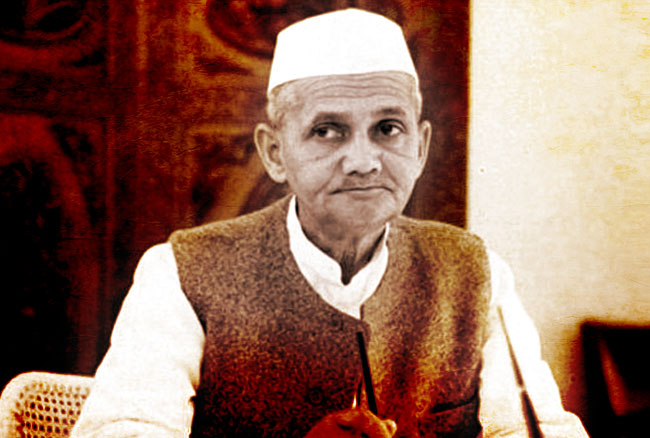
Amongst the most noteworthy ‘Satyagrahi’, politician turned minister was the “little man” – LAL BAHADUR SHASTRI. Most people associate him as the second Prime Minister of INDIA for a brief period from 9th June 1964 to 11th January 1966 and seldom assess his importance on the basis of his Prime Ministerial period, but very few know about his previous political achievements. Therefore, in order to critically analyse his role in the making of India after independence, one has to consider from the very beginning of his political career.
LAL BAHADUR was born on 2nd October 1904 in Mughalsarai to SHARADA PRASAD and RAMDULARI DEVI. He lost his father when he was barely a year and a half old, for which his maternal grandfather HAZARI LAL took them to his house where Lal spent most of his childhood. He went to Harishchandra High School, it was here that Lal Bahadur’s heart throbbed with patriotism under the guidance of his teacher and mentor, Nishkameshwar Prasad Misra. He listened to Mahatma Gandhi and Lokmanya tilak’s speeches, being spellbound by their charisma, he realized there was no greater force than truth and justice. Thus, when Gandhiji started the Civil Disobedience Movement, Lal Bahadur not only left his school but also actively participated throughout the movement spreading the spirit of patriotism and nationalism. He then joined the Kashi Vidyapeeth – a nationalist school by patriots – where he took his degree in philosophy and came out as Lal Bahadur Shastri in 1926 to take up the responsibility of a nation builder.
He joined the Servants of the People Society founded by Lala Lajpat Rai in 1926 and became its third president after Purushottamdas Tondon. Tondon made him secretary of the District Congress Committee alongside his lifetime membership of the People Society. It was through these positions in Allahabad that Lal Bahadur carried out the first phase of his political career. He himself acknowledged, “ It was due to life membership of the Servants of the People Society that I got an opportunity to serve my country the most. Society has been instrumental in inculcating in me the true meaning of the term ‘servants of people’”. Lal Bahadur caught the attention of the congress “ top brass ” when he was elected in the U.P Assembly and his Land Reform Report became the basis of the Land Reform Legislation in 1937. Even during the Quit India Agitation, where all the congress leaders were arrested, Lal Bahadur kept hiding and continued the congress “underground” work.
Lal Bahadur Shastri
His return from the jail in 1945 and the Independence of India marks the second phase of Lal Bahadur’s political career. Pandit Govind Ballabh Pant appointed Lal Bahadur as one of his parliamentary secretaries. Impressed by his hard work and sincerity, Pant appointed him as the Police and Transport Minister in the Government when the position stood vacant. As the police and transport minister, he sought to bring a better understanding between the people and the Police Force. For this, he injected young men into the police cadre and created the Prantiya Raksha Dal – the second line of defence – which comprised young men from society who instilled a spirit of patriotism and discipline and years later fought the Chinese invaders bravely. He initiated nationalised road transport in UP, which established contact with the hitherto backward areas and brought trade and economic prosperity. He took a socially radical move by opening bus conducting jobs to women and enforced law and order with firmness and impartiality. When Nehru took over Congress Presidentship, he appointed Lal Bahadur as the General Secretary of the Congress Party Headquarters, which the latter accepted and moved to New Delhi in 1951.
Lal Bahadur proved his skills and sincerity for which he was straightway included in the central cabinet as the Railways and Transport Minister. Lal bahadur had to take up “ the triple task of rejuvenating the railway administration and repairing the ravages of partition and providing more amenities to the ever-mounting number of passengers who were outstripping the capacity of the Indian railways.” He rearranged the travelling classes, introduced reserved three and two-tier accommodations, third class air-conditioned chair car and electric fans for the third class compartments and even solved the food problem, thus, bringing extensive relief to middle-class passengers. To improve railway efficiency, an Efficiency Bureau was set up along with a Security Adviser and a Railway Protection Force and was even responsible for the reconstitution of new units such as South-Eastern and Central Railways. He constituted Railway User’s Consultative Committee at every level and in 1954-55, approved the Ganga Bridge Project Administration for the construction of road cum rail bridge across the Ganga. These measures led to the advancement of the previously neglected sphere of Railways and inaugurated the process of making India.
In the 1957 elections, Lal Bahadur was given the Ministry of Transport and Communication for a short period, where he brought some changes in administration in accordance with the then economy. He was then moved to the Ministry of Commerce and Industry. His tenure saw remarkable progress in Commercial and Industrial fields. The Heavy Engineering Corporation was set up with the help of the Soviet Union and Czechoslovakia, Small Scale Enterprises and Industries were supported and Agro-Industries were encouraged. The Automobile Industry saw a boost in its output and these measures sought to eradicate the problem of Agricultural Unemployment and Underemployment. After the death of Home Minister, Pandit Govind Ballabh Pant in April 1961, he was appointed as the Union Minister for Home Affairs. In his new position, he faced the threat of Tara Singh in Punjab and the critical situation of Assam, where the former was a political demand; the latter arose out of language controversy. These turmoils threatened internal peace and order and disrupted the stability of the country.
Lal Bahadur was able to elope the problems and tactfully overcame the challenges. The Shastri formula was somewhat successful in re-establishing communal harmony in Assam, but the language problem was not only the “apple of discord” in Assam, rather generated tensions in other parts of the country, especially between the South and the North. He convened a National Integration Conference in New Delhi, where it was accepted that ultimately Hindi would become the national language but the need for continuation of English till the time Hindi was fully developed was also realised. The Conference set up a Permanent National Integration Council and appointed three committees, the Ashoka Mehta Committee, the Sampurnanand Committee, and the C. P Ramaswamy Aiyar Committee, to lay down the means to implement decisions. Lal Bahadur also devoted to administrative reform to curb corruption and inefficiency in the administration by setting up the Central Bureau of Investigation and appointed the Santhanam Commission. He even established the All India Board to promote the social and economic well-being of the most backward classes of India. In his tenure of the home ministry, he had to face the Chinese crisis and was to handle the state of emergency, where he is said to have played rather a “positive role”. His consequent visit to Nepal and establishing a cordial relation with the country earned him great prestige in the national arena.
Lal Bahadur enjoyed the confidence and support of the majority of the ministers for his gentle personality and his hard work. Even Jawaharlal Nehru relied on Lal Bahadur for his assistance and made him a “Minister without Portfolio” in 1964 when he himself was seriously ill. Thus, when ultimately the “banyan tree” fell, the question “ After Nehru Who and What?” became apparent. Between the two contestants, Morarji Desai and Lal Bahadur, the latter was appointed by the so-called ‘syndicate’ and the chief ministers, as the next Prime Minister of India without any strife. As the Prime Minister of India, Lal Bahadur retained the predecessor’s policy which he said, “ is beneficial to India and will be for the country in the future.” In his short tenure of 19 months of Prime Ministership, he had to face a lot of criticism along with problems. The main problems being Pakistan and Chinese invasions. In his dealings with the Chinese, he made it clear that the Colombo proposals alone could form the basis of talks and said ” we have gone to the utmost limit in accepting them” and there was no going beyond them. He, however, appeared to be more flexible with Pakistan, calling them kin and kith of Indians and believed that the two countries should live together in peace and harmony. His policy towards China and Pakistan was “one of persuasion without abandoning our basic principle.”
His main task as Prime Minister was to form his cabinet, which he did remarkably and brought Indira Gandhi into the cabinet as the Minister for Information and Broadcasting. Although his retention of Foreign Affairs evoked criticism, still he was highly accepted as the Prime Minister because of his “practical and vigorous policy to accelerate the economic growth of the country.” Along with his Prime Ministerial Ship, he inherited a” plateful of unresolved thorny problems.” Since his tenure was the product of the ‘Syndicate’ and some Chief Ministers, he owed to them, who by now acted as “powerful satraps” which ultimately slowed down the decision making and implementation process of the government. His tenure saw the food crisis affecting the economy where the prices increased 22% in 18 months. As an immediate action, he increased food import and spread the Fair Price Programme to the entire country. The Government established a Food Grain Trading Corporation, as an interim measure until the Agriculture Prices Commission took up the charge and an Adhoc Committee was appointed. The legislation was introduced for quality control of improved seeds and Irrigation along with Plant Protection was extended to the entire country. The initiation of the Green Revolution and the White Revolution also contributed to the improvement of the situation. The Prime Minister contributed to the rectification of the country’s development planning which was contributing to the problem of inflation. Even though the government was able to tackle some of the issues, the foreign exchange crisis and the southern language shook the foundation of the Shastri government.
The Kutch Incidents triggered from Jan 1965 between India and Pakistan which came to an end on July 1st with a cease-fire line. Pakistan again on September 1st, invaded Kashmir and war continued for 22 days, ultimately with the joint USA and USSR sponsored Security Council, adopted a resolution of cease-fire line from 22nd Sept. The international compulsion brought both Shastri and Ayub together at Tashkent under soviet premiere Alexie Kosygin. The Tashkent talks resulted in the signing of the famous Tashkent agreement on January 10, 1966, which ensured peace at that moment but failed to provide any permanent solution to the Kashmir issue. The government’s spokesman explained that even though the agreement could not afford any solution to the Kashmir problem, still its significance lies in the fact that both the countries despite differences, pledged to live together in peace and harmony as good neighbours.
Unfortunately, the action that gained him huge popularity and the time which favoured his grip over the Prime Ministerial position came to an end because of his unprecedented death by cardiac arrest the next day, i.e, 11th Jan 1966. Thus came to an end, the brilliant career of an outstanding politician-cum-minister, whose great achievement was to lighten the Indian people’s sinking spirits during the depressing years. Had he lived longer, he could have solved many knotty problems confronted by the country for which he remains to be criticised. The fact remains that during the first years Shastri confronted a series of crises that became the reason for his not getting time to rest back, think and formulate new policies. Thus, when he swam across the ” sea of troubles”, the critics narrated him as “a prisoner of indecision”. But from the start of his political career, his contribution for both the freedom movement and the making of a self-reliant, independent country India, can never be ignored or neglected. And thus, “the little man” from India will continue to be remembered by Indians forever.
NOTES AND REFERENCES:-
MANKEKAR, D. R, ‘Builders of Modern India- Lal Bahadur Sashtri’, Publications Division, Ministry of Information and Broadcasting, Government of India, New Delhi, 1973
Chandra Bipan, Mukherjee Mridula, Mukherjee Aditya, ‘India Since Independence’, Penguin Random House Publishing, Haryana,2008
LOCATING DARA SHUKOH IN INDIA’S COMPOSITE AND MYSTICAL TRADITIONS.
Dara shukoh – emperor Shah Jahan’s favourite son, and heir-apparent to the mughal throne prior to being defeated by Aurangzeb – has sometimes been portrayed as an effete prince, incompetent in military and administrative matters. But the myths and anecdotes surrounding him and his desperate effort and zeal to seek the truth along with his distinctive nature of tolerance toward other faiths, continue to fuel the popular imagination. In this discourse of study, the main objective is to explore and provide an overview of Dara Shukoh’s mystical and philosophical thoughts, rather than discussing his royal credentials, and try to locate him amidst the culturally heterogeneous society of India. He occupies an unique place amongst the Mughal princes for his comparative study of Muslim Mysticism and Classical Hindu philosophy. Being a follower of the Qadiri order of Sufis and a disciple of Miyan Mir, Dara believed that the mystical traditions of both Hinduism and Islam spoke of the same truth. Dara Shukoh greatly contributed to the study of Ancient Indian Spirituality along with Islamic Mystical Traditions by highlighting commonalities between classical Hindu and Islamic Sufi teachings. Like many Muslim Sufis, he belived that their mingling could bring about harmony between the Hindu and the Muslim subjects of Mughal Empire. The Mughal Emperors, in general, were great scholars by themselves and patronized scholarship in all forms, be it worldly science, or the religious and mystical one. Right from Babur to Bahadur Shah Zafar, most of them patronized the learned scholars of both the creeds – Islam and Hinduism.
Mughal Prince Dara Shukoh was the symbol of ‘cultural pluralism’. However, it should be remembered that many liberal thinkers in India before and after him made sincere efforts to promote mutual understanding and dialogue between different communities, which in the words of Prof. Amit Dey, is the “sine qua non” for human progress and peaceful as well as meaningful coexistence based on mutual intimacy and interactions. In respect of ‘Indian Renaissance’, the history of enlightenment in India can be traced back particularly to the sixteenth century, because of Akbar’s experiment, advent of the Naqshbandi Sufis and the Europeans, and the increase in number of ‘Hajis’ (those who have performed the Hajj pilgrimage). One of the manifestations of this Indo- Muslim synthesis in the domain of spirituality was the emergence and popularity of a number of Reformist Religious Trends. These religious reformers called for bringing the Hindus and the Muslim closer to each other by mutual accommodation of each others’ religious teachings. “Instead of promoting the process of Persianization, the leading Sufi Saints in India often encouraged Vernacularization of religious knowledge in order to reach out to the common people.” Like the Sufis the Bhakti Saints also encouraged this Vernacularization process. This linguistic intermingling can be called as “Majma-ul-Zabanat”, that actually preceded Dara’s “Majma-ul-Bahrain” or Intermingling of Two Oceans; Hinduism and Islam. In this way a liberal environment was created in different parts of India and this intermingling and admixture of different traditions characterised Indian Civilization even before Dara Shukoh.
Scholars such as Satish Chandra, Amalendu De and others have pointed out that the spirit of mutual understanding and appreciation was strengthened by the interaction between the Sufi and Bhakti Movements in Indian Subcontinent and that this process started earlier than the age of Dara. Great scholar Al Biruni translated Patanjali’s ‘Yoga Sutra’ into Arabic. Yogis used to visit Sufi ‘Khanqah’ and “Jamat Khanah’s” run by Sufis. In Fact some of them including Shaikh Nizamuddin Auliya adopted some breathing exercises, basically after being influenced by the yogis. The Sufi doctrines of ‘Wahdat-ul-Wajud’ and ‘Hama Ust’ meaning everything is ‘He’ often extended in claiming that “god is also reflected in a Heathen or a Hindu and under such circumstances a Hindu cannot be denounced as a ‘kafir’ or ‘infidel’”. Mirza mazhar Jan-i-Janan, a Naqshbandi Sufi poet, propounded that the vedas were revealed books, like Quran and hence, Hindus could not be identified with the ‘kafirs’. “He even argued that there was little difference between idol worship and ‘tasawwar-i-shaikh’… or concentration on the mental image of the perceptor.” Sultan Zaynul Abidin of Kashmir, Sultan Sikandar Lodi and several other Muslim rulers undertook the task of translating various Sanskrit works into Persian not only “to satisfy their own intellectual curiosity” but also “to increase muslim understanding of hinduism”.
However, it was with the Great Mughal Emperor Akbar (1556- 1605), that the interest in religious matters took a dramatic turn. The Ramayana and Mahabharata were translated into Persian in the ‘Maktab Khana’ set up by Akbar. He came in contact with other religions and was convinced that “all religions contained some truth and that this was not the prerogative of Islam”. Akbar sought to build a bridge between the various composite cultures of his subjects and even introduced a new religion called ‘Din-i-Illahi’ in which he tried to combine the selected elements of a number of religions – Muslim mysticism, Hinduism, Jainism, Zoroaster-ism and others. He claimed to have realized his ‘Rabb-i-Nav’, the enlightened form, residing in the ‘Alam-i-Misal’ (the world of form), resembling the platonic world of ideas as put forward in Shihabuddin Suhrawardi Maqtul’s ‘Ishraqi’ philosophy (illuminationism) which Abul Fazl justifying Akbar’s Mysticism, wrote in Ain-i-Akbari that a just king (Badshah-i-Adil) is illumined by divine light (Farr-i-Izidi) and ‘Kingly Luminescence’ (Kaiwan-Khura). Akbar’s philosophy of ‘Sulh-i-Kul’ (peace with all) also demanded religious tolerance and he, to some extent, was able to establish “Pax – Mughalica” or Mughal Peace. Even his son, Jahangir had liberal views, who had pitted that “the science of Bedant [Vedanta] is the science of Tasawwuf.” Thus, “Dara Shukoh, did not invest this notion, he inherited it; but he wonderfully elaborated it and endeavored to prove it in detail.”
The most prominent representative of these syncretistic religious and philosophical thoughts, in the medieval period, was Dara Shukoh, who by his literary and philosophical works greatly contributed to the spiritual treasure of the subcontinent. Never perhaps, in the history of Mughal Empire, was there an eclectic personality, who could be equated with the Mughal Prince Dara Shukoh in terms of Mystical Chauvinism and “multiculturalism”. Dara shukoh, the eldest son of Mughal Ruler Shah Jahan, born in the suburbs of Sagartal Lake, near Ajmer on 29 Safar, 1024 A.H (Monday, 20th Mar, 1615 A.D), was “a sound scholar, poet and calligrapher with an artistic bent of mind”, having no desire to be another conqueror, rather wanted to be a ‘thinker’. There are not many sources to get to know more about him other than his own works, with exception of Padshanama and Muhammad Salih Kambu’s ‘Amal-i-Salih’ which are some early sources from where we get meagre information about this brilliant personality. Mulla Abdul Latif, teacher of Dara, was responsible for intellectual advancement of the young prince, under whom Dara “studied the Quran and Hadith but with his eyes open and rejected from his childhood, the commentaries of the orthodox school.” Thus from the very childhood, Dara refrained from making a “fetish of the stereotyped dogmas.”
In the beginning, Sufism played an important role in the formation of Dara’s philosophical outlook. In the introduction of his own work, ‘Sirr-i-Akbar’, he himself has mentioned that “his Sufistic Learnings from an early age led him to study the well-known works on Islamic Mysticism”. Highly influenced by Miyan Mir, Dara was initiated to Qadiriya order by Mullah Shah Badakhshi, in 1049 A.H, which provided him a scope for spiritual attainment and opened the door of Mysticism and Self-realization for him. His studies, other than Sufism and Islamism, extended a wide range, starting from Hindu Mythology, Gnosticism, Vedanta Philosophy, the ‘Psalms’, the ‘Gospel’, and Pentateuch to Upanishads, Yoga Vasistha, and Bhagawat Gita, of which he was greatly involved in Persian translations. Also, he patronised learned men from all grounds – Saints, Theologians, Philosophers, Poets and Mystics of every community – Hindus, Muslims, Christians, Jews and so on. Thus, “with an insatiable thirst for knowledge and truth”, gradually Dara’s religious outlook became broadened and he started contributing to Mysticism extensively.
Dara Shukoh, like his Great Grandfather, Akbar, must have also realized the the need of secularism to facilitate a smooth governance in a multicultural country like India, and thus in a composite Indian Culture, his motives may have engaged some political agendas, since he was the would-be ruler of Mughal India. Some scholars try to prove this hypothesis, but B.J. Hasrat, in his work, ‘Dara Shikoh: Life and Works’, has asserted Dara’s approach towards other faiths to be from a different point of view, and that it was not at all politically motivated. According to him, “it was the approach of a seeker of truth, in whose heart was burning passion for knowledge, and who, irrespective of the basis of its source, eagerly sought it whenever he could find it”. He mentions that Dara had a Mystic Enthusiasm and was an ardent advocate of the Unity of God, who tried to establish a sort of ‘rapprochement’ between Islam and Hinduism.
His earlier works were the outcome of his association and respect for Sufis and religious divines. Dara had not only contributed to the Sufi Literature, rather handsomely produced Persian Literature and Prose, and thus has left behind a substantial amount of literary heritage. His early works include ‘Safinat-ul-Auliya’ (The Notebook of the Saints) 1640, ‘Sakinat-ul-Auliya’ (1642-43), and ‘Risala-i-Haq Numa (The ‘Compass of Truth’) 1651-1653. These books are basically about the life and works of Sufi Saints, and revolve around Mysticism, where in his very first work, most significantly, focus on women and female mystics are found. In another work ‘Hasanat-al- Arfeen’ (1652), Dara has collected sayings of the Saints belonging to different orders. “Mukalma-e-Baba Lal w Dara Shikoh” written in 1653 contains Dara’s dialogue with Bhakti leader Baba Lal Das Bairagi. There are several discussions in this book mainly on the subjects of Indian philosophy and mythology. His other early works include ‘Tariqat-ul-Haqiqat’, ‘Hasanut-ul-’Arifin’, and ‘Iksir-i-A’zam’ (Diwan-i-Dara Shikuh).
First published in the Journal of Royal Asian Society of Bengal in 1939, ‘Iksir-i-A’zam’ is very important for the study of the philosophical viewpoint of Dara Shikoh. In this work Dara has explained his Pantheistic world outlook through poetry. In the perception of Dara, the world and nature are parts of God and the emanation of His essence. Therefore, everything that exists in this world carries divine essence. All remaining that does not carry His essence is mirage, and illusion of the man. According to Dara, man himself is not only the creation of God but also the part of His essence, therefore he calls for cognizing oneself in order to know the essence of God. In his poetry he writes that man is like a drop and God is like Ocean. It is characteristic of Pantheism to consider the unity of opposites as the highest substance. God as the highest unity unifying in Him all seem incompatible opposites therefore the most important in Pantheist philosophy is the problem of unity and diversity, immortal and mortal and in ethical context – problem of good and evil. In the works of Dara the image of the highest substance – God is compared with the image of a limitless sea or ocean. And the world, surrounding the human are like the waves, bubbles and drops made by the movements of the God-ocean. By these images Dara Shikoh emphasizes mortality of all existing and immortality of God-ocean, which gives birth to all existing, that will at the end return to Him.
In his epic work, ‘Majma-ul-Bahrain’ (Intermingling of Two Oceans), he brings out the points of agreement between the two schools – ‘Wahdat-al-Wujud’ and the Vedanta philosophy. In this work, Dara has tried to discover the affinities between Vedic and Sufi perceptions of the Ultimate Truth. He desires to establish a fundamental similarity between the Islamic and Hindu doctrines of Unity of God. He identifies three important angels, ‘Jibrail’, ‘Mikail’ and ‘Israfil’ with Brahma, Vishnu and Maheshwara (shiv). “Dara again identifies the angels with Devata, the Absolute and Necessary Being with Nirgun and Nirankar, Allah with Om, Huma (he) with ‘sab’ and ‘Mazhar-i-Atam’ with Awatara (incarnation) and believes incarnation to be the source of the manifestation of His Power (Qudrat). ” It appears from this work that Dara believed in ‘Ijtihad’ (interpreting scriptures according to situation), and put emphasis on ‘Aql’ (reason) rather on ‘Ilm’ (scriptural knowledge in narrow sense) like his forefather Akbar and cultural successor, Raja Ram Mohan Ray. His other works include ‘Mukalama-i-Baba Lal wa Dara Shikuh’ (1062 A.H), Yoga Vasishta (1066 A.H), Bhagavat Gita (1067 A.H) and ‘Sirr-i-Akbar’ (1067 A.H), which were basically the translations from Sanskrit to study Hinduism and its philosophy.
“Dara portrayed himself as a ‘fakir’ endowed with esoteric knowledge (Ilm-i-Batin) with which he aspired to know the tenets of religion of the Indian monotheists”. Dara acquired knowledge about ‘Tawhid’ (monotheism) and ‘Irfan’ (divine knowledge) which enabled him to explore and appreciate Upanishadic monotheism. In 1066 A.H, he got ‘Jug Bashist’ translated into Persian and next he himself translated the Upanishads in Persian Prose (Sirr-i-Akbar).Dara speaks of four planes of existence (awalim) – ‘Alam-i-Nasut’ (world of matter), ‘Alam-i-Malakut’ or ‘Alam-i-Misal’ (world of angels, spirits and forms), ‘Alam-i-Jabarut’ (world of divine attributes) and ultimately ‘Alam-i-Lahut’ (world of ‘huwiyah’ or ‘thatness’ ). Dara believed that the book “which was hidden”, suggested in Quran, ‘Kitab al-Maknun’, symbolises the ‘Upanekhets’ (“secrets to be concealed”) for it is ‘a treasure –house of monotheism’.
In his eclectic mind, Dara had an ambition “to supplant exoteric Islam by Esoteric Mysticism as a living moral force among the Muslim intellectuals.” His ideal was to liberate the true spirit of Islam from the dogmatism of that time. His new formula was to preach the ‘Underlying Unity’ of different religions, for he knew that the conflict between Pandits and Mullas were on grounds of rituals but in spiritual matters they could be easily reconciled. The main doctrines propounded by Dara were ‘tawhid’ (‘He is everything’), ‘huwaiyyat’ (the truth) and ‘ruyat’ (vision of god). He indicates that there is no difference between ‘I’ and ‘Thou’ and has himself said that,
“here is the secret of tawhid, O friend, understand it;
nowhere exists anything but god;
all that you see or know other than him;
verily is separate in name, but in essence one with god.”
According to Dara, the ‘Vision of God’ is common faith of all men and has elaborated five kinds of it.
Dara Shukoh, in his ‘Sirr-i-Akbar’ (the Great Secret), has translated the Upanishad in 1067 A.H, “without any worldly motive”. According to B.J. Hasrat, this work “throws light on Dara Shikuh’s spiritual longings, his thirst for religious investigation and attitude towards Hinduism ”. Because of his advanced liberal personality and their narrow political objectives, the orthodox muslims denounced him to be a ‘heretic, atheist, hypocrite, opportunist and devoid of all religions’ and thus he was beheaded on September 10, 1659 at the age of 44 years, when Aurangzeb won the succession war.
Thus, ended the life of a brilliant being, who was ahead of his time in respect of his thinking and mind. Although he could not succeed in building a bridge between different communities of our multicultural country during his time, his efforts came as an inspiration to every man with a wider outlook, placing religion on a broader foundation, and tended to create a brotherhood between hindus and muslims. Bernier has commented on Dara’s nature that – “born a Muhametan, he continued in the exercise of that religion; but although publicly thus professing his adherence to the faith, Dara Shikuh, was , in private, a Gentile with a Gentile and a Christian with a Christian.”
In Dara Sukhoh, we thus see a rare combination of contradictions. A rational thinker and a practicing Mystic, a Prince by virtue of his birth, a Sufi by temperament….. He wanted to go where the argument led him and was relentless in search of truth. He was aware of harshness that grew around him particularly amongst the ulama group, but he didn’t care – for he wrote – “heaven is where there’s no mullah, nor any desputation, nor noise from the mullah.” Indian traditions remember Dara Shukuh not so much as an Emperor’s son, but as a Mystic Philosopher. The Great dream of his life – a dream shattered by his untimely death – was the brotherhood of all faiths and the unity of mankind. After him the vision of unity was lost in the atmosphere of hatred and rivalry created by the warring sects and religious school. Dara Shukoh should be called “a propounder of the concept of modernism based on universalism”, which was more visible in the ideas and activities of Raja Ram Mohan Ray since the beginning of the 19th c. Rabindranath Tagore, has realized the importance of Dara Shukoh in Indian History, in respect of Hindu-Muslim Unity. In the context of “multiculturalism”, Maulana Abdul Kalam Azad (1888-1958) continued the eclectic thread of Dara and thus the legacy of Eclecticism of Dara continued.
Dara Shukoh’s work on Mystic Islam and Hindu scriptures particularly his translation of the Upanishads into Persian played a very important role in stirring Western academic interest in the wisdom of subcontinent. Later, the Persian translations of Dara’s Upanishads were translated into various European languages. Dara opened the window of Indian Mysticism and philosophy for the intellectual circles of the West. Thus, as an eclectic minded prince, Dara Shukoh remains to be appreciated by academicians and scholars for his masterpiece contributions to the Mystical Traditions in a composite cultural country, for which his stand in Mysticism shall always remain intact.
SOURCES –
Dey Amit, ‘Islam in South Asia’, Parul Prakashani, kolkata, 2016
Dey Amit, ‘Dara Shukoh, Abul Kalam Azad And Eclectic Traditions In India.’
Hasrat BikramaJit, ‘Dara Shikuh: Life and works’, Prabhat Kumar Mukherjee, Viswabharati Publishing Department, 1953.
Latif Shahid and Mushtaq Abdul Qadir, ‘Dara Shukoh: Mystical and Philosophical Discourse’, International Journal of History and Research (IJHR), 2013. [Source: Jstor]
Hussain Tasadduq, ‘The Spiritual journey of Dara Shukoh’, Medieval India, IHC: Proceedings, 61st (Millennium) session, 2001. [Source: Jstor]



 Track2Training
You must be logged in to post a comment.