Allahabad is a venue for Urdu-Hindi literary feat.
A feast for the lovers of art and literature, Allahabad is a venue for Urdu-Hindi literary feat. Allahabad is a cradle of the Hindi and Urdu literary world which attracts writers, poets and scholars from all over the world.
Allahabad has been a political hub since the very beginning and has also contributed to the making of at least six prime ministers, namely Jawaharlal Nehru, Indira and Rajiv Gandhi, Lal Bahadur Shastri, VP Singh and Chandrashekhar and it is very well known that politics leads to creation and invention of different forms art, poetry, stories.
Art and writing, poems and stories, basically any form of art is revolutionary and hence, there was also a literary movement taking place during the time when politics was at its peak in Allahabad. One of the contributing factors was the Allahabad University, which was for a long while referred to by the proud alumni as the “Oxford of the East”.
The city is also associated with some of the literary giants of the Hindi-Urdu world in the last century. Some of the legends are mentioned below:
1.Sumitranandan Pant: Sumitranandan Pant was an Indian poet. He was one of the most celebrated 20th century poets of the Hindi language and was known for romanticism in his poems which were inspired by nature, people and beauty within.
He is considered one of the major poets of the Chhayavaadi school of Hindi literature. Pant mostly wrote in Sanskritized Hindi. Pant authored twenty-eight published works including poetry, verse plays and essays. Apart from Chhayavaadi poems, Pant also wrote progressive, socialist, humanist poems and philosophical (influenced by Sri Aurobindo) poems. Pant eventually moved beyond this style. As the late scholar and translator of Pant, David Rubin, writes, “In the early forties the new psychological and experimental “schools” were emerging. It was typical of both Nirala and Pant that they themselves anticipated these trends and, by the time the new approaches were in vogue, they had already moved on to newer areas of experimentation.”
2.Mahadevi Varma: Mahadevi Varma was an Indian Hindi-language poet and a novelist. She is considered one of the four major pillars of the Chhayawadi era in Hindi literature. She has been also addressed as the Modern Meera. Poet Nirala had once called her “Saraswati in the vast temple of Hindi Literature”. Varma had witnessed India both before and after independence. She was one of those poets who worked for the wider society of India. Not only her poetry but also her social upliftment work and welfare development among women were also depicted deeply in her writings. These largely influenced not only the readers but also the critics especially through her novel Deepshikha. Varma was a feminist par-excellence even before the term became trendy in public discourse. She was turned down by her husband only a few years after marriage. Her looks were not the kind that the fashion industry portrays as desirable, but the physicality of being has little to do with the beauty of her soul and intellect.
3.Firaq Gorakhpuri: Raghupati Sahay, better known under his pen name Firaq Gorakhpuri, was a writer, critic, and, according to one commentator, one of the most noted contemporary Urdu poets from India. He established himself among peers including Muhammad Iqbal, Yagana Changezi, Jigar Moradabadi and Josh Malihabadi. Some of his works are as followed,
Gul-e-Naghma
Gul-e-Ra’naa
Mash’aal
Rooh-e-Kaayenaat
Roop
4. Harivansh Rai Bachchan: Harivansh Rai Bachchan was an Indian poet and writer of the Nayi Kavita literary movement (romantic upsurge) of early 20th century Hindi literature. He was also a poet of the Hindi Kavi Sammelan. He is best known for his early work Madhushala. He is also the husband of social activist, Teji Bachchan, father of Amitabh Bachchan and Ajitabh Bachchan, and grandfather of Abhishek Bachchan. In 1976, he received the Padma Bhushan for his service to Hindi literature.
As the river Saraswati flows in the city and is regarded as the goddess of education according to the Hindu scriptures, hence, Allahabad is gifted with literature. The city is buffet of art and literature and is a feast for explorers.
Allahabad is one of the oldest cities in India. It is also known as Prayagraj, Diversities glorify India. When you visit India, you get to explore different places. The glorious city is popular due to its cultural heritage. Not only this, you cannot ignore the friendly people of this place. Moreover, the world-famous Kumbh Mela takes place here. It has a deep connection with Indian history. Besides, this city holds great religious values and traditions. Thus, Allahabad offers many famous places to visit. As a result, many tourists from all over the world flock to the city every year.
Top 10 Famous Places, You can visit –
Triveni Sangam
One of the holiest places in Central India, Triveni Sangam is located about 7 kilometres away from Civil Lines in Allahabad (Prayagraj). It is the meeting point of three rivers – Ganga, Yamuna, and Saraswati (which is a mythical river, supposed to have dried up more than 4,000 years ago). All three rivers Ganga, Yamuna, and Saraswati are highly revered rivers in Indian mythology, and hence the confluence point of these rivers hold tremendous religious importance. According to Hindu mythology, taking a bath in the holy Triveni Sangam is supposed to flush away all the sins and free you from the cycle of rebirth. Moreover, the Sangam itself is a beautiful and peaceful place to visit. The brownish Ganga meeting the slightly greenish Yamuna is indeed a sight to behold.
If you take a boat ride to the gently flowing waters of Ganga and Yamuna, you’ll be able to make out the difference in colours of water from the two rivers. There are also makeshift wooden banks made at the Sangam. Hence, devotees who want can take a bath right at the confluence point. The water is clean enough at the Triveni Sangam for a bath, especially during the winters; and also not very deep, so it is fun to take a dip in the water here.
Allahabad Fort
Allahabad Fort is a splendid work of architecture that was built during the reign of Akbar, the Mughal Emperor in 1583. The marvellous structure is located on the banks of the confluence of the Rivers Ganga and Yamuna and is well-known for being the largest fort ever built by Akbar. This famous attraction draws thousands of tourists from all over the world not only for its historical importance but also for its architectural magnificence. Tourists are allowed inside only during the Kumbh Mela, which is held once every 12 years. Nevertheless, the glorious architecture and the massive build of the monument as it stands strong on the banks of the confluence of the two rivers is a sight to behold!
The Allahabad Fort holds a huge significance and is managed by the Archaeological Survey of India. The fort is also quite well known for its Akshayavat Tree (Banyan Tree) which, according to a legend, was used by the locals to commit suicide to attain salvation. For those who wish to see the Akshayavat Tree, entry is allowed through a small gate to only the area that is occupied by the magnificent tree. Allahabad Fort is also home to the Patalpuri Temple, which is said to be home all the gates of hell.
Chandra Shekhar Azad Park (Alfred Park)
Formerly Alfred Park, Chandrasekhar Azad Park is more a monument than a conventional garden. Famous Indian revolutionary Chandrasekhar Azad sacrificed his life here and the park was renamed after him in later years. Azad was no less than an enigma and mystery for the British government due to his mastery over disguise and combat skills. He was known for his vow to never get arrested and remain free for life. In fact the word Azad (free in Urdu) stuck to his name after due to his freedom clamour! In his brief life span of 24 years, he made his presence felt in such a manner that the British rulers wanted him behind the bars or dead at any cost. So when the police got information that the iconic rebel was in Allahabad and meeting fellow revolutionary Sukhdev in the then Alfred Park in 27th February, 1931, they surrounded the park with over 40 policemen. A gun battle followed where Azad killed three policemen with his pistol and facilitate the escape of Sukhdev. He fought the police force for over 30 minutes alone and when he was left with only one bullet, he decided to turn it on himself honouring his pledge not to get caught or killed by the British oppressors. Azad Park today is a tribute to that great man with a memorial in place.
The tree under which he sacrificed his life for his motherland is also preserved. Allahabad Museum, that is also in the park premises has Azad’s pistol in show. Be there and pay homage to a brave man who was unlike any other 24 year old!
Khusro Bagh
This is one of the major attractions in the city, even though the crowd here is much less compared to other places in Allahabad. It is a beautiful garden with high walls surrounding it and has four tombs inside.
The garden was built as a pleasure garden for Prince Salim, who was the son of the Mughal Emperor Akbar and rebelled against his father. Well, he grew up to become Emperor Jahangir. History repeated itself and there arose a discord between Jahangir and his eldest son Khusrau. Despaired by the sad turn of events, Shah Begum, Khusrau’s mother, committed suicide and was buried in the park. She was a Rajput princess and the first tomb here was built in memory of Shah Begum in 1606.
Jawahar Planetarium (Anand Bhawan)
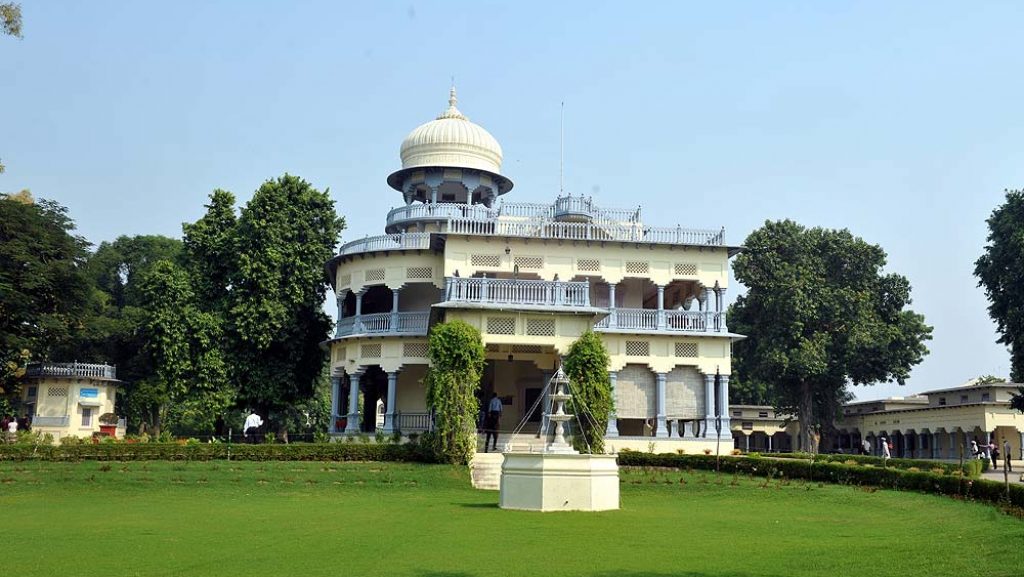
Anand Bhawan, the home of the Nehru family in Allahabad, was handed over to the Fund by Shrimati Indira Gandhi in November 1970. This is in keeping with a similar gesture made by her illustrious grandfather when he donated Swaraj Bhawan to the nation. Anand Bhawan is intimately connected with India’s struggle for freedom. Some of the rooms in the building which are redolent with history have been either preserved or recreated. A comprehensive exhibition of the Nehru family’s role in the country’s struggle for freedom has also been arranged. The electrical wiring and fittings of Anand Bhawan building have been completely replaced and upgraded by German ERCO light fittings in 2014.
The Library at Anand Bhawan consisting of nearly 7500 books has been catalogued. The National Museum and the Allahabad Museum have rendered valuable assistance to the Fund in the preservation of books, records and relic articles in Anand Bhawan. Several lakhs of visitors from all over the country and abroad come and visit this ancestral home of Nehrus. Memorial functions and an annual lecture are also a part of the Anand Bhavan’s annual programme.
All Saints Cathedral
Built in the late 19th century, All Saints Cathedral or Patthar Girja is a spectacular Anglican Christian Church on M G Marg, Allahabad. One of the beautiful churches in the state, it is thronged by tourists and pilgrims alike. All known as the “Church of Stone”, All Saints Cathedral was formerly founded in 1871 by Lady Muir Elizabeth Huntly Wemyss. Post its consecration in 1887, the church was further completed in 1891. Constructed in gothic-styled architecture, the church hosts carved glass panels and marble-finished sanctuaries. It is one of the significant remnants of colonial design in the country. This church also houses the iconic ‘jaali’ work expressed throughout its arched windows. The light sandalwood tinted walls of the All Saints Cathedral was built with Sandstone from Chunar in UP.
Alopi Devi Temple
Located at Alopibagh, near the holy Sangam (confluence of Ganga, Yamuna and Saraswati) in Allahabad, Alopi Devi Mandir is an unconventional temple revered by Hindu faith. The Alopi Devi Mandir does not have any presiding deity but a wooden chariot called a doliê which is mostly worshipped by the devotees of Lord Shiva. Housing the last of Goddess Sati’s body parts, the Alopi Devi Mandir counts among the Shakti Peethas of the country. Tuesdays are a busy day at this temple. This holy site attracts vast crowds of devotees during the Hindu festival of Navratri.
New Yamuna Bridge
The New Yamuna Bridge is like a new feather in Prayagraj’s cap. The images speak about the stupendous architecture of the New Yamuna Bridge. The view of the bridge during dawn and dusk is mesmerizing. Also known as the Naini Bridge, the New Yamuna Bridge is among India’s longest cable-stayed bridges. It runs across the Yamuna River in the North-South direction, connecting Prayagraj to Naini. It was constructed in the year 2004 to minimize the traffic congestions over the old Naini Bridge. The construction of the bridge was a joint responsibility of the Hindustan Construction Company and Hyundai Engineering and Construction.
The New Yamuna Bridge is also the first six-lane bridge in India built with modern design and structure. It has two pylons, made up of concrete material, that provide support to the major part of the deck of the bridge held together by steel cables. The bridge also acts as a road link between Prayagraj and NH-27 stretching across for 370 meters. The modern technology combined with environmental compatibility and excellent quality make for some of the features of this bridge that offer great benefits. India has a stupendous network of bridges and this bridge is a fine example of the country’s tremendous growth in infrastructure.
Allahabad Museum
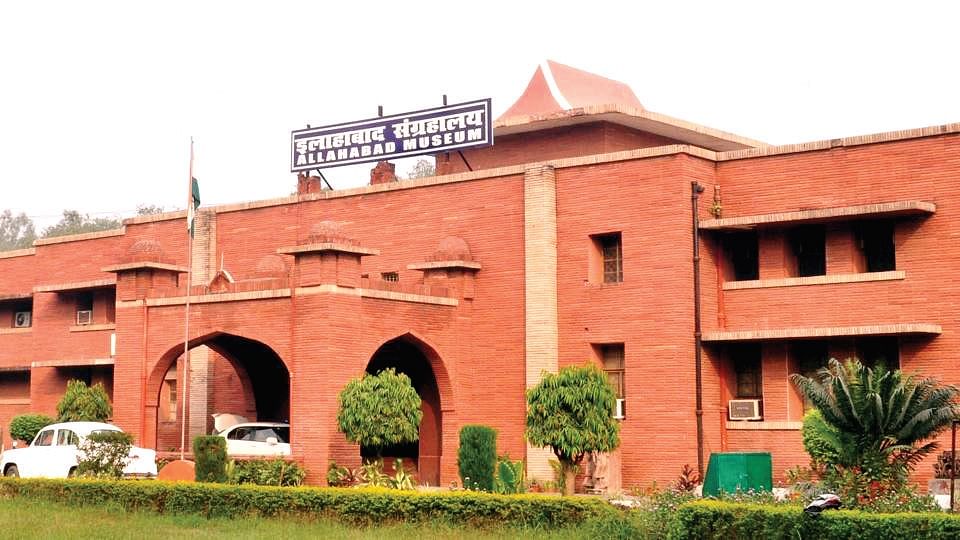
The Allahabad Museum is centrally located in the Civil Lines area of the city in a lush green garden at Chandrashekhar Azad Park, popularly known as Company Bagh. In 1863, the Board of Revenue requested the Government of North- Western Provinces for the establishment of a public library and a museum. With donations from the provincial government, the famous Orientalist Sir William Muir and the Maharaja of Vijaynagaram, a superintendent of the library and museum was appointed and an ornate building was inaugurated in 1878 to house the collection. For unforeseen reasons or due to paucity of fund the museum was closed down in 1881. With the initiative of Pandit Jawaharlal Nehru, the President of the Allahabad Municipal Board and Pt. Brijmohan Vyas in the 1923-24 efforts were made to establish a new museum in the city. It was under the operational direction of Pandit Brij Mohan Vyas, the executive officer of the board, a museum was opened in the Municipal Building in 1931.
Bade Hunauman Temple
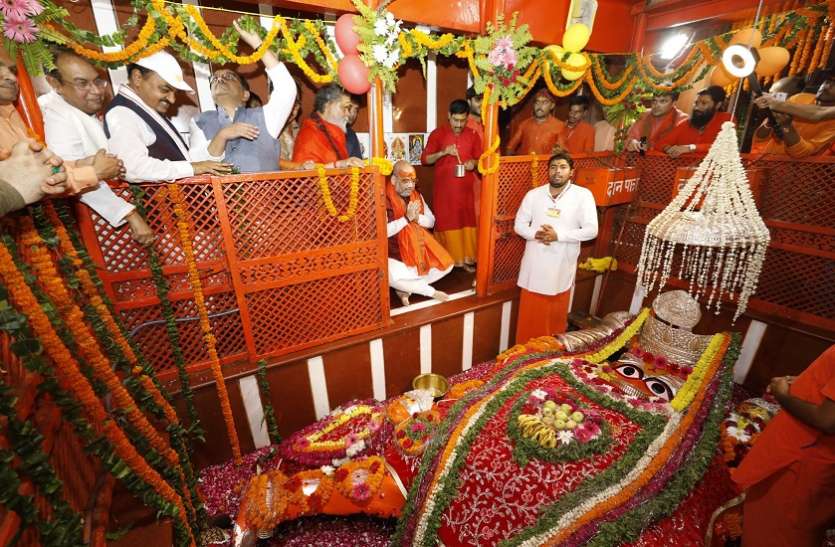
This famous temple of Lord Hanuman, one of the most worshipped god of India is a must visit place in Allahabad or Prayagraj It is located very close to Sangam and so most of the devotees visiting Prayagraj will not consider their visit complete unless they have darshan of Hanumanji at this temple. Here Hanumanji is in lying position instead of being in sitting or standing form as is common in thousands of other Hanuman temples in India. There are a few sweet shops selling prasad and the whole temple complex is well maintained.







 Track2Training
You must be logged in to post a comment.