
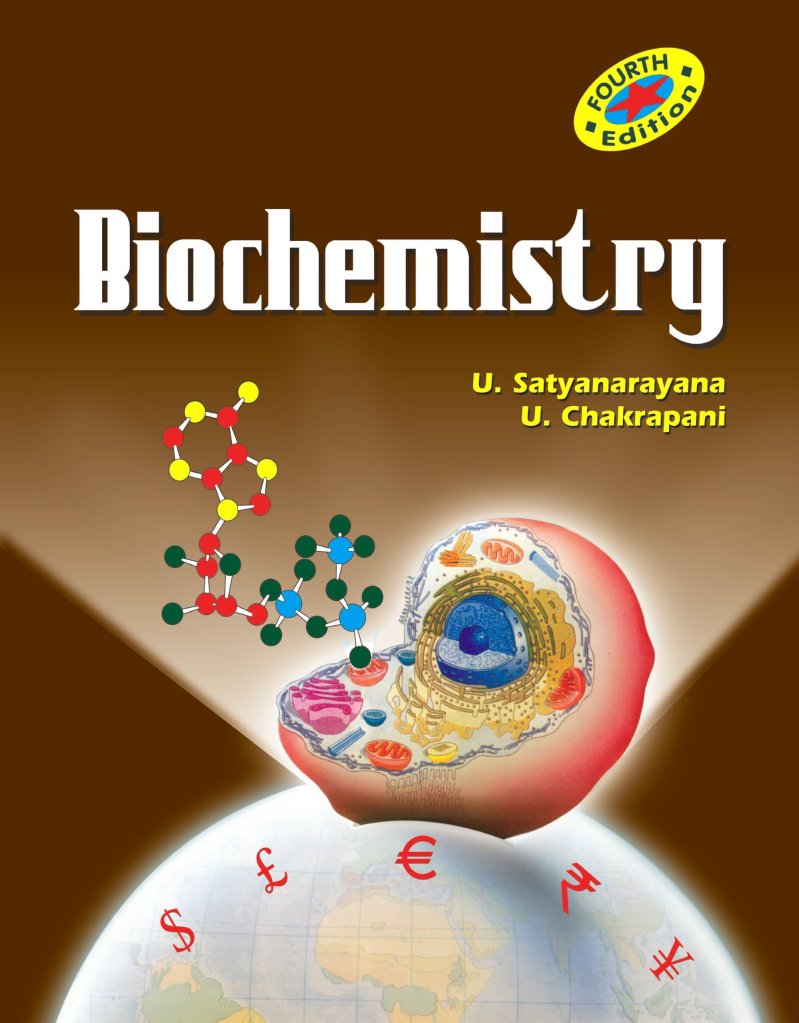
Are you also reading, “Satyanarayana & Chakrapani’s Book?

Yeah, you heard it right I am talking about the book that is used by most of the”PHARMACY” novices and other fields students also referred to this book.

The authors of this, book are “U. Satyanarayan and U.Chakrapani”.

Let’s talk in detail about this novel.

Why should we use this book, it’s a major question that arises in our mind, so the simplest key is that it includes clinical concepts along with its case studies, which will be helpful in the coming academic year.

we are pharmacy students, we should know about various clinical concepts alog with its case studies . So this book should be our perfect choice.

The silent features of this book are the –

    -It encompasses basic knowledge about biochemistry.

  –  It includes seven domains in the hierarchical order of biochemistry, which will be useful for us to study smoother.

  – Each chapter in this book is a carefully colour portrayal along with headings and subheadings to facilitate quick understanding.

      –  This book also incorporated knowledge about the various applications of biochemistry in our daily life.

“Why should we read this book?”
There are myriad boons of this book, for everyone it may be a student or it can be a teacher also.

This book amasses a variety of different things related to our syllabus, that fascinate everyone for reading.

    This book elucidates the important application of biochemistry to human health and disease are put together as biochemical or clinical beliefs, that are useful in the next year of our educational openings.

    The icons are used at appropriate places to serve as a ” landmark.”

The origin of the biochemical words, practical biochemistry, biochemistry in the laboratory and case studies with biochemical correlation, given in this book very properly, makes its book appropriate for various types of references studies.

    We never thought that the advances in biochemistry have a tremendous effect on human welfare and they have largely benefited mankind & their lives, that known to us after reading this book.

Now, we simply have to look at the organisation of the book:-

Section 1:- It deals with the chemical constituent of esprit that includes carbohydrates, lipids, proteins etc.

Section 2:-  It includes the physiological chemistry.

Section 3:- It embodies all the metabolism (carbohydrates, lipids, proteins, amino acids, nucleotides& minerals )

Section 4:-  It shrouds hormones, organ function tests, water, electrolytes etc.

Section 5:-  Is solely devoted to molecular biology and biotechnology.

Section 6:- Gives relevant information on the current theme such as the human genome project, gene therapy, bioinformatics etc.

Section 7:-  It deals with the basic aspects of learning and understanding biochemistry.

    Through looking the various sections of the book, you have came roughly idea about what is included in this book and its organisation.

I am also a pharmacy student, so according to me, it is the best reference tale for learning and understanding biochemistry.

Not only me but the professors have also suggested this book as a reference for students.

Finally, we can say that:-

 “The book is so organized as to equip bibliomaniac with a meticulous knowledge of biochemistry”.

The other links 🔗 for reference :-

https://www.goodreads.com/book/show/1859853.Biochemistry.

!Thank you!

‘The Secret Garden’ by Frances Hodgson Burnett

“At first people refuse to believe that a strange new thing can be done, then they begin to hope it can be done, then they see it can be done – then it is done and all the world wonders why it was not done centuries ago.” 

‘The Secret Garden’ by Frances Hodgson Burnett, though belongs to children’s literature, is an interesting read even for adults. Mary Lennox, a sick looking girl, goes to Yorkshire after her uncle takes her custody due to the death of her parents in India. Having brought up without any motherly love and having got her way in everything from her childhood, Mary finds Yorkshire a new world. Her caretaker Martha, being a young girl herself, isn’t subservient to Mary and this is all new to Mary who has always got her own way. Mary learns about Yorkshire from Martha and also learns about the Secret garden in her uncle’s manor. The door to that garden was locked ten years ago and the key has also been buried, whose whereabouts no one knows. Intrigued by this, Mary tries to find the secret garden. The book progresses to show whether Mary finds the secret garden and what she finds in there and what effect it has on her. 

Colin, who is also of the same age as Mary, is introduced as a sick and bed ridden boy. As the story progresses, we can also see that he imagines an illness which he doesn’t have and expects to die soon. In simple words, Colin suffers from hypochondria. So, what happens when Mary and Colin meet? What changes do they bring to each other? How will Mary assure Colin that he won’t die? All these are answered as the plot unfolds.

One character that everyone has to look out for in the novel is Dickon. Just as how he is loved by everyone in the novel, he is loved by every reader. Who doesn’t love a person who is friends with every animal, bird and plant. Being elder to Mary and Colin by two years, Dickon acts as a good friend and as an agent of positive influence on them. 

This novel is a healing novel. It has the best lines which teaches the reader on how living with nature heals the soul and makes one to grow positive and healthy. When we see things budding and thriving to come out of the earth, it makes us believe we can grow too. 

“If you look the right way, you can see that the whole world is a garden.”

Another lesson we learn from the book is about magic. Now, you don’t need to relate magic to flying castles and extraordinary power. Magic is found in everything even within us. That which makes things come true is magic. That which fills us with goodness and makes us move forward is magic. Magic is in everything.

“Magic is always pushing and drawing and making things out of nothing. Everything is made out of magic, leaves and trees, flowers and birds, badgers and foxes and squirrels and people. So it must be all around us. In this garden – in all the places.”

The novel is an amazing read except for the racism and stereotypes it contains against India. Thus, ‘The Secret Garden’ is a book you would love to read and recommend. 

‘Pride and Prejudice’ by Jane Austen.

“It is a truth universally acknowledged, that a single man in possession of good fortune, must be in want of a wife.”

The very first statement, which starts the novel “Pride and Prejudice”, sets forth the major themes of the novel. Opening with an introduction to the Bennets, the first chapter shows an anxious Mrs. Bennet, who wants her daughters hitched and their new neighbour Mr. Bingley seems right for that purpose. When Mr. Bingley organises a ball, everyone in the neighbourhood is invited. There, the meeting takes place between Elizabeth Bennet and Fitzwilliam Darcy, the protagonists of this story. The story proceeds as the misunderstanding between our protagonists grows and they break away only to understand each other better. 

Beyond the obvious love brewing between various characters, the novel discusses other themes like class difference, need of money, marriage, the status of women, parenting and self – reflection. Unlike the Chivalric romances, Jane Austen portrays reality in her novel. The novelist shows how women of that age weren’t allowed to work and were expected to learn everything (knitting, embroidery, housekeeping, music and such) to be considered accomplished women. And when our female protagonist stands up for women, she is criticised. Elizabeth challenges the established beliefs of that age and gives out the message that women needn’t be perfect to be accomplished.  

“I never saw such a woman. I never saw capacity, taste, and application, and elegance, as you described, united.”

The novel also shows how women were dependent on marriage for financial support and they should also possess some money for a successful marriage. Instead of showing a fantasy where love solves everything, the plot showcases the importance of money in life but this doesn’t necessarily mean money defines happiness. The influence of class difference was strongly felt by the way Darcy and the Bingley sisters treated others like the Bennets. This is one of the important factors in the love story of Darcy and Elizabeth and Bingley and Jane. 

One of the best things about the novel is that we can vividly see how the characters evolve. The character development in both Elizabeth and Darcy is what brings together. There comes a situation when both have to step back from each other before they can grow closer. This brief interval helps them to understand themselves and face their inner flaws. The attributes in the title are clearly associated with the protagonists. Darcy was self conceited and Elizabeth was prejudiced.

Jane Austen had written some of the finest lines in English in this novel. The lines make us think and what makes them more attractive is that it appeals to people of all ages and all nations. 

“Pride relates more to our opinion of ourselves, vanity to what we have others think of us.”

“And yours,” he replied with a smile, “is wilfully to misunderstand them.”

These lines have the most impact when one reads the story. Adding, Jane Austen is also the best at description. Her descriptions of landscapes, settings and others transports us to that age.

This book also helps to reflect on ourselves. We are all proud and we are all prejudiced at least sometimes. All it takes is us admitting them and trying to work on it. This novel is relatable even in the 21st century.

‘A Tale of Two Cities’ by Charles Dickens.

“It was the best of times, it was the worst of times, it was the age of wisdom, it was the age of foolishness, it was the epoch of belief, it was the epoch of incredulity, it was the season of light, it was the season of darkness, it was the spring of hope, it was the winter of despair.”

This is the opening line of the book ‘A Tale of Two Cities’ by Charles Dickens. Set in the time of French Revolution, this historical novel gives an insight of the cause and outcome of the revolution. The revolution, which was expected to be the kickstart of the new era and new hopes, turned out to be a bloody massacre. Dickens has intricately woven his plot to align with the timeline of the real events. 

A fiction which is set in the past is Historical fiction. Such a genre mingles the fact, events as in the recorded history, and fiction, the author’s imagination. As the novel is set in the past, the characters, the places, the language, the conflict should all accord to those of that period. The plot doesn’t completely depart from the records.  All these characteristics are observed in the novel ‘A Tale of Two Cities’.

The novel features two cities London and Paris and which in turn bridges two countries England and France.  The French Revolution which occurs in France also casts its shadow on England.  The novel traces the causes of French Revolution. Though a part of it may be fictional as in the part of St. Marquis Evremonde, the novelist brings out the cruelty of the aristocrats in the embodiment of Evremonde. It brings out the horror of the age and how inhumanely the third estates were treated.  

“The mill which had worked them down, was the mill that grinds young people old; the children had ancient faces and grave voices; and upon them, and upon the grown faces, and ploughed into every furrow of age and coming up afresh, was the sigh, Hunger. It was prevalent everywhere.”

The conduct of the characters is also in congruence to the period. The time period and the cruelty of the age justifies the actions of the Defarges and the other revolutionaries. The conflict in the novel is also a parallel to the period of the revolutions. The novelist foreshadows from the very beginning of the impending terror in the novel. 

“The time was to come, when that wine too would be spilled on the street-stones, and when the stain of it would be red upon many there.”

But the conflict is not only between the aristocrats and revolutionaries but also between the innocent whose lives were claimed by the revolutionaries. This is portrayed through the misfortunes of Darnay and his family. Though they were innocent, they were pulled into the political storm of France. By providing many sides of the history, the author makes us think to which degree the revolution was successful and to which degree it was a failure.

The novel doesn’t just bring out the themes of revolution, class division, poverty but also the themes of love, hatred, self-hatred, mental health and other complex themes. The character which makes the most impact in the reader is Sydney Carton. He doesn’t fail to move the readers to tears and a character with a lot of inner conflicts which is worth analyzing. No other words can give such a powerful ending as these.

“It is a far, far better thing that I do, than I have ever done; it is a far, far better rest that I go to than I have ever known.”

Thus, by going beyond the expectations of readers and by enchanting them with a descriptive language, Dickens has produced a timeless classic – ‘A Tale of Two Cities’.

Read more about Historical fiction at https://awriterofhistory.com/2015/03/24/7-elements-of-historical-fiction/

Read the novel at https://www.gutenberg.org/files/98/old/2city12p.pdf