Hierarchy of Plans in Urban and Regional Planning

rban and regional planning is inherently a multi-scalar and multi-layered process that requires the integration of diverse spatial, economic, social, and environmental considerations. To ensure systematic development, planning activities are organized within a hierarchical framework of plans, where each level addresses specific spatial extents, functional priorities, and implementation mechanisms.
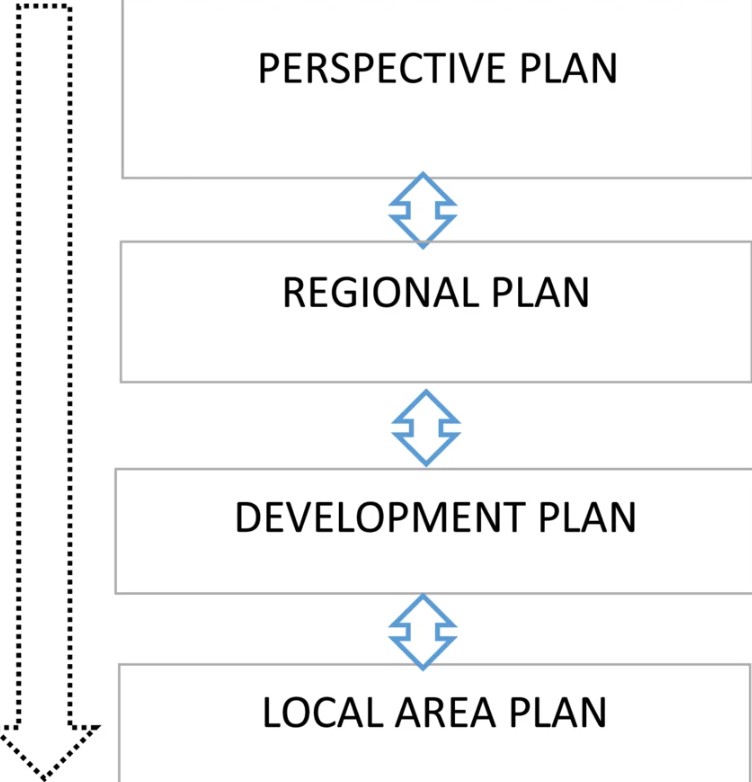
The hierarchy of plans provides a top-down strategic direction while enabling bottom-up implementation, ensuring coherence between macro-level policies and micro-level interventions. This structured approach is essential for achieving sustainable development, efficient land use, infrastructure optimization, and improved quality of life.

In the Indian context, the hierarchy of plans is influenced by legislative frameworks such as the Town and Country Planning Acts of various states, and national guidelines like the URDPFI Guidelines (Urban and Regional Development Plans Formulation and Implementation).

The major levels in the hierarchy include:

  • Regional Plan
  • Sub-Regional Plan
  • Sectoral Plans
  • Spatial (Development) Plans
  • Town Planning Schemes

Each level differs in scale, scope, detail, and implementation mechanism, but they are interlinked and mutually reinforcing.


2. Concept of Hierarchical Planning

Hierarchical planning refers to a structured system in which plans are prepared at different spatial scales and levels of detail. The key characteristics include:

  • Vertical Integration: Ensures alignment between national, regional, and local objectives
  • Horizontal Coordination: Integrates sectors such as transport, housing, environment, and economy
  • Progressive Detailing: Higher-level plans provide broad strategies, while lower-level plans focus on implementation

This hierarchy is essential to avoid fragmentation, duplication, and inconsistencies in planning decisions.


3. Regional Plan

3.1 Definition and Scope

A Regional Plan is a long-term strategic plan prepared for a large geographical area, typically encompassing multiple cities, towns, and rural areas. It aims to guide the overall spatial and economic development of the region.

3.2 Objectives

  • Balanced regional development
  • Reduction of inter-regional disparities
  • Efficient allocation of resources
  • Promotion of economic growth and employment
  • Environmental conservation

3.3 Key Components

  • Regional land use structure
  • Settlement hierarchy (metropolitan cities, towns, villages)
  • Transport and infrastructure networks
  • Economic development zones
  • Environmental and ecological zones

3.4 Time Horizon

Typically 20โ€“25 years, with periodic revisions.

3.5 Example

  • National Capital Region (NCR) Regional Plan

3.6 Role in Hierarchy

The regional plan serves as the foundation of the planning hierarchy, providing a macro-level framework within which all lower-level plans must operate.


4. Sub-Regional Plan

4.1 Definition

A Sub-Regional Plan is prepared for a smaller unit within a region, such as a district or group of districts, translating regional strategies into more localized actions.

4.2 Purpose

  • Bridge between regional and local plans
  • Address area-specific issues
  • Provide detailed strategies for development

4.3 Key Features

  • Identification of growth centers
  • Infrastructure planning at district level
  • Resource allocation and prioritization
  • Integration of rural and urban development

4.4 Importance

Sub-regional planning is particularly important in large and diverse regions where uniform strategies may not be effective.

4.5 Example

  • District Development Plans in various Indian states

4.6 Role in Hierarchy

Acts as an intermediate planning layer, refining regional policies and guiding sectoral and spatial plans.


5. Sectoral Plans

5.1 Definition

Sectoral plans focus on specific sectors such as:

  • Transportation
  • Housing
  • Water supply
  • Sanitation
  • Environment
  • Economic development

5.2 Objectives

  • Address sector-specific challenges
  • Improve service delivery
  • Enhance efficiency and sustainability

5.3 Characteristics

  • Thematic and specialized
  • Prepared by technical agencies
  • Can be standalone or integrated

5.4 Examples

  • Comprehensive Mobility Plan (CMP)
  • Housing for All Plan
  • Water Supply Master Plan

5.5 Role in Hierarchy

Sectoral plans provide technical inputs to spatial and development plans and ensure that sectoral investments align with broader planning goals.


6. Spatial (Development) Plans

6.1 Definition

Spatial plans, often referred to as Master Plans or Development Plans, are statutory documents that guide the physical development and land use of urban areas.

6.2 Objectives

  • Regulate land use
  • Guide urban growth
  • Ensure provision of infrastructure
  • Promote orderly development

6.3 Key Components

  • Land use zoning (residential, commercial, industrial, etc.)
  • Transportation networks
  • Public facilities and amenities
  • Environmental management

6.4 Legal Status

Spatial plans are typically statutory in nature, meaning they are legally enforceable.

6.5 Time Horizon

Usually 15โ€“20 years

6.6 Importance

They translate broader policies into specific land-use regulations, making them a critical tool for urban governance.

6.7 Role in Hierarchy

Spatial plans act as a link between strategic planning and implementation, incorporating inputs from regional, sub-regional, and sectoral plans.


7. Town Planning Schemes

7.1 Definition

Town Planning Schemes (TPS) are micro-level implementation tools used for the detailed planning and development of specific urban areas.

7.2 Key Features

  • Land pooling and reconstitution
  • Provision of infrastructure
  • Redistribution of land parcels
  • Cost recovery mechanisms

7.3 Objectives

  • Ensure planned development
  • Provide infrastructure efficiently
  • Prevent unplanned growth

7.4 Process

  1. Declaration of scheme area
  2. Preparation of draft scheme
  3. Land pooling and redistribution
  4. Infrastructure development
  5. Final scheme implementation

7.5 Example

  • Town Planning Schemes in Gujarat (e.g., Ahmedabad TPS)

7.6 Role in Hierarchy

TPS represents the lowest level of planning hierarchy, focusing on implementation and execution.


8. Interrelationships Among Different Plans

The hierarchy of plans functions through strong interconnections:

8.1 Top-Down Approach

  • Regional Plan โ†’ Sub-Regional Plan โ†’ Spatial Plan โ†’ TPS

8.2 Bottom-Up Feedback

  • Local-level issues inform higher-level plans

8.3 Integration of Sectoral Plans

  • Sectoral plans provide inputs at all levels

8.4 Example

A regional transport strategy influences:

  • Sub-regional road networks
  • City-level transport plans
  • Local street design in TPS

9. Importance of Hierarchical Planning

9.1 Ensures Coordination

Prevents conflicts between different levels of planning.

9.2 Promotes Efficiency

Optimizes use of resources and infrastructure.

9.3 Facilitates Implementation

Provides clear roles and responsibilities.

9.4 Enhances Sustainability

Integrates environmental considerations at all levels.

9.5 Supports Policy Integration

Aligns national, state, and local objectives.


10. Challenges in Hierarchical Planning

Despite its advantages, several challenges exist:

10.1 Lack of Coordination

Fragmentation between agencies and departments.

10.2 Data Limitations

Inadequate or outdated data affects planning accuracy.

10.3 Implementation Gaps

Weak enforcement of plans.

10.4 Political and Institutional Constraints

Frequent policy changes and institutional conflicts.

10.5 Public Participation Issues

Limited stakeholder involvement.


11. Indian Context of Planning Hierarchy

In India, the planning hierarchy is shaped by:

  • State Town and Country Planning Acts
  • 74th Constitutional Amendment
  • URDPFI Guidelines

11.1 Key Observations

  • Strong emphasis on Master Plans
  • Limited integration of regional planning
  • Increasing focus on participatory planning

12. Relevance to Contemporary Planning

12.1 Smart Cities and Integrated Planning

Modern planning emphasizes integration across levels.

12.2 Transit-Oriented Development (TOD)

TOD requires coordination across:

  • Regional transport planning
  • City-level land use planning
  • Local area development

12.3 Sustainability and Climate Change

Hierarchical planning helps address:

  • Urban resilience
  • Environmental conservation

13. Conclusion

The hierarchy of plans is fundamental to the practice of urban and regional planning. It ensures that development is guided by a coherent framework, balancing strategic vision with practical implementation. Each levelโ€”regional, sub-regional, sectoral, spatial, and localโ€”plays a distinct yet interconnected role in shaping sustainable and inclusive urban environments.

In the Indian context, strengthening the integration between these levels, improving institutional coordination, and enhancing public participation are essential for effective planning. As cities face increasing challenges such as rapid urbanization, climate change, and infrastructure deficits, a well-structured hierarchical planning system becomes indispensable.

Daily writing prompt
What job would you do for free?

Cost Estimation and Determination of Rates for Infrastructure Services (Roads)

Road infrastructure is a fundamental component of urban and regional development, directly influencing mobility, accessibility, economic growth, and land-use patterns. Accurate cost estimation and rate analysis of road works are essential for planning, budgeting, tendering, and execution of projects.

Cost estimation in road construction involves determining quantities of materials, labor, equipment, and associated costs for various components such as earthwork, subgrade, pavement layers, drainage, and finishing works. Rate determination ensures realistic pricing based on market conditions and standard schedules like PWD/CPWD Schedule of Rates (SOR).


2. Objectives of Road Cost Estimation

  • To determine total project cost
  • To prepare budgets and DPRs
  • To support tendering and contract management
  • To evaluate alternative designs
  • To ensure cost control during construction
  • To facilitate economic feasibility analysis

3. Components of Road Construction

Road construction consists of multiple layers and associated infrastructure:


3.1 Earthwork (Subgrade Preparation)

  • Excavation and filling
  • Compaction
  • Formation of subgrade

3.2 Pavement Layers

Flexible Pavement

  • Sub-base (GSB โ€“ Granular Sub Base)
  • Base course (WMM โ€“ Wet Mix Macadam)
  • Binder course (Bituminous Macadam)
  • Surface course (Bituminous Concrete)

Rigid Pavement

  • Sub-base
  • Dry lean concrete (DLC)
  • Cement concrete slab

3.3 Shoulders and Side Slopes

  • Earthen or paved shoulders
  • Turfing or protection

3.4 Drainage Works

  • Side drains
  • Culverts
  • Cross drainage structures

3.5 Road Furniture

  • Signboards
  • Road markings
  • Guardrails
  • Street lighting

4. Types of Cost Estimates for Roads


4.1 Preliminary Estimate

  • Based on road length ร— rate per km
  • Used in planning stage

4.2 Detailed Estimate

  • Item-wise quantity calculation
  • Most accurate method

4.3 Revised and Supplementary Estimates

  • Prepared for changes or additional works

5. Methods of Estimation


5.1 Per Kilometer Method

  • Cost per km based on similar projects

Example:

  • Rural road: โ‚น60 lakh/km
  • Urban road: โ‚น2โ€“5 crore/km

5.2 Detailed Quantity Method

  • Based on cross-section and layer thickness

6. Quantity Estimation of Road Components


6.1 Earthwork Calculation

Volume = Length ร— Width ร— Height

Example:

  • Length = 1000 m
  • Width = 10 m
  • Height = 0.5 m

Volume = 1000 ร— 10 ร— 0.5 = 5000 mยณ


6.2 Granular Sub Base (GSB)

Volume = Length ร— Width ร— Thickness


6.3 Bituminous Layers

  • Measured in tonnes or mยฒ
  • Based on thickness and density

7. Determination of Rates (Rate Analysis)

Rate analysis is carried out for each item of work.


7.1 Components of Rate Analysis

(a) Material Cost

  • Aggregates
  • Bitumen
  • Cement

(b) Labor Cost

  • Skilled labor (operators)
  • Unskilled labor

(c) Machinery Cost

  • Rollers
  • Pavers
  • Mix plants

(d) Transportation

  • Hauling materials to site

(e) Overheads and Profit

  • Typically 10โ€“15%

8. Example Rate Analysis


8.1 Earthwork in Excavation (1 mยณ)

ComponentCost (โ‚น)
Labor150
Equipment100
Miscellaneous50
Total300
Add 10% profit30
Final Rateโ‚น330/mยณ

8.2 WMM (Wet Mix Macadam) (1 mยณ)

ComponentCost (โ‚น)
Aggregates1200
Labor300
Machinery400
Transport300
Total2200
Profit (10%)220
Final Rateโ‚น2420/mยณ

8.3 Bituminous Concrete (1 mยฒ)

ComponentCost (โ‚น)
Bitumen250
Aggregates300
Labor150
Machinery200
Total900
Profit90
Final Rateโ‚น990/mยฒ

9. Cost Estimation Example (Road Project)

Given

  • Length: 1 km
  • Width: 7 m

Cost Breakdown

ComponentCost (โ‚น)
Earthwork5,00,000
GSB8,00,000
WMM10,00,000
Bituminous layers15,00,000
Drainage5,00,000
Road furniture2,00,000
Totalโ‚น45,00,000

10. Factors Affecting Road Construction Cost


10.1 Material Availability

  • Distance from quarry
  • Bitumen prices

10.2 Labor Cost

  • Regional wage variations

10.3 Terrain

  • Plain vs hilly areas

10.4 Traffic Load

  • Heavier traffic โ†’ stronger pavement โ†’ higher cost

10.5 Design Standards

  • IRC specifications
  • Lane width, thickness

10.6 Climate Conditions

  • Rainfall affects drainage design

11. Standard Schedule of Rates (SOR)

  • Issued by CPWD/PWD
  • Updated annually
  • Used for:
    • Tendering
    • Estimation
    • Rate validation

12. Cost Optimization Techniques

  • Use of local materials
  • Recycling (RAP โ€“ Reclaimed Asphalt Pavement)
  • Mechanized construction
  • Proper design to avoid overdesign

13. BOQ (Bill of Quantities)

Typical BOQ items:

  • Earthwork excavation
  • Subgrade preparation
  • GSB
  • WMM
  • Bituminous layers
  • Drainage works
  • Road markings

14. Role in Transportation Planning

In transportation planning (as per standard literature like Kadiyali, Khisty & Lall, Papacostas):

  • Cost estimation supports project prioritization
  • Helps in economic evaluation (CBA)
  • Influences infrastructure investment decisions
  • Essential for TOD corridor development

15. Challenges in Estimation

  • Price fluctuations (bitumen, fuel)
  • Inaccurate traffic projections
  • Design changes
  • Delays and cost overruns

16. Conclusion

Cost estimation and rate determination for road infrastructure are critical for efficient planning and execution of transportation projects. Accurate estimation ensures optimal allocation of resources, financial feasibility, and long-term performance of road systems. By integrating engineering standards, economic principles, and modern construction practices, planners and engineers can deliver cost-effective and sustainable road infrastructure.

Daily writing prompt
What job would you do for free?

Detailed Specifications for Boundary Wall

A boundary wall is a critical component of site development that provides security, demarcation, privacy, and aesthetic enhancement to a property. It acts as a physical barrier to prevent unauthorized access, defines land ownership, and contributes to the visual character of the site. In urban and peri-urban contexts, boundary walls also play a role in controlling noise, dust, and visual intrusion.

This specification outlines the materials, construction methodology, design considerations, and quality standards for the construction of boundary walls, ensuring structural stability, durability, and compliance with engineering norms.


2. Scope of Work

The work shall include:

  • Site clearance and layout marking
  • Excavation for foundation
  • PCC (Plain Cement Concrete) bed
  • Construction of foundation and plinth
  • Masonry work (brick/stone/block)
  • RCC components (columns, coping beam if applicable)
  • Plastering and finishing
  • Installation of gates (if included)
  • Painting and protective coatings
  • Drainage provisions around wall

3. Types of Boundary Walls

Depending on design and functional requirements, boundary walls may include:

3.1 Solid Masonry Wall

  • Constructed using brick, stone, or concrete blocks
  • Provides maximum privacy and security

3.2 RCC Column with Infill Panels

  • RCC columns at regular intervals
  • Infill with brickwork or precast panels

3.3 Barbed Wire / Chain Link Fence with Base Wall

  • Low masonry base with fencing above
  • Used for large plots or institutional areas

3.4 Precast Boundary Wall

  • Precast concrete panels inserted between RCC posts
  • Faster construction and cost-effective

4. Site Preparation and Layout

4.1 Clearing and Marking

  • Remove vegetation, debris, and obstructions
  • Mark boundary line using survey instruments
  • Establish reference points and levels

4.2 Setting Out

  • Layout shall be checked for alignment and right angles
  • Corner points shall be fixed with concrete markers

5. Excavation

5.1 Specifications

  • Excavation shall be done to the required depth (typically 600 mm to 1200 mm depending on soil conditions)
  • Width shall be at least 2โ€“3 times the wall thickness

5.2 Safety Measures

  • Proper shoring for deep excavation
  • Dewatering if groundwater is encountered

5.3 Disposal

  • Excavated material shall be disposed of or reused as per site requirements

6. Foundation Work

6.1 Plain Cement Concrete (PCC)

Specifications

  • Grade: M10 or 1:3:6 (cement:sand:aggregate)
  • Thickness: 100โ€“150 mm

Purpose

  • Provides a stable base
  • Prevents direct contact between soil and masonry

6.2 Footing / Foundation Masonry

Brick/Stone Foundation

  • Brickwork in cement mortar (1:6)
  • Stepped footing to distribute load

Depth

  • Minimum 600 mm below ground level (or as per soil condition)

7. Plinth and DPC (Damp Proof Course)

7.1 Plinth Construction

  • Plinth height: 300โ€“600 mm above ground level
  • Brick masonry in cement mortar (1:6)

7.2 Damp Proof Course

  • 25โ€“40 mm thick PCC layer with waterproofing compound
  • Prevents moisture rise

8. Superstructure (Wall Construction)

8.1 Materials

Brick Masonry

  • First-class bricks
  • Compressive strength as per IS standards

Concrete Blocks

  • Hollow or solid blocks
  • Lightweight and faster construction

Stone Masonry

  • Random rubble or dressed stone
  • Suitable for rural or aesthetic applications

8.2 Mortar

  • Cement mortar ratio: 1:4 or 1:6 depending on design
  • Proper mixing and consistency

8.3 Wall Thickness

  • 230 mm (9 inch) for standard walls
  • 115 mm (4.5 inch) for partition or low-height walls

8.4 Height of Wall

  • Typically 1.5 m to 2.4 m
  • May vary based on security requirements

8.5 RCC Columns (if applicable)

Spacing

  • 2.5 m to 4 m center-to-center

Size

  • Minimum 230 mm ร— 230 mm

Reinforcement

  • 4โ€“6 bars of 10โ€“12 mm diameter
  • Stirrups: 6โ€“8 mm @ 150 mm c/c

Concrete Grade

  • Minimum M20

8.6 Coping

Purpose

  • Protects wall from rainwater
  • Enhances durability

Specifications

  • RCC or stone coping
  • Slope for water drainage
  • Thickness: 50โ€“75 mm

9. Plastering and Finishing

9.1 Plastering

  • External plaster: 12โ€“15 mm thick
  • Cement mortar ratio: 1:4 or 1:6

9.2 Finishes

  • Smooth or textured finish
  • Waterproofing additives recommended

9.3 Painting

  • Primer coat followed by 2 coats of exterior paint
  • Weather-resistant paint preferred

10. Gates and Openings

10.1 Gate Types

  • Steel gates
  • Sliding or swing gates

10.2 Installation

  • Fixed to RCC columns
  • Proper alignment and leveling

11. Drainage and Protection

11.1 Drainage

  • Provide slope away from wall
  • Prevent water accumulation

11.2 Anti-Termite Treatment

  • Applied at foundation level

12. Quality Control

12.1 Material Testing

  • Cement, sand, and aggregates shall meet IS standards
  • Bricks shall be tested for strength and water absorption

12.2 Workmanship

  • Proper alignment and verticality
  • Uniform joint thickness

12.3 Inspection

  • Each stage shall be inspected before proceeding

13. Safety Measures

  • Use of PPE (helmets, gloves, safety shoes)
  • Proper scaffolding for height work
  • Safe handling of materials

14. Maintenance Guidelines

14.1 Routine Maintenance

  • Inspection for cracks and damages
  • Cleaning and repainting

14.2 Repairs

  • Crack filling with cement mortar
  • Replacement of damaged sections

15. Sustainability Considerations

  • Use of locally available materials
  • Recycled construction materials
  • Permeable design where possible

16. Cost Considerations

  • Material cost (brick, cement, steel)
  • Labor cost
  • Maintenance cost

17. Conclusion

The construction of a boundary wall requires careful planning, proper material selection, and adherence to engineering standards to ensure durability, safety, and functionality. A well-constructed boundary wall not only enhances security but also contributes to the overall aesthetics and value of the property.

Daily writing prompt
What job would you do for free?

Mastering Qualitative Data Analysis and Report Writing: A Guide for Researchers

Daily writing prompt
What job would you do for free?

By Kavita Dehalwar

Qualitative research methods have gained prominence in academia and industry alike for their ability to provide rich insights into complex phenomena. However, mastering qualitative data analysis and report writing can be challenging for novice researchers. In this article, we will explore the essential steps in teaching qualitative research methods and report writing to help researchers effectively analyze data and communicate their findings.

Understanding Qualitative Data Analysis: Qualitative data analysis involves a systematic approach to interpreting textual or visual data to uncover patterns, themes, and meanings. Unlike quantitative methods that focus on numerical data and statistical analysis, qualitative analysis emphasizes understanding the context, perspectives, and experiences of participants. Here are key steps in qualitative data analysis:

  1. Data Preparation: Organize and transcribe raw data such as interviews, focus group discussions, or observations. This step ensures data are ready for analysis and facilitates easy access during the process.
  2. Familiarization: Immersing oneself in the data by reading and re-reading transcripts or viewing recordings helps researchers gain familiarity with the content and identify initial patterns or themes.
  3. Coding: Coding involves systematically labeling segments of data with descriptive or interpretive tags. Researchers use codes to categorize data based on commonalities, differences, or recurring concepts.
  4. Theme Development: Once coding is complete, researchers identify overarching themes or patterns within the coded data. Themes represent meaningful clusters of codes that capture key aspects of the research topic.
  5. Interpretation: Researchers interpret the identified themes by examining their significance in relation to the research questions or objectives. This involves exploring relationships between themes, considering contextual factors, and generating explanations or theories.

Teaching Qualitative Data Analysis: Teaching qualitative data analysis requires a combination of theoretical understanding and practical skills development. Here are some strategies for effective instruction:

  1. Theory and Concepts: Begin by introducing students to the fundamental principles of qualitative research, including its philosophical underpinnings, epistemological assumptions, and methodological approaches. Help students understand the rationale behind qualitative data analysis and its suitability for exploring complex social phenomena.
  2. Hands-on Practice: Provide opportunities for students to engage in hands-on data analysis exercises using real or simulated data sets. Encourage them to practice coding, identifying themes, and interpreting findings under guided supervision.
  3. Software Training: Familiarize students with qualitative data analysis software such as NVivo, ATLAS.ti, or MAXQDA. Demonstrate how these tools can streamline the coding process, facilitate data organization, and support collaborative analysis.
  4. Peer Collaboration: Promote peer collaboration and discussion among students to facilitate knowledge sharing, peer feedback, and collective sense-making. Encourage students to work in pairs or small groups to analyze data collaboratively and compare their interpretations.

Report Writing: Effective report writing is essential for communicating qualitative research findings in a clear, coherent, and compelling manner. Here are key elements of a well-written qualitative research report:

  1. Introduction: Provide a concise overview of the research topic, objectives, and methodology. Clearly articulate the research questions or hypotheses guiding the study and justify the use of qualitative methods.
  2. Literature Review: Situate the study within the existing literature by reviewing relevant theoretical frameworks, prior research findings, and conceptual debates. Identify gaps or unresolved issues that the current study aims to address.
  3. Methodology: Describe the research design, data collection methods, and sampling strategy in detail. Explain how data were analyzed, including the coding process, software used (if applicable), and criteria for theme development.
  4. Findings: Present the key findings of the study, organized around the identified themes or patterns. Use quotes, excerpts, or visual representations to illustrate and support each theme. Provide rich descriptive detail and contextual information to enhance understanding.
  5. Discussion: Interpret the findings in relation to the research questions and theoretical framework. Discuss the implications of the findings for theory, practice, or policy, and consider any limitations or challenges encountered during the study.
  6. Conclusion: Summarize the main findings, reiterate the significance of the study, and suggest directions for future research. Reflect on the broader implications of the research and its contribution to knowledge in the field.

Conclusion: Teaching qualitative research methods and report writing requires a combination of theoretical knowledge, practical skills development, and hands-on experience. By following a systematic approach to qualitative data analysis and report writing, researchers can effectively uncover insights, generate new knowledge, and communicate their findings to diverse audiences. With proper guidance and support, novice researchers can master the art of qualitative inquiry and make meaningful contributions to their respective fields of study.

References

Christensen, L. B., Johnson, B., Turner, L. A., & Christensen, L. B. (2011). Research methods, design, and analysis.

Dehalwar, K., & Sharma, S. N. (2023).ย Fundamentals of Research Writing and Uses of Research Methodologies. Edupedia Publications Pvt Ltd.

Dehalwar, K., & Sharma, S. N. (2024). Exploring the Distinctions between Quantitative and Qualitative Research Methods.ย Think India Journal,ย 27(1), 7-15.

Lancaster, G. (2007).ย Research methods in management. Routledge.

Patten, M. L. (2016).ย Understanding research methods: An overview of the essentials. Routledge.

Sevilla, C. G. (1992).ย Research methods. Rex Bookstore, Inc..

Sharma, S. N., & Dehalwar, K. (2023). Council of Planning for Promoting Planning Education and Planning Professionals.ย Journal of Planning Education and Research,ย 43(4), 748-749.

Terrell, S. R. (2012). Mixed-methods research methodologies.ย Qualitative report,ย 17(1), 254-280.

Williams, C. (2007). Research methods.ย Journal of Business & Economics Research (JBER),ย 5(3).

A Comprehensive Guide to Data Analysis Using R Studio

Daily writing prompt
What job would you do for free?

By Shashikant Nishant Sharma

In today’s data-driven world, the ability to effectively analyze data is becoming increasingly important across various industries. R Studio, a powerful integrated development environment (IDE) for R programming language, provides a comprehensive suite of tools for data analysis, making it a popular choice among data scientists, statisticians, and analysts. In this article, we will explore the fundamentals of data analysis using R Studio, covering essential concepts, techniques, and best practices.

1. Getting Started with R Studio

Before diving into data analysis, it’s essential to set up R Studio on your computer. R Studio is available for Windows, macOS, and Linux operating systems. You can download and install it from the official R Studio website (https://rstudio.com/).

Once installed, launch R Studio, and you’ll be greeted with a user-friendly interface consisting of several panes: the script editor, console, environment, and files. Familiarize yourself with these panes as they are where you will write, execute, and manage your R code and data.

2. Loading Data

Data analysis begins with loading your dataset into R Studio. R supports various data formats, including CSV, Excel, SQL databases, and more. You can use functions like read.csv() for CSV files, read.table() for tab-delimited files, and read_excel() from the readxl package for Excel files.

RCopy code# Example: Loading a CSV file
data <- read.csv("data.csv")

After loading the data, it’s essential to explore its structure, dimensions, and summary statistics using functions like str(), dim(), and summary().

3. Data Cleaning and Preprocessing

Before performing any analysis, it’s crucial to clean and preprocess the data to ensure its quality and consistency. Common tasks include handling missing values, removing duplicates, and transforming variables.

RCopy code# Example: Handling missing values
data <- na.omit(data)

# Example: Removing duplicates
data <- unique(data)

# Example: Transforming variables
data$age <- log(data$age)

Additionally, you may need to convert data types, scale or normalize numeric variables, and encode categorical variables using techniques like one-hot encoding.

4. Exploratory Data Analysis (EDA)

EDA is a critical step in data analysis that involves visually exploring and summarizing the main characteristics of the dataset. R Studio offers a plethora of packages and visualization tools for EDA, including ggplot2, dplyr, tidyr, and ggplotly.

RCopy code# Example: Creating a scatter plot
library(ggplot2)
ggplot(data, aes(x = age, y = income)) + 
  geom_point() + 
  labs(title = "Scatter Plot of Age vs. Income")

During EDA, you can identify patterns, trends, outliers, and relationships between variables, guiding further analysis and modeling decisions.

5. Statistical Analysis

R Studio provides extensive support for statistical analysis, ranging from basic descriptive statistics to advanced inferential and predictive modeling techniques. Common statistical functions and packages include summary(), cor(), t.test(), lm(), and glm().

RCopy code# Example: Conducting a t-test
t_test_result <- t.test(data$income ~ data$gender)
print(t_test_result)

Statistical analysis allows you to test hypotheses, make inferences, and derive insights from the data, enabling evidence-based decision-making.

6. Machine Learning

R Studio is a powerhouse for machine learning with numerous packages for building and evaluating predictive models. Popular machine learning packages include caret, randomForest, glmnet, and xgboost.

RCopy code# Example: Training a random forest model
library(randomForest)
model <- randomForest(target ~ ., data = data)

You can train models for classification, regression, clustering, and more, using techniques such as decision trees, support vector machines, neural networks, and ensemble methods.

7. Reporting and Visualization

R Studio facilitates the creation of professional reports and visualizations to communicate your findings effectively. The knitr package enables dynamic report generation, while ggplot2, plotly, and shiny allow for the creation of interactive and customizable visualizations.

RCopy code# Example: Generating a dynamic report
library(knitr)
knitr::kable(head(data))

Interactive visualizations enhance engagement and understanding, enabling stakeholders to interactively explore the data and insights.

Conclusion

Data analysis using R Studio is a versatile and powerful process that enables individuals and organizations to extract actionable insights from data. By leveraging its extensive ecosystem of packages, tools, and resources, you can tackle diverse data analysis challenges effectively. Whether you’re a beginner or an experienced data scientist, mastering R Studio can significantly enhance your analytical capabilities and decision-making prowess in the data-driven world.

In conclusion, this article has provided a comprehensive overview of data analysis using R Studio, covering essential concepts, techniques, and best practices. Armed with this knowledge, you’re well-equipped to embark on your data analysis journey with R Studio and unlock the full potential of your data.

References

Bhat, W. A., Khan, N. L., Manzoor, A., Dada, Z. A., & Qureshi, R. A. (2023). How to Conduct Bibliometric Analysis Using R-Studio: A Practical Guide.ย European Economic Letters (EEL),ย 13(3), 681-700.

Grรถmping, U. (2015). Using R and RStudio for data management, statistical analysis and graphics.ย Journal of Statistical Software,ย 68, 1-7.

Horton, N. J., & Kleinman, K. (2015).ย Using R and RStudio for data management, statistical analysis, and graphics. CRC Press.

Jaichandran, R., Bagath Basha, C., Shunmuganathan, K. L., Rajaprakash, S., & Kanagasuba Raja, S. (2019). Sentiment analysis of movies on social media using R studio.ย Int. J. Eng. Adv. Technol,ย 8, 2171-2175.

Komperda, R. (2017). Likert-type survey data analysis with R and RStudio. Inย Computer-Aided Data Analysis in Chemical Education Research (CADACER): Advances and Avenuesย (pp. 91-116). American Chemical Society.

Photo by Liza Summer on Pexels.com