
Introduction
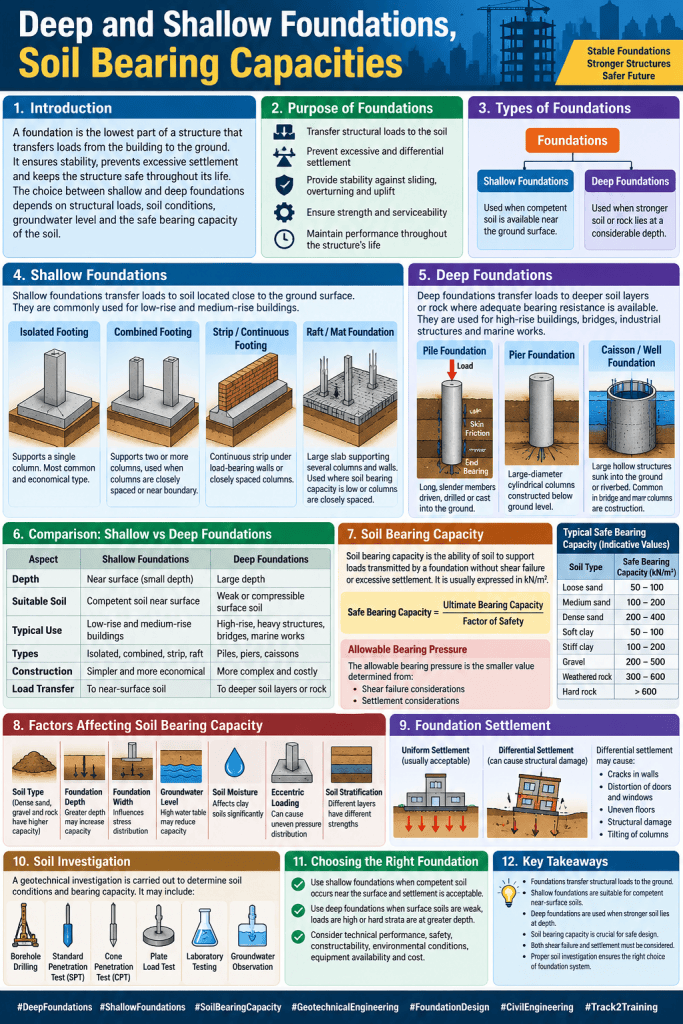
The foundation is one of the most important parts of any building or civil engineering structure. It forms the lowest portion of the structure and transfers loads from columns, walls, beams, and slabs safely to the ground. A properly designed foundation ensures stability, prevents excessive settlement, and protects the structure from failure. The choice of foundation depends largely on the magnitude of structural loads, soil conditions, groundwater level, site characteristics, and the safe bearing capacity of the soil.
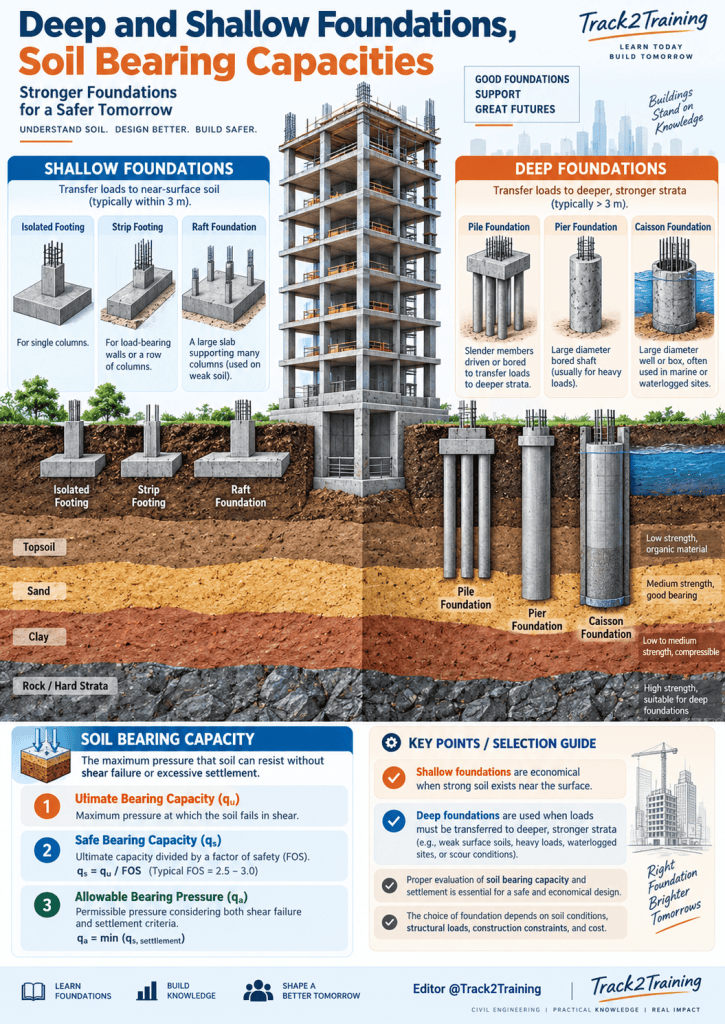
Foundations are broadly classified into shallow foundations and deep foundations. Shallow foundations are suitable when competent soil is available near the ground surface, whereas deep foundations are used when stronger soil or rock lies at a considerable depth. Understanding soil bearing capacity is therefore essential for selecting and designing an appropriate foundation system.
Purpose of Foundations
The primary function of a foundation is to distribute the structural load over a sufficient area of soil so that the pressure imposed on the ground remains within safe limits. A foundation must also prevent excessive or uneven settlement, resist horizontal and uplift forces, provide stability against sliding and overturning, and ensure that the structure remains serviceable throughout its life.
A well-designed foundation should satisfy both strength and serviceability requirements. Strength relates to the ability of soil and foundation materials to resist failure, while serviceability mainly concerns settlement, tilting, cracking, and deformation.
Shallow Foundations
A shallow foundation transfers structural loads to soil located relatively close to the ground surface. In general, a foundation is considered shallow when its depth is small compared with its width.
Shallow foundations are commonly used for low-rise and medium-rise buildings where soil near the surface has adequate bearing capacity.
Types of Shallow Foundations
1. Isolated Footing
An isolated footing supports a single column. It is one of the most common and economical foundation types used in framed buildings.
The footing may be square, rectangular, or circular depending on column shape, loading, and soil conditions. Its main purpose is to spread the concentrated column load over a larger soil area.
2. Combined Footing
A combined footing supports two or more columns. It is generally adopted when columns are closely spaced or when an exterior column is located near the property boundary.
Combined footings may be rectangular or trapezoidal. They are designed so that the resultant load passes approximately through the centroid of the footing area.
3. Strip or Continuous Footing
Strip foundations consist of continuous strips of concrete placed under load-bearing walls or closely spaced columns. They distribute wall loads along a continuous length.
They are widely used in residential buildings and masonry structures where loads are moderate and soil conditions are satisfactory.
4. Raft or Mat Foundation
A raft foundation is a large reinforced concrete slab supporting several columns and walls over most or all of the building area.
Raft foundations are useful where:
- soil bearing capacity is low,
- columns are closely spaced,
- individual footings would cover a large portion of the site,
- differential settlement must be minimized.
Raft foundations distribute loads over a wide area, thereby reducing soil pressure.
Deep Foundations
Deep foundations transfer loads to deeper soil layers or rock where sufficient bearing resistance is available. They are adopted when near-surface soil is weak, compressible, expansive, or unsuitable for carrying structural loads.
Deep foundations are commonly used for high-rise buildings, bridges, industrial structures, marine structures, and heavy infrastructure projects.
Types of Deep Foundations
1. Pile Foundations
Pile foundations consist of long, slender structural members driven, drilled, or cast into the ground.
Piles may be made of concrete, steel, timber, or composite materials.
According to load-transfer mechanism, piles may be classified as:
End-bearing piles: These transfer the structural load to a hard stratum or rock at their tip.
Friction piles: These transfer load through skin friction developed between the pile surface and surrounding soil.
Combined end-bearing and friction piles: These transfer loads through both mechanisms.
Piles may also be used to resist uplift, lateral forces, and soil movement.
2. Pier Foundations
Pier foundations consist of relatively large-diameter cylindrical columns constructed below ground level. They transfer heavy loads to stronger soil strata.
They are usually shorter and larger in diameter than conventional piles.
3. Caisson or Well Foundations
Caisson foundations are large hollow structures sunk into the ground or riverbed. They are commonly used for bridge piers, waterfront structures, and foundations constructed in deep water.
Well foundations are particularly common in bridge construction because they can resist significant vertical and lateral forces.
Soil Bearing Capacity
Soil bearing capacity refers to the ability of soil to support loads transmitted by a foundation without experiencing shear failure or excessive settlement.
It is usually expressed in units such as kN/m².
The bearing capacity of soil depends on several factors, including:
- soil type,
- soil density,
- moisture content,
- depth of foundation,
- width and shape of footing,
- groundwater level,
- soil stratification,
- loading conditions.
Ultimate Bearing Capacity
The ultimate bearing capacity is the maximum pressure that the soil can sustain before shear failure occurs.
If foundation pressure exceeds this value, the soil may fail suddenly or undergo excessive deformation.
For shallow foundations, bearing capacity is often estimated using classical bearing-capacity theories based on soil cohesion, friction angle, foundation dimensions, and unit weight.
Safe Bearing Capacity
The safe bearing capacity is obtained by applying a factor of safety to the ultimate bearing capacity.
A simplified expression is:
Safe Bearing Capacity = Ultimate Bearing Capacity / Factor of Safety
For example, if the ultimate bearing capacity is 600 kN/m² and the factor of safety is 3:
Safe Bearing Capacity = 600 / 3 = 200 kN/m²
The factor of safety accounts for uncertainties in soil properties, loading conditions, construction quality, and analytical assumptions.
Allowable Bearing Pressure
Allowable bearing pressure considers both soil shear strength and permissible settlement. Even if soil is strong enough against shear failure, excessive settlement may still damage the structure.
Therefore, allowable bearing pressure is generally taken as the smaller value determined from:
- shear failure considerations, and
- settlement considerations.
Factors Affecting Soil Bearing Capacity
Soil Type
Dense sand, gravel, and hard rock generally have high bearing capacities. Loose sand, soft clay, filled ground, and organic soil normally have lower bearing capacities.
Foundation Depth
Increasing foundation depth may improve bearing capacity because of higher confining pressure and stronger underlying strata.
Foundation Width
Foundation width influences the stress distribution in soil. Larger foundations distribute loads over a wider area but may also influence deeper soil layers.
Groundwater Level
A high groundwater table may reduce effective soil stress and bearing capacity, particularly in granular soils.
Soil Moisture
Changes in moisture content can significantly influence clay soils. Some clays may swell when wet and shrink when dry, causing foundation movement.
Eccentric Loading
Loads acting away from the center of a footing can cause uneven pressure distribution and increase the risk of settlement or rotation.
Foundation Settlement
Settlement occurs when soil compresses under building loads. A small amount of uniform settlement may be acceptable, but differential settlement is more serious because different parts of a structure move by different amounts.
Differential settlement may cause:
- cracks in walls,
- distortion of doors and windows,
- uneven floors,
- structural damage,
- tilting of columns.
Proper geotechnical investigation and foundation design are therefore essential.
Soil Investigation
Before selecting a foundation, a geotechnical investigation is usually carried out. It may include:
- borehole drilling,
- soil sampling,
- Standard Penetration Test,
- Cone Penetration Test,
- plate load test,
- laboratory testing,
- groundwater observation.
The investigation helps determine soil stratification, shear strength, compressibility, density, groundwater conditions, and suitable foundation depth.
Choosing Between Shallow and Deep Foundations
Shallow foundations are generally preferred when competent soil occurs close to the surface and expected settlement is within acceptable limits. They are usually simpler and more economical.
Deep foundations become necessary when surface soils are weak, structural loads are very high, settlement needs strict control, or hard-bearing layers are available only at greater depths.
The final selection should consider technical performance, safety, constructability, environmental conditions, equipment availability, and cost.
Conclusion
Deep and shallow foundations are fundamental components of structural engineering because they provide a stable interface between buildings and the ground. Shallow foundations, including isolated, combined, strip, and raft footings, are suitable where adequate bearing soil is available near the surface. Deep foundations, such as piles, piers, and caissons, transfer loads to stronger strata located at greater depths.
Soil bearing capacity is a key parameter in foundation design. It determines how much load the ground can safely support without shear failure or excessive settlement. Accurate soil investigation, proper assessment of bearing capacity, and careful consideration of settlement are essential for selecting the correct foundation system.




You must be logged in to post a comment.