76th Session of UNGA

“Assembly of hope and resolutions”

United Nations General Assembly (UNGA) is the main deliberative, policymaking and representative organ of the United Nations (UN). Each 193 member state has equal power to vote, providing a unique forum for multilateral discussion of the International issue by comprising all the member states.


Each year in September the Assembly meets for regular sessions; thereafter as required. Through the dedicated agenda items or sub-items discussion of certain issues is done which leads to the adoption of resolutions. Amid covid-19 when all in-person meeting was not possible UNGA included virtual platforms to conduct meetings and other novel means to guarantee business continuity.


Abdulla Shahid of the Maldives opened the 76th session of the United Nations General Assembly on 14 September 2021 as he was sworn in as General Assembly President. Over 100 heads of state and government are expected to attend in person. The size of delegations allowed into the General Assembly Hall has been limited. Due to the global pandemic, UN Member States were encouraged to provide pre-recorded statements instead of travelling to UN Headquarters.

Pandemic is not the only problem the world is facing right now. The world has been facing the challenges such as Racism, intolerance, inequality, poverty, hunger, armed conflict, climate change and other ills for decades. General Assembly is an important opportunity for all to come together and work for the future that is different from today.


The theme for the 76th session is “Building Resilience through hope to recover from COVID-19, rebuild sustainably, respond to the needs of the planet, respect the rights of people, and revitalise the United Nations.”


SUSTAINABLE DEVELOPMENT GOALS (SDG)

Sustainable Development Goals are a call for action by all countries- poor, rich and middle-income – to promote prosperity while protecting the planet. It is also an outline for fighting poverty and hunger, achieving gender equality, confronting the climate crisis and much more, within the next ten years.


In unpredictable times, the SDGs show the way to advance towards a strong recovery from COVID-19 and a better future for all on a safe and healthy planet. Sustainable Development Goals are a global pact to create a future where nobody is left behind. These 17 goals were adopted by all countries at the United Nations in September 2015.


DECADE OF ACTION
In the aspect of human and planetary well being ‘Decade of action’ is a universal call to action to end poverty, to protect Earth and ensure all people enjoy peace and prosperity.
In September 2019, the secretary-general called on all sectors of society to mobilize for a decade of action on three levels:
Global action to secure greater leadership, more resources and smarter solutions for the Sustainable Development Goals;
local action implanting the needed transitions in the policies, budgets, institutions and regulatory frameworks of governments, cities and local authorities; and
people action, including by youth, civil society, the media, the private sector, unions, academia and other stakeholders, to generate an unstoppable movement pushing for the required transformations.


Progress is being made in several places but action to meet the Goals is not yet developing at speed that is required to meet the achievements. The Decade of Action calls for accelerating sustainable solutions to all the world’s biggest challenges — ranging from poverty and gender to climate change, inequality and closing the finance gap.


The pandemic became the unprecedented wake-up call that demanded urgency in actions and ambition. The progress that was planned and had been achieved for the decade of action got shaken in the very first five months of the pandemic, spreading the vary that then SGD moment is going off track.


Covid-19 began as a health crisis and quickly become a human and socio-economic crisis. It also urged everyone to see the importance of the preservation of the achieved progress.

“We need to turn the recovery into a real opportunity to do things right for the future.”
– UN Secretary-General António Guterres.


Some of the event highlights

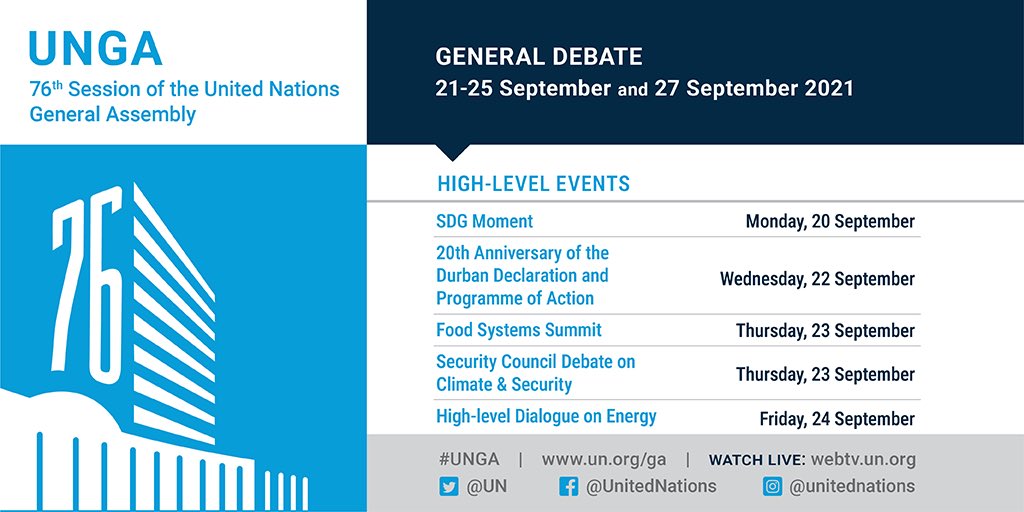
• On 20 September the second SDG moment took place with leaders from over 30 countries addressing the theme ‘Plans, pathways and partners for Recovery and beyond.’ In inclusion of four focal topics Gender equality; Connectivity; Youth in Action; and Localising the SDGs.

• On 23 September, the first-ever food summit will take place completely virtually to mobilise the actionable commitments to transform food systems.

• On 24 September, the first global gathering on energy under UNGA auspices since the UN Conference on New and Renewable Sources of Energy in 1981, ‘High-level Dialogue on Energy’ will be commenced.

• On 28 September, the High-Level Event on Jobs and Social Protection for Poverty Elimination event will be conveyed virtually.


2021 remains a crucial year to bring back the balance with nature, take measures about the climate emergency, and get ahead of the pollution crisis while making sure that no one is left behind. The topics that have been discussed and are to be discussed in the 76th United Nations general assembly are a reminder of what must be done for the future so our dreams won’t be lost forever.
Only by being together, we can tackle the feeling of helplessness and hopelessness that many of us are currently feeling. As long as we are united we can make a difference for the sake of our planet and each other.


‘One person can hope for change and two can make it come true with the support of each other.’
Continue reading “76th Session of UNGA”

Career opportunities for BA Programme students

If you are a BA student and confused about what to do after graduation, don’t worry we have sorted out some career paths that you can choose after getting a bachelor’s degree in BA programme.

As we all know BA is one of the most popular undergraduate course among students specially humanities students. This three year course allows you to study a combination of subjects ranging from English, Hindi, Economics to History, political science and philosophy. Due to variety of subjects it opens up many job opportunities. Following are the most popular career paths after doing BA:

  1. Post Graduation in courses like B.Ed. or M.A. (in a specific subject).

After M.A in Education, candidates are eligible for PGT jobs, elementary and secondary teaching jobs in private and government schools. After qualifying NET/SET in education, candidates are also eligible for university level teaching jobs in private and government institutions while obtaining a degree of B.Ed. only provides an opportunity to be a teacher in a government or private school.

2. MBA (Masters in Business Administration) is another sought after course after a degree in BA programme where upon completion, candidates are offered jobs in private/ government financial institutes.  In an MBA program, you’ll learn about solving business problems, which would allow you to become a competent manager. You need to give the Common Admission Test (CAT) to apply for MBA degrees in numerous colleges and universities. Your CAT Score determines which colleges you can enter.  Students of every stream are eligible for this course. This job pays handsome amount of money. Average salary of a MBA graduate is 5-10 LPA.

3. Civil Services Examination, Bank PO Exams, NDA Exams – After completing graduation, students are eligible to apply for civil service examinations and Bank PO exams. They can apply in Union public service communication for posts like IPS, IAS, IFS, Indian defense service. Jobs in public sector banking system is another good option. As these jobs provide job security.

4. Computer Courses– A B.A. graduate can pursue many certifications like web designing, animations, coral draw etc. to get a job/profession in the media industry in fields like web and graphics designing. This field is becoming broader with the rise of social media platform and inclusion of AI. It is almost certain that this field will provide a large number of jobs in near future.

5. Law – Students who have studied English, Hindi, Political Science as subjects can pursue law as a career. The program imparts extensive knowledge on topics like Jurisprudence, Environment Laws, Arbitration, Law of Insurance, Consumer Protection Act. Upon completing the course, one can either pursue LLB, start practice after registering oneself with the respective councils or can work in government or private sectors.

6. Master of Fine Arts is another sought after course for ones who are inclined towards artistic endeavors. Some of the prominent specialization offered under master’s level design programmes are: Industrial design, design computing, architectural design, fashion and textile design, shoe designing, leather designing, graphic designing, house design etc. After completion of the course, one can practice as a designer in the field of specialization in the private/government sector.

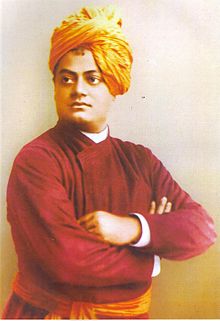
Swami Vivekananda

If the modern world had not known Swami Vivekananda, who stirred up world thought with his short life span, we would probably have disbelieved the life of Adi Shankara, who completed his mission in just 32 years.

Vivekananda spoke to human beings only about the spirit and the essence of man. The very definition of ‘Man is Potential Divine’ can be considered as the heart of Vivekananda’s message. Gandhiji said: “I want to tell the youth not to return empty-handed to Vivekananda.”Swami Vivekananda, who presented the Upanishads in a modern style in the Western world, was shaking up Western thought itself, describing the value of life and the way to bring it out and express it. The notion that ‘sin is the greatest sin’ was enough to shake up the whole thinking of the West.Many Western geniuses inspired by Vivekananda are proof that this gospel of power has transformed the Western world. The French philosopher Romain Roland, Margaret Noble, Tesla and Maxller all enriched that column by saying that the wise men could be heard as electric shocks.Swami Vivekananda is considered to have achieved ‘universal victory’, perhaps because of his re-establishment of worldview in this way by highlighting the theories of the Vedas.

This influence on the field of thought can be summed up by borrowing the words of Nataraja Guru: ‘Swami Vivekananda has made a permanent investment in the West. Anyone can be there for the interest. ‘ An important truth accepted by the whole world about the message of Vivekananda is that, as Tagore said, ‘there is nothing negative in Vivekananda’. Even that form of Vivekananda is reminiscent of eternal youth and eternal inspiration.

ANCIENT INDIAN HERITAGE

India has a long history behind it, though as an independent nation it is still a rich. India is rich in almost every aspect of human activity. This richness is not of the recent past but dates back to thousands of years. We, living today, are heirs to a rich, healthy heritage which is the envy and admiration of the rest of the world. Our culture is one of the best and oldest. The nations which are highly developed and which hold an important place today in the comity of nations, were little known at a time when the glory of India was widespread. Many things have contributed to the proud heritage that has been handed over to us by our forefathers.

Evidence of our heritage and culture can be got from the excavations made in Harappa and Mohenjodaro. The Indus Valley Civilisation is one of the oldest and offers proof of a great culture that existed in the distant past. The Vedas and the Upanishads, the oldest of literatures are rich in pearls of wisdom. Spiritual and moral ‘tenets’ and guidance are got in plenty from these. They transcend boundaries of nations or creeds or religions, but apply to the whole world. Among the greatest epics of the world are the Ramayana and the Mahabaratha. The Bhagavat Gita is a Universal Document of Wisdom and Truth, holding a rich store of knowledge in various aspects of life. One who is an avid reader and follower of the Gita will get its truth instilled into one’s nature and such a one will be looked upon with love, respect and admiration by others, such is the value of the classic.undefined

Kings and Emperors in ancient days were patrons of art and literature. They have had counsellors who gave them valuable guidance and advice not only religious matters but also on the economic, social and political aspects of life. There were also men of genius who entertained the kings and the people with their poetic skill and imagination. There is no subject left untouched or unadorned by our ancients. Great men like kalidasa and kautilya will live as long as human beings inhabit this world. “Shakunthalam” and “Meghadoot” of Kalidasa and “The Arthasastra” of Kautilya are immortal. The latter is a treatise on political philosophy of the highest order.

Art, architecture, painting and sculpture, weaving, music and dance…. there is no field left undistinguished by our ancients. Artists of every description were patronised by great Emperors and Kings some of whom were themselves eminent in the arts and music.Temples are repositories of architectural beauty and monumental proof of the artistic skills of people of the past. Many examples of beautiful temples can be found. The Brihadeeswara Temple at Thanjavur in Tamil Nadu is a standing testimony to the technological protection that was the hallmark of such structures. It offers proof for the technical proficiency of the builders who did not have any of the advantages that modern technology offers to builders.

Arts and architecture of the ancients were developed later by others and even foreign rulers of India admired them and made them blend with other cultures. Bharatanatyam, Kathakali, Kathak and Manipuri among dances, the Kushan, Gandhara and Guptha forms among art forms, were revelations to the innumerable foreign travelers who visited India at various times in the past. Painting was not far behind these, as is evident from the Ajantha paintings. A modern marvel of art and architecture that had its roots in the past and which is a fine legacy left to us in Mamallapuram or better known as Mahabalipuram near Chennai.

Considering all these facts, it may be said that our heritage is one of the valuable treasures handed over to us by our forefathers. Western education, adoption of Western modes of dress and ways of life, faith in rationality, disbelief in religious tenets and truths tend to undermine the value of our heritage. It is the bounden duty of everyone, every Indian worth his salt, to preserve the ancient heritage handed over to us, so that we would be in a position to pass on this wealth of wisdom to posterity. We have to see to it that divisive tendencies do not destroy the cultural heritage that has come down to us through the centuries. India and culture should ever be an inseparable combination that should act as a model and a beacon light to the rest of the world.

Transgender, Trains and Taboos

What’s the first image that comes to your mind upon hearing the word “Transgender”? Is it one of disapproval, disgust and social stigma? I don’t blame you entirely because our societies since ages have developed many taboos around the transgender community. However, blaming the society for their miserable treatment doesn’t come across as a nice defense as we are ourselves form a part of that very same society.

The word Transgender is an umbrella term that describes people whose gender identity or expression does not match the sex they were assigned at birth. For example, a transgender person may identify as a woman despite having been born with male genitalia.” You would be amazed to know about the transgender themes occurring in the Indian mythology. From the Mohini avatar of lord Vishnu, Sikhandi in Mahabharata, Lord Agni (The consort of moon good) and Lord Aravan (the transgender god) ,all find mention in ancient Indian epics and puranas).

Yet why is it that we aren’t inclusive of the transgender community?

This community has faced atrocities and discrimination to a point that it pushed the government to pass the Transgender Persons (Protection of Rights) Bill, 2019 in Parliament on November 26, 2019. This bill prohibits discrimination and grants rights to the transgender community of which they had been robbed of for long.

Has the bill really brought about a significant change in status quo of the Transgender community? Let’s figure it out for ourselves

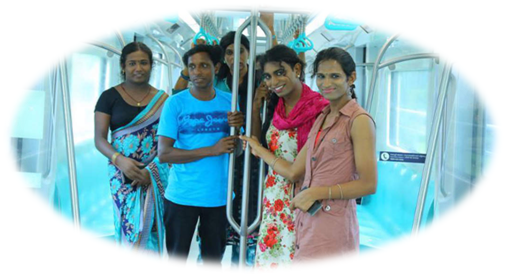
  • Kochi metro employs transgender people: Kerala’s Kochi Metro Rail Ltd (KMRL) shattered all myths when it offered jobs to 23 transgender people in their staff in the year 2017 through Kudumbashree Mission .It was a laudable move by KMRL which not only aimed at making the community financially independent but also  bringing about social inclusion .

One of the transgender employees says “This also was our first secure job. It proved that we too can do jobs that any other person does. With increasing acceptability, getting accommodation too became easier”.

While the other transgender members were happy to receive wedding invites from their colleagues. The commuters too expressed a welcoming attitude towards them with no incidence of misbehaving.

  • However, this once promising move could not contribute significantly in bringing about a change in the real sense. At present, out of 23 transgender persons hired only 6 are working with the KMRL. Many quit jobs citing a poor pay. The members had hard time in finding accommodation in the city .With no hike in the salary, sustaining in the city became a nightmare. 

Faisu , a former employee with the KMRL says “Since we were hired on contract, the salary was less. Our salary was `13,000, which reduced to `9,000 after all the deductions, including Provident Fund. It is difficult to meet our monthly expenses with the amount.”

  • Noida metro dedicates station for transgender Community: Following the Kochi metro model, the Noida metro dedicated Noida Sector 50 metro station for the transgender community. It is the first of its kind in North India. This praiseworthy initiative by the Yogi government aims at uplifting and providing employment to the transgender people. The station has been renamed “She man” for the inclusion of community into the mainstream. But this name hasn’t gone down well with certain people and human rights activists who called it as trans- phobic, derogatory and insulting. The committee has taken this criticism into consideration and invited suggestions on the same.These members will be offered mainly housekeeping, ticket collecting roles. This initiative comes as a ray of hope because as per Census 2011, there are 4.9 lakh transgenders in India out of which approximately 30,000 to 40,000 stay in the NCR.

Now here come the big questions

  • Who will make sure that the NOIDA metro model does not meet a similar fate as the Kochi metro?
  • Who will ensure that the transgender members get adequate salary?
  • Most importantly, who will ensure they receive fair treatment and inclusion that they deserve?

No, it is not the sole responsibility of the authorities. It is rather a collective effort. It is our combined responsibility to ensure that the transgender community receives the welcoming treatment they have long been denied. These schemes, initiatives are just a small step. In order to make them fruitful we have to work at grass root levels, spreading awareness and sensitivity about gender identity. It has to start with you and me. It’s time we bust the taboos and embrace the transgender community with open hearts.

For the Love Of Lingo !


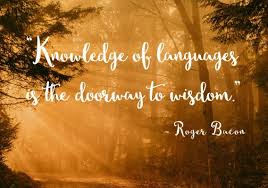
Haruki Murakami, the renowned Japanese author quoted “Learning another language is like becoming another person”. The journey of learning a second language is indeed a beautiful one. For a language carries within itself the ethos of an age old civilization, its traditions and the glorious tales of its evolution. It is rightly said, ‘To learn a new language is to posses a second soul ’.
Sounds fascinating right? From the groovy Spanish number “Despacito” to watching Korean TV series or going gaga over the K-pop band BTS , we’re are all in awe of these rich languages. Sometimes that fascination of ours leads to learning. Yes, you guessed it right; we embark on the journey to learn that language. And if you haven’t considered learning a new language until now ,then let me introduce you to the benefits learning the lingo!!
· Travel: Are you a wander who loves to explore new places and cultures? Travelling across lands is one to the most enriching experience if done right. By right I mean immersing oneself into the local culture of the place, far away from the luxury hotels. Interacting heart to heart with the locals. That’s where knowing the language comes into play. Who knows what hidden gems, tales you might discover besides making memories of a lifetime. Hey you!! Do add a language holiday to your bucket list for a cherishing experience.
· Friends, Family and Culture : With new language comes new friends and the world feels like a family. Exchange of ideas, coming together of speakers of different languages inculcates a sense of mutual respect, empathy and admiration towards other traditions. Imagine going to Brazil and cheering your favorite football team or appreciating the all time classic French movies in their original form. From deciphering the Arabic scripts on the Islamic tombs or the new found confidence within you on being able to read those complicated street signs in Chinese script. It’s no less of euphoria than the “Eureka moment “, right?
· Food for the Brain: Here comes the good news! Did you know learning a new language not only boosts your brain power but also enhances your memory? Studies prove that multilingual people have an edge at multitasking and decision-making skills compared to their monolingual counterparts. Also, learning the lingo keeps Alzheimer’s at bay.
· Career Boost and CV skills: Having a second language on your CV is like cherry on the cake. It gives you an upper hand over others, opening new career avenues. As a student, it increases your chances of selection for Student exchange Programs and being a part of global immersion. On the professional front, one can apply to Embassies, language translator and various other promising profiles.
· Diving into the world of literature : Learning a new language helps one discover the real gems of literature whose essence is lost in translation. Be it the original works of Persian poet Rumi, Les Misérables by Victor Hugo, the heart wrenching tales of Nazi Germany expressed originally in Dutch by Anne Frank in her Diary. They all offer insights into the realities of world ,broaden our perspectives and help us embrace the world with kindness. Romance languages (French, Spanish, Portuguese, Italian and Romanian) have similar roots and knowing either of one makes it quite easy to learn another. Having prior knowledge of Portuguese myself, I found Spanish quite easy to comprehend.
Still wondering when, how and where to start from?
Let me help you with this. The answer is pretty simple.
· When: If not now then when? There’s no better time to learn a language than now. It all starts with a simple step.
Just set aside an hour from your busy schedule everyday and start learning the language you’ve always dreamt of being fluent in.
· How: Here’s an interesting answer. Pick that one language you are passionate about. It could be as simple as impressing your love with French ( most romantic language in the world ) or maybe German cause you want to move there for higher studies . I’m sure you have plenty of reasons to pick your Lingo! ( For me , It was reading the Alchemist by Paulo Coelho in Portuguese )
· Where: Start from the basics, build a strong foundation. There are plenty of online resources available such as Coursera , Duolingo , Memrise along with various podcasts and resources available on the internet . There’s an entire ocean to choose from, you just have to pick your pearls.
Remember, Change is hard at first, Messy in the middle and gorgeous at the end.” This journey of learning the lingo might be frustrating. There are gonna be times you’d feel frustrated and wanting to giving up. Be consistent because Rome wasn’t built in a day. Eventually, you’ll fall in love with the journey and the language itself.
P.S. Carpe Diem Folks!! (Live the moment, Live the lingo)
Happy learning !