
There are external and internal threats to India’s security and various specialized Indian forces deal with these threats. External threats are typically handled by the armed forces of the Department of Defense, while internal threats are handled by the Department of Home affairs .
Security forces
1.Indian Armed Forces
2.Central Armed Police Force
Indian Armed Force
The defense forces are divided into four sub-heads.
- Indian Army Personnel.
- Indian Air Force Personnel.
- Indian Navy Personnel.
- Indian Coast Guard Personnel.
The Supreme Commander of the Indian Armed Forces is the President of India. All three of these services are under the Department of Defense.
Indian Army
The Indian Army is the land component of the armed forces. It evolved from the armed forces of the East India Company, eventually transforming into the British Indian Army and the Indian Army after independence.
It is commanded by the Chief of Staff of the Army (COAS). It is considered the second largest active army in the world. The mission of the Indian Army is to ensure national security and protect India’s sovereignty, territorial integrity and harmony against foreign aggression and threats. This also includes providing humanitarian assistance and aid to civilians during natural disasters and unexpected times.
Indian Navy
India has a coastline of 7516.6 km. The Indian Navy secures India’s maritime borders and interests. It also protected Indian merchant ships by fighting pirates on the high seas, and at the same time, it aided civilians in disasters. It is commanded by the Chief of Naval Staff, an Admiral. The Indian Navy is deployed under three commands: Eastern Naval Command – Vishakhapatnam is the headquarters. Western Naval Command – Mumbai is the headquarters The Southern Naval Command – Kochi is the headquarters. The navy is used to support foreign policy goals, build “bridges of friendship” and strengthen international cooperation.
Indian Air Force
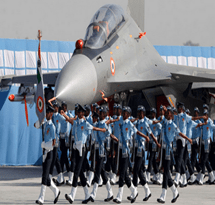
The Indian Air Force was officially established on 8 October 1932. The force was known as the Royal Indian Air Force in recognition of its service during the Second World War. . After Independence, the term “Royal” was dropped. It is considered the 4th largest air force in the world. The primary responsibility of the Indian Air Force is to secure Indian airspace and conduct air wars in times of conflict. In addition to the wars of independence for India and humanitarian action, she has participated in many UN peacekeeping missions. An Air Marshal is the commander of the air forces in India. The Air Force Network (AFNet), launched September 14, 2010, is a digital information network that enables rapid and accurate response to threats. It is a fiber-based network.
Security Forces Dealing with Internal Threats
There are many divisions of Central Armed Police Force, which deal with internal threats.
Central Armed Police Force (CAPF)
- Assam Rifles (AR)
- Border Security Force (BSF)
- Central Industrial Security Force (CISF)
- Central Reserve Police Force (CRPF)
- Indo Tibetan Border Police (ITBP)
- National Security Guard (NSG)
- Sashastra Seema Bal (SSB)
Duties of various security forces and agencies The Ministry of Home Affairs (MHA) has many responsibilities, the most important of which are internal security, management of paramilitary forces, border management, center-state relations, administration of territories. of the Union, disaster management, etc. Article 355 of the Constitution ordered the Union to defend each State against external aggression and internal disturbances and to ensure that each State’s government was carried out in accordance with the provisions of the Constitution.
 Track2Training
You must be logged in to post a comment.