Farm Loan Waiver

Before diving to the details about loan waiver let’s all get an idea about what actually is loan waiver.
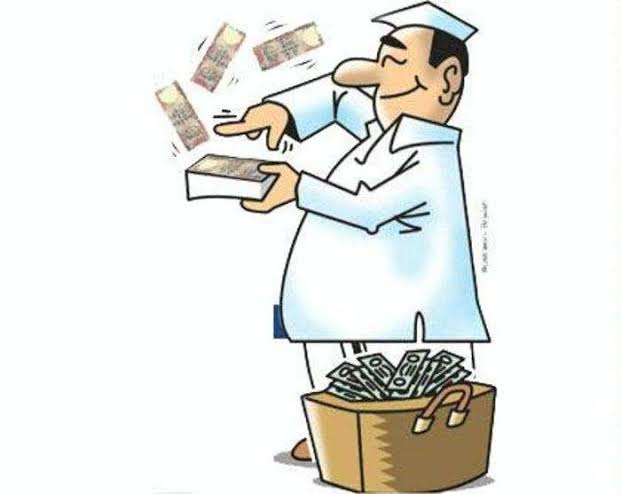
Farm loan waiver: To assist the farmers who are in distress, the Government came up with the process called Loan waiver. In accordance with this, the government will pay defaulted loans taken by the farmers. There is a timeline vis-a-vis when this process took it’s birth but acknowledging those details are meant to eat your time. But dont worry I will fill you about the details in gist/crisp manner.

2016-18: States too have followed the footsteps of Union Government and adopted loan waiver. Ex. Madhyapradesh, Jammu and Kashmir, Tamilnadu, Telangana, Andhrapradesh etc.

Budget -2008: Agriculture Debt Waiver and Debt Relief Scheme (ADWDRS) promised to pay loans taken by the small&marginal farmers and other farmers offering waiving percentage 100% and 25% respectively.

2017- Considering the problems faced by farmers during demonetization, the Budget (17) announced 60 days of interest waivers to farmers.

Arguments in favor:
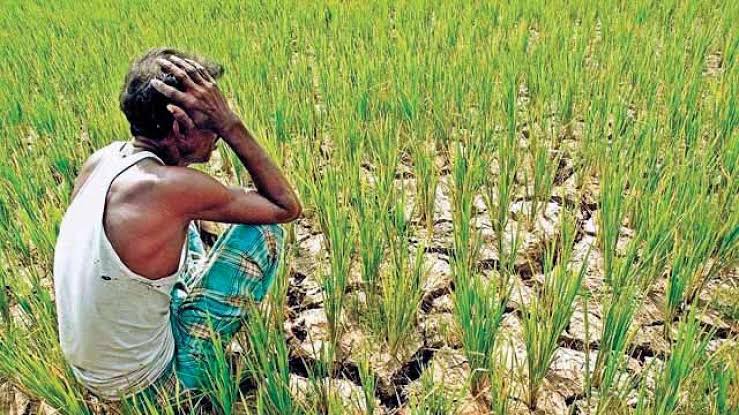
=>Few people opine that the situation of farmers since a decade(2008-18) have became worse with post-subpime crisis (2008), global financial crisis (2008) ,droughts (2017, 18), and demonetization (2016). These have raised issues like dropping down prices and demand for the products example being textile industry in international market and are forced to sell them in domestic market at cheaper rates

=>In addition to this, the government have came up with the plans of restructuring for loans by corporate borrowers which reinforced support-farmer people to demand for same as debt waiver.

=>Violent agrarian agitations in Maharashtra, Uttarpradesh and Madhyapradesh also made it visible the pathetic plight of the farmers.

=>Farmers are being more prone to Debt Overhang (where all the income earned so far was used to repay accumulated debts) and are forced to use savings/income in buying farm inputs(seeds, fertilizers, pesticides)

Challenges associated with loan waiver:
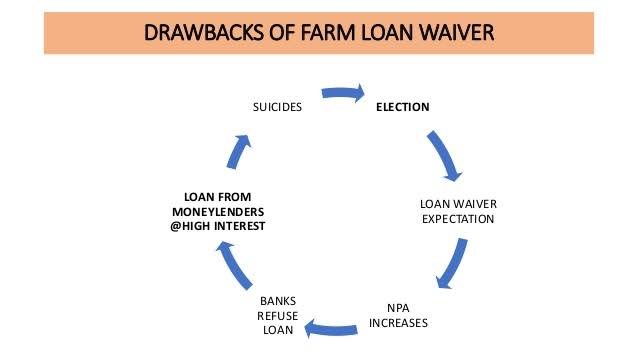
” Loan waivers undermine credit culture. NPA problem will get aggravated ” __ ex-RBI Governor Urjit Patel

“Farm loan waiver should not form part of election poll promises”__ Former RBI Governor Raghuram Rajan

These are only individual opinions but serious measures are yet to be taken and implemented.

=>Impact on behavior: Loan waiver reduces the hard working capacity and chances for developing negligent behavior/lack of discipline in farmers are more likely.

=>Partial Coverage: Out of 100% loans borrowed by farmers only 60% are from formal sector(banks,NBFCs) and rest of the borrowings are from informal sector (Marwadi, Shroff). So even though government announced loan waiver significant percentage of farmers deprived of benefit.

=>Feedback: Comptroller and Audit General (CAG) commented on ADWDRS which implemented in 2008 ,as it is prone to serious exclusion and inclusive errors. Also Economic Survey-2017 pointed out that loan waivers haven’t contributed neither in accentuating GDP contribution nor in development of farmers.

=>Multiplier Effect: WHO recommended 5% of GDP to health sector whereas the actual allocation was less than 2%.The amount allotted for waiving tantamount to 1.5% of GDP. So it would be justifiable for the government to invest money in the schemes which promotes welfare for majority of populace than in the schemes which have serious implications on other developmental expenditure.

=>Fiscal Deficit: It would be burdensome on state governments implementing the waiver process and there are also chances that a particular state would end up in inflation too. Ex: Report in 2017 by RBI quoted that ₹88000 crores used as loan waiver by 7 States ( Uttarpradesh. Maharashtra etc) notified as a states with inflation.

=>No recognition: Loan waiver focussed mainly on cultivators and the truth that agricultural workers are also being impacted was neglected.

Farmers distress is a real and pressing problem.But the government intervention has hurt more than it has helped.Loan waiver is not a magic wand that could solve the long-standing problems, it could only be used as a temporary relief (like a bandage to serious wound).There are certain issues to be considered in this regard to get ushered in right direction. Like proper identification of vulnerable farmers, enhancing non-farm works, improving technology , expansion of irrigation cover ,focussing on long-term solutions etc.

Hope you have enjoyed the article. Happy reading!

A TIMELINE OF INDIA’S MOST PROMINENT AGRARIAN PROTESTS

The four-month-old farmer’s protests in India took a violent turn on January 26, 2021, when farmers stormed the streets of Delhi, demanding the abolition of the three new farm bills. Farmers were greeted with tear gas, water guns, and abuse as they rode their tractors onto the roads. These agrarian demonstrations, on the other hand, are not the first in India’s history. For a large portion of India’s independent existence, farmers have been protesting. The majority of protests arose as a result of promises of economic growth eluding farmers and general disillusionment with a government that is unresponsive to their plight. “Large-scale protests have been taking place against a background of widespread and growing unrest in India’s vast countryside, often rooted in the discontent caused by agricultural stagnation and unemployment,” writes Alf Gunvald Nilsen, professor of sociology at the University of Pretoria. Here is a timeline of some of India’s most significant and large-scale agrarian protests.

1988, BOAT CLUB PROTESTS, DELHI

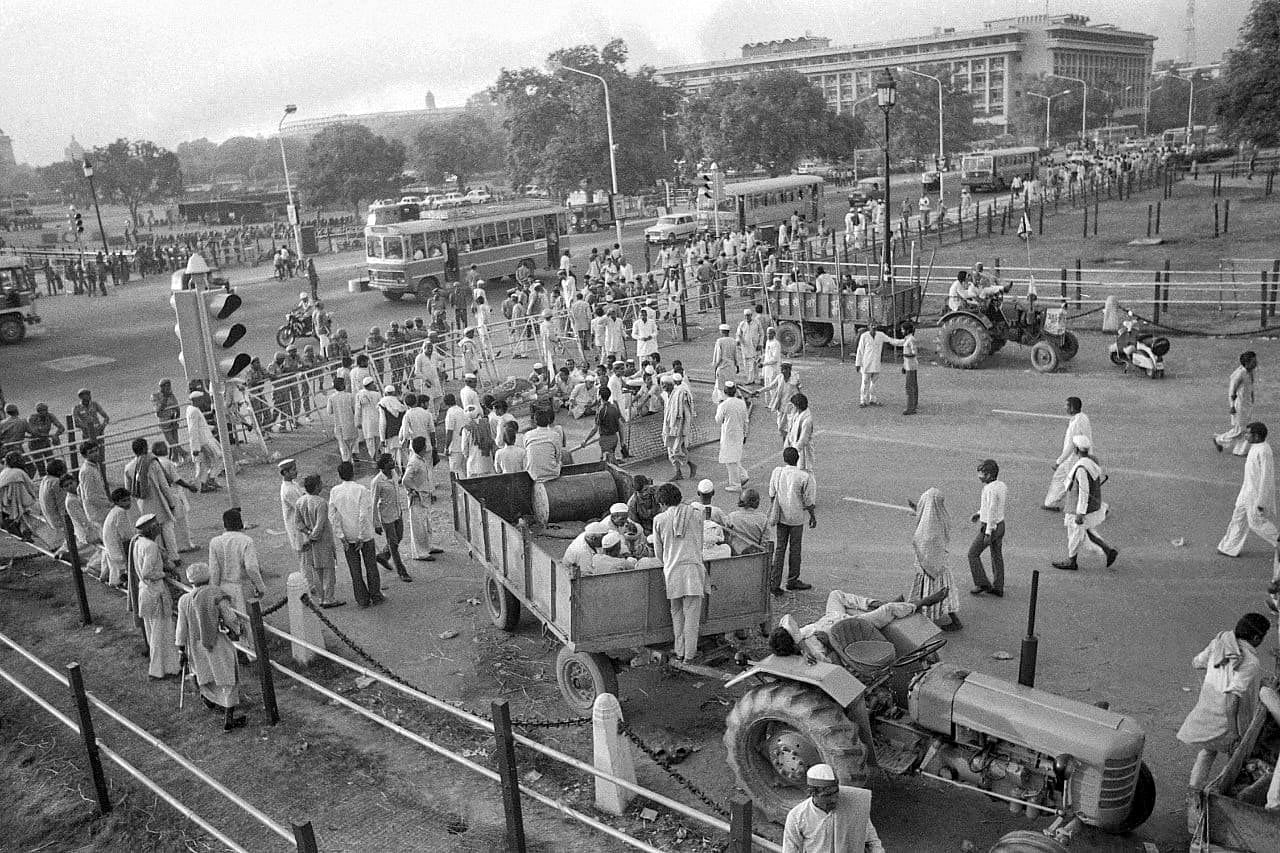
The protests of 1988, in which Mahendra Singh Tikait, a Jat farmer from Uttar Pradesh and the chief of the Bharatiya Kisan Union (BKU), stormed the Boat Club Lawns of Delhi with a charter of demands, are recounted by writer Rakesh Sinha in The Indian Express. This sit-in drew over 5 lakh farmers who demanded a rise in sugarcane prices as well as loan forgiveness. They were within hearing distance of the legislature and made their voices known just before the winter session began. It was one of the most significant farmer demonstrations in the 1980s and 1990s.

Farmers with tractors, hookahs & chaupar — rare photos of protests at  Delhi's Boat Club – ThePrint

2017, MANDSAUR PROTESTS, MADHYA PRADESH

Five farmers were shot dead in Mandsaur, Madhya Pradesh, in June 2017, while seeking higher MSPs for the onion crop and grains, as well as loan waivers for farmers who were experiencing firsthand the negative effects of the 2016 demonetization on the rural economy, according to an article in India Today.

Mandsaur News: Read Latest News & Live Updates on Mandsaur, Photos, Videos  at CNBCTV18.com

TAMIL NADU FARMERS PROTESTS, 2017

Farmers from Tamil Nadu staged a dharna in Delhi in 2017, led by P Ayyakannu. They demanded a 40,000-rupee drought relief package from the federal government, as well as an increase in retired farmers’ pensions. When protesting, they performed grotesque acts such as staging suicides and wearing skulls around their necks. They said that these skulls belonged to farmers who committed suicide because they couldn’t cope with their overwhelming debt. Sunaina Kumar, a journalist, dubbed it the “skull protest,” which was at the time the “longest continuous demonstration of nonviolent demonstrations.” Farmers with half of their faces shaved as a form of protest are depicted in iconic photographs from these demonstrations.

Will the Tamil Nadu farmers' protest in Delhi go beyond theatrics to  translate to action?

THE 2018, KISAN LONG MARCH, MUMBAI

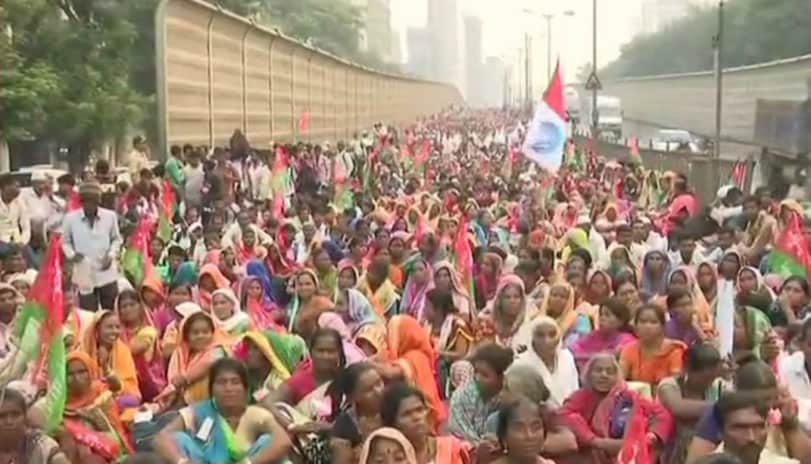
In 2018, 50,000 farmers marched 180 kilometres barefoot from Nashik to Mumbai in favour of drought relief, better minimum support prices (MSPs), and crop insurance. This peaceful protest came to an end after the Maharashtra government gave these farmers assurances, which, according to a Scroll paper, have yet to be fulfilled.

Kisan Long March: Over 30,000 farmers reach Mumbai's Azad Maidan; gherao  Maharashtra Assembly

Why do Indian farmers feel compelled to use violent tactics in protests that began peacefully?
Rakesh Tikait, the son of the aforementioned Mahendra Singh Tikait, is leading the latest farmer protests that have ravaged the country for the past six months. This may reflect generations of farmers’ resentment of India’s deep-rooted agrarian crisis and the negative consequences it has had on the agricultural sector and our Indian farmers. “India’s agrarian crisis—a crisis that has resulted in over 3,00,000 suicides among farmers and farmworkers in the last twenty years,” writes Nilsen.

“To say that protesting farmers are misled or confused is to evade critical issues,” writes Sudha Narayanan, Associate Professor at the Indira Gandhi Institute of Development Research. She emphasises the importance of farmers being included in discussions about the implementation of new agricultural laws, as well as the role they play in Indian democracy through demonstrations, which are an important way to keep a democratically elected government in check.

THE SUFFEREING OF INDIAN FARMERS

Thousands of farmers from Haryana and Punjab have surrounded Delhi for the past four months in defiance of the three ordinances passed by the Indian parliament on September 14, 2020. This protest, which has gathered thousands of farmers in the capital and set up camp on three major sites in the city, is being dubbed the single largest protest in human history. Farmers are expressing their dissatisfaction with the bills, fearing that they will simply empower big companies and leave farmers at their mercy.

Farmers- The Core of Our Economy

India’s agricultural sector has shown resilience in the face of COVID-induced lockdowns, according to the Economic Survey 2020-2021. Agriculture and related activities were the only bright spot in an otherwise dismal GDP efficiency, growing at a rate of 3.4 percent at constant prices in 2020-21. The agriculture sector employs more than half of the country’s workforce. We must comprehend our farmers’ plight and the difficulties they have faced. Be it colonial-induced famines, landowner exploitation, debt burdens, recent locust invasions, crop destruction due to severe weather conditions, or alarmingly high suicide rates. It is our responsibility to listen carefully and understand their concerns as well as the reasons for their dissatisfaction.

The Modifications has been Simplified

The three farm bills proposed are as follows –

The Essential Commodities Act (which is based on a colonial-era law governing the quantity of produce that can be stored or sold) only provides for the control of particular food products in the event of natural disasters or war.

This amendment restricts the ability of the federal government and states to enforce stock and price limits. These restrictions should only be enforced in an emergency. As a result, large companies now have complete leverage over resources such as cereals, pulses, edible oil, onions, and potatoes.

The Farmers’ Produce Exchange and Commerce (Promotion and Facilitation) Bill, also known as the APMC Bypass Bill, addresses the mechanism that now allows farmers to trade their produce both intra-state and inter-state. Previously, they could only carry their produce to the APMC (Agricultural Produce Market Committee) Mandis, no matter how far away they were. This bill also provides for electronic produce trading and e-commerce. It prohibits the state government from charging farmers or electronic trading platforms a market fee for selling produce outside of the designated mandi.

The Farmers (Empowerment and Protection) Agreement on Price Assurance and Farm Services Bill, the third bill, allows farmers to participate in “contract farming,” which allows them to enter into a contract with Agri-firms or large buyers for a specific crop at a predetermined price.

What is the aim of Farmer’s Mobilization

The aim of these bills appears to be to benefit and enable farmers to sell at larger markets without being taxed, engage in e-commerce, minimise interactions with middlemen, and incorporate technology into their farming practises. All of this is made possible by the ruling party’s deregulatory reforms, which encourage privatisation. In India, contract farming is not a new phenomenon. Contract farming has already been tried by the governments of Punjab and Gujarat. Their knowledge will aid us in determining the possible consequences of the new legislation in other parts of the world. Let’s take a peek at the state of Punjab. For more than three decades, PepsiCo has been involved in contract farming and has proven to be profitable. Farmers’ incomes increased as a result of the increased jobs. PepsiCo’s arrival ushered in a potato revolt. Small-scale or neglected producers, on the other hand, are said to be dissatisfied. Sunara Singh, a 15-acre farmer, claims that small-scale farmers who try to sell a few kilos of produce (as opposed to the tonnes sold by large-scale farmers) are not even spoken to politely or given gate passes to PepsiCo’s premises, as stated by Basant Kumar in an article for NewsLaundary in October 2020.

Another issue with the proposed laws is that, in the event of a conflict between a large company and a farmer, most small farmers have little resources in terms of time, funding, or legal skills. Farmers are unable to resolve cases ex post facto in either a civil or SDM (Sub-district magistrate) court due to a lack of documentary evidence to support their claims. The farmer will eventually be at the mercy of the corporate buyer. The bill mentions a Minimum Sales Price (MSP) for the crops, but no concrete legislation is in place to enact it. MSP does not have a statutory backup. MSP serves as a benchmark or signal price for all crop trade in the United States.

“The point is that in a country where 86 per cent of farmers have a land of the size of
fewer than two hectares, you can’t expect the farmer to carry his produce to far off
places to sell. What we need is an assured price for the farmers. If the markets are
saying they will provide a higher price to farmers, the question is a higher price to
what? There must be some benchmark.” Says Davindar Sharma, a food and trade policy
analyst at Al Jazeera.

The Agriculture Produce Marketing Committee (APMC) Act, also known as the Mandi system, was repealed by the state government of Bihar in 2006. “The financial situation of 94% of farmers in Bihar — who didn’t go to mandis or weren’t covered under minimum support price (MSP) — should have improved in the past 14 years, but their situation has worsened,” says economist DM Diwakar. This goes on to show that removing and selling agricultural produce outside of the APMC’s jurisdiction has an effect on the MSP that farmers are obligated to earn while trading inside the APMC Market Yard.

Educate, Organize, Agitate and Fact-Check!

Freedom of speech is important in a democracy. It must encourage people to express themselves, whether via social media sites, toolkits, or rallies. Tear gas and water cannons were used on protesters, demonstrators were arrested for standing up for their cause or without overt proof of a foreign plot, and the right to private counsel was denied during remand.

The Indian media has based its attention on the forces that have created instability, losing sight of the true causes of the unrest. Is it fair to ignore or, to put it another way, ridicule the majority of demonstrators who carried out their dissent in accordance with the government’s parameters and routes because a few groups had ulterior motives?

We must educate ourselves from reliable sources and double-check the information we ingest. We appear to equate oppressed people’s rage with their lack of credibility. We must empathise with the agitation and place it in perspective. If we really want to stand in solidarity, we must put an end to the dissemination of misinformation.