Are You Emotionally Intelligent?

When a person is described with the word ‘intelligent’, what usually comes to our mind is high IQ, ‘he must do well in his subjects’ or ‘he must be good at math. What if I told you that having just a high IQ isn’t enough to become successful? Most people think that people who are good at studies or those who get good grades will do well in life but not every topper has an exceptional career – shining stars of a workplace could be average scoring students. The concept of emotional intelligence or emotional quotient (EQ) is relatively new but very effective for one’s career if he or she is able to master it. 

Daniel Goleman popularized the term ‘emotional intelligence’ by authoring a book with the same name in 1996, defined it as ‘the ability to perceive emotions, to access and generate emotions so as to assist thought, to understand emotions and emotional knowledge, and to reflectively regulate emotions so as to promote emotional and intellectual growth.’ The five components of emotional intelligence that an individual should familiarise himself with are self-awareness, self-regulation, motivation, empathy and social skills.

The ability to identify your emotions towards a particular person or a situation is called self-awareness and it forms the basis for the other higher level components. If one can accurately assess what he is feeling, it can be said that he knows himself from inside-out. Such an individual would also know his strengths and weaknesses and his emotional sensitivity towards different topics. Just knowing what you are feeling can help you control your expressions and actions to some extent. For an instance, if you don’t get a promotion you have been waiting for, as an emotionally unaware individual, you could be angry and make an impulsive decision of quitting the job. However, you could have a more positive outlook and try to improve yourself and work on what you are lacking. The latter would certainly be more beneficial for you.

Motivation is the drive that keeps one going and makes efforts to achieve his goals. To remain self-motivated, one must have a burning urge to reach the level of excellence and it should not be driven by mere external rewards like pay rise or promotion but own satisfaction. The goals that one is working towards should not intersect with organisational goals to avoid conflict of interest and inefficiency in turn. To cease every opportunity that one comes across and overcome any obstacle or setback with an optimistic approach are also qualities of self-motivated individuals.

Empathising with someone is the awareness of someone else’s feelings. To understand people and what makes them do what they do, recognizing their emotions is one of the most important and basic things and it even helps a person in regulating his behaviour towards the people that he is trying to understand. It is not easy and it cannot surely be accurate but it is something worth trying. A person can only fulfill the needs of customers and exceed the expectations of people if he is empathetic enough to recognise them.

Social skills, like the name suggests, are the ways in which a person interacts with the people that are surrounding him in both his work and personal life. The kind of relationships that he has with people is only a result of his social skills. Social skills make a person influential and good at communicating his ideas such that an individual can both lead and work as a member of a team effectively. The person is not only able to initiate and drive change if he wants to but also resolve conflict or disagreement that arises due to the change.

Emotional Check-Ins in a Teaching Webinar

I always start my classes with some form of emotional check-in regardless of age or grade level. I do so in my college classes as well as in my elementary gifted classes. I think this is even more imperative given the stress students are experiencing due to COVID19. The 10 to 15 minutes it takes is so worth the class time.

Some of the benefits of emotional check-ins discussed in the Edutopia article, A Simple but Powerful Class Opening Activity, include:

Students know that every voice matters: The emotional check-in gets every student’s voice into the room at the start of each class. Although students can always say “pass” instead of sharing, each student has the opportunity to be heard every class session. The check-in is also a great opportunity to practice active listening, turn-taking, and following group norms.

Students develop awareness of others’ emotions—and how to respond to them: When students share their emotions during the check-in, they give their classmates a snapshot of their emotional state. And if I hear a student say that “I didn’t sleep much last night” or “I feel like I can’t focus today,” I can adjust my interactions with that person accordingly.

The check-ins also acknowledge that how students are feeling is important to the educator, that they matter as human beings who have feelings and emotions.

One of my college classes moved from face-to-face to Zoom this semester. What follows are some of the check-in activities I have done with them.

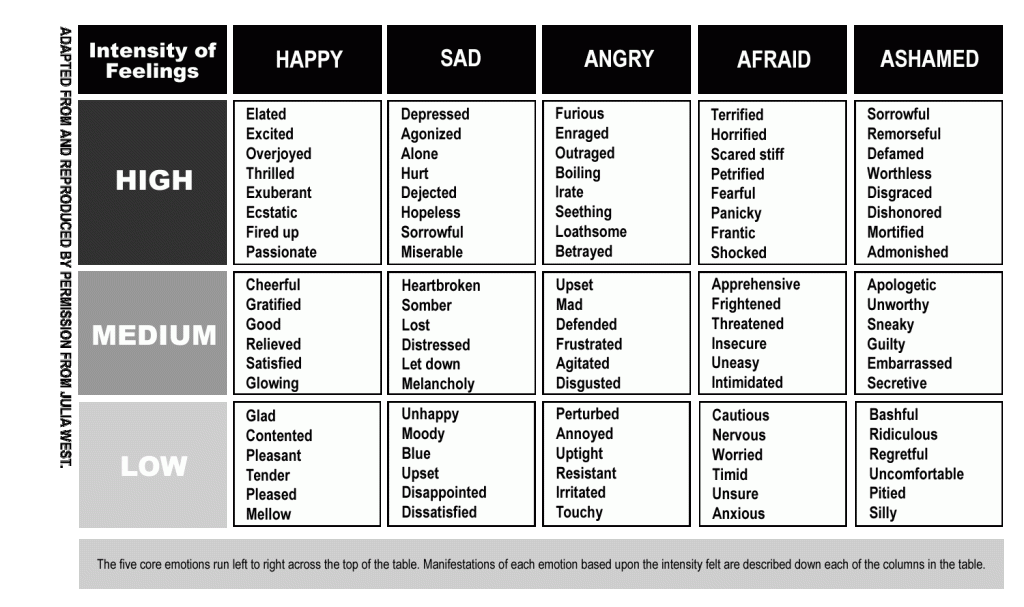
Using a Feeling Chart

Students use a feeling chart to describe how they are feeling. A side benefit of using feeling charts is that they help students increase their feelings vocabulary.

Source: Emotional Intelligence 2.0 by Travis Bradberry

Share a Rose; Share a Thorn

Each student shares a Rose, something good or positive, from the day or week; and a Thorn, something not-so-good or positive, from the day or week.

Four Types of Care

Students, during the check-in, take turns using the four types of self care graphic to describe strategies they are doing or would like to do to be physically, emotionally, socially, and spiritually healthy.

5 Step Check-In Process

The teacher leads students through the 5 step check-in process described in Emotional Check-ins: Why You Need Them:

  1. Tune into your body.
  2. Take a deep breath.
  3. Ask the question. Use the simple question, “How am I feeling?” Make it even more specific by tacking on the phrase “right now” or “in this moment.” 
  4. Use descriptive words to capture how you feel. 
  5. Brainstorm what might be contributing to those emotions.

Then each student is given an opportunity to share what came up for them during the exercise.

Pear Deck

Pear Decks are very similar to a PowerPoint or Google Slides presentation. But instead of simply static, informational slides, you get to create Interactive Slides that let every student respond to your questions or prompts. Once PearDeck is activated, through the Google Slides add-on, students are given a code to access the Pear Deck. There they interact with each slide through typing, drawing, and using a draggable icon depending how the teacher set up the slide. What follows is the Pear Deck I used for a check-in at the start of one of my classes.


Create an Image Based Timeline of Feelings

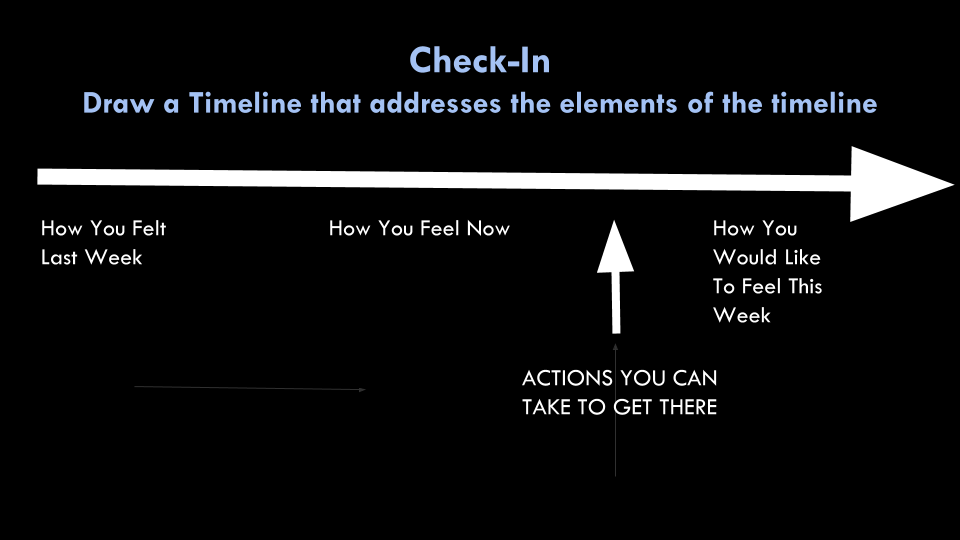
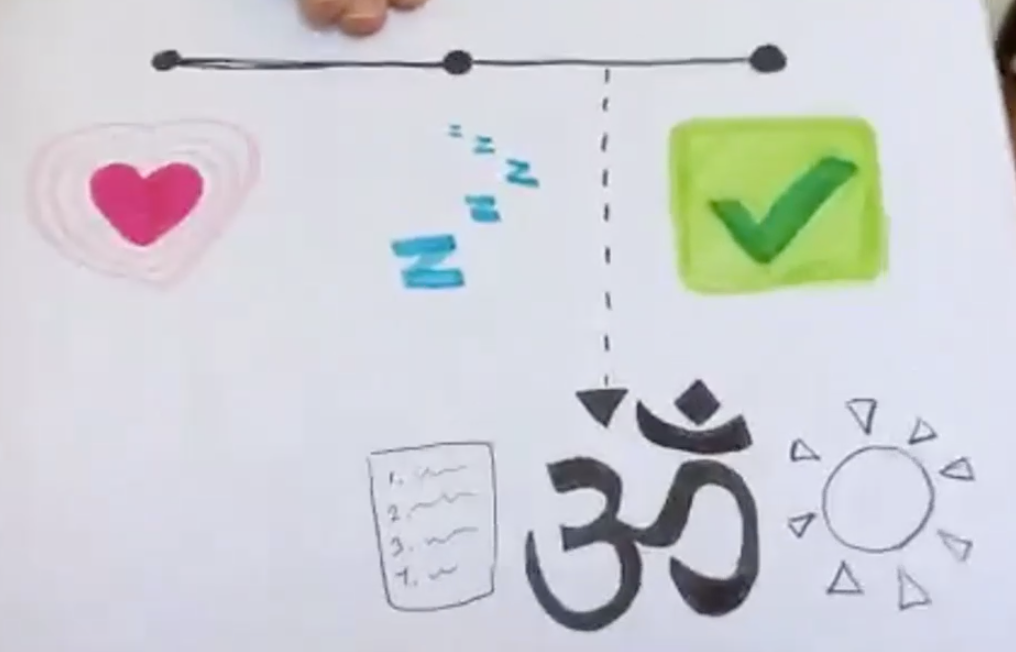
Students create a timeline of images that represent: how you felt last week; how you feel today; how you want to feel this coming week; and finally, what strategies you can use to get to how you want to feel this coming week. Students then share their images via their webinar cameras and discuss their meaning with the rest of the class. What follows are (1) the prompt for this activity, and (2) sample student pictures:

Gif Image

Using Giphy students do a search for different feelings and emotions they are currently experiencing, and then select one or more Gifs that represent those feelings. They then take turns to do a screenshare of their selected Giphy and explain why they selected it.

Padlet Check-In

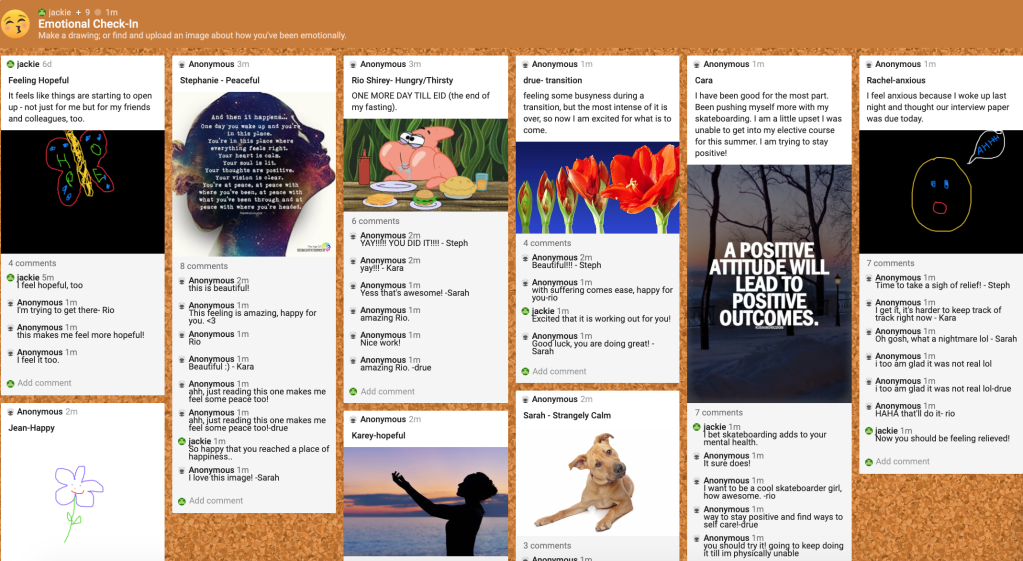
Padlet is an application to create an online bulletin board that you can use to display information for any topic. You can add images, links, videos, text, and drawings. Below is a Padlet I created for an emotional check-in.

Mentimeter

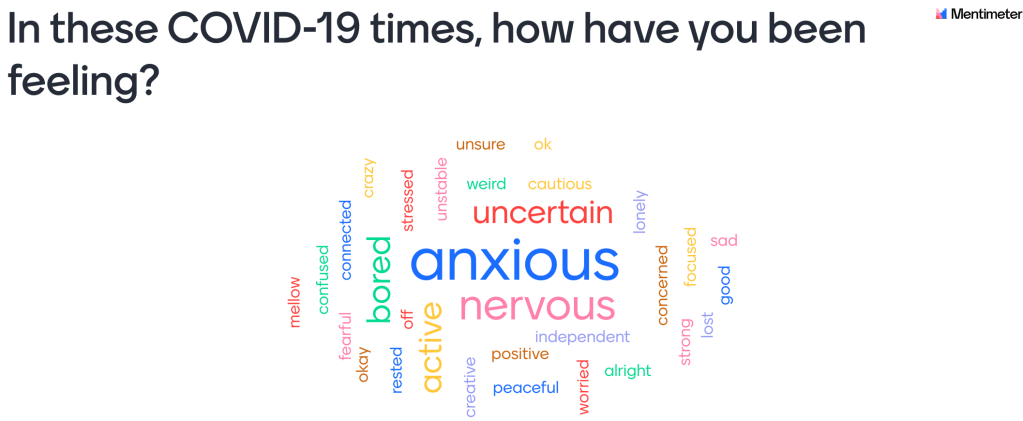
Menitmeter allows teachers to engage and interact with students in real-time. It is a polling tool wherein teachers can set the questions and your students can give their input using a mobile phone or any other device connected to the Internet. Their input is displayed on a slide in a selected format: Word Cloud, Speech Bubbles, One-By-One, and Flowchart. In the case of check-ins, it can be used to have students put in responses to a question related to how they feeling at the start of class and their responses then are shown to the class via a slide. The example below shows a slide with a Word Cloud of emotional check-in responses.

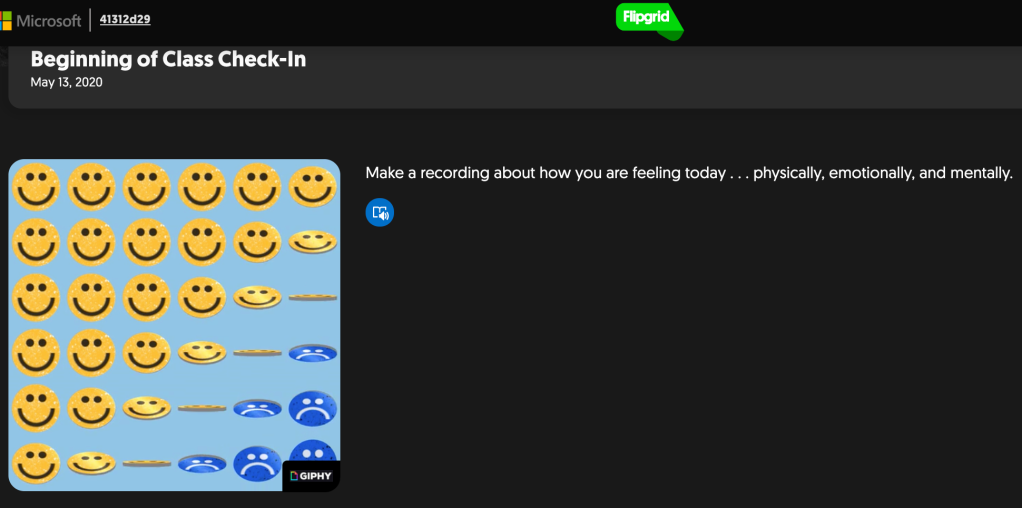
Flipgrid

Flipgrid is a website that allows teachers to create “grids” to facilitate video discussions. Each grid is like a message board where teachers can pose questions, called “topics,” and their students can post video responses. For an emotional check-in, students record a short video about how they are feeling.