
Introduction
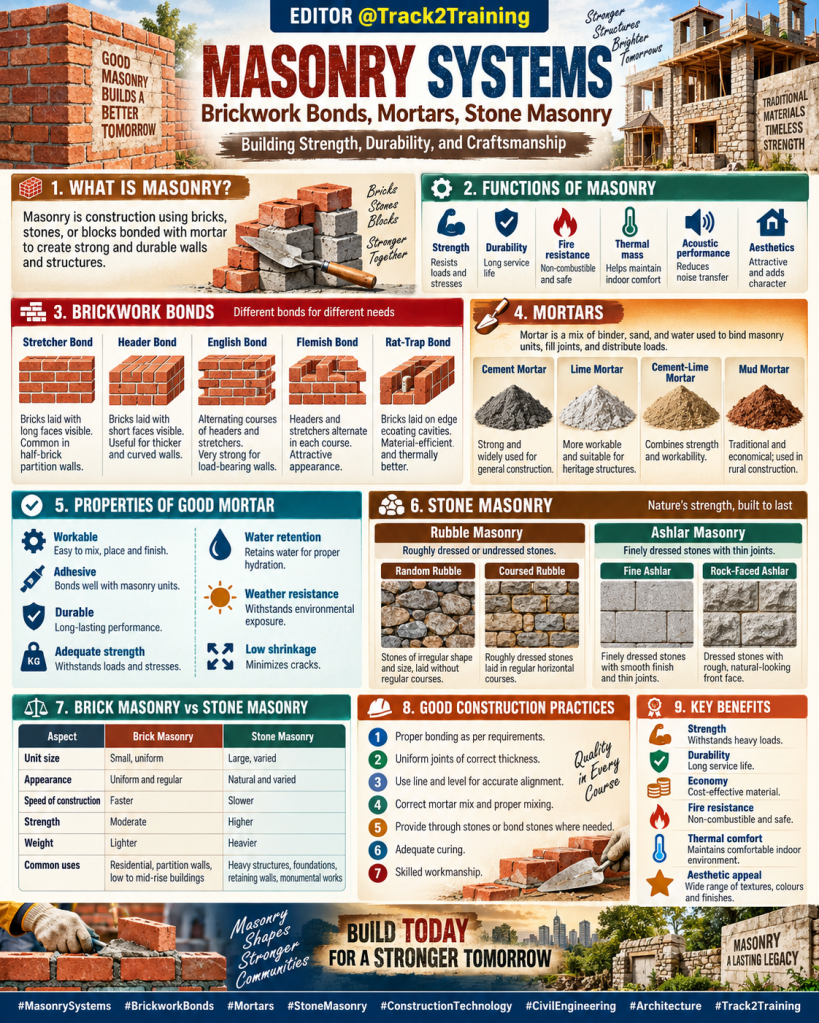
Masonry is one of the oldest and most widely used construction systems in the world. It involves assembling individual units such as bricks, concrete blocks, or stones and bonding them together with mortar to form walls, partitions, foundations, arches, retaining structures, and other building components. Masonry is valued for its durability, strength, fire resistance, thermal mass, acoustic performance, and architectural character.
Three important aspects of masonry construction are brickwork bonds, mortars, and stone masonry. Brick bonds determine how bricks are arranged to achieve strength and stability. Mortar binds the masonry units together, distributes loads, seals joints, and accommodates minor irregularities. Stone masonry uses natural stone units arranged in different patterns to produce strong, durable, and often visually impressive structures. Understanding these systems is essential for architects, engineers, builders, and students of construction technology.
Brick Masonry
Brick masonry is formed by laying bricks in horizontal courses and joining them with mortar. Bricks may be made from burnt clay, fly ash, concrete, calcium silicate, or other materials. Good brick masonry depends on proper bonding, accurate alignment, uniform joints, suitable mortar, and adequate curing.
A well-constructed brick wall should have:
- proper line and level;
- uniform mortar joints;
- overlapping vertical joints;
- good bond between bricks;
- appropriate wall thickness;
- adequate curing and workmanship.
The arrangement of bricks in a wall is known as a brick bond.
Purpose of Brick Bonds
Brick bonds are used to connect individual bricks into a unified wall mass. If vertical joints continue through several courses, the wall becomes weak and may crack or separate easily. Bonding breaks these continuous joints and distributes loads more effectively.
A good brick bond should provide:
- structural strength;
- lateral stability;
- uniform load transfer;
- proper interlocking of bricks;
- attractive appearance;
- economy in construction.
Different bonds are used depending on wall thickness, structural requirement, appearance, and construction tradition.
Stretcher Bond
In stretcher bond, all bricks are laid with their longer face visible on the wall surface. Each brick overlaps the joint below it by approximately half a brick length.
This bond is commonly used for:
- half-brick-thick walls;
- partition walls;
- cavity wall leaves;
- boundary walls;
- non-load-bearing walls.
Stretcher bond is simple, economical, and easy to construct. However, it is not suitable by itself for thick load-bearing walls because it provides limited transverse bonding.
Header Bond
In header bond, bricks are laid with their shorter face visible on the wall surface. Each course consists primarily of headers.
This bond is suitable for:
- one-brick-thick walls;
- curved brickwork;
- foundations;
- thick masonry where transverse bonding is needed.
Header bond provides better connection across the wall thickness than stretcher bond.
English Bond
English bond is one of the strongest and most widely used brick bonds. It consists of alternate courses of headers and stretchers.
In one course, all bricks are laid as headers, while in the next course they are laid as stretchers. Proper closers are used near corners to maintain bonding.
Advantages of English bond include:
- high structural strength;
- excellent load distribution;
- good bonding across wall thickness;
- suitability for load-bearing walls.
Because of its strength and simplicity, it is commonly used in traditional and heavy masonry construction.
Flemish Bond
In Flemish bond, each course contains alternating headers and stretchers. The header in one course is generally centered over the stretcher below.
Flemish bond provides a more decorative and uniform appearance than English bond.
It may be classified as:
Double Flemish Bond: Flemish pattern is visible on both faces.
Single Flemish Bond: Flemish bond appears on the exposed face, while English bond is used internally.
Flemish bond is visually attractive but usually requires greater skill and careful workmanship.
Rat-Trap Bond
Rat-trap bond is an energy- and material-efficient brickwork system in which bricks are laid on edge to create cavities within the wall.
Advantages include:
- reduced number of bricks;
- lower mortar consumption;
- improved thermal insulation;
- lighter wall construction;
- potential reduction in construction cost.
The cavities reduce heat transfer and may improve indoor comfort in suitable climates. However, good workmanship and detailing are essential.
Mortar in Masonry
Mortar is a workable mixture used to join masonry units together. It generally consists of a binder, fine aggregate, and water.
The binder may be cement, lime, or a combination of both. Sand is the most common fine aggregate.
The main functions of mortar are to:
- bind masonry units;
- fill joints and surface irregularities;
- distribute loads uniformly;
- provide weather resistance;
- improve airtightness;
- accommodate small movements;
- improve appearance.
Mortar should be workable enough for laying but sufficiently strong and durable after hardening.
Types of Mortar
Cement Mortar
Cement mortar is made from cement, sand, and water.
It provides:
- relatively high strength;
- good durability;
- rapid setting;
- resistance to moisture.
It is commonly used in foundations, external walls, load-bearing masonry, and damp locations.
However, very strong cement mortar may sometimes be too rigid for weak masonry units.
Lime Mortar
Lime mortar consists mainly of lime, sand, and water.
Its advantages include:
- excellent workability;
- good water retention;
- flexibility;
- ability to accommodate minor movement;
- suitability for historic masonry.
Lime mortar develops strength more slowly than cement mortar but is often preferred in conservation and restoration work because it is compatible with traditional masonry.
Cement-Lime Mortar
Cement-lime mortar combines the strength of cement with the workability and flexibility of lime.
It is widely used in general masonry construction because it provides a balance between:
- strength;
- adhesion;
- workability;
- durability.
Mud Mortar
Mud mortar is made using locally available soil and water, sometimes with additives such as straw or natural fibers.
It has traditionally been used in rural and low-cost construction.
Advantages include:
- very low embodied energy;
- local availability;
- low cost;
- environmental compatibility.
Its main limitations are low water resistance and lower durability unless adequately protected.
Properties of Good Mortar
A good masonry mortar should possess several important qualities.
It should have:
- good workability;
- adequate strength;
- strong adhesion;
- sufficient water retention;
- suitable setting time;
- durability;
- resistance to weathering;
- limited shrinkage.
The strength of mortar should be compatible with the masonry units. Excessively strong mortar can sometimes lead to cracking of softer bricks or stones.
Mortar Joints
Mortar joints influence both performance and appearance.
Common joint finishes include:
- flush joint;
- recessed joint;
- struck joint;
- weathered joint;
- keyed joint;
- concave joint.
External walls often require joint profiles that encourage water runoff and improve weather resistance.
Stone Masonry
Stone masonry is the construction of walls and other structural elements using natural stones bonded with mortar or, in some cases, carefully fitted without mortar.
Stone masonry has been used for centuries in temples, forts, bridges, retaining walls, monuments, and residential buildings.
Advantages of stone masonry include:
- high compressive strength;
- durability;
- resistance to weathering;
- fire resistance;
- attractive natural appearance;
- long service life.
Its disadvantages may include high self-weight, labor-intensive construction, transportation cost, and the need for skilled workmanship.
Types of Stone Masonry
Stone masonry is generally classified into two major categories:
- Rubble masonry
- Ashlar masonry
Rubble Masonry
Rubble masonry uses stones that are roughly dressed or undressed.
Random Rubble Masonry
In random rubble masonry, stones of irregular shapes and sizes are used. Larger stones are carefully placed, while smaller stones fill the gaps.
It is commonly used for:
- foundations;
- retaining walls;
- boundary walls;
- rural buildings.
Coursed Rubble Masonry
In coursed rubble masonry, stones are roughly dressed and arranged in approximately horizontal courses.
It provides a more organized and stronger appearance than random rubble masonry.
Ashlar Masonry
Ashlar masonry uses finely dressed stones with accurate dimensions and smooth faces.
The joints are thin and regular, giving the wall a refined appearance.
Types of ashlar masonry include:
- fine ashlar;
- rough-tooled ashlar;
- rock-faced ashlar;
- chamfered ashlar;
- block-in-course masonry.
Ashlar masonry requires skilled labor and careful stone dressing and is generally more expensive than rubble masonry.
Construction Principles of Stone Masonry
Good stone masonry should follow certain principles.
Large and strong stones should be used at corners and important load-bearing locations. Stones should be laid on their natural beds whenever possible.
Vertical joints should not continue through several courses. Bond stones or through stones should be provided to connect the wall faces.
Small stone chips should not be excessively used as substitutes for proper bonding. Cavities should be filled carefully with mortar and spalls.
Brick Masonry vs Stone Masonry
Brick masonry is generally lighter, easier to handle, and faster to construct. Brick units are uniform in size, making alignment simpler.
Stone masonry is heavier and often stronger in compression. It provides greater durability and a natural architectural character, but construction is usually slower and more labor-intensive.
Brick masonry is common in residential and urban construction, whereas stone masonry is often used in retaining walls, foundations, heritage buildings, landscape structures, and areas where suitable stone is locally available.
Sustainability in Masonry
Masonry can contribute to sustainable construction when materials are selected responsibly.
Locally produced bricks and locally sourced stone can reduce transportation impacts. Reclaimed bricks and stones can be reused in new construction.
Lime-based mortars may offer lower embodied energy than cement-rich mortars and can be especially appropriate for heritage work.
Innovative systems such as fly-ash bricks, compressed earth blocks, and rat-trap bonds can also reduce material consumption and environmental impact.
Conclusion
Masonry remains an essential construction system because of its durability, versatility, strength, and visual character. Brickwork bonds such as stretcher, header, English, Flemish, and rat-trap bond determine how effectively bricks work together as a structural unit. Mortar plays an equally important role by bonding masonry units, filling joints, distributing loads, and protecting walls from weather.
Stone masonry, whether rubble or ashlar, provides strength, durability, and architectural richness. The choice between brick and stone masonry depends on structural needs, local materials, cost, appearance, workmanship, and environmental conditions.
Good masonry construction requires more than simply placing bricks or stones together. Proper bonding, suitable mortar, accurate alignment, correct joint treatment, careful curing, and skilled workmanship are essential. When these principles are followed, masonry systems can provide safe, durable, economical, and attractive buildings for generations.


You must be logged in to post a comment.