
Introduction
The building sector is one of the largest consumers of energy and natural resources worldwide. Buildings require considerable amounts of energy for heating, cooling, lighting, ventilation, water supply, appliances, and other services. At the same time, construction activities consume materials such as cement, steel, glass, timber, and aggregates, all of which carry environmental impacts through extraction, processing, transportation, and disposal. As concerns about climate change, resource depletion, urbanization, and rising energy costs increase, sustainable building technologies have become an important part of modern architecture, engineering, and urban development.
Sustainable buildings are designed, constructed, operated, and eventually dismantled in ways that minimize environmental impacts while providing healthy, comfortable, and productive indoor spaces. Among the most advanced forms of sustainable development is the Zero-Energy Building, commonly known as a Zero-Energy Building (ZEB) or Net-Zero Energy Building (NZEB). Such buildings attempt to balance their annual energy consumption with energy generated from renewable sources.
Concept of Sustainable Building Technology
Sustainable building technology refers to the application of environmentally responsible materials, systems, construction techniques, and management practices throughout the life cycle of a building. The objective is not simply to reduce energy consumption but also to improve water efficiency, material utilization, indoor environmental quality, durability, resilience, and occupant comfort.
A sustainable building therefore considers the entire process from site selection and design to construction, operation, maintenance, renovation, and demolition. Life-cycle thinking is important because a building that saves operational energy but requires highly energy-intensive materials may still have a considerable environmental footprint.
Sustainable design attempts to achieve a balance between environmental performance, economic feasibility, and social well-being.
Passive Design Strategies
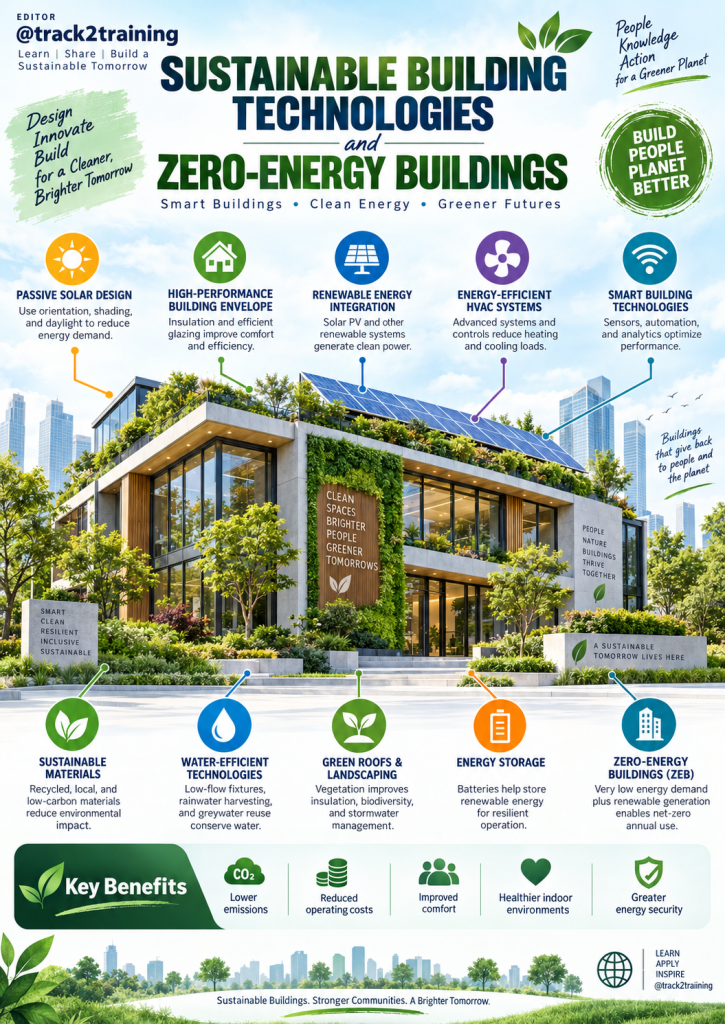
Passive design is one of the most effective approaches to reducing building energy demand. Passive techniques use the natural characteristics of climate, site, orientation, building form, and materials rather than depending entirely on mechanical systems.
Building orientation is particularly important. In warm climates, appropriate orientation can reduce unwanted solar heat gain, while properly located openings can improve daylight and natural ventilation. Shading devices such as overhangs, louvers, balconies, vegetation, and fins can protect building interiors from excessive solar radiation.
Natural ventilation can reduce the need for mechanical cooling when outdoor climatic conditions are suitable. Courtyards, atriums, wind towers, cross-ventilation, and stack ventilation can be incorporated into architectural design to improve air movement.
Thermal insulation also plays a major role. Well-insulated walls and roofs reduce heat transfer between indoor and outdoor environments, thereby decreasing cooling and heating requirements.
High-Performance Building Envelope
The building envelope includes the walls, roof, windows, doors, floors, and other components separating indoor spaces from the external environment. A high-performance envelope minimizes unwanted heat gain or heat loss.
Modern sustainable buildings may use high-performance glazing, insulated wall systems, reflective roofing materials, airtight construction, thermal-break systems, and advanced façade technologies.
Double- or triple-glazed windows can improve thermal performance while allowing natural light to enter. Low-emissivity coatings can further reduce heat transfer through glazing. In hot climates, reflective or cool roofs help decrease roof surface temperatures and reduce cooling loads.
Green roofs are another sustainable technology. Vegetation installed on roofs can provide thermal insulation, reduce stormwater runoff, improve biodiversity, and mitigate the urban heat island effect.
Energy-Efficient Lighting and Equipment
Lighting can account for a significant proportion of energy consumption, particularly in commercial and institutional buildings. The use of LED lighting substantially reduces electricity demand compared with conventional incandescent or fluorescent systems.
Lighting controls can provide additional savings. Occupancy sensors automatically switch lights off when spaces are vacant, while daylight sensors reduce artificial lighting when sufficient natural illumination is available.
Energy-efficient appliances, pumps, motors, elevators, and office equipment further reduce building electricity consumption. Proper equipment sizing is also important because oversized systems may operate inefficiently and increase initial costs.
Efficient HVAC Systems
Heating, ventilation, and air-conditioning systems are often the largest energy consumers in modern buildings. Sustainable buildings use high-efficiency HVAC technologies combined with intelligent controls.
Variable refrigerant flow systems, high-efficiency chillers, heat pumps, radiant cooling, energy recovery ventilators, and variable-speed drives are among the technologies that can improve performance.
Smart thermostats and building management systems can adjust operating conditions according to occupancy, indoor temperature, outdoor climate, and energy demand. Regular monitoring and commissioning help ensure that installed systems continue to operate at their designed efficiency.
Renewable Energy Technologies
Renewable energy systems are essential for achieving zero-energy performance. Solar photovoltaic systems are among the most commonly used technologies because they can be installed on rooftops, façades, parking structures, and other available surfaces.
Building-integrated photovoltaics take this concept further by integrating solar cells directly into construction elements such as façades, skylights, windows, and roofing materials.
Solar thermal collectors can provide hot water and support space-heating systems. Depending on location and climatic conditions, buildings may also use small wind turbines, biomass, geothermal systems, or ground-source heat pumps.
The selection of renewable energy technology should be based on local climate, available resources, building demand, cost, and maintenance requirements.
Water-Efficient Technologies
Sustainable buildings also seek to conserve water. Low-flow taps, dual-flush toilets, water-efficient fixtures, and sensor-based fittings help reduce potable water consumption.
Rainwater harvesting systems can collect roof runoff for irrigation, flushing, cleaning, and other non-potable purposes. Greywater from washbasins, showers, and certain other sources can be treated and reused within the building.
Landscape design should also support water conservation. Native and drought-resistant plants generally require less irrigation and maintenance than water-intensive landscaping.
Sustainable Building Materials
Material selection significantly influences the environmental performance of a building. Sustainable materials generally have lower embodied energy, reduced toxicity, longer service life, and greater potential for reuse or recycling.
Examples include recycled steel, fly-ash or slag-blended cement, recycled aggregates, engineered timber, bamboo, compressed earth blocks, and locally sourced materials.
Using local materials can reduce transportation-related emissions while supporting regional economies. Reclaimed materials from demolished buildings can also be reused, reducing waste sent to landfills.
Life-cycle assessment can help designers compare materials according to environmental impacts associated with extraction, manufacturing, transportation, use, and disposal.
Smart Building Technologies
Digital technologies are increasingly important in sustainable buildings. Sensors, smart meters, Internet of Things devices, automated controls, and building management systems allow real-time monitoring of energy, water, indoor air quality, temperature, humidity, lighting, and occupancy.
Building automation systems can adjust lighting and HVAC operation depending on actual demand rather than fixed schedules. Energy dashboards can also provide occupants and facility managers with information about consumption patterns.
Artificial intelligence and predictive controls are increasingly being used to optimize building operation by analyzing historical and real-time data.
Zero-Energy Buildings
A Zero-Energy Building is designed to achieve a balance between energy consumed and renewable energy produced over a defined period, usually one year.
The process begins with minimizing energy demand. Passive design, insulation, efficient glazing, daylighting, natural ventilation, efficient HVAC systems, and energy-saving equipment are used first. Renewable energy is then introduced to meet the remaining energy demand.
This approach is important because simply adding a large solar photovoltaic system to an inefficient building does not represent good zero-energy design. Energy efficiency should always precede renewable energy generation.
A simplified annual energy balance can be expressed as:
Net Energy = Annual Energy Consumption − Annual Renewable Energy Generation
When annual renewable energy generation equals annual energy consumption, the building can achieve net-zero energy performance under the adopted accounting method.
Types of Zero-Energy Approaches
Zero-energy performance can be interpreted in different ways. A site zero-energy building generates as much renewable energy on or near the site as it consumes annually.
A source zero-energy building considers the primary energy required to generate and deliver energy to the building.
A zero-energy cost building attempts to balance annual energy costs through energy savings and renewable energy production.
A zero-carbon building focuses on reducing or balancing carbon emissions associated with building energy use. Increasingly, attention is also being given to embodied carbon from construction materials.
These definitions demonstrate that zero-energy and zero-carbon concepts are closely related but are not always identical.
Benefits and Challenges
Sustainable and zero-energy buildings can provide several benefits, including lower operating costs, reduced greenhouse gas emissions, improved indoor environmental quality, increased resilience, and decreased dependence on conventional energy sources.
However, challenges remain. Advanced building systems may require higher initial investment, specialized technical knowledge, careful commissioning, and long-term maintenance. Renewable energy generation may also be constrained by building height, roof area, shading, climate, or site conditions.
Occupant behavior is another important factor. A technically efficient building may still consume excessive energy if users operate equipment inefficiently or override automated systems.
Therefore, successful zero-energy buildings require collaboration among architects, planners, engineers, contractors, facility managers, energy consultants, and building occupants.
Conclusion
Sustainable building technologies represent a fundamental transition from conventional resource-intensive construction toward buildings that use energy, water, materials, and land more responsibly. Passive design, high-performance envelopes, efficient HVAC systems, LED lighting, water conservation, sustainable materials, renewable energy, and smart building controls collectively contribute to improved environmental performance.
Zero-Energy Buildings take this concept further by aiming to balance annual energy demand with renewable energy generation. Their successful implementation depends first on reducing energy requirements and then meeting the remaining demand through clean energy sources.
As cities continue to grow and climate-related challenges become more significant, sustainable and zero-energy buildings will play an increasingly important role in reducing emissions, improving urban resilience, controlling long-term operating costs, and creating healthier built environments. They represent not merely a technological innovation but a broader approach to designing buildings that can meet present needs while conserving resources for future generations.


