5 Main Aims of Government for Economy Development

1. Full Employment:

Most governments try to achieve full employment. This means that people who are willing and able to work can find employment. Of course, not everyone wants to work or is able to work. These people are not in the labour force. They are said to be economically inactive and are dependent on those in the labour force.

They include children, the retired, those engaged in full time education, home makers and those who are too sick or disabled to work. Those who are in work or are unemployed but actively seeking work, form the labour force and are said to be economically active.

The unemployment rate is calculated as a percentage of the labour force, i.e.:

Unemployed / Labour force X 100

So if 5 million people are unemployed out of a labour force of 40 million, the unemployment rate is:

5m / 40m X 100 = 12.5%

Most economists think that full employment is not actually 0% unemployed. They usually put the figure at approximately 3%. This is because they think that even in a strong economy with demand for labour equalling the supply of labour, there will always be some workers changing jobs and being unemployed for short periods.

2. Price Stability:

Governments aim for price stability because it ensures greater economic certainty and prevents the countryโ€™s products from losing international competitiveness. If firms, households and workers have an idea. About future level of prices, they can plan with greater confidence. It also means that they will not act in a way that will cause prices to rise in the future.

Firms will not raise their prices because they expect their costs to be higher, households will not bring forward purchases for fear that items will be more expensive in the future and workers will not press for wage increases just to maintain their real disposable income.

In seeking to achieve price stability, most governments are not aiming for a zero percentage change in price. A common target is a stable inflation rate of 2%. They do not aim for unchanged prices, for two main reasons. One is that measures of inflation tend to overstate rises in prices.

A price index , for instance, might indicate that the general price level has risen by 1% but in practice, prices might not have changed and might have even fallen slightly. Some of the prices paid by people are lower than those appearing in the official price level indices, as people buy some products at reduced prices in sales and also make second hand purchases.

Price rises can also hide the improvements in products. A car may cost $100 more this year than last year, but it may incorporate a number of new features such as satellite navigation. So the question arises, is the car actually more expensive or is it a different car?

A second reason is that a slight rise in prices can provide some benefits. It can encourage producers to increase their output, as they may think that higher prices will lead to higher profits. It can also enable firms to cut their wage costs by not raising wages in line with inflation. The alternative to such a move might be a cut in employment.

3. Economic Growth:

When an economy experiences economic growth, there is an increase in its output in the short run. This is sometimes referred to as actual economic growth. In the long run, for an economy to sustain its growth, the productive potential of the economy has to be increased. Such an increase can be achieved as a result of a rise in the quantity and/or quality of factors of production.

The difference between actual and potential economic growth can be shown on a production possibility curve. On Fig, the movement from point A to point B represents actual economic growth โ€“ more capital and consumer goods are made. The shift outwards of the production possibility curve from YY to ZZ represents potential economic growth โ€“ the economy is capable of producing more.

Actual and Potential Economics Growth

In analyzing economic growth and other macroeconomic issues, economists also make use of aggregate demand and aggregate supply diagrams. Aggregate demand (AD) is the total demand for an economyโ€™s products and consists of consumption (C), investment (I), government expenditure (G) and exports minus imports (X-M).

Aggregate supply is the total output of producers in an economy. Aggregate supply is perfectly elastic if the economy has a significant number of unemployed resources, as then more can be produced without a contingent rise in costs of production and prices.

The curve becomes more inelastic as the economy approaches full employment since then the firms will be competing for resources and this will push up their costs and, as a result, the price level. At full employment of resources, aggregate supply becomes perfectly inelastic, since at this point further increase in output is not possible.

Fig. 2 shows actual economic growth. The rise in AD has resulted in a rise in the countryโ€™s output (see unit 40 on real GDP) and a small rise in the price level.

Actual Economic Growth

Fig. 3 shows potential economic growth. The maximum amount, that the economy can produce, has increased.

Potential Economic Growth

In this case, the rise in the quantity and/or quality of resources has no impact on output. If, however, an increase in productive potential occurs when an economy is operating close to full employment, it can cause a rise in the countryโ€™s output and a fall in the price level as shown in Fig. 4.

Potential Economic Growth Causing a Rise in National Output

Governments want to achieve economic growth because producing more goods and services can raise peopleโ€™s living standards. Economic growth can indeed transform peopleโ€™s lives and enable them to live longer because of better nutrition, housing and health care.

The determinant of a countryโ€™s possible economic growth rate is its level of output, in relation to its current maximum possible output and its growth in productive capacity.

If, for instance, an economy is growing at 2% below its maximum possible output and its productive capacity is expected to increase by 3% this year, itโ€™s possible economic growth rate is 5%. Most governments would like their economies to be working at full capacity and their actual economic growth rate to coincide with their potential economic growth rate.

4. Redistribution of Income:

A government may seek to redistribute income from the rich to the poor. The more money someone has, the less they tend to appreciate each unit. A rich person with an income of $10,000 a week is unlikely to miss $100 but that sum would make a huge difference to someone currently struggling on $20 a week.

Governments redistribute income by taxing and spending. The rich are taxed more than the poor. Some of the money raised is spent directly on the poor by means of benefits such as housing benefit and unemployment benefit. Other forms of government expenditure, such as that on education and health, particularly benefit the poor

Without the government providing these services free of cost or at subsidized prices, the poor may not find them accessible. Governments are unlikely to aim for a perfectly equal distribution of income. This is because taxing the rich too heavily and providing too generous benefits may act as a disincentive to effort and enterprise.

5. Balance of Payments Stability:

Over the long run, most governments want the value of their exports to equal the value of their imports. If expenditure on imports exceeds revenue from exports for a long period of time, the country will be living beyond its means and will get into debt. If export revenue is greater than import expenditure, the inhabitants of the country will not be enjoying as many products as possible.

Governments also seek to avoid sudden changes in other parts of the balance of payments. This is because they can prove to be disruptive for the economy. For instance, there may be a sudden and unexpected movement of money out of the countryโ€™s financial institutions into financial institutions of other countries. Such a movement can have an adverse effect not only on the banks of a country but also on the countryโ€™s exchange rate and eventually on the price of the countryโ€™s imports.

OBJECTIVES OF MARKETING MANAGEMENT

Objectives of Marketing Management

Management is the process of getting things done through other people. Following are the five key objectives of marketing management:-

Generate customer base

The responsibility of the marketing manager is to attract new customers and retain old customers for the business enterprise. Thus, to create product awareness among people many promotional activities viz. advertisement, distribution of samples, display of goods, etc. are carried out, which in turn increase sell of goods and services and generate profit for the firm.

Customer Satisfaction

The basic priority of the modern marketing is the satisfaction of the customer (or consumer). Thus, the marketing manager scientifically studies the needs and demands of the customers before offering them any goods or services.  Here, satisfying customers does not simply mean matching products with customersโ€™ needs. It also requires regular supply of goods and services of reasonable quality at fair prices.

Market Share

The purpose of business activity is to increase its market share i.e. the ratio of its sales to the total sales in the economy. For this, companies may adopt all means of sales promotion viz. discounts, sales promotion, gifts, gift coupons, etc. to create awareness of its product in the market.

Profit Maximization

Without earning profit, no firm can survive in the market. Thus, profits are also needed for the growth and diversification of the firm. Hence, for maximization of profit, the marketing manager tries to satisfy the needs and wants of customer and maintains the regular supply of goods and services at fair prices.

Earn goodwill for the business

To build up the public image of the firm, the marketing management provides good quality products to the customers at reasonable rates and thus creates its positive image among the customers. The role of marketing manager is to sustain and raise the goodwill of the business through sales promotion, publicity, advertisement, high quality and reasonable prices of products, convenient distribution outlets, etc. If a firm enjoys goodwill in the market, it would increase the morale of itsโ€™ sales-force, which in turn increases profit.

Increases living standard among people

The marketing management attempts to increase the quality of life of the people by providing them better goods and services at reasonable rates. It facilitates production and distribution of a wide variety of goods and services for use by the customer.

ABC ANALYSIS

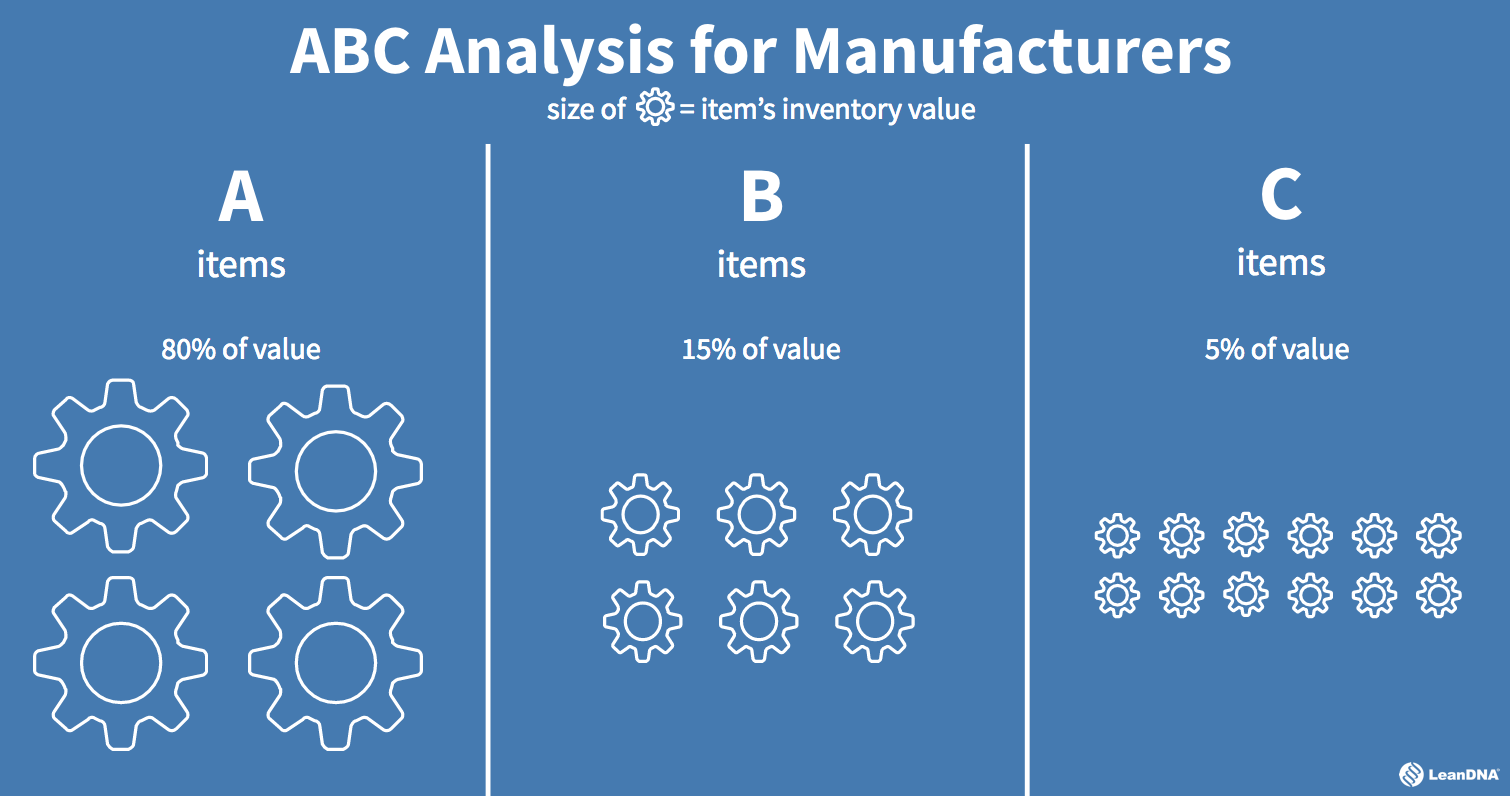
Every single item we order does not have equal value. Some parts cost more. Some are used more frequently. Some are both. ABC inventory analysis helps categorize those items so we can understand which ones should receive our full attention.

As the name suggests, this inventory categorization technique groups your inventory in three buckets: A, B, & C.

  • Aโ€™ items are the most important to an organization. This material should receive your full focus due to its high usage rate or a high price (or both).
  • โ€˜Bโ€™ items have a lower dollar volume and are thus less important than โ€˜Asโ€™.
  • Finally, โ€˜Cโ€™ items are the low rung on the ladder. Out of the three groups, youโ€™ll have the highest number of โ€˜Cโ€™ items, but they will account for the lowest portion for your inventory value.

The pareto principle states that 80% of your inventory costs comes from just 20% of your inventory. This is known as the 80/20 rule and it helps shape the results of your ABC Analysis. LeanDNA recommends the following breakdown as the optimal way to determine the three categories:

  • โ€˜Aโ€™ items โ€“ 80% of the annual inventory value of your items (likely made up of just 20% of your items)
  • โ€˜Bโ€™ items โ€“ 15% of the annual inventory value of your items (likely made up of 30% of your items)
  • โ€˜Cโ€™ items โ€“ 5% of the annual inventory value of your items (likely made up of 50% of your items)

ABC analysis has a lot of similarities to RRS analysis โ€“ โ€œRunner, Repeater, Stranger analysis,โ€ that is. Runners are your โ€˜Aโ€™ items, Repeaters are your โ€˜Bโ€™ items, and Strangers are your โ€˜Cโ€™ items.

In order to determine which parts fall into which categories, use the following steps:

  1. Determine inventory value by multiplying the price of an item by the consumption volume of that item in a year period. Simply put, item cost * annual consumption = inventory value.
  2. Repeat step 1 for all items to calculate total inventory value.
  3. Sort your parts from highest inventory value to lowest.
  4. Calculate each itemโ€™s percentage of total inventory value. That itemโ€™s inventory value / sum of all inventory values = item % of total inventory value.
  5. Group the parts that account for the highest 80% of your total inventory and allocate them as โ€˜Aโ€™ items. Group the parts that account for the next 15% and allocate them as โ€˜Bโ€™ items. Group all remaining items as โ€˜Cโ€™.

OBJECTIVES OF SALES MANAGEMENT

Let us delve deeper into the 4 main objectives of sales management

1) Achieving Sales volume

Achieving sales volume is the first objective of Sales. The word โ€œvolumeโ€ is critical because whenever a product sales start, the market is supposed to be a virgin market. Thus there needs to be optimum penetration so that the product reaches all corners of the region targeted. Ultimately, penetration levels can be decided on the basis of sales volume achieved.

2) Contribution to profit

Sales brings turnover for the company and this turnover results in profits. Naturally, sales has a major contribution to profit and it is categorized as a profit function in several organizations. But there is one more aspect to the contribution of profit by sales.

The objective of sales management is to sell the product at the optimum price. Some companies might target a premium pricing for a product to make it premium in the market. But if the sales team drops the price, then the objectives are not being met and the profit is dropping. This has to be kept in check by seniors as price drops directly affect the margin of the product.

3) Continuous growth

A company cannot remain stagnant. There are salaries to be paid, costs have been incurred and there are shareholders to be answered. So a company cannot survive without continuous growth. If there is no innovation at the product level or at the company level, then the company has to be blamed. But if the products are good, and still the penetration is not happening, then it is the fault of sales manager and sales executives.

It is the job of marketing to take feedback and bring new products in the market. But if the sales team does not provide the appropriate feedback of โ€œWhy the product is not sellingโ€, then growth becomes impossible. This is why, more penetration and more growth is in the hand of sales people.

4) Sales Management and financial results

Financial Results are another objective of sales management and are closely related and therefore sales management has financial implications as well.

Sales โ€“ Cost of Sales = Gross Profit

Gross Margin โ€“ Expenses = Net profit.

Thus the variation in Sales will directly affect the Net profit of a company. Hence maintaining and managing sales is important to keep the product / service / organization financially viable.

The Objectives of sales are therefore decided on the basis of where the organization stands and where it wants to reach. It is a collaborated effort from the top management along with the marketing managers and sales managers to provide with a targeted estimate.

SUSTAINABLE DEVELOPMENT GOALS(SDG) OF INDIA

India, home to one-sixth of all humanity, holds the key to the success of the 2030 Agenda. India in its second VNR has made a paradigm shift to a โ€œwhole-of-societyโ€ approach with Government of India engaging sub-national and local governments, civil society organizations, local communities, people in vulnerable situations and the private sector.

Indiaโ€™s commitment to the SDGs is reflected in its convergence with the national development agenda as reflected in the motto of Sabka Saath Sabka Vikaas (Collective Efforts for Inclusive Growth). Based on the evidence from the SDG India Index, which measures progress at the subnational level, the country has developed a robust SDG localization model centered on adoption, implementation and monitoring at the State and district levels.

The following narrative further encapsulates Indiaโ€™s progress across the SDGs.

Sashakt Bharat – Sabal Bharat (Empowered and Resilient India): India has successfully lifted more than 271 million people out of multidimensional poverty through economic growth and empowerment. Enhanced access to nutrition, child health, education, sanitation, drinking water, electricity and housing, has led to reduced inequalities especially among people in vulnerable situations.

Swachh Bharat – Swasth Bharat (Clean and Healthy India): Through a nationwide initiative triggered by the Clean India Campaign and the National Nutrition Mission, India achieved 100% rural sanitation and sharp reduction in stunting and child and maternal mortality rates. Universal health coverage has been institutionalized through Ayushmaan Bharat, the worldโ€™s largest health protection scheme which provides an annual cover of USD 7,000 to 100 million families, covering nearly 500 million individuals.

India is at the forefront in the call for joint global action to address the COVID-19 pandemic. The country has extended medical assistance to several countries and has operationalized the SAARC COVID-19 Emergency Fund with an initial contribution of USD 10 million. Domestically, Indiaโ€™s response to the COVID-19 pandemic includes an initial USD 22.5 billion economic stimulus package, comprehensive health coverage for front-line workers and direct cash transfers for the most vulnerable.

Samagra Bharat – Saksham Bharat (Inclusive and Entrepreneurial India): Social inclusion is pursued through universalizing access to nutrition, health, education, social protection, and developing capabilities for entrepreneurship and employment. Financial inclusion through Jan Dhan-Aadhaar-Mobile (JAM) trinity โ€“ near universal access to bank accounts aided by the Jan Dhan Yojana (National Financial Inclusion Scheme); Aadhaar card (National unique identity number) for over 90% of the population; and expansive access to mobile phones, has propelled new avenues of credit, insurance, and Direct Benefit Transfers (DBT) to the poor, including to over 200 million women, thereby accelerating their economic empowerment.

Satat Bharat โ€“ Sanatan Bharat (Sustainable India): Indiaโ€™s climate action strategies call for clean and efficient energy systems, disaster resilient infrastructure, and planned eco-restoration. Acting on its nationally-determined contributions, India has electrified 100% of its villages, reduced 38 million tonnes of CO2 emissions annually through energy efficient appliances, provided clean cooking fuel to 80 million poor households, and set a target to install 450GW of renewable energy and restore 26 million hectares of degraded land by 2030. Globally, India stands third in renewable power, fourth in wind power, and fifth in solar power. India launched the Coalition for Disaster Resilient Infrastructure and the International Solar Alliance to leverage global partnerships for climate action and disaster resilience.

Sampanna Bharat- Samriddh Bharat (Prosperous and Vibrant India): India is one of the fastest growing emerging market economies with a young population and burgeoning innovation and business ecosystem. With a GDP of USD 2.72 trillion in 2018-19, India strives to become a USD 5 trillion economy by 2025, and pursue an inclusive and sustainable growth trajectory by stimulating manufacturing, building infrastructure, spurring investments, fostering technological innovation, and boosting entrepreneurship.

In the spirit of South-South Cooperation, for realizing the 2030 Agenda, India supports developing countries through the USD 150 million India-UN Development Partnership Fund. In this spirit of regional and global partnerships, and the countryโ€™s commitment to โ€˜leave no one behindโ€™, India steps into the Decade of Action, drawing confidence from its experience in addressing challenges. Government of India will continue to work collaboratively with all domestic and global stakeholders to accelerate efforts for a sustainable planet for future generations.

CORPORATE SOCIAL RESPONSIBILITY(CSR) IN INDIA

Now Corporate Social Responsibility (CSR) is well accepted among shareholders as well as with various other stakeholders of society in India. The term CSR is new normal for Indian organisations. CSR tends to focus on what is done with profits after they are made. Larger corporations understand that CSR is an integral part of business framework for sustainable development. Companies also consider that CSR is an approach towards sustainable development and focus on the triple bottom line of Economic, Environmental and Social performance.

In India, the term Corporate Social Responsibility (CSR) is widely being used even though related concepts and terms, such as business responsibility, sustainable development, philanthropy, sustainability, corporate citizenship, responsible business, triple bottom line, shared value, value creation, business ethics, socio-economic responsibility, bottom of pyramid, stakeholder management, corporate responsibility, and corporate social performance.

The CSR activities of Indian companies are in line with the provisions of Section 135 with Schedule VII to the Companies Act, 2013. The CSR initiatives of companies thrust on creating value in the lives of the communities around its areas of business and manufacturing operations.

CSR has become an effective tool to work in the line of Sustainable Development Goals (SDGs) with a strong focus on social performance indicated in the CSR projects of the organizations. The SDGs, otherwise known as the Global Goals, are a universal call to action to end poverty, protect the planet and ensure that all people enjoy peace and prosperity.

Most of the businesses consider community as one of its apex stakeholders and believes in inclusive growth. This year most of the organisations continued its CSR initiatives in the realm of Education, Health, Livelihood, Rural Development and Social Entrepreneurship.

Organisationโ€™s diverse projects and operations touch lives of people in many ways and create value by helping in overall and holistic development of communities within multiple geographies. Through its various initiatives, Companies endeavour to play a relevant role by serving communities and projects that address gaps in basic societal requirements.

Conscious business decisions by the Companies have directly and indirectly created value for multiple stakeholders and helped in improving lives of the people and species. Businesses in India believed in creating societal value by providing affordable products and services which have assisted in the growth of relevant and allied industries. Across all its areas of operations of Business, there are inherent linkages and interconnections with the immediate and long term societal impact.

Most of the business have a practice of reporting the CSR performance not only in Annual Report but also in dedicated Annual CSR Report and Sustainable Development Report. These reports are externally verified and are in accordance with the Global Reporting Initiative (GRI) guidelines and Business Responsibility Report, mandated by the law and competent authorities.

CSR initiatives are conceptualized and implemented through Corporate Foundations, Non-Government Organisation (NGOs) and Agencies and not-for-profit organisations. Most of the organisations worked on 4P model (Public-Private-People-Partnership) for empowering communities and stakeholders. Businesses have positively impacted lives particularly of several hundreds of thousand underprivileged people through various CSR activities and approaches.

It has been observed that for Indian Companies, Corporate Social Responsibility (CSR) is the commitment of businesses to contribute to sustainable economic development by working with the employees, their families, the local community, experts and the society at large to improve lives in ways that are good for business and for its development.

In the broad manner, CSR segment of the organisation is guided by the Board of Governance, Business DNA, CSR and Sustainability Mission of the Companies. In compliance with the provisions of Section 135 of the Companies Act, 2013 with the Companies (Corporate Social Responsibility Policy) Rules, 2014, Companies have taken measures and steps to ensure improvement and betterment.

Most of the businesses seek to continue its contribution to the society through its distinct value proposition that meets the needs of millions of people, enhancing their lives through education, healthcare, improving quality of living by providing attitude, means and enabling livelihoods by creating employment opportunities through and for the Business, By the Business and Beyond the Business.

For the Business, value is being created for the society through business including employment generation, market growth and opportunity creation. By the Business- value is also being created through Corporate Social Responsibility (CSR) interventions across different operating facilities with appropriate linkages to local communities in which businesses operate and Beyond Business- value is being created through interventions for the societies in diverse geographies across India through creation of demand and services.

At public sector business organisations in India, CSR has been also looked upon as closely linked with the principle of sustainable economic development, which demand that organisations should make decisions and act based not only on financial factors but also on immediate and long term social and environmental consequences of their operations and activities.

Businesses in India have been sensitive towards the concerns of society and is committed to operating its core business in a socially responsible way by taking into consideration the wider interests of the community and the environment.

Seven pillars of CSR strategy

1. Need of partnership in CSR

2. Cross learning

3. Supplementing and nurturing CSR

4. Per beneficiary cost reduction and maximizing the impact while reaching more people

5. Knowledge management and documentation

6. Use and reuse of resources for better CSR

7. Capacity building of the CSR workforce and re-skilling

Need of partnership in CSR

Business organisations now recognise Corporate Social Responsibility (CSR) as a great opportunity to significantly strengthen their businesses โ€“ while building, strengthening and renewing human, social and natural resources and wealth. Finding the right kind of partners is absolutely important to the success of a CSR strategy. We are in connected world.

All issues are connected to the other issues, perspective and environment. Working alone is good but working together is great. Working alone yields lesser benefits as compared to the working together always. CSR world should explore togetherness by partnering with other entities. Togetherness in addressing the social and environmental issues is good for all. CSR world should encourage partnership to execute the mega social projects.

To fulfil the corporate social responsibility (CSR) goals businesses have to realise and act in partnership. Formation of partnerships has played a very significant role in progress and prosperity across the world. Partnership brings companies, businesses, people and society together and then pool their resources together in order to achieve the set goals. Partnerships is CSR is need of hour. Partnership opens doors for cross learning of knowledge and experiences.

Cross learning in CSR

Cross learning is key to CSR strategies. Learning improves performance and minimise risks. Effective partnership among likeminded organisations for CSR execution ensures cross learning in Corporate Social Responsibility. CSR leaders from different organisations must visit specific CSR locations of other organisation where CSR projects are being implemented and meanwhile they should meet the beneficiaries to gain new insights. CSR leaders must build a deep understanding of the socio-economic issues and they must be open enough to understand issues both from a business and a societal perspective. Learning from others in CSR can save time and resources. Concentrate on your CSR efforts but same time CSR leaders must learn from variety of successful CSR programmes. The greatest opportunities will come from areas where the business significantly interacts with society. Cross learning in CSR is immensely helpful in supplementing and nurturing CSR programme and projects.

Supplementing and nurturing CSR

Good CSR strategy and projects must be encouraged and supplemented. Opportunities for complementing and supplementing ongoing social projects and initiatives, programmes must be explored. Supplementing CSR emphasises on the sustainability of projects and programmes to ensure they remain relevant and viable even upon disengagement at the end of the project period. Every organisation explore possibilities for collaborating and co-operating with other corporations in order to synergise its efforts and increase both financial and social resources as well as outcomes and impact. Businesses may consider in supplementing even in smaller well defined CSR projects. Supplementing the CSR projects by the smaller or larger organisations matter in order to ensure optimal utilisation of the CSR budget and resources.

Per beneficiary cost reduction in CSR

Per beneficiary cost reduction and maximizing the impact while reaching more beneficiaries in CSR is key to success. Business organisations have a variety of motives for being attentive to CSR and run a CSR projects. Leaders can increase impact and reduce costs when they understand the role of Corporate Social Performance (CSP) in driving CSR Performance (CP). Business should think of reaching more people by using less money and resources. Reduction in per beneficiary cost can be achieved by the partnership, collaboration, cross learning and reuse of resources.

Knowledge management and documentation

CSR reporting practices strengthen organizations. The process of documenting and communicating CSR practices provides benefits to corporations, including the ability to formalize their position on CSR, identify organisational strengths and weaknesses, and manage stakeholder relationships and expectations. In India, any shortfall in spending in CSR shall be explained in the financial statements and the Board of Directors shall state the amount unspent and reasons for not spending that amount. As per the CSR Law, the CSR Committee of organisation shall institute a transparent monitoring mechanism for implementation of the CSR projects or programs or activities undertaken by the company.

Documentation, reporting and communication of the CSR performance in crucial to the CSR strategy.  Documentation of the CSR must be organised and structured and should be accessible. Companies can explore the new way of documentation, reporting and communications.

Use and reuse of resources for better CSR

Effective use and reuse of resources can improve the CSR performance. Awareness on use and reuse of resources among across the stakeholders can help in achieving the desired goals of CSR sustainability. Sustainable CSR can be achieved through community and beneficiaries engagement. CSR is a process oriented task.

Recycling and reuse often are the easiest places to start. CSR leaders should take the essential steps to recycle the commonly recyclable materials, and look for easy opportunities to replace disposable or recyclable items with reusable ones. CSR leaders also should look for partners to help with more challenging to recycle or exotic materials, as well as for opportunities to introduce reusable packaging. And of course, look upstream to design new idea, services and programmes.

Capacity building of the CSR workforce and re-skilling

In the fast changing world, capacity building of CSR workforce and re-skilling them are always relevant and are key to CSR performance. Human resource are fundamental requirement. CSR leaders must empower their subordinates by providing them right attitude, knowledge, information and trainings. Same time, CSR managers also be open to learn new things. Developing soft skill, professional skill, project management skill and leadership skill among CSR workforce is continuous process. Rigorous training, development and re-skilling of the CSR manners can save time, efforts and resources.

CORPORATE GOVERNANCE IN INDIA

Corporate Governance in India is a set on internal controls, policy and procedures which form the framework of a companyโ€™s operations and its dealings with various stakeholders such as customers, management, employees, government and industry bodies. The framework of such policies should be such as to uphold the principles of transparency, integrity, ethics and honesty. Corporate Governance is the soul of an organisation and must be adhered to while indulging in any business practices

It is indeed a proud moment for the Indian corporate sector. Around 12 Indian companies have featured in the Forbes list of the worldโ€™s 2,000 best regarded firms. Infosys. TCS, Tata Motors secured the 31st, 35th and 70th ranks, respectively.

Other Indian biggies like Tata Steel, L&T, Grasim, GIC, Mahindra & Mahindra, Asian Paints, SAIL and ITC are some of the other companies who have made it to this prestigious list. HDFC is the only company from the banking and financial sector to have attained a position in this list.

Forbes partnered with Statista, which surveyed 15,000 people from 60 countries regarding their opinion on top 2000 companies across the globe. Companies were evaluated on parameters such as trustworthiness, social conduct, performance of the companyโ€™s product or service and the company as an employer.

When bank scams, financial frauds, and cybercrimes become the order of the day, news like these reinstate our belief in the importance of sound Corporate Governance in India.

Why is Corporate Governance so important?

  • Risk Mitigation and compliance

There is a direct relationship between governance, risk mitigation and compliance. If a company is governed on the basis of sound principles, it will naturally work efficiently and ensure compliance with every statutory law and guideline. Being on track with the policies and law ensures that the company is braced well for any uncertainty and thus has risk mitigation mechanisms in place. More disciplined a company is in its operations, the better it is placed to face any risk or disruption arising out of political, technological and economic events.

  • Enhances shareholder value

While there is no established relation between corporate governance and market value of a company, it does enhance shareholder satisfaction. Corporate Governance in India plays a key role in protecting valuations of a company because the ultimate goal of good governance is to maximise the interest of all stakeholders. The value accumulated by the company over the years can be wiped away by a single unlawful incident, thus internal controls at the right place is mandatory.

  • Better image during economic downturns

During the last few months, we have heard many stories of banking frauds and financial malpractices. It is but natural for people to believe that all banks and financial institutions are involved in all these, which is not true. It is only when an organisation can ensure people about their inherent governance practises that people will believe them. Trustworthiness that has been established over ages plays a strong role in upholding the companyโ€™s image even during tough situations.

  • Improved organisational efficiency

Corporate Governance is an important determinant of industrial competitiveness. Nowadays there are many questions raised on the way a company is governed. Better governance ensures enhanced corporate performance and better economic results. Corporate Governance lays the foundation for behaviour of the company, the utilization of resources, product/service innovation and overall corporate strategies.

  • Crucial during mergers & acquisitions

Corporate Governance in India plays a critical role during restructuring events such as mergers and acquisitions. Not only does corporate governance of a company helps to differentiate between good deals from bad ones, but M&A activity by a company with good corporate governance is better received by stakeholders in the market. Another aspect to be mentioned is that mergers and acquisitions also has the power to improve the quality of corporate governance of the organisation.

Corporate Governance in India: The unseen force behind an organisation

A company is not all about just profits, market valuations, P/E multiples and turnovers, there is a lot that goes into building its position and image. Corporate Governance is one such hidden force. After numerous scandals, maligned reputations and economic downturns, companies are now realising that few concrete steps towards better governance could have saved years of their labour.

Most companies chase only monetary gains and take corporate governance for granted. Due to lack of trust on governance, investor sentiments go awry resulting in mass outflow of FII funds, sale by majority shareholders, reduced market value and so on.

Designing the framework of corporate governance in India is no mean task in itself. The requirement and fundamentals vary across sectors, industries as well as nationalities. Profound corporate governance is a must for banks and healthcare in particular.

Other sectors, such as FMCG, IT and Retail need to prioritize good governance, but this may not help them in enhancing their market value. The influence of governance on value also varies. It gains more importance during tough times rather than smooth sailing periods.

Nevertheless, corporate governance in India will continue to be crucial no matter what. The approach must be a perfect balance between excessive stringency and too much flexibility. Only the framework must be holistic and take the interests of all the stakeholders into account.

PERFORMANCE MANAGEMENT SYSTEM(PMS)

What Is Performance Management?

Performance management is the process of continuous feedback and communication between managers and their employees to ensure the achievement of the strategic objectives of the organization.

The definition of performance management has evolved since it first appeared as a concept. What was once an annual process is now transitioning to continuous performance management. The goal is to ensure that employees are performing efficiently throughout the year, and in the process, address any issues that may arise along the way that affect employee performance.

“Most workers perceive their organization’s performance management approach as confusing, subjective, and infrequent,” said Kathi Enderes (vice president, Talent, and Workforce Research Leader) and Matthew Shannon (senior research analyst) at Bersin, Deloitte Consulting LLP, in an exclusive with HR Technologist.

This is the current state of performance management. However, it doesn’t have to be that way. Automation now plays a significant role in performance management, and many of the processes involved can be streamlined so that employee performance can be strategically managed. This is the age of continuous performance management, and hereโ€™s everything you need to know about it.

Performance management differs from talent management in that the latter is a set of initiatives taken to engage employees to retain them. Performance management, on the other hand, is an initiative that guides employees towards establishing and achieving their goals in alignment with the organization’s immediate and overarching goals.

Why is performance management important?

1. Performance management supplements the annual performance review. This prepares both employees and managers about what to expect during the annual appraisal. It keeps both the manager and the employee in the loop about ongoing changes to the performance management process, what both can do to streamline it, and how performance overall can be improved.

2. To employees, continuous performance management indicates that managers value them. Employees believe that their managers are interested in their work and care about their goals and any issues they may face in the course of their job. They also become more open to receiving constructive feedback.

The Performance Management Cycle

The performance management process or cycle is a series of five key steps. These steps are imperative, regardless of how often you review employee performance.

1. Planning

This stage entails setting employees’ goals and communicating these goals with them. While these goals should be disclosed in the job description to attract quality candidates, they should be communicated once again when the candidate becomes a new hire. Depending on the performance management process in your organization, you may want to assign a percentage to each of these goals to be able to evaluate their achievement.

2. Monitoring

In this phase, managers are required to monitor the employeesโ€™ performance on the goal. This is where continuous performance management comes into the picture. With the right performance management software, you can track your teamโ€™s performance in real-time and modify and correct course whenever required.

3. Developing

This phase includes using the data obtained during the monitoring phase to improve the performance of employees. It may require suggesting refresher courses, providing an assignment that helps them improve their knowledge and performance on the job, or altering the course of employee development to enhance performance or sustain excellence.

4. Rating

Each employeeโ€™s performance must be rated periodically and then at the time of the performance appraisal. Ratings are essential to identify the state of employee performance and implement changes accordingly. Both peers and managers can provide these ratings for 360-degree feedback.

5. Rewarding

Recognizing and rewarding good performance is essential to the performance management process, as well as an important part of employee engagement. You can do this with a simple thank you, social recognition, or a full-scale employee rewards program that regularly recognizes and rewards excellent performance in the organization.

FUNCTIONS OF CENTRAL BANK

Function 1 # Bank of Issue:

Central bank now-a-days has the monopoly of note-issue in every country. The currency notes printed and issued by the central bank are declared unlimited legal tender throughout the country.

Central bank has been given exclusive monopoly of note-issue in the interest of uniformity, better control, elasticity, supervision, and simplicity. It will also avoid the possibility of over-issue by individual banks.

The central banks, thus, regulate the currency of country and the total money-supply in the economy. The central bank has to keep gold, silver or other securities against the notes issued. The system of note-issue differs from country to country.

The main objects of the system of currency regulation in general are to see that:

(i) Peopleโ€™s confidence in the currency is maintained,

(ii) Its supply is adjusted to demand in the economy.

Thus, keeping in view the aims of uniformity, elasticity, safety and security, the system of note-issue has been varying from time to time.

Function 2 # Banker, Agent and Adviser to the Government:

Central bank, everywhere, performs the functions of banker, agent and adviser to the government.

As banker to the government, it makes and receives payments on behalf of the government. It advances short-term loans to the government to tide over difficulties.

It floats public loans and manages the public debts on behalf of the government. It keeps the banking accounts and balances of the government after making disbursements and remittances. As an adviser to the government it advises the government on all monetary and economic matters. The central bank also acts as an agent to the government where general exchange control is in force.

Function 3 # Custodian of Cash Reserves:

All commercial banks in a country keep a part of their cash balances as deposits with the central bank, may be on account of convention or legal compulsion. They draw during busy seasons and pay back during slack seasons. Part of these balances is used for clearing purposes. Other member banks look to it for guidance, help and direction in time of need.

It affects centralisation of cash reserves of the member banks. โ€œThe centralisation of cash reserves in the central bank is a source of great strength to the banking system of any country. Centralised cash reserves can at least serve as the basis of a large and more elastic credit structure than if the same amount were scattered amongst the individual banks.

It is obvious, when bank reserves are pooled in one institution which is, moreover, charged with the responsibility of safeguarding the national economic interest, such reserves can be employed to the fullest extent possible and in the most effective manner during periods of seasonal strain and in financial crises or general emergenciesโ€ฆthe centralisation of cash reserves is conducive to economy in their use and to increased elasticity and liquidity of the banking system and of the credit structure as a whole.โ€

Function 4 # Custodian of Foreign Balances:

Under the gold standard or when the country is on the gold standard, the management of that standard, with a view to securing stability of exchange rate, is left to the central bank.

After World War I, central banks have been keeping gold and foreign currencies as reserve note-issue and also to meet adverse balance of payment, if any, with other countries. It is the function of the central bank to maintain the exchange rate fixed by the government and manage exchange control and other restrictions imposed by the state. Thus, it becomes a custodian of nationโ€™s reserves of international currency or foreign balances.

Function 5 # Lender of Last Resort:

Central bank is the lender of last resort, for it can give cash to the member banks to strengthen their cash reserves position by rediscounting first class bills in case there is a crisis or panic which develops into โ€˜runโ€™ on banks or when there is a seasonal strain. Member banks can also take advances on approved short-term securities from the central bank to add to their cash resources at the shortest time.

This facility of turning their assets into cash at short notice is of great use to them and promotes in the banking and credit system economy, elasticity and liquidity.

Thus, the central bank by acting as the lender of the last resort assumes the responsibility of meeting all reasonable demands for accommodation by commercial banks in times of difficulties and strains.

De Kock expresses the opinion that the lending of last resort function of the central bank imparts greater liquidity and elasticity to the entire credit structure of the country. According to Hawtrey, the essential duty of the central bank as the lender of last resort is to make good a shortage of cash among the competitive banks.

Function 6 # Clearing House:

Central bank also acts as a clearing house for the settlement of accounts of commercial banks. A clearing house is an organisation where mutual claims of banks on one another are offset, and a settlement is made by the payment of the difference. Central bank being a bankersโ€™ bank keeps the cash balances of commercial banks and as such it becomes easier for the member banks to adjust or settle their claims against one another through the central bank.

Suppose there are two banks, they draw cheques on each other. Suppose bank A has due to it Rs. 3,000 from bank B and has to pay Rs. 4,000 to B. At the clearing house, mutual claims are offset and bank A pays the balance of Rs. 1,000 to B and the account is settled. Clearing house function of the central bank leads to a good deal of economy in the use of cash and much of labour and inconvenience are avoided.

Function 7 # Controller of Credit:

The control or adjustment of credit of commercial banks by the central bank is accepted as its most important function. Commercial banks create lot of credit which sometimes results in inflation.

The expansion or contraction of currency and credit may be said to be the most important causes of business fluctuations. The need for credit control is obvious. It mainly arises from the fact that money and credit play an important role in determining the level of incomes, output and employment.

According to Dr. De Kock, โ€œthe control and adjustment of credit is accepted by most economists and bankers as the main function of a central bank. It is the function which embraces the most important questions of central banking policy and the one through which practically all other functions are united and made to serve a common purpose.โ€

Thus, the control which the central bank exercises over commercial banks as regards their deposits, is called controller of credit.

Function 8 # Protection of Depositors Interests:

The central bank has to supervise the functioning of commercial banks so as to protect the interest of the depositors and ensure development of banking on sound lines.

The business of banking has, therefore, been recognized as a public service necessitating legislative safeguards to prevent bank failures.

Legislation is enacted to enable the central bank to inspect commercial banks in order to maintain a sound banking system, comprising strong individual units with adequate financial resources operating under proper management in conformity with the banking laws and regulations and public and national interests.

THE IMPORTANCE OF TRAINING

The importance of training can be discussed under the following heads:

(i) Advantages of standardization:

The methods of production are standardised through training. All trained employees follow same methods and techniques of production and hence there can be little variation in output and standards produced by different employees. By using standardised methods, the quality of output would be increased.

(ii) Increasing organisational stability and flexibility:

Training provides opportunities for the employees to learn an acquire skills to work in several departments in an organisation. Training also results in low rate of labour turnover which means high consistency in organisations in retaining people for long period of time.

Low labour turnover means high organisational stability. Flexibility is ensured because employees may be placed in several departments over a period of time as they acquire multiplicity of skills through adequate training

(iii) Heightened morale:

Training results in increased morale of employees because of reduction in dissatisfaction at work, reduced complaints, and reduced absenteeism, and increased interest in work during the post-training period. Heightened morale results in increased loyalty to the organisation.

(iv) Reduced supervision and direction:

A trained employee knows what job he has to do and how to do that job and requires no guidance and supervision. Supervisors can devote their time to solve more important problems rather than concentrating on constant and regular supervision.

(v) Economical use of resources:

A well-trained employee makes better and economical use of available resources (materials, machines, and equipment). Optimum utilisation of resources results in reduced cost on production and higher profits.

(vi) Increase in productivity:

Training brings about increase in quantity and quality of goods produced resulting in high productivity.

(vii) Future manpower needs:

Through proper training employees become eligible for promotion handling more responsibility. An expanding and growing organisation wishes to train the existing employees so as to place them in higher positions in future.

(viii) Better industrial relations:

Training provides a platform for maintaining smooth industrial relations. Employees develop a feeling that organisation is taking care and interest in them through training programmes.

(ix) Reduced accidents at workplace:

Untrained people are bound to commit errors while handling machinery and equipment resulting in incidents at workplace. Training eliminates (reduces) the possibility of incident due to mishandling of equipment, machinery, and other resources of the organisation.

Proper training and development programmes ensure safety in handling the organisationโ€™s resources which results in reduction in the accident rates.

(x) Reduced learning time:

An untrained worker consumes a lot of time to learn the methods, technique of doing the work. Skilled and trained employees reach the acceptable level of performance within no time. Therefore, training results in reduced learning time.

THE IMPORTANCE OF CAREER COUNSELLING

Career counselling plays a vital role in the studentโ€™s life. There are several roles played by career counselling in the making of a student to a professional as discussed below.

  • Development of Student: By teaching the subjects to students cannot develop them intellectually. Self-knowledge is the factor which enhances the intellectual of learners. It is the forgotten factor in our educational system. So, itโ€™s the primary focus of the counselling process. Counselling helps the students to understand their self so that they come to know about their needs and interests.
  • Determine the Potential: There are various students who have clear thoughts about what they want to become, whereas, on the other hand, there are various others who are either in dilemma or have no idea about their career preferences. Career counsellors conduct the regular aptitude tests and counselling sessions which can help students in finding out the right career options and the fields in which they show interest. On the basis of these counselling results, students can make the right selection regarding in which course they want to enrol in order to accomplish their career goals.
  • Clear the Doubts: Despite having a clear thought of what students want to achieve in their life, some students do not know the career path they need to follow to have the requisite academic qualification to join a particular course. Career counselling can help students clear these doubts by giving them a clear cut view of what they can expect from various educational courses. Some students might also have several doubts about certain fields. Career counselling also helps students to overcome these doubts by knowing the true facts.
  • Support and Motivation: A career counsellor also provides essential support and boosts the morale of a student by understanding the kind of requirements and nature of the candidate because building the motivational level of a student is necessary for long-term success. This aids in improving the overall performance of a student. In addition, career counselling also teaches how to expand your social network which further enhances emotional support.
  • Various Career Opportunities: Career Counselors are well aware of the jobs in the market and the skills that are required for specific fields. For instance, there are many rewarding fields such as bartending, ethical hacking, astrophysics, etc. that are still un-tapped and many people are not aware of these streams. There are also other careers such as Aviation and Defense, about which you may not know how to get into them. Hence, with the help of their experience and knowledge, a career counsellor helps you explore and discover various career opportunities for career selection and growth.
  • In Case of Loss of Job: A career expert or other advisor can help recently unemployed customers to adapt to practical issues like applying for unemployment benefits and taking care of health insurance etc. In fact, he or she can enable the customer to start with the job searching process. They can likewise get motivation and guidance from experts and, through support groups, from other people who are in a similar circumstance. They prove to be useful from both a mental and technical perspective.
  • Clarity on Future Goals: Every student has set a goal to achieve in his life. There are various question roaming in the mind of students like what ambitions or targets do you have? Where do you see yourself five years from now? The best aspect of career counselling is that it is objective and strategic. A clear picture of your goal can be created informing you about where you will head and what obstacles you will face on this journey. After having a serious discussion with the counsellor, you should be confident of the fact that the future you are heading for is fun-filled and something that you will be able to stick on to for long.
  • Ideal Courses: These professionals provide you with the best information about the ideal colleges and courses in India as well as overseas. If you want to stay in India and study over here then you might have some knowledge about the future aspects of the courses which you want to do. But if you want to go overseas for studies and for career growth, you might not have all the information related to that countryโ€™s market. You do not know whether the future for that field is growing or diminishing. In this case, career advice from experts is the best way to understand the prospects of an option in different countries.
  • Aim Leads to Success: A counsellor can help the students to choose the right aim and help them with the process of achieving it. Furthermore, an experienced counsellor can help them with a well-planned track to reach the goal. A step by step career map of reaching the goal in a realistic manner helps the students to achieve their desired career faster. With right goal setting, a person can attend career success over a very short time period.

ANSOFF MATRIX

Ansoff’s Matrix is a marketing planning model that helps a business determine its product and market growth strategy.

Ansoffโ€™s product/market growth matrix suggests that a businessโ€™ attempts to grow depend on whether it markets new or existing products in new or existing markets. The output from the Ansoff product/market matrix is a series of suggested growth strategies which set the direction for the business strategy. These are described below:

Market penetration

Market penetration is the name given to a growth strategy where the business focuses on selling existing products into existing markets.

Market penetration seeks to achieve four main objectives:

  • Maintain or increase the market share of current products โ€“ this can be achieved by a combination of competitive pricing strategies, advertising, sales promotion and perhaps more resources dedicated to personal selling
  • Secure dominance of growth markets
  • Restructure a mature market by driving out competitors; this would require a much more aggressive promotional campaign, supported by a pricing strategy designed to make the market unattractive for competitors
  • Increase usage by existing customers โ€“ for example by introducing loyalty schemes

A market penetration marketing strategy is very much about โ€œbusiness as usualโ€. The business is focusing on markets and products it knows well. It is likely to have good information on competitors and on customer needs. It is unlikely, therefore, that this strategy will require much investment in new market research.

Market development

Market development is the name given to a growth strategy where the business seeks to sell its existing products into new markets.

There are many possible ways of approaching this strategy, including:

  • New geographical markets; for example exporting the product to a new country
  • New product dimensions or packaging: for example
  • New distribution channels (e.g. moving from selling via retail to selling using e-commerce and mail order)
  • Different pricing policies to attract different customers or create new market segments

Market development is a more risky strategy than market penetration because of the targeting of new markets.

Product development

Product development is the name given to a growth strategy where a business aims to introduce new products into existing markets. This strategy may require the development of new competencies and requires the business to develop modified products which can appeal to existing markets.

A strategy of product development is particularly suitable for a business where the product needs to be differentiated in order to remain competitive. A successful product development strategy places the marketing emphasis on:

  • Research & development and innovation
  • Detailed insights into customer needs (and how they change)
  • Being first to market

Diversification

Diversification is the name given to the growth strategy where a business markets new products in new markets.

This is an inherently more risk strategy because the business is moving into markets in which it has little or no experience.

For a business to adopt a diversification strategy, therefore, it must have a clear idea about what it expects to gain from the strategy and an honest assessment of the risks. However, for the right balance between risk and reward, a marketing strategy of diversification can be highly rewarding.

IMPORTANCE OF OPERATIONS RESEARCH IN DECISION MAKING

Operations research is a quantitative approach that solves problems, using a number of mathematical techniques. It is helpful to use operations research when you’re trying to make decisions but the conditions are uncertain, and when differing objectives are in conflict with each other.

Advantages of Operations Research

These mathematical techniques used in operations research help managers do their jobs more effectively:

Maintaining Better Control

Managers use techniques of operations research to maintain better control over their subordinates. This is possible because operations research provides a basis in which to establish standards of performance and ways to measure productivity. Reporting deviations from standards enables managers to identify problem areas and to take corrective action.

Better Decision Making

The mathematical models of operations research allow people to analyze a greater number of alternatives and constraints than would usually be possible, if they were to use only an intuitive approach. Using operations research, it is easier to analyze multiple alternatives, which results in greater confidence in the optimal choice.

Better Coordination of Departments

Operations research analysis blends together the objectives of different departments. For example, operations research coordinates the aims of the marketing department with the schedules of the production department.

Increased Business Productivity

The mathematical formulas used in operations research can increase productivity, as they offer a greater number of optimal choices of inventory mix, plant machine utilization, factory size, manpower planning and implementing new technologies.

Operations Research Model

Operations research has evolved into a standard framework that’s used for identifying and solving problems. The steps are as follows:

  • Orientation
  • Defining the problem
  • Collecting data
  • Formulating constraints and objectives
  • Solution
  • Validating the model and output analysis
  • Implementation and monitoring

Example of Operations Research Analysis

A good example of how to use operations research analysis is to consider the plight of farmer Jones. He must decide how many acres of corn and wheat to plant this year. One acre of corn will yield 10 bushels, and will require four hours of labor per week, and it will sell at $3 per bushel. Wheat will sell at $4 a bushel, will need 10 hours of labor a week and will yield 25 bushels per acre.

Farmer Jones has seven acres of land and can only work 40 hours per week. The government states that he must produce at least 30 bushels of corn in the coming year.

How many acres of corn and wheat does Farmer Jones plant to maximize his revenue? The linear programming technique of operations research gives the optimal answer โ€“ he should plant three acres of corn and 2.8 acres of wheat.

Operations Research Limitation: Problem must be Quantifiable

Operations research only functions when all factors in a problem can be quantified. Other relevant inputs to a problem might not be expressible in numbers.

Difficulties in Implementation

Implementing optimal solutions that result from operations research does not take human reactions and behavior into consideration.

Management is constantly under pressure to make economical decisions that result in more efficient operations and greater profits. The techniques of operations research help managers allocate resources more effectively and enables them to better optimize the performance of their businesses.

MASLOW’S HIERARCHY OF NEED THEORY

What Is Maslowโ€™s Hierarchy of Needs?

In order to better understand what motivates human beings, Maslow proposed that human needs can be organized into a hierarchy. This hierarchy ranges from more concrete needs such as food and water to abstract concepts such as self-fulfillment. According to Maslow, when a lower need is met, the next need on the hierarchy becomes our focus of attention.

These are the five categories of needs according to Maslow:

Physiological

These refer to basic physical needs like drinking when thirsty or eating when hungry. According to Maslow, some of these needs involve our efforts to meet the bodyโ€™s need for homeostasis; that is, maintaining consistent levels in different bodily systems (for example, maintaining a body temperature of 98.6ยฐ).1

Maslow considered physiological needs to be the most essential of our needs. If someone is lacking in more than one need, theyโ€™re likely to try to meet these physiological needs first. For example, if someone is extremely hungry, itโ€™s hard to focus on anything else besides food. Another example of a physiological need would be the need for adequate sleep.

Safety

Once peopleโ€™s physiological requirements are met, the next need that arises is a safe environment. Our safety needs are apparent even early in childhood, as children have a need for safe and predictable environments and typically react with fear or anxiety when these are not met. Maslow pointed out that in adults living in developed nations, safety needs are more apparent in emergency situations (e.g. war and disasters), but this need can also explain why we tend toย prefer the familiarย or why we do things like purchase insurance and contribute to a savings account.

Love and Belonging

According to Maslow, the next need in the hierarchy involves feeling loved and accepted. This need includes both romantic relationships as well as ties to friends and family members. It also includes our need to feel that we belong to a social group. Importantly, this need encompasses both feeling loved and feeling love towards others.

Since Maslowโ€™s time, researchers have continued to explore how love and belonging needs impact well-being. For example, having social connections is related to better physical health and, conversely, feeling isolated (i.e. having unmet belonging needs) has negative consequences for health and well-being.2๏ปฟ

Esteem

Our esteem needs involve the desire to feel good about ourselves. According to Maslow, esteem needs include two components. The first involves feeling self-confidence and feeling good about oneself. The second component involves feeling valued by others; that is, feeling that our achievements and contributions have been recognized by other people. When peopleโ€™s esteem needs are met, they feel confident and see their contributions and achievements as valuable and important. However, when their esteem needs are not met, they may experience what psychologist Alfred Adler called โ€œfeelings of inferiority.โ€

Self-Actualization

Self-actualization refers to feeling fulfilled, or feeling that we are living up to our potential. One unique feature of self-actualization is that it looks different for everyone. For one person, self-actualization might involve helping others; for another person, it might involve achievements in an artistic or creative field. Essentially, self-actualization means feeling that we are doing what we believe we are meant to do. According to Maslow, achieving self-actualization is relatively rare, and his examples of famous self-actualized individuals include Abraham Lincoln, Albert Einstein, and Mother Teresa.

How People Progress Through the Hierarchy of Needs

Maslow postulated that there were several prerequisites to meeting these needs. For example, having freedom of speech and freedom of expression or living in a just and fair society arenโ€™t specifically mentioned within the hierarchy of needs, but Maslow believed that having these things makes it easier for people to achieve their needs.

In addition to these needs, Maslow also believed that we have a need to learn new information and to better understand the world around us. This is partially because learning more about our environment helps us meet our other needs; for example, learning more about the world can help us feel safer, and developing a better understanding of a topic one is passionate about can contribute to self-actualization. However, Maslow also believed that this call to understand the world around us is an innate need as well.

Although Maslow presented his needs in a hierarchy, he also acknowledged that meeting each need is not an all-or-nothing phenomenon. Consequently, people donโ€™t need to completely satisfy one need in order for the next need in the hierarchy to emerge. Maslow suggests that, at any given time, most people tend to have each of their needs partly metโ€”and that needs lower on the hierarchy are typically the ones that people have made the most progress towards.

Additionally, Maslow pointed out that one behavior might meet two or more needs. For example, sharing a meal with someone meets the physiological need for food, but it might also meet the need of belonging. Similarly, working as a paid caregiver would provide someone with income (which allows them to pay for food and shelter), but can also provide them a sense of social connection and fulfillment.

Testing Maslowโ€™s Theory

In the time since Maslow published his original paper, his idea that we go through five specific stages hasnโ€™t always been supported by research. In a 2011 study of human needs across cultures, researchers Louis Tay and Ed Diener looked at data from over 60,000 participants in over 120 different countries. They assessed six needs similar to Maslowโ€™s: basic needs (similar to physiological needs), safety, love, pride and respect (similar to esteem needs), mastery, and autonomy. They found that meeting these needs was indeed linked to well-being. In particular, having basic needs met was linked to peopleโ€™s overall assessment of their lives, and feeling positive emotions was linked to meeting the needs of feeling loved and respected.3

However, although Tay and Diener found support for some of Maslowโ€™s basic needs, the order that people go through these steps seems to be more of a rough guide than a strict rule. For example, people living in poverty might have had trouble meeting their needs for food and safety, but these individuals still sometimes reported feeling loved and supported by the people around them. Meeting the previous needs in the hierarchy wasnโ€™t always a prerequisite for people to meet their love and belonging needs.

Maslowโ€™s Impact on Other Researchers

Maslowโ€™s theory has had a strong influence on other researchers, who have sought to build on his theory. For example, psychologists Carol Ryff and Burton Singer drew on Maslowโ€™s theories when developing their theory of eudaimonic well-being. According to Ryff and Singer, eudaimonic well-being refers to feeling purpose and meaningโ€”which is similar to Maslowโ€™s idea of self-actualization.4๏ปฟ

Psychologists Roy Baumeister and Mark Leary built on Maslowโ€™s idea of love and belonging needs. According to Baumeister and Leary, feeling that one belongs is a fundamental need, and they suggest that feeling isolated or left out can have negative consequences for mental and physical health.5๏ปฟ

THE IMPACT OF SOCIAL MEDIA ON BUSINESS

Here are six reasons why investing in social media is a wise business move.

1. Build Awareness

If people donโ€™t know about your business, they canโ€™t become your customers. Social media boosts your visibility among potential customers, letting you reach a wide audience by using a large amount of time and effort. And itโ€™s free to create a business profile on all the major social networks, so you have nothing to lose.

Define what you want to get out of social media to develop a social media strategy. Do you want new customers to discover your services? Do you hope to bring more local shoppers into your stores? By keeping your strategy specific, you can determine which social media channels are the best fit for your business.

2. Communicate Authority

Customers are increasingly savvier and more discerning about which businesses they support. Before making a decision, theyโ€™ll do a quick search to browse your website and social media.

Will they find an empty storefront or a rich source of information? Setting up robust profiles that you update frequently with relevant content will build your brandโ€™s authority and make sure you make a positive first impression through social media, showing that your business is trustworthy, knowledgeable, and approachable.

Look for ways to demonstrate your expertise as a thought leader in your industryโ€”like writing pieces related to your expertise or expanding on your companyโ€™s mission. By showing what your business offers and values, you will establish confidence in potential customers.

3. Show Authenticity

Customers arenโ€™t interested in businesses that publish dry, corporate-style social media posts.

Instead, let your brandโ€™s personality shine through in everything you share on social media. What does your brand voice sound like? How does it represent who you are?

Practice getting your tone just right, whether itโ€™s casual and funny or formal and friendly. Be true to who you are, not who you think you should be. Followers want to see real people behind your social profiles. Show them.

4. Encourage Engagement

Social channels evolve, constantly releasing new features, and this rapidly changing environment can be intimidating for some business owners.

But remember: you donโ€™t have to do everything. Play with new ways to connect with your audience, and give yourself permission to learn as you go. One day, you could post a series of Instagram Stories to give customers a behind-the-scenes tour of your office. The next, you could host a quick Q&A session via Facebook Live video streaming. Over time, youโ€™ll get a better idea of your followersโ€™ preferences.

You can create engaging video content for social media with a simple setupโ€”good lighting, a smartphone, and a tripod. Also, do a test run before you go live to make sure your internet connection or hotspot has enough speed to avoid delays and interruptions.

5. Provide Support

Social platforms have successfully broken down barriers between companies and their customers. Now, instead of calling a customer service line, many people turn to Facebook or Twitter to solve problems or find information.

Develop your reputation as a responsive, caring brand by offering support through social channels:

  • Create a system for tracking customer comments, questions, and complaints on social media.
  • Respond as quickly as possible to questions and concerns.
  • Go out of your way to be positive and helpful.
  • Listen to criticism and make customers feel heard.
  • Know when to resolve public conversations in private messages.

6. Grow Affordably

Marketing costs add up, and not every business can afford huge campaigns. But you can get a lot of value for your dollar with social media advertising. Your business, regardless of size or budget, has an opportunity to grow your audience and reach your objectives through ads on social platforms like Facebook and Instagram.

When building an ad campaign, know who youโ€™re trying to reach and what goal you want to achieve so you donโ€™t waste any of your budget on unhelpful advertising. Avoid overly salesy ads, and opt for content that educates or entertains (or does both at the same time).

LEADERSHIP STYLES

1. Coach

A coaching leader is someone who can quickly recognise their team membersโ€™ strengths, weaknesses and motivations to help each individual improve. This type of leader often assists team members in setting smart goals and then provides regular feedback with challenging projects to promote growth. Theyโ€™re skilled in setting clear expectations and creating a positive, motivating environment.

The coach leadership style is one of the most advantageous for employers as well as for the employees they manage. Unfortunately, itโ€™s often also one of the most underutilised stylesโ€”largely because it can be more time-intensive than other types of leadership.

Example: A sales manager gathers his team of account executives for a meeting to discuss learnings from the previous quarter. They start the meeting by completing an assessment together of strengths, weaknesses, opportunities and threats regarding the teamโ€™s performance. The manager then recognises specific team members for exceptional performance and goes over the goals achieved by the team. Finally, the manager closes the meeting by announcing a contest to start the next quarter in order to motivate the sales people to reach their goals.

2. Visionary

Visionary leaders have a powerful ability to drive progress and usher in periods of change by inspiring employees and earning trust for new ideas. A visionary leader is also able to establish a strong organisational bond. They strive to foster confidence among direct reports and colleagues alike.

This type of leadership is especially helpful for small, fast-growing organisations or larger organisations experiencing transformations or corporate restructuring.

Example: A teacher starts a group at work for colleagues who want to help resolve anxieties and issues students have outside of school. The goal is to help students better focus on and succeed at school. He has developed testing methods so they can find meaningful ways to help students in a quick and efficient way.

3. Servant

Servant leaders live by a people-first mindset and believe that when team members feel personally and professionally fulfilled, theyโ€™re more effective and more likely to produce great work regularly. Because of their emphasis on employee satisfaction and collaboration, they tend to achieve higher levels of respect.

A servant leader is an excellent leadership style for organisations of any industry and size but is especially prevalent within nonprofits. These types of leaders are exceptionally skilled in building employee morale and helping people re-engage with their work.

Example: A product manager hosts monthly one-on-one coffee meetings with everyone who has concerns, questions or thoughts about improving or using the product. This time is meant for her to address the needs of and help those who are using the product in any capacity.

4. Autocratic

Also called the authoritarian style of leadership, this type of leader is focused almost entirely on results and efficiency. They often make decisions alone or with a small, trusted group and expect employees to do exactly what theyโ€™re asked. It can be helpful to think of these types of leaders as military commanders.

This leadership style can be useful in organisations with strict guidelines or compliance-heavy industries. It can also be beneficial when used with employees who need a great deal of supervision such as those with little to no experience. However, this leadership style can stifle creativity and make employees feel confined.

Example: Before an operation, the surgeon carefully recounts the rules and processes of the operation room with every team member who will be helping during the surgery. She wants to ensure everyone is clear on the expectations and follows each procedure carefully and exactly so the surgery goes as smoothly as possible.

5. Laissez-faire or hands-off

This leadership style is the opposite of the autocratic leadership type focusing mostly on delegating many tasks to team members and providing little to no supervision. Because laissez-faire leaders do not spend their time intensely managing employees, they often have more time to dedicate to other projects.

Managers may adopt this leadership style when all team members are highly experienced, well trained and require little oversight. However, it can also cause a dip in productivity if employees are confused about their leaderโ€™s expectations or if some team members need consistent motivation and boundaries to work well.

Example: When welcoming new employees, Keisha explains that her engineers can set and maintain their own work schedules as long as they are tracking towards and hitting goals that they set together as a team. They are also free to learn about and participate in projects that they might be interested in outside their team.

6. Democratic

The democratic leadership style (also called the participative style) is a combination of the autocratic and laissez-faire types of leadership. Democratic leaders ask for input and consider feedback from their team before making a decision. Because team members feel that their voice is heard and their contributions matter, a democratic leadership style is often credited with fostering higher levels of employee engagement and workplace satisfaction.

Because this type of leadership drives discussion and participation, itโ€™s an excellent style for organisations focused on creativity and innovation such as those in the technology industry.

Example: As a store manager, Jack has hired many brilliant and focused team members who he trusts. When deciding on storefronts and floor design, Jack acts only as the final moderator for his team to move forward with their ideas. He is there to answer questions and present possible improvements for his team to consider.

7. Pacesetter

The pacesetting leadership style is one of the most effective for driving fast results. These leaders are primarily focused on performance. They often set high standards and hold their team members accountable for hitting their goals.

While the pacesetting leadership style is motivational and helpful in fast-paced environments where team members need to be energised, itโ€™s not always the best option for team members who need mentorship and feedback.

Example: The leader of a weekly meeting recognised that an hour out of everyoneโ€™s schedule, once a week, did not justify the purpose of the meeting. To increase efficiency, she changed the meeting to a 15-minute stand-up with only those she had updates for.

8. Transformational

The transformational leadership style is similar to the coach style in that it focuses on clear communication, goal setting and employee motivation. However, instead of placing majority of the energy into each employeeโ€™s individual goals, the transformational leader is driven by a commitment to the organisationโ€™s objectives.

Because these types of leaders spend much of their time on the big picture, this style of leading is best for teams that can handle many delegated tasks without constant supervision.

Example: Reyna is hired to lead a marketing department. The CEO asks her to set new goals and organise teams to reach those objectives. She spends the first months in her new role getting to know the company and the marketing employees. She gains a strong understanding of current trends and organisational strengths. After three months, she has set clear targets for each of the teams that report to her and asked individuals to set goals for themselves that align with those.

9. Transactional

A transactional leader is someone who is laser-focused on performance similar to a pacesetter. Under this leadership style, the manager establishes predetermined incentives usually in the form of monetary reward for success and disciplinary action for failure. Unlike the pacesetter leadership style, transactional leaders are also focused on mentorship, instruction and training to achieve goals and enjoy the rewards.

While this type of leader is great for organisations or teams tasked with hitting specific goals such as sales and revenue, itโ€™s not the best leadership style for driving creativity.

Example: A bank branch manager meets with each member of the team bi-weekly to discuss ways the team can meet and exceed monthly company goals to get their bonus. Each of the top 10 performers in the district receives a monetary reward.

10. Bureaucratic

Bureaucratic leaders are similar to autocratic leaders in that they expect their team members to follow the rules and procedures precisely as written.

The bureaucratic leadership style focuses on fixed duties within a hierarchy where each employee has a set list of responsibilities and there is little need for collaboration and creativity. This leadership style is most effective in highly regulated industries or departments such as finance, healthcare or government.

Example: Managers at the office of the department of motor vehicles instruct their employees to work within a specific, defined framework. They must take many steps to complete a task with strict order and rules.

Remember, most leaders borrow from a variety of styles to achieve various goals at different times in their career. While you may have excelled in a role using one type of leadership, another position may require a different set of habits to ensure your team is operating most effectively.

By understanding each of these leadership types, and the outcomes theyโ€™re designed to achieve, you can select the right leadership style for your current situation.

NECESSITY, IMPORTANCE, OBJECTIVES AND FUNCTIONS OF MAINTENANCE MANAGEMENT

Necessity of Maintenance Management:

Maintenance activities are related with repair, replacement and service of components or some identifiable group of components in a manufacturing plant so that it may continue to operate at a specified โ€˜availabilityโ€™ for a specified period.

Thus maintenance management is associated with the direction and organisation of various resources so as to control the availability and performance of the industrial unit to some specified level.

Thus maintenance management may be treated as a restorative function of production management which is entrusted with the task of keeping equipment/machines and plant services ever available in proper operating condition.

The minimization of machine breakdowns and down time has been the main objective of maintenance but the strategies adopted by maintenance management to achieve this aim have undergone great changes in the past.

Maintenance has been considered just to repair the faulty equipment and put them back in order in minimum possible time.

In view of the utilization of mostly general purpose/conventional machines with low production output, the demands on maintenance function were not very high. But with fast developments in the design, development and mechanisms of control such as electronic, NC and CNC in machine tools the manufacturing scenario has changed a lot.

The stringent control of dimensional tolerances and surface finish of the product have increased the tendency to adopt standardization and interchange-ability of parts/components of machines.

In the current production setups even a minor down time leads to serious production problems both technological as well as economical. All this is due to tough competition in the industrial market. Under the present circumstances effective and objectively designed efforts to update maintenance management has become a necessity.

Importance of Maintenance Management:

Maintenance management is responsible for the smooth and efficient working of the industrial plant and helps in improving the productivity.

It also helps to keep the machines/equipment in their optimum operating conditions. Thus plant maintenance is an important and inevitable service function of an efficient production system.

It also helps in maintaining and improving the operational efficiency of the plant facilities and hence contributes towards revenue by decreasing the operating cost and improving the quality and quantity of the product being manufactured.

As a service function it is related with the incurrence of certain costs. The important component of such costs are โ€” employment of maintenance staff, other minor administrative expenses, investment in maintenance equipment and inventory of repair components/ parts and maintenance materials.

Absence of plant maintenance may lead to frequent machine breakdown and failure of certain productive centres/services which in turn would result in stoppages of production activities, idle man and machine time, dislocation of the subsequent operations, poor quality of production, failure to meet delivery dates of product supply, industrial accidents endangering the life of workers/ operators and allied costs etc.

However, the importance of plant maintenance varies with the type of plant and its production but it plays a prominent role in production management because plant breakdown creates problems such as:

(i) Loss of production.

(ii) Rescheduling of production.

(iii) Materials wastage (due to sudden stoppage of process damages in process materials).

(iv) Need for overtimes,

(v) Need for work subcontracting.

(vi) For maximum manpower utilization workers may need alternative work due to temporary work shortages.

Hence, the absence of planned maintenance service proves costlier. So it should be provided in the light of cost benefit analysis. Since plant maintenance is a service function, it should be provided at the least possible cost but it is very important as discussed above.

Objectives of Maintenance Management:

The purpose of maintenance management is to optimize the performance of productive facilities of an organization by ensuring that these facilities function regularly and efficiently. This can be achieved by preventing the failures or breakdowns if any, as far as possible and by minimizing the production loss due to failures.

The main objectives of maintenance management are as follows:

(1) Minimizing the loss of productive time because of equipment failure to maximize the availability of plant, equipment and machinery for productive utilization through planned maintenance.

(2) To extend the useful life of the plant, machinery and other facilities by minimizing their wear and tear.

(3) Minimizing the loss due to production stoppages.

(4) To ensure operational readiness of all equipmentโ€™s needed for emergency purposes at all times such as fire-fighting equipment.

(5) Efficient use of maintenance equipmentโ€™s and personnel.

(6) To ensure safety of personnel through regular inspection and maintenance of facilities such as boilers, compressors and material handling equipment etc.

(7) To maximize efficiency and economy in production through optimum utilization of available facilities.

(8) To improve the quality of products and to improve the productivity of the plant.

(9) To minimize the total maintenance cost which may consist of cost of repairs, cost of preventive maintenance and inventory costs associated with spare parts/materials required for maintenance.

(10) To improve reliability, availability and maintainability.

Functions of Maintenance Management:

The important functions of maintenance can be summarized as follows:

(1) To develop maintenance policies, procedures and standards for the plant maintenance system.

(2) To schedule the maintenance work after due consultation with the concerned production departments.

(3) To carry out repairs and rectify or overhaul planned equipment/facilities for achieving the required level of availability and optimum operational efficiency.

(4) To ensure scheduled inspection, lubrication oil checking, and adjustment of plant machinery and equipment.

(5) To document and maintain record of each maintenance activity (i.e., repairs, replacement, overhauls, modifications and lubrication etc.).

(6) To maintain and carry out repairs of buildings, utilities, material handling equipmentโ€™s and other service facilities such as electrical installations, sewers, central stores and roadways etc.

(7) To carry out and facilitate periodic inspections of equipment and facilities to know their conditions related to their failure and stoppage of production.

(8) To prepare inventory list of spare parts and materials required for maintenance.

(9) To ensure cost effective maintenance.

(10) To forecast the maintenance expenditure and prepare a budget and to ensure that maintenance expenditure is as per planned budget.

(11) To recruit and train personnel to prepare the maintenance workforce for effective and efficient plant maintenance.

(12) To implement safety standards as required for the use of specific equipment or certain categories of equipment such as boilers, overhead cranes and chemical plants etc.

(13) To develop management information systems, to provide information to top management regarding the maintenance activities.

(14) To monitor the equipment condition at regular intervals.

(15) To ensure proper inventory control of spare parts and other materials required.

In terms of plants operations the functions of maintenance are:

(a) The plant must be available as and when required.

(b) The plant must not breakdown during actual operation state.

(c) The plant must operate in an efficient manner at required level of plant operation.

(d) The down time must not interfere with production runs.

(e) The down time due to breakdown should be a minimum.

To accomplish these conditions there must be complete cooperation and mutual understanding between maintenance and production departments. There must be an effective maintenance policy for planning, controlling and directing all maintenance activities.

The plant maintenance department must be well organized, adequately staffed sufficiently experienced and adequate in number to carry out corrective and timely maintenance with the efforts in minimizing breakdowns.

THE NEED FOR PLANNING IN ORGANIZATIONS

Planning helps an organization chart a course for the achievement of its goals. The process begins with reviewing the current operations of the organization and identifying what needs to be improved operationally in the upcoming year. From there, planning involves envisioning the results the organization wants to achieve, and determining the steps necessary to arrive at the intended destination โ€“ success, whether that is measured in financial terms, or goals that include being the highest-rated organization in customer satisfaction.

Efficient Use of Resources

All organizations, large and small, have limited resources. The planning process provides the information top management needs to make effective decisions about how to allocate the resources in a way that will enable the organization to reach its objectives. Productivity is maximized and resources are not wasted on projects with little chance of success.

Establishing Organizational Goals

Setting goals that challenge everyone in the organization to strive for better performance is one of the key aspects of the planning process. Goals must be aggressive, but realistic. Organizations cannot allow themselves to become too satisfied with how they are currently doing โ€“ or they are likely to lose ground to competitors.

The goal setting process can be a wake-up call for managers that have become complacent. The other benefit of goal setting comes when forecast results are compared to actual results. Organizations analyze significant variances from forecast and take action to remedy situations where revenues were lower than plan or expenses higher.

Managing Risk And Uncertainty

Managing risk is essential to an organizationโ€™s success. Even the largest corporations cannot control the economic and competitive environment around them. Unforeseen events occur that must be dealt with quickly, before negative financial consequences from these events become severe.

Planning encourages the development of โ€œwhat-ifโ€ scenarios, where managers attempt to envision possible risk factors and develop contingency plans to deal with them. The pace of change in business is rapid, and organizations must be able to rapidly adjust their strategies to these changing conditions.

Team Building and Cooperation

Planning promotes team building and a spirit of cooperation. When the plan is completed and communicated to members of the organization, everyone knows what their responsibilities are, and how other areas of the organization need their assistance and expertise in order to complete assigned tasks. They see how their work contributes to the success of the organization as a whole and can take pride in their contributions.

Potential conflict can be reduced when top management solicits department or division managersโ€™ input during the goal setting process. Individuals are less likely to resent budgetary targets when they had a say in their creation.

Creating Competitive Advantages

Planning helps organizations get a realistic view of their current strengths and weaknesses relative to major competitors. The management team sees areas where competitors may be vulnerable and then crafts marketing strategies to take advantage of these weaknesses. Observing competitorsโ€™ actions can also help organizations identify opportunities they may have overlooked, such as emerging international markets or opportunities to market products to completely different customer groups.

ETHICAL HACKING

he term โ€˜Hackerโ€™ was coined in the 1960s at the Massachusetts Institute of Technology to describe experts who used their skills to re-develop mainframe systems, increasing their efficiency and allowing them to multi-task.

Nowadays, the term routinely describes skilled programmers who gain unauthorized access into computer systems by exploiting weaknesses or using bugs, motivated either by malice or mischief. For example, a hacker can create algorithms to crack passwords, penetrate networks, or even disrupt network services.

With the increased popularity of the Internet and E-Commerce, malicious hacking became the most commonly known form, an impression reinforced by its depiction in various forms of news media and entertainment. As a rule, the primary motive of malicious/unethical hacking involves stealing valuable information or financial gain.

That said, not all hacking is bad. This brings us to the second type of hacking: Ethical hacking. Ethical hackers are hired by organizations to look into the vulnerabilities of their systems and networks and develop solutions to prevent data breaches. Consider it a high-tech permutation of the old saying โ€œIt takes a thief to catch a thief.โ€

What is Ethical Hacking?

Ethical Hacking is an authorized practice of bypassing system security to identify potential data breaches and threats in a network. The company that owns the system or network allows Cyber Security experts to perform such activities in order to test the systemโ€™s defenses. Thus, unlike malicious hacking, this process is planned, approved, and more importantly, legal.

Ethical hackers aim to investigate the system or network for weak points that malicious hackers can exploit or destroy. They collect and analyze the information to figure out ways to strengthen the security of the system/network/applications. By doing so,  they can improve the security footprint so that it can better withstand attacks or divert them.

Ethical Hackers check for key vulnerabilities include but are not limited to:

  • Injection attacks
  • Changes in security settings
  • Exposure of sensitive data
  • Breach in authentication protocols
  • Components used in the system or network that may be used as access points

Types of Hackers

The practice of ethical hacking is called โ€œWhite Hatโ€ hacking, and those who perform it are called White Hat hackers. In contrast to Ethical Hacking, โ€œBlack Hatโ€ hacking describes practices involving security violations. The Black Hat hackers use illegal techniques to compromise the system or destroy information.

Unlike White Hat hackers, โ€œGrey Hatโ€ hackers donโ€™t ask for permission before getting into your system. But Grey Hats are also different from Black Hats because they donโ€™t perform hacking for any personal or third-party benefit. These hackers do not have any malicious intention and hack systems for fun or various other reasons, usually informing the owner about any threats they find. Grey Hat and Black Hat hacking are both illegal as they both constitute an unauthorized system breach, even though the intentions of both types of hackers differ.

White Hat vs Black Hat Hacker 

The best way to differentiate between White Hat and Black Hat hackers is by taking a look at their motives. Black Hat hackers are motivated by malicious intent, manifested by personal gains, profit, or harassment; whereas White Hat hackers seek out and remedy vulnerabilities, so as to prevent Black Hats from taking advantage.

The other ways to draw a distinction between White Hat and Black Hat hackers include:

  • Techniques used: White Hat hackers duplicate the techniques and methods followed by malicious hackers in order to find out the system discrepancies, replicating all the latterโ€™s steps to find out how a system attack occurred or may occur. If they find a weak point in the system or network, they report it immediately and fix the flaw.
  • Legality: Even though White Hat hacking follows the same techniques and methods as Black Hat hacking, only one is legally acceptable. Black Hat hackers break the law by penetrating systems without consent.
  • Ownership: White Hat hackers are employed by organizations to penetrate their systems and detect security issues. Black hat hackers neither own the system nor work for someone who owns it.

Roles and Responsibilities of an Ethical Hacker

Ethical Hackers must follow certain guidelines in order to perform hacking legally. A good hacker knows his or her responsibility and adheres to all of the ethical guidelines. Here are the most important rules of Ethical Hacking:

  • An ethical hacker must seek authorization from the organization that owns the system. Hackers should obtain complete approval before performing any security assessment on the system or network.
  • Determine the scope of their assessment and make known their plan to the organization.
  • Report any security breaches and vulnerabilities found in the system or network.
  • Keep their discoveries confidential. As their purpose is to secure the system or network, ethical hackers should agree to and respect their non-disclosure agreement.
  • Erase all traces of the hack after checking the system for any vulnerability. It prevents malicious hackers from entering the system through the identified loopholes.

Benefits of Ethical Hacking 

Learning ethical hacking involves studying the mindset and techniques of black hat hackers and testers to learn how to identify and correct vulnerabilities within networks. Studying ethical hacking can be applied by security pros across industries and in a multitude of sectors.  This sphere includes network defender, risk management, and quality assurance tester. 

However, the most obvious benefit of learning ethical hacking is its potential to inform and improve and defend corporate networks. The primary threat to any organization’s security is a hacker: learning, understanding, and implementing how hackers operate can help network defenders prioritize potential risks and learn how to remediate them best. Additionally, getting an ethical hacking training or certifications can benefit those who are seeking a new role in the security realm or those wanting to demonstrate skills and quality to their organization.

Skills Required to Become an Ethical Hacker

An ethical hacker should have in-depth knowledge about all the systems, networks, program codes, security measures, etc. to perform hacking efficiently. Some of these skills include:

  • Knowledge of programming – It is required for security professionals working in the field of application security and Software Development Life Cycle (SDLC).
  • Scripting knowledge – This is required for professionals dealing with network-based attacks and host-based attacks.
  • Networking skills – This skill is important because threats mostly originate from networks. You should know about all of the devices present in the network, how they are connected, and how to identify if they are compromised.
  • Understanding of databases – Attacks are mostly targeted at databases. Knowledge of database management systems such as SQL will help you to effectively inspect operations carried out in databases.
  • Knowledge of multiple platforms like Windows, Linux, Unix, etc.
  • The ability to work with different hacking tools available in the market.
  • Knowledge of search engines and servers.

What Next?

Ethical Hacking is a challenging area of study as it requires mastery of everything that makes up a system or network. This is why certifications have become popular among aspiring ethical hackers.  

With relevant Ethical Hacking certifications, you can advance your career in cybersecurity in the following ways:

  • Certified individuals know how to design, build, and maintain a secure business environment. If you can demonstrate your knowledge in these areas, you will be invaluable when it comes to analyzing threats and devising effective solutions.
  • Certified cybersecurity professionals have better salary prospects compared to their non-certified peers. According to Payscale, Certified Ethical Hackers earn an average salary of $90K in the U.S. ย 
  • Certification validates your skills in the field of IT security and makes you more noticeable while applying for challenging job roles.
  • With the growing incidents of security breaches, organizations are investing hugely in IT security and prefer certified candidates for their organization. ย 
  • Startups need highly skilled professionals experienced in repelling cyber threats. A certification can help you demonstrate your IT security skills to earn high-paying jobs at startups.

In todayโ€™s world, cybersecurity has become a trending topic of increasing interest among many businesses. With malicious hackers finding newer ways to breach the defenses of networks almost every day, the role of ethical hackers has become increasingly important across all sectors. It has created a plethora of opportunities for cybersecurity professionals and has inspired individuals to take up ethical hacking as their career

THE IMPORTANCE OF HUMAN RESOURCE PLANNING(HRP) IN ORGANIZATIONS

Everything you need to know about the importance of human resource planning. Human resource planning is very important as it helps in determining the future human resource needs of the organization.

The effectiveness of human resource planning process decides the adequacy of available manpower in the organization. An unsuccessful human resource planning leads to either shortage or surplus of workforce in the organization and brings serious disaster.

Importance of Human Resource Planning โ€“ Key to Managerial Functions, Efficient Utilization, Motivation, Better Industrial Relations and Higher Productivity

We are acquainted with the objectives, approaches, forecasting, and techniques of HR planning. Obviously the importance of HR planning is manifold. It serves as a key to managerial functions, efficient utilizaยญtion of men, identifying and motivating them, promoting industrial relations, and boosting productivity.

i. Key to Managerial Functions:

Planning, organizing, leading, directing, and controlling (POLDC) are the five managerial functions that need HR for their execution. Human resources help in the accomplishment of all these managerial activities effectively and efficiently. Therefore, staffing becomes a key to all managerial functions.

ii. Efficient Utilization:

With the emergence of the concept of the global village, handling HR efficiently has become an imporยญtant function in the industry. Large organizations need huge HR to execute their job effectively. As such, the staffing function has emerged as a critical organization process.

iii. Motivation:

Irrespective of their levels, organizational citizens need motivation. The staffing function, in addition to putting the right men on the right job, also comprises various motivational programmes. It is essential to launch financial and non-financial motivational schemes, including incentive plans. Therefore, all types of incentive plans become an integral part of staffing function to satisfy both intrinsic and extrinsic motivation.

iv. Better Industrial Relations:

Stability, smooth running, and growth of a concern depend on the quality of interpersonal relations; especially on the relation between the management and unions. Members from the unions and assoยญciations form a collective bargaining forum. A strong relation between them helps taking decisions collectively. Furthermore, human relations can become even stronger through effective control, clear communication, and effective supervision and leadership.

v. Higher Productivity:

Productivity levels increase with the efficient utilization of resources in the best possible manner. Productivity is enhanced by minimizing wastage of time, money, efforts, and energies. Alternatively, cost reduction, value engineering, method study and work measurement, and other techniques help to enhance productivity. Human resource and its related activities/systems such as performance appraisal, / training and development, remuneration, further settle on productivity.

It is, therefore, suitable on the part of the organization to opt for HR Planning to prevent any unnecessary hurdles in its workforce needs. An HR Consulting Firm can provide the organization with a comprehensive HR assessment and planning to meet its future requirements in the most cost-effective and timely manner.


IMPORTANCE OF PERFORMANCE APPRAISAL

1. Performance Feedback

Most employees are very interested in knowing how well they are doing at present and how they can do better in a future. They want this information to improve their performance in order to get promotions and merit pay. Proper performance feedback can improve the employee’s future performance. It also gives him satisfaction and motivation.

2. Employee Training and Development Decisions

Performance Appraisal information is used to find out whether an employee requires additional training and development. Deficiencies in performance may be due to inadequate knowledge or skills. For e.g. A professor may improve his efficiency by attending workshops or seminars about his subject. Performance appraisal helps a manager to find out whether he needs additional training for improving his current job performance. Similarly, if the performance appraisal results show that he can perform well in a higher position, then he is given training for the higher level position.

3. Validation of Selection Process

Performance appraisal is a means of validating both internal (promotions and transfers) and external (hiring new employees from outside) sources. Organisations spend a lot of time and money for recruiting and selecting employees. Various tools used in the selection process are application blanks, interviews, psychological tests, etc. These tools are used to predict (guess) the candidate’s performance on the job. A proper performance appraisal finds out the validity of the various selection tools and so the company can follow suitable steps for selecting employees in future.

4. Promotions

Performance appraisal is a way of finding out which employee should be given a promotion. Past appraisals, together with other background data, will enable management to select proper persons for promotion.

5. Transfers

Performance appraisal is also useful for taking transfer decisions. Transfers often involve changes in job responsibilities, and it is important to find out the employees who can take these responsibilities. Such identification of employees who can be transferred is possible through the performance appraisal.

6. Layoff Decisions

Performance appraisal is a good way of taking layoff decisions. Employees may be asked to lay off, if the need arises. The weakest performers are the first to be laid off. If there is no performance appraisal, then there are chances that the best men in the department may be laid off.

7. Compensation Decisions

Performance appraisal can be used to compensate the employees by increasing their pay and other incentives. This is truer in the case of managerial jobs and also in the case of employees in non-unionized organisations. The better performances are rewarded with merit pay.

8. Human Resource Planning (HRP)

The appraisal process helps in human resource planning(HRP). Accurate and current appraisal data regarding certain employees helps the management in talking decisions for future employment. Without the knowledge of who is capable of being promoted, demoted, transferred, laid off or terminated, management cannot make employment plans for the future.

9. Career Development

Performance appraisal also enables managers to coach and counsel employees in their career development.

THE IMPORTANCE OF HUMAN RESOURCE MANAGEMENT(HRM) IN ORGANIZATIONS

The Importance of HRM must be viewed through of overall strategic goals for the organization instead of a standalone tint that takes a unit based or a micro approach. The idea here is to adopt a holistic perspective towards HRM that ensures that there are no piecemeal strategies and the HRM policy enmeshes itself fully with those of the organizational goals.HRM becomes significant for business organization due to the following reasons.

Importance  of HRM are:

  1. Objective :-

HRM helps a company to achieve its objective from time to time by creating a positive attitude among workers. Reducing wastage and making maximum use of resources etc.

  1. Facilitates professional growth :-

Due to proper HR policies employees are trained well and this makes them ready for future promotions. Their talent can be utilized not only in the company in which they are currently working but also in other companies which the employees may join in the future.

  1. Better relations between union and management :-

Healthy HRM practices can help the organization to maintain co-ordinal relationship with the unions. Union members start realizing that the company is also interested in the workers and will not go against them therefore chances of going on strike are greatly reduced.

  1. Helps an individual to work in a team/group :-

Effective HR practices teach individuals team work and adjustment. The individuals are now very comfortable while working in team thus team work improves.

  1. Identifies person for the future :-

Since employees are constantly trained, they are ready to meet the job requirements. The company is also able to identify potential employees who can be promoted in the future for the top level jobs. Thus one of the advantages of HRM is preparing people for the future.

  1. Allocating the jobs to the right person :-

If proper recruitment and selection methods are followed, the company will be able to select the right people for the right job. When this happens the number of people leaving the job will reduce as the will be satisfied with their job leading to decrease in labor turnover.

  1. Improves the economy :

Effective HR practices lead to higher profits and better performance by companies due to this the company achieves a chance to enter into new business and start new ventured thus industrial development increases and the economy improves.

THE IMPORTANCE OF MARKET SEGMENTATION

Benefits or importance of market segmentation can be better explained by below stated points:

1. More Precise Definition of the Market:

Segmentation improves companyโ€™s understanding of why consumers do or do not buy certain products. Marketer can have very clear understanding of his consumers. He knows adequately about the market. He can formulate and implement marketing plan more successfully.

2. Maximum Customer Satisfaction:

Marketer can cater needs of customers more effectively. Market segmentation is relevant to the modern marketing practices. It ensures both maximum satisfaction to consumers and maximum sales to the company. Maximum consumer satisfaction is the master key to solve any problem. Marketer can cater needs of customers more effectively. Customers can have products as per their needs; they can get better products or services at lower costs.

3. Effective Marketing Strategy:

Market segmentation provides an opportunity to understand needs and wants of different segments of the market. This can help in formulating marketing mix/programme more meaningfully. Company can gain a maximum market response.

4. Essence of Modern Marketing:

Market segmentation strategy fits with modern marketing philosophy. If the marketer wants to satisfy his valued consumers, market segmentation is the only option. It is an essential condition for the successful modern marketing practice.

5. Improved Profitability:

On the basis of the study on needs of specific group of buyers, the products are manufactured. Company can attract distinct groups of buyers and can increase sales. An increased sale has positive impact on its profitability.

6. Optimum Use of Productive Resources:

Market segmentation leads to effective use of the valuable resources. Resources are allocated and used exactly as per market needs, avoiding mismatching between what marketer offers and what the market needs. So, valuable resources like man, money, material, space, technology, time, etc., can be utilized more effectively.

7. Benefit of Specialization:

It is easy to direct marketing efforts more clearly and specifically. Company designs its marketing programme for different products and for various groups of buyers. Specialization in production and marketing can offer a lot of benefits to the company.

8. High Competitiveness:

As a result of market segmentation, a company can treat its consumers more effectively than competitors. It improves competitive strength of the company. Company can respond strongly to the competitor; can prevent the entry of competitors; or can defeat competitors. Company can create and maintain the loyal consumers for long period of time.

9. Collection of Valuable Information:

Market segmentation process elicits a lot of valuable information for the company. Such information is instrumental for marketing research, product development, and evaluation of marketing activities. It is also useful for measuring effectiveness of sales and distribution facilities.

10. Identifying Market opportunity:

Market segmentation helps establish close relations with specific groups of buyers. Close relations facilitate a continuous interaction between consumers and company. Consumers inform the company regarding changes in their needs, wants, and habits on a continuous basis or whenever asked. Thus, it is easy for a marketer to project the future trends. He can identify opportunities to be available currently or in the near future, and can plan accordingly.

11. Benefits to Society and Nation:

Market segmentation, if taken objectively, can contribute to social welfare and national development. Basically, it is a consumer-oriented philosophy, and it results into a win-win-win approach, that is, company, society, and nation, all three, are benefited.

This can improve overall economic system by manufacturing the right products of the right quantity and quality for the right groups of consumers, made available continuously at the right price and place by the right distribution channel.

12. Benefits to Small Scale Industrial Units:

We know that small-scale industrial units can function on a limited scale of operation. They can have only the limited manufacturing and marketing capacity. Industries working on a small- scale basis can take advantages of market segmentation. By concentrating on special demand of specific group of a limited number of consumers, they can afford products and get profitable market easily. They can compete with the large industrial units, too.

IMPORTANCE OF MARKETING MANAGEMENT IN BUSINESS

The heart of any business success lies in its marketing techniques. The most perspective of your business depends on successful marketing. Marketing management simplifies the activities and functions which are involved in the distribution of goods and services. According to Philip Kotler, โ€œMarketing management is the analysis, planning, implementation and control of programs designed to bring about desired exchanges with target markets for the purpose of achieving organizational objectives.โ€

In short word, marketing management is a process by which a product or service is introduced and promoted to potential customers. The process covers advertising, public relations, promotions, and sales. It represents the โ€œroad mapโ€ to accomplish greater results, such as sales growth, brand recognition, higher market percolation, and much more.

The Importance of Marketing Management in Business

Marketing management has obtained importance to meet thriving competition and the need for developed strategies of distribution to reduce cost and to increase profits. Marketing is very beneficial for the transfer, exchange, and movement of goods. Marketing management today is the most important function in a commercial and business enterprise. The following factors will help you to understand why marketing management is important in this competitive world:

 Introduce new products

For a business to succeed, the product or service it provides must be known to potential buyers. If your business is unknown to the potential customers and you donโ€™t have any kind of relation with your customers then marketing techniques can help you to create brand awareness for your service or product.

In simpler terms, Marketing Management is important for any business, because:

  • Understand the customer needs
  • Improving the product and/or service to satisfy customer needs
  • Expand the technique to reach potential customers
  • Provide the right tools at the right time
  • Saves company time and money by focusing the resources

Boost your Sale

Adam Smith has remarked that โ€œnothing happens in our country until somebody sells somethingโ€. Marketing is the kingpin that sets the economy revolving. The marketing concept is about matching a companyโ€™s capabilities with customer wants. Once your product, service or company gets on the place that you expected, it increases your chances that consumers will make a sale. And more important is that marketing strategies also help to reduce the cost of sales and distribution.

Increase Company Reputation

The major marketing activities are buying, selling, financing, transport, warehousing, risk bearing, and build company reputation. The success of a company often rests on a solid reputation. The companyโ€™s image is very important! It is the soul of the business. And only marketing strategies can help any company to build a strong reputation by identifying the best opportunities worth pursuing as well as the threats to be avoided.

Source of New Ideas

The concept of marketing is a dynamic concept. Marketing differentiates a company from competition by recognizing the distinctive benefits and the supporting elements. Marketing also nourishes an environment in the marketplace for healthy completion. Marketing as a document of measurement gives scope for understanding this new demand pattern and improves the effectiveness of the Marketing message to customers and partners.

In short word, marketing management works for translating the company vision, mission, and objectives, into effective Marketing initiatives. What do you think about the importance of Marketing Management in business? Do you want to add something more? Let us know your feedback.

IMPORTANCE OF E- COMMERCE IN MODERN TIMES

E-commerce stores, online payments services and affiliate marketing websites have one thing in common: they all use e-business practices to generate revenue and attract customers. Even though the terms “e-business” and “e-commerce” are often used interchangeably, they’re not one and the same.

E-business refers to any business conducted online using the internet and related digital technologies. E-commerce involves buying and selling products or services on the internet.

Importance of E-Commerce in business

Think of “e-business” as an umbrella term that encompasses e-commerce, e-sales, e-banking, e-learning and online communication. It was first used by IBM in 1996. Today, it plays a key role in the way companies do business, shaping the global economy.

Reduced Business Costs

One of the primary benefits of e-business is its ability to cut costs. This technology eliminates the need to have a physical presence, such as a brick-and-mortar store or an office. Companies no longer have to rent a space and pay for utilities unless they want to.

For example, if you provide PR and marketing services, it’s not necessary to rent an office. You can run your business remotely and reach customers worldwide. Sure, you can expand your operations, rent a space and hire staff but that’s optional. You could just as well hire a remote team and do everything online. The choice is up to you.

Additionally, e-business strategies like social media and online advertising involve lower costs than traditional marketing which allows startups and small companies to reach their target audience and compete against big industry names without spending a fortune. Furthermore, technologies such as AI and machine learning can help reduce your operational costs and increase your productivity.

More Efficient Marketing

Over 93 percent of online experiences begin with a search engine. Today, most customers look for information about products and services on the internet. By implementing the best e-business practices, you can reach a wider audience and increase customer engagement.

Modern technologies, such as programmatic marketing, use smart data for more precise targeting which allows you to define your ideal buyer persona and display relevant ads accurately. You’ll no longer spend your marketing budget on banners and digital ads that customers will either block or ignore altogether.

Centralized Data

The latest e-business functions enable companies to store massive amounts of data and keep it secure. Cloud hosting, for example, allows you to take customer data, videos, contracts, employee records and other information away from the office to a virtual storage location which means youโ€™ll no longer have to rely on USB drives or paper documents. Plus, you can access these files on the go, regardless of your location.

Improved Inventory Control

In today’s digital era, organizations can automate the inventory of goods, process orders and accept payments without handwork. Modern e-business practices allow e-commerce stores, logistics centers and other product-based companies to gather information faster and have better control over their goods.

Automated inventory management tools can free up your time and eliminate human error resulting in lower operational costs and improved efficiency. You can focus on the core aspects of your business without having to worry about the small things.

Superior Customer Experience

Customer Relationship Management (CRM) software allows for more efficient communication with your prospects and clients. With these e-business solutions, companies can maximize upselling and cross-selling, get better insights into their audience and improve customer experience.

If a customer contacts your team, they will be able to retrieve key data related to past purchases and buying preferences within minutes. Furthermore, CRM software automates everyday tasks, such as data entry, sales tracking and reporting.

Higher Revenue

The latest e-business strategies can translate into higher revenue for your business. They can not only reduce costs but also enhance communication within your organization. Data-driven marketing, CRM software, content management tools and other technologies contribute to your business growth.

By integrating these solutions into your daily activities, you’ll get more done in less time. All of your employees, suppliers, customers and processes will be interconnected. Your departments can share valuable information in real time so they can achieve the desired result, whether it’s closing a sale or increasing marketing reach which can lead to higher productivity and performance, increased customer satisfaction and efficient transactions.

So, E-Commerce has become an integral part of today’s business.

IMPORTANCE OF EDUCATION

Getting educated is imperative in todayโ€™s society, world economies, commerce, and business are excelling at rapid paces with new emerging technologies. The pace that information is shared is astounding and those who cannot adapt will be left behind. The centerpiece to staying relevant in this fast-paced environment is educating yourself on current trends and advances.

Many think that a formal education from an institution that leaves you with a degree is the key, but to the contrary, it isnโ€™t. Having a degree is essential to being marketable but that is the tip of the iceberg.

Many millennials with multiple degrees are having difficult times acquiring jobs thinking that a degree or in some cases an advanced degree will secure their future. You have to continue to add tools to your toolbelt to keep yourself in the game. Skills such as knowledge in technology, online marketing, networking, finance, and social media are a ground base of skills that you need to be adept in.

You can no longer be a one-trick pony in this world, the landscape is too competitive. The sharing of information is at an all-time high and through technology, you can gain these skills from places like Youtube, weekend or week-long Bootcamps, and Meetup groups.

A breakdown of the bare minimum things that everyone should know in todayโ€™s culture.

  • Technology. Having a general understanding of coding goes a long way, learn HTML, CSS, and Javascript. These are the foundational elements that make the web work in todayโ€™s Internet Age.
  • Online Marketing. Learn about SEO, SEM, and Online Advertising. Having an understanding of these areas will greatly enhance what you bring to the table when it comes to knowing how to drive traffic in the online world.
  • Networking.ย With the advances that came along with technology also brought along the unwillingness of people wanting to rub elbows. You need to know how to interact with others in social atmospheres.
  • Finance. Knowing the driving factors of commerce is huge and finance is the cornerstone of it. Learn about Global Markets, different types of investing, Mutual Funds, ETFโ€™s, Active vs Passive investing.
  • Social Media. Social Media isnโ€™t all about seeing the current status of your friendโ€™s lives, there is an explosion in the online influencer world, learning how to tap into this market is vital.

In the broadest sense, education is what gives people access to learning and when one learns something, they have the opportunity to acquire knowledge that can be processed, reflected upon, and recalled in a variety of circumstances and interpersonal relationships both personally and professionally.

In terms of scholastic education, when young children have a solid and positive foundation that instills the joy of learning through exploration and discovery, they start to form positive habits of becoming lifelong learners. By the time they approach middle school, they are prepared to take on more sophisticated challenges when approaching a range of subject matter that can help them define their path of study along with rediscovering themselves within the world as they go through physical, emotional, and mental changes.

Without having primary, secondary, and at the very least, undergraduate level education or vocational training, individuals will find themselves virtually โ€œiced-outโ€ of true possibility of financial stability as they enter into adulthood.

What the global community needs to understand is that education has to be at the forefront of our mindsโ€”starting within our homes, within school districts, society, and reaching up to the governing level. The day that we stop learning is the day that we stop living.

IMPORTANCE OF LEADERSHIP IN BUSINESS ORGANIZATIONS

A successful business is not only composed of business strategies but also exceptional leadership. A great leader acts as the catalyst that makes all the other things work together. A business that has all the fundamental things which are needed to operate a business but lacks a good leader will not be able to retain its positioning the market. A leaderless organization is an army without general, a school without teacher and a family without parents. There are following nitty-gritty reasons why good leadership is needed by the business:

  • REASON # 1 (Leadership and business objective)

A good leadership is required to help define why to the audience. A leader explains the employees the purpose of the business and conveys the objective of the business to them. A purpose eradicates their confusion and tells them what their purpose is. A great leader is the one who is humble, strong and decisive. This helps people to work well together that foster positive vibe in the entire organization. It defines employees the purpose of the business in the market. A leader gives is our โ€œwhyโ€ and the reason that we are doing what we do.

  • REASON # 2 (Leadership and organization culture)

There are companies that have amazing branding and goodwill in the market but their internal structure depicts a completely opposite picture. The internal structure is the culture of the organization.  The culture of the organization is what increases the employee retention rate. The key players in forming a great organizational culture are the upper management people because they have the authority to create a culture. A culture that appreciates, supports and motivates employee participation increases employee retention rate. A good leadership creates a better work world which increases the productivity and overall efficiency of the business.

  • REASON # 3 (Leadership and vision)

Leadership provides the sense of purpose to the business. A leader looks forward and sees where the business is headed. It helps us to avert from the catastrophe before it happens. It is essential to realize the need for the business and guide them during the rocky times. It provides the employee with the strategic direction ensuring that all the company employees and department are headed in the same direction. If the company has good leadership the obstacles will seem insignificant. A good leader preserves vision. It taps the vision into the sentiments of the employees.

  • REASON # 4 (Leadership and risk management)

The environment in which the company is operating is always changing. The element of risk is present all the time. To handle the risk and make the employee aware of the circumstances that appear with the risk a good leadership is crucial. A good leader trains the employees for the future and current risk management. Keeping workforce prepared will help them gain strategic vision which will indirectly add extensive value to the business.

  • REASON # 5 (Leadership and skill refinement)

A good leadership helps employees to refine their skills. It helps employees realize their potential talent and polished their skills. It provides the opportunity to practice those skills and enhance them. It shows them the skills that they need to attain a place they inspire to get. This creates equal success for employee and the company.

  • REASON # 6 (Leadership and values)

A good leader creates value for the organization in the employees. It focuses employee attention on the values of the organization; it syncs the values within the team so that they are being implemented. The attitude of the leader to the values is modeled by the team. These values create a better workplace for the employees. A great leader starts to live with the values and get employees to follow and believe in the values you do. This helps employees to feel connected to the organization. A famous quote from First Lady Eleanor Roosevelt states that the greatest leaders of all time are the ones who inspire others to have confidence in them rather than just in other leaders.

  • Reason # 7 (Leadership and integrity)

Every business needs a good leadership because he fosters integrity in the organization. Every executive agrees that the core of integrity is truthfulness. When leader practices integrity in the organization, he portrays a message for the employee that when you do the right thing they have nothing to be guilty about. A leader demonstrates to tell truth to the people in each situation because it makes a business a success. The real sign of leadership is how fair one can be when others are been unfair. It makes the business successful because the people out there can rely on you and this is because of the magic of integrity.

It doesnโ€™t matter which industry you operate in, a good leadership helps your employees in determining where to move with a vision.

IMPORTANCE OF DIGITAL MARKETING IN TODAY’S WORLD

Internet has unlocked the door of endless opportunities for businesses. Social networks have become an effective way to approach new clients. It can be a good platform where you can accelerate your business by acquiring new clients and interacting with your old customers. You can increase your business visibility which in turn can boost up your business. All this can be done with the help of Digital Marketing.Traditional marketing includes advertising and promotion of products and services on print media like pamphlets, posters, commercial ads on radio and television, hoardings, bill boards and other expensive ways. At that time, social media or internet were not utilized for promotion.ย  Traditional marketing had the restricted scope and customer reach. But after the invention of digital marketing, there are multiple online channels through which you can promote your business If a business is going digital, only then it can survive in todayโ€™s world.

The importance of Digital marketing has grown over the years because With the growth of the Internet, more people are spending their time online. Over 6 Million use the Internet across the globe. Itโ€™s become an integral part of everyday life to conduct searches, check social media, and purchase products online.Your customers are online, which highlights the importance of digital marketing. Theyโ€™re browsing the web looking for your products or services. If they canโ€™t find them because you donโ€™t have an online presence, you risk losing those leads to your competitors.To drive the best results for your business, you need to build your online presence. You will reach more leads that want your products or services. Second reason is that one can target their target market or audience.The ability to target your audience better is one of the most obvious reasons why digital marketing is important.Imagine being able to market directly to people who have an interest in your products or services. With digital marketing, you have the capability to directly reach leads interested in your business. You donโ€™t have to hope that people will see your traditional marketing efforts and contact your business.With digital marketing, you can target your audience more precisely than traditional methods. You can input important information about your audience and use that information to shape your digital marketing campaigns. It makes it easy for you to reach the right people. Another reason is that you can monitor your campaigns and optimize them for better results, The importance of digital marketing is that you can easily track and your Campaigns. When you invest time and money into your campaigns, you want to know that they are working. Digital marketing makes it easy for you to track your campaigns, which allows you to adapt and drive better results.When you use traditional methods, itโ€™s challenging to know the results of your campaign. If you run a TV ad, you may have to ask every person that comes into the store about what brought them to your business. It would be a very time-consuming effort that could annoy people who visit your business.With digital marketing, you donโ€™t need to worry about bothering your audience. Every campaign you run is trackable. You can easily keep an watch on campaigns Return on Investments and other indicators to see if it is driving valuable results for your business.You can see metrics such as impressions, clicks, likes, shares, comments, conversions, and more. The type of metrics will depend upon the medium and what you want to measure. You can easily set up your tracking system to monitor specific metrics for your campaigns.When you can track your campaignโ€™s performance, itโ€™s easier to fix it and adapt to changes.

So Itโ€™s clear. Businesses in the modern economy need digital marketing to compete. Online is where the customers are these days . Itโ€™s where they prefer that you reach them. Online is the place where action takes place in today’s world.

ROLE OF HR MANAGERS IN POST COVID-19 ERA

In last 10 years or so improvement in technologies allowed technology-enabled talent platforms to accelerate the digital HR disruption to create a new age where people can have control over the way they work and finding a balance between work and home.

As things were falling into place , Covid-19 came and started affecting all spheres of human life, disrupting human routine, lifestyle, businesses and the global economy. The overall economic impact of the outbreak will be felt over the years in business operations around the world.

But in the middle of the crisis one aspect that stood out of was the ability of HR functions that holds all ends together fix gaps quickly to ensure smooth running of their businesses. There are several vital important roles that HR managers will have to play in post Covid era to ensure smooth running of business operations.

The important role that HR managers has to play is to look after Physical health and well being of employees because constant staying at home will take its toll on mental health. With a potential increase in mental health issues, there is an increasing need for its importance and how companies can provide solutions, employment benefits, incentives to help its employees. Secondly HR Mangers need to look after its employees and get them used to various technologies that are being used to ensure work from home. Learning to use a new system, communication software or a tool can get challenging, and it worsens when one can’t get immediate support in person, this is where HR managers need to play a crucial role to ensure smooth transitioning. Next Important role is to look after Issues related to jobs and work continuity, this is very crucial area that every HR managers needs to look after since there is already layoffs , termination , pay cuts of employees across business sectors, the managers needs to chalk out a plan in consultation with the management and decide on a clear cut policy especially related to the employees who has been currently laid off. Lastly, HR Managers need to look after the various career opportunities that will arise once things stable, the situation has forced organizations to shift the fundamentals of jobs and the way theyโ€™re designed, thus creating more career opportunities. When the economy comes back after this Covid-19, there will be great requirements for employees and that the employees can catch up quickly, act, and put motivation behind efforts that make things happen for organizations. Whether internal or external or gig work , the organizations people will be needing people for their organization.

HR managers can innovate with work schedules and assignments by allowing flexible scheduling parameters and being creative in how the work gets done in post covid era. HR managers should Allow or expand flex-time opportunities for the majority of positions. HR managers should also be considerate about the salaries of the employees in the post covid era , where there will be more cut throat competition.

The Post Covid era will leave plethora of Challenges and opportunities for business organizations and HR managers will play a crucial role in this regard.

EMPLOYMENT IN POST COVID-19 ERA

The Covid-19 pandemic has rocked the entire world, with people all around the world locked up at their houses. It has affected all spheres of life , but most importantly it has changed the way we work in workplaces with more and more work from home initiatives being taken up by various employers and organizations and automation of business processes is another thing that is been most sought after by companies around the world.

Employment will be an major issue post covid-19 especially in country like India Since in sectors such as in aviation , hospitality, restaurant Jobs are or will be lost forever. Even some of the top retail chains will have to cut jobs, Retail giants Such as Future Group is already reeling due to Covid-19 onslaught. Many companies in China are moving out from there and going back to US and other developed countries mainly because in those countries comparatively there are greater scope of automation and tax benefits or incentives unlike in countries Like India.This fact bears testimony to the tough conditions that India’s Young Workforce will be facing in Post Covid times. As per a report published by World Bank in 2016, it had predicted that 69% of India’s Manufacturing jobs are facing the threat of Business automation , now with Covid-19 , automation of jobs will be be given more preference by employers around the world, which is already showing in the unemployment rates as published by CMIE, as per their estimate, India has lost around 122 million jobs and the rate of unemployment rose up to 27%. The images of migrant Workers returning from their workplace bears some testimony to this.

The use of Artificial Intelligence(AI) and automation of business operations will be the theme of the day post Covid-19 Crisis. After the World becomes stable post Covid crisis many factories will reboot and restart their operations and their workforce, with labour shortage and fear of covid-19, which factories around the world will obviously look up to use of Artificial Intelligence(AI) in the business operations, which in turn will affect the employment rates or unemployment rates of Job seekers all over the world. Job seekers will have to work on their existing skills and acquire new skills to survive in post covid era where there will be more cut- throat competition due to loss of jobs of existing employees , workers , labours in this covid-19 crisis,who cannot upkeep or not capable enough to acquire new skills, upskilling will be of paramamount importance in post Covid-19 era.

According to reports many organizations are using AI-powered bots in place of call center employees and using some temporary workers to fill in other positions. As this strategy is saving a lot of money and time, companies may continue this practice even after the pandemic is resolved.

The World post Covid-19 may largely be driven by Artificial Intelligence(AI). Currently thousands of employees are working from home , all kinds of business meetings, workshops , seminars all are being held in online applications such Microsoft Team, Zoom ,Google meet etc.So job seekers need to be fully aware of the skills ย that they need toย  acquire ย ย to survive in post Covid era.