What Is Patriarchy?

Patriarchy is a social system in which men hold primary power and predominate in roles of political leadership, moral authority, social privilege and control of property. Some patriarchal societies are also patrilineal, meaning that property and title are inherited by the male lineage.

Patriarchy is associated with a set of ideas, a patriarchal ideology that acts to explain and justify this dominance and attributes it to inherent natural differences between men and women. Sociologists hold varied opinions on whether patriarchy is a social product or an outcome of innate differences between the sexes.

Historically, patriarchy has manifested itself in the social, legal, political, religious, and economic organization of a range of different cultures. Most contemporary societies are, in practice, patriarchal.

How Patriarchy Affects Men

Toxic masculinity begins when a child is born. The blue outfit and blue beanie atop their head says, “male”. As a male child grows they are often told that they cannot play with “female” toys, and that if they are hurt they must not cry or show emotion. The phrases, “man up” and “act like a man” are typical, toxically-masculine phrases that are consistently said to young boys. As a child gets older the toxicity grows, men that do not fit into patriarchal norms are called “faggot” and “pussy”. “The socialization of young boys often prepetuates this violence and bullyig by claiming that boys will be boys” ; alluding to men that it is okay to be violent and aggressive.

The term “toxic masculinity” is not meant to demonize men, but rather to show the harmful effects of conforming to traditional “masculine” traits such as dominance, self-reliance, and competition.

Patriarchal society perpetuates toxic masculinity, which perpetuates, sexual assault, sexual aggression, substance abuse, negative mental health, domestic violence, and negative parenting techniques and expectations. For example, being a stay-at-home dad is not “normal”, but being a stay-at-home mom is both normal, and encouraged. For a woman to make more money than her male partner is frowned upon, and thus the male partner feels less than. These two examples are all directly linked to the fact that our culture sees parenting and childcare as a feminine activity.

Conclusion

If we don’t begin by raising our children to understand that traditional gender roles are antiquated and unnecessary, we will have another generation of women, and society as a whole, living in a rape culture. By not understanding how patriarchy impacts men, we are negating the entire message of feminism: that there should be equality amongst all genders.

UNESCO’s World Heritage Sites- Madhya Pradesh


Madhya Pradesh, often called the “Heart of India” is a state located in the central India. Tourism in Madhya Pradesh has been an attraction of India because of its location in the centre of the country.The heart of Central India is a treasure trove of natural richness, wildlife, history, heritage & beauty. Overall, there are three UNESCO world heritage sites in Madhya Pradesh.

These three sites in Madhya Pradesh have been declared World Heritage Sites by UNESCO:

  • The Khajuraho Group of Monuments
  • Buddhist Monuments at Sanchi 
  • The Rock Shelters of Bhimbetka 

The Khajuraho Group of Monuments:

Photo by Yogendra Singh on Pexels.com

Khajuraho was the principal seat of authority of the Chandella rulers who adorned it with numerous tanks, scores of lofty temples of sculptural grace and architectural splendour. Temples of Khajuraho are world famous for their architectural art. Most Khajuraho temples were built between 885 AD and 1050 AD by the Chandela dynasty. Historical records note that the Khajuraho temple site had 85 temples by the 12th century, spread over 20 square kilometers. Of these, only about 25 temples have survived, spread over six square kilometers. Of the surviving temples, the Kandariya Mahadeva Temple is decorated with a profusion of sculptures with intricate details, symbolism and expressiveness of ancient Indian art.

The Khajuraho temples are made of sandstone, with a granite foundation that is almost concealed from view. The builders didn’t use mortar: the stones were put together with mortise and tenon joints and they were held in place by gravity. This form of construction requires very precise joints. The columns and architraves were built with megaliths that weighed up to 20 tons. The Khajuraho and Kalinjar region is home to superior quality of sandstone, which can be carved precisely. The surviving sculpture reflect fine details such as strands of hair, manicured nails, and intricate jewelry. These temples are exiqusite example of medieval India’s architecture.

Sanchi Stupa

Sketch by Mahima Jain

Sanchi is located in west-central Madhya Pradesh state,near the city of Bhopal.The town of Sanchi is synonymous with Buddhist Stupas – hemispherical structures typically containing relics of the Buddha or his followers. The Stupas of Sanchi were constructed on the orders of Emperor Ashoka to preserve and spread the Buddhist philosophy. Sanchi has been protecting these beautiful and sacred architectural wonders, just the way these wonders have been safeguarding ancient history and art of the Mauryan period.

The numerous stupas, temples, monasteries and an Ashokan pillar have been the focus of interest and awe for global audiences as well.

The Rock Shelters of Bhimbetka 

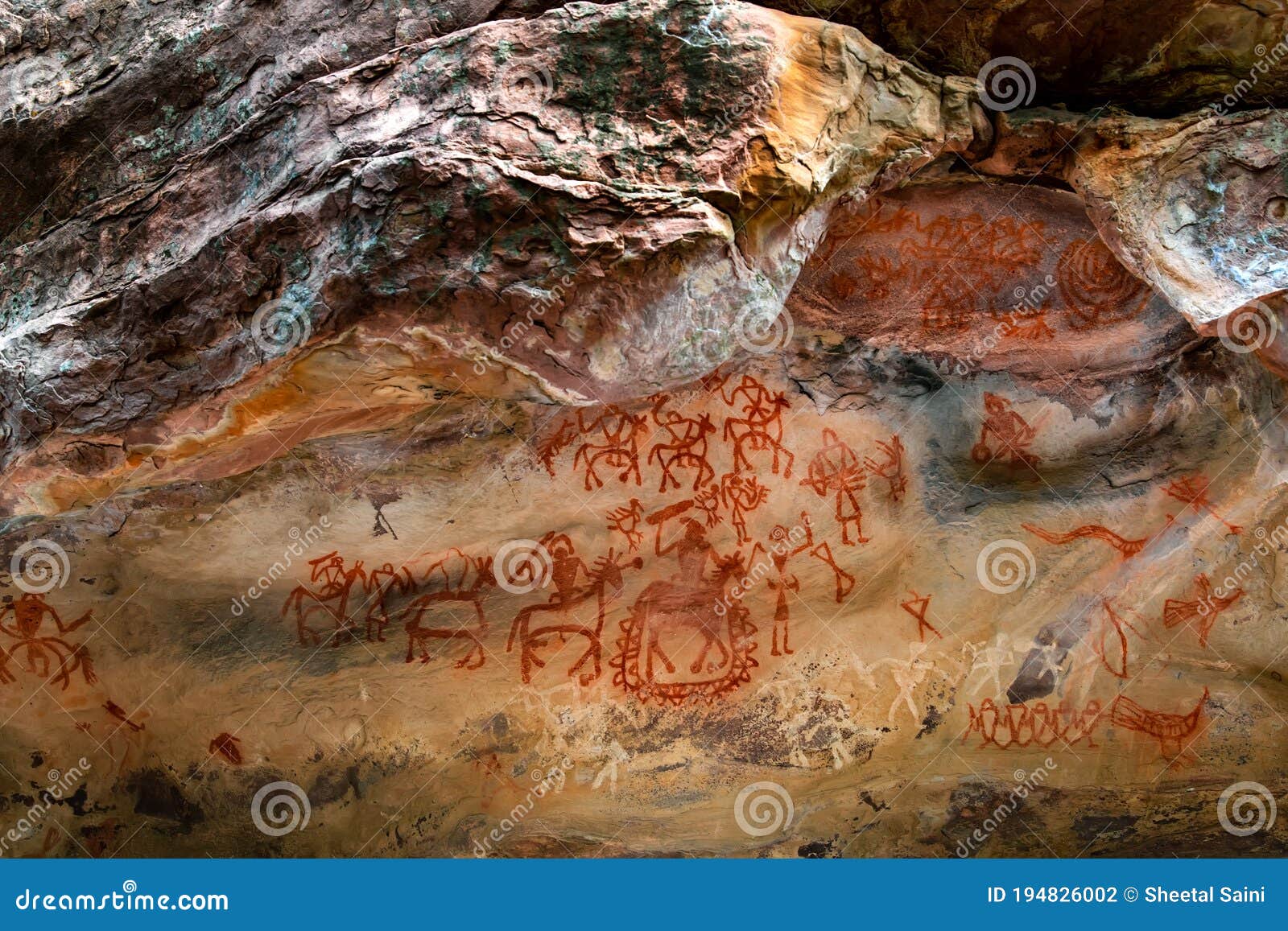
Bhimbedkar Caves

Bhimbetka rock shelters, series of natural rock shelters in the foothills of the Vindhya Range, central India. They are situated some 28 miles (45 km) south of Bhopal, in west-central Madhya Pradesh.

The Bhimbetka rock shelters are an archaeological site in central India that spans the prehistoric Paleolithic and Mesolithic periods, as well as the historic period. It exhibits the earliest traces of human life in India and evidence of Stone Age starting at the site in Acheulian times. It is a UNESCO World Heritage Site that consists of seven hills and over 750 rock shelters distributed over 10 km (6.2 mi). At least some of the shelters were inhabited more than 100,000 years ago. The rock shelters and caves provide evidence of, according to Encyclopædia Britannica, a “rare glimpse” into human settlement and cultural evolution from hunter-gatherers, to agriculture, and expressions of prehistoric spirituality.

Some of the Bhimbetka rock shelters feature prehistoric cave paintings and the earliest are about 10,000 years old (c. 8,000 BCE), corresponding to the Indian Mesolithic. These cave paintings show themes such as animals, early evidence of dance and hunting. The Bhimbetka site has the oldest-known rock art in India, as well as is one of the largest prehistoric complexes.

Writer’s Block

While writing have you ever felt lack of thoughts and ideas. You sit there thinking for hours and still don’t come up with anything. This phenomenon is called writer’s block.

Writer’s block is a condition when an author or a writer runs out of ideas to produce new work or experiences creativity slowdown. Most writers have experienced it at one point or another in their careers. And it doesn’t just happen to writers. Creatives from all walks of life—artists, musicians, poets, entrepreneurs—can suffer from it. Sometimes inspiration just doesn’t strike.

Photo by Ivan Samkov on Pexels.com

The reason why it’s so hard to get started and find continuous inspiration varies greatly from person to person. Some reasons for writer’s block are:-

  • Excessively harsh self-criticism
  • Fear of rejection
  • Fear of comparison to other writers
  • Lack of external motivation, like attention and praise
  • Lack of internal motivation, like the desire to tell one’s story
  • Pressure from a previous success

The best antidote for writer’s block is self-knowledge.When you find what’s stopping you from writing, you’ll find strategies to retaliate and, soon, return to writing. These strategies might help to overcome writer’s block :-

  • Write about the problem.
  • Go for a walk.
  • Listen to music.
  • Reward yourself for little things.
  • Rid yourself of distractions. 
  • Look to the news.
  • Ask family and friends for help.

Overcoming writer’s block is a delicate process that is often highly subjective and depends on each individual. But, at the end of the day, it is about conquering self-doubt and knowing that hard work will pay off.

PLASTIC EATING BACTERIA

Photo by Chokniti Khongchum on Pexels.com

Ideonella sakaiensis is Gram-negative, aerobic, and rod-shaped is a bacterium from the genus Ideonella and family Comamonadaceae, capable of breaking down and consuming the plastic polyethylene terephthalate (PET) as a sole carbon and energy source.

DISCOVERY

In 2016, Japanese team, led by Dr. Kohei Oda from the Kyoto Institute of Technology and Dr. Kenji Miyamoto from Keio University, collected 250 samples of PET debris and screened for bacterial candidates that depend on PET film as a primary source of carbon for growth. The bacterium was isolated from a consortium of microorganisms in the sediment sample, including protozoa and yeast-like cells. The entire microbial community was shown to mineralize 75% of the degraded PET into carbon dioxide once it had been initially degraded and assimilated by ‘Ideonella sakaiensis’

They identified Ideonella sakaiensis 201-F6, which could nearly completely degrade a thin film of PET after six weeks at a temperature of 86 degrees Fahrenheit (30 degrees Celsius). The PET degrading enzyme of Ideonella sakaiensis, has been genetically modified and combined with MHETase to break down PET faster, and also degrades PEF. This may possibly, along with other approaches, be useful in efforts for recycling and upcycling of mixed plastics.

HOW DOES IT WORKS?

Plastics are polymers, meaning they have a long repeating chain of molecules.

These long chains are exceptionally durable, making them tough to break down and decompose naturally.

If these long polymer chains could somehow be broken down into shorter chains, then they could be recycled easier to form new plastics.

This is exactly what the newly discovered bacteria do; break down the molecules of the plastics into their original building blocks.

By secreting an enzyme which “eats” the chemical bonds in the chain, the molecules are broken down into their smaller components, making them easier to be recycled.

Social Problems In India

SOCIAL PROBLEMS IN INDIA

Contemporary Indian society has numerous issues that are labelled as
social problems. Some of them are poverty, unemployment, molestation, overpopulation, infectious disease like covid, drugs, child labour, etc..
A social problem, in general, creates the situation of chaos and disrupts the balance in the society.

What is social problem?

A social problem is any condition or behavior that has negative consequences for large numbers of people and that is generally recognized as a condition or behavior that needs to be addressed. 

Another widely used definition specifies that “no condition, no matter how dramatic or shocking to someone else, is a social problem unless and until the values of a considerable number of people define it as a
problem”.

A social problem is normally a term used to describe problems with a particular area or group of people in the world. Examples can include:

  • Poverty
  • Drug abuse
  • Prostitution
  • Racial discrimination
  • Alcohol abuse
  • Economic Deprivation
  • Political Corruption
  • Unemployment
  • Sexual abuse

Characteristics of Social Problem :-

  • A social problem does not exist for a society unless it is recognised by that society to exist.
  • All social problems are opposite of the “ideal” situation.
  • All social problems have some
    common basis of origin.
  • Social problems occur in all societies and they also affect all sections of society.
  • Social problems can be caused due to economical, biological, cultural or psychological factors.

Division / groupism of Social Problem :

Diverse social problems can be broadly grouped under
four categories, they are:

1. Economical factors:

  • Poverty.
  • Unemployment.
Poverty
Unemployment

2. Cultural Factors:

Problems that are caused due to
established beliefs, values,
traditions and laws of a region. For example, dowry, child marriage, etc.

3. Biological factors:

The problems due to natural calamities, infectious diseases,
famine, etc fall under this category. For example, Covid.

4. Psychological Factors:

Problems that arise from ill
mental and neurological
health fall under this
category.

All these problems are barrier to the growth and development of our society. To overcome them we must work together and create a healthy, safe and happy environment that exhilarate positivity .